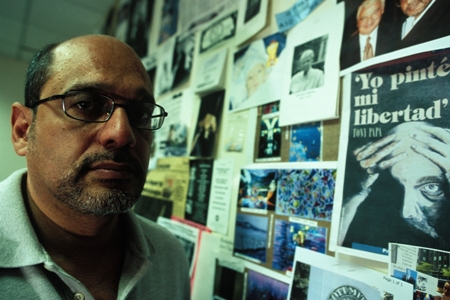
Yo pinte mi libertad = "I PAINTED MY FREEDOM"
(photo by Andy Kropa)
Support the Arts in Prison
The Prison Creative Arts Project
Prisons Foundation
National Art
Gallery
Art Foundations
Online Art Classes
Support The Arts
September 27 2008 Notes
from a workshop held at Critical Resistance in Oakland California
From: prison-arts-coalition@googlegroups.com [
mailto:prison-arts-coalition@googlegroups.com]
On Behalf Of Lizzy
Sent: Monday, October 06, 2008 4:49 PM
To: Prison Arts Coalition
Subject: {Prison Arts Coalition} Notes from CR-10 - also in Files section
Buzz and Tory spoke to what brought us to this point (ways some of us
have met nationally, history of moving toward a real coalition), and
described agenda of the workshop.
Emily facilitated a sharing of names of those in the room, as well as
names of programs
Allie facilitated process of gathering written information: name, program
name and contact info, email, and one central question or concern or reason
they desire a coalition.
Suzanne lead brainstorm on what we need to move toward an actual
coalition.
Groups exploring funding, coalition development and website creation met.
Judith facilitated report from groups.
Material on Handout –
Starting Thoughts on a Prison Arts Coalition:
Inclusive: formerly incarcerated individuals and other individuals who
have engaged in creative activity inside prisons and juvenile facilities,
acting in alliance with individuals and organizations active for prison
reform and abolition.
Advocate for access to the arts and other forms of support for
incarcerated individuals.
Seek funding, including funding for incarcerated individuals when they
return home and wish to continue as actors, artists, and writers.
Advocate for prisoners’ rights.
Bear witness and bring the voices and images of prisoners to public
attention
Resources toward Prison Arts Network
Web
Community Arts Network
http://www.communityarts.net/archivefiles/corrections/index.php
Prison Arts Network
http://www.prisonarts.info/
Arts in Criminal Justice Conference
http://www.artsincriminaljustice.org/aicj/public/home.htm
PCAP’s site (with resources)
www.prisonarts.org
Judith Tannenbaum’s website. Lots of links and information (including
manual for artists working in prison) on prison arts page
http://www.judithtannenbaum.com
Books
Creativity Held Captive (excellent handbook for artists working in
prison, written by Toni McConnel who’s done time herself)
http://logoria.com/CreativityHeldCaptive.htm
Teaching the Arts Behind Bars, edited by Rachel Williams
(cover art by Anthony Papa )
http://www.upne.com/1-55553-569-0.html
Handbooks prepared by PEN Prison Writing Program
http://www.pen.org/page.php/prmID/234
WEB
Group Brainstorm
Existing projects
Blog space
–
story/art share
Social networking
List existing resources
List upcoming events/feature art
Media
Publication list
Mapping of resources
Small Group Notes
Create our own website?
Interactive blog?
Website takes money (especially a good one). Also a lot of opportunity
(video conferencing; keeping in contact) Do we know anyone who can develop a
website?
People coming out of prison as the group to develop a site?
Might an art school take it on?
Great Lakes Urban Exchange
–
CCS students created, blog space, art exchange Gallery 555 might be able to
help Google map showing who is in your community and who is elsewhere Sell
artwork on the site?
Helping people with their re-entry by involving them For now, creating a
simpler program
–
google group Make a timeline of goals Web developer in Michigan SolveMedia
Sandy Jaszczak consultant/owner
(22456 Beach
Street/St. Clair Shores MI 48226
www.esolvemedia.com
sandy@esolvemedia.com 313.330-0880 Formerly incarcerated persons caucus at
CR10 also wants to blog –
fits the group’s goal What pages do we want on our blog? Resource list
Existing sites (see list handed out) have lots of resources but static
sites; blog will allow
networking
Will blogger let several people be in charge of the blog/ administrators?
Should we limit?
Redundancy? too messy if many can post?
Blog can be a placeholder for the website, to update on website Be
user-friendly, available and accessible for people coming out Website Mary
likes
http://www.kcad.edu/
Taking Action
Lizzie Baskerville will create google group
– as soon as she
receives contact info Julia Taylor will create blog
– within two weeks
Ellen will moderate blog Amber will take info off of google group and post
onto blog when we want info to be public
Allie will talk to web-knowledgeable friends to get advice and leads
– within a
month Lizzie will also investigate website design/construction
Caitlyn will be part of networking in NY to begin archives of
organizations Meghan will help compile West Coast resources Evan will add to
Bay area resources/supply resources Lynne Elizabeth will help with resource
section Judith has tons of resources she’ll make available Jenn will gather
theater suggestions, write up stories/suggestions/ etc.
Alex will contribute work coming out of Santa Cruz and dedicate time
looking for cheaper open-source software Mary will gather stories of people
coming out on radio and link to website Laura interested in layout/design of
blog/website, can contribute ideas, will communicate with Mary
COALITION DEVELOPMENT
Group Brainstorm
Regional coordinators
Knowledge share
Structure
–
leadership planning committee Share expertise Partner organizations
Recruitment/outreach/diversity Identify who will make moves Other ways to
connect Voices of incarcerated/formally incarcerated folks in
decision-making
Small Group Notes
How do we include inmates in/out, (recidivism), who is included in the
coalition, is it broad, flexible enough?
How do we build trust, esp. for prisoners who don’t trust outside
organizations?
Can we (groups) vouch for each other? How can we validate our
organizations esp. among prisoners?
What were the initial goals made during the Philly conference for
coalition? On the one hand we want to be expansive, but need a common bond.
Local connections that are part of a broader coalition
– ideally have
someone in all 50 states.
A community (groups have similar goals); coalition (to support each other
and provide new ideas
One goal, model
–
AIDS quilt, we together will talk about the effect we have on helping to end
injustices
One goal is to be a support system for each other Platform for coalition
– first step
to communicate with each other Develop a unifying platform (how do we
communicate as we create Mission Statement)
– talking to both in
and out.
Inclusive
–
connect all people doing prison work, identify who is drawn to work Develop
a new meeting –
who facilitates? Everyone involved in prison work or does it need some
people leading the movement for coalition? When do we meet again?
Develop a model
Who (which people) have the energy? Identify the people who will put in
the time to lead and solidify this coalition building. Who will take on the
tasks?
Who will do funding? Sustainable young energetic person to take over,
make it sustainable.
Hard for people who are already immersed n prison work
– need new energy
and funding Reliable people and diverse people, ability to work through
their failures.
Prison resources, talk about system’s dysfunctions Art exists all over
– expansion
– avoid
distraction, keep it focused CR provided an outlet to see the whole picture
of poverty, halfway houses Are transition houses, halfway houses the glue
for people coming out?
Re-entry issue.
Incorporating job skills into the art
– contributes to the
bigger issue of housing, jobs Let’s include all groups working on issues
related to prisons Let’s provide a place to inform people to keep continuing
their art, job skills, for those in and out, people out there using their
art, let’s incorporate this in our structure Informing workers inside of the
prison, problems preparing the artist teachers to be more
efficient, to really prepare the teachers, importance of preparing your
teachers and
supporting them while they teach
Develop training programs
–
have this be part of the Mission Statement Show that this is about
collaboration and not just "this is my project" and we are teaching
responsibly.
Need next steps, regional directors, connect regions Carsell class should
be part of the mission.
Members of this small group
Amy Jo Sayre Roberts aroberts@sci.edu
Michael Key KmichaelKey1@yahoo.com
Emily Rose Emrose77@yahoo.com
Shana Davis davis.shana@gmail.com
Sarah Ross sarahross@yahoo.com
Bok Choy jenell.nyberg@gmail.com
Nina Billone NBillone@berekeley.edu
Aleksandra Zauko Culture.efry@qc.aira.com Phoenix Moore Shaunnie@umich.edu
Lacey Janeroberts laceyjaneroberts@yahoo.com Kate Short kateleeshort@gmail.com
(510) 452-7425 Bruce Reilly bruha554@gmail.com (401) 286-1507 Steve Emrick
(San Quentin) (415) 454-1460 x 1460 Melissa Klein (Rising Voices)
melissaklein@riseup.net (415) 351-9429 Chase Finney chasefinney@gmail.com
Sarah Carswell sacarswe@gmail.com Sabrina Alli allisabrina@hotmail.com
FUNDING
Group Brainstorm
Mission/Goals/Objectives
Donors with money
Annual membership fee
Resource list for materials
Regional fundraising events
Partner organizations
Annual showcase to raise money
Small Group Notes
Steps:
1) Find artists and organizations that are interested
2) Training to members
3) Use the web to connect people, some resources already exist
4) Research and finding out who is out there (use list from
Philadelphia)
5) Apply for grants
6) Regional communication and contact
MISC
Group Brainstorm
Research re: facilities
–
how to access
Touring shows nationally
How to guide
Forum for sharing
Way of sharing the art, made widely available (scholarly journals,
publications list) Other stakeholders (lawyers, gov, etc) Educational
workshops Encouraging universities to incorporate the work
Notes from group gathered on Sunday 9/28
Attending were:
Nina Billone
Bruce Reilly
Melissa Klein
K Michael Key
Tory Sammartino
Buzz Alexander
Allie Horwitz
Suzanne Gothard
Judith Tannenbaum
Caroline (?) from Texas
Tory and Buzz had just attended a workshop offered by the Peace
Development Fund
http://www.peacedevelopmentfund.org/
and felt this was a possible funder to consider.
Focus on next steps (see below)
Talk about interest in training to do this work and recognition that down
the road perhaps this is something some group of us can provide.
Meanwhile, be sure to emphasize the advice-related resources that now
exist. Also, hope that the blog Julia sets up will allow people to ask
specific questions and for advice. Report that many have talked about the
need to focus on doing this work responsibly.
Similarly, report of lots of interest in knowing what’s already out there
(people doing this work, programs). Again, this is information we can intend
to gather, but in the meanwhile emphasize existing lists (especially
material Krista developed
http://www.prisonarts.info/
and CAN site
http://www.communityarts.net/archivefiles/corrections/index.php
Also Judith’s website prison arts page (
www.judithtannenbaum.com)
Suggestion that we develop a questionnaire that people can take as they
teach/facilitate to get the input of people inside about what would be
useful to them in a coalition.
Suggestion that someone figure out a way to organize email addresses and
material regionally.
We temporarily settled with name Prison Arts Coalition. We recognize some
of the limitations of this (not all the work is in prison, some in jail,
some in juvenile settings, etc) but this seems the most general (and also
simple
–
allowing people to find us) we could come up with. Suggestion that we
describe the nuance in our mission statement.
Next Steps
Buzz is going to contact Kazu Haga from Peace Development Fund Judith is
going to contact her Soros Fellow friend who said he would talk with Soros
about funding (this will be an informal first step contact) Judith will
draft a letter to Claudine K. Brown at Nathan Cummings to report on what we
accomplished this week-end; Buzz will then work on letter with Judith Allie,
Emily, Suzanne and Judith are going to draft a Mission Statement that they
will send to this Sunday group for input, and then on to the whole group
Melissa will join Allie, Emily, Suzanne and Judith to create a list of
coalition programmatic goals that we’ll send to the group for input Suzanne
will also organize Sat. workshop attendees’ names, email addresses, programs
etc regionally Once the google group and blog have been up and operating for
a short while, Bruce will create a post looking for someone interested in
volunteering to create a website for us (perhaps a college student or design
student). Bruce will contact Mary who is also interested in this aspect of
the tasks ahead.
Next step needed (I don’t have in my notes that anyone signed up to do
this): Drafting questionnaire to be taken inside for input of people in
prison. Bruce, were you going to work on this?
Goals described by Buzz, Tory, Nick, Judith and others in the alliance
that met after the October 2007 Art & Criminal Justice conference in Philly
1) A highly interactive website, for contact, conversation, resource
sharing, calendar, organizing of meetings, updates on issues, and more. In
the meeting following the conference, we proposed a very developed internet
resource, contact, and conversation site.
2) A series of meetings of 14-20 people over the next two years. Our
proposal builds on the history and models of the Blue Mountain Artists
Opposed to Massive Incarceration meetings in the first years of this decade,
the 2006 Haystack Mountain School of Crafts gathering in Maine, and
California’s Arts-in-Corrections state-wide conferences in the 1980s. These
meetings are to be inclusive: the formerly incarcerated, young people in the
field, and people working alone in isolated parts of the country should be
able to attend. The meetings could be regional or national, and their
content will depend on the conveners. The effort will be to "think into the
harder places of our work" and to address issues of any kind. The gatherings
might include prison activists from outside the arts and policy makers,
depending on the nature of the gathering.
--~--~---------~--~----~------------~-------~--~----~
You received this message because you are subscribed to the Google Groups
"Prison Arts Coalition" group.
To post to this group, send email to prison-arts-coalition@googlegroups.com
To unsubscribe from this group, send email to prison-arts-coalition+unsubscribe@googlegroups.com
For more options, visit this group at
http://groups.google.com/group/prison-arts-coalition?hl=en
_________________________
BOSTON TO JOIN NYS IN ART BAN???
Socialist Worker Online
AN ONLINE art show sponsored by New York’s Fortune Society generated
national attention recently because one of the participants in the show was
serial killer Alfred J. Gaynor.
The Fortune Society and advocates believe that art and other prison programs
are therapeutic and rehabilitative. The auction is a way for artists to show
and sell their artwork, generating small income in order to buy art supplies.
“Learning how to paint behind bars saved my life,” said artist Anthony Papa,
who served 12 years of a 15-to-life sentence under the New York Rockefeller
Drug Laws.
On March 29, 2002, New York State Corrections Commissioner Glen Goord ended
35 years of artistic _expression in the New York State prison system by
banning the sale of art by prisoners. Before the ban, prisoners in New York
were allowed to exhibit their art once a year in the legislative office
building in Albany. The art was sold, and 50 percent of the profits were
donated to the Crime Victims Board.
In the 2002 show, however, a painting created by a serial killer was
displayed. The press found out about it, and the political process went into
overkill trying to look tough on crime. The public reasoning behind Goord’s
decision was that he felt it was not worth the anguish crime victims feel to
allow imprisoned artists to sell their art.
“For many men and women in prison, art is a life-sustaining source,” said
Papa, who is the author of 15 to Life: How I Painted My Way to Freedom and
currently works with the Drug Policy Alliance. “For most of them, earning
money selling their art enables them to buy food and toiletries and help
support their families in the outside world.”
Now, Massachusetts appears to be following New York’s lead. In response to
sensationalistic media, state Reps. Cheryl Rivera and Peter Koutoujian
introduced bills that would prohibit inmate artists receive any profits from
their art. “Creating and selling art instills a sense of self-esteem, which
is a very important element in re-entering society,” Papa said. “Instead of
attacking programs like this, we should be expanding them.”
Tony Newman, Director of Communications, Drug Policy Alliance
_________________
http://www.masslive.com/metrowest/republican/index.ssf?/base/news-0/1134377013208260.xml&coll=1&thispage=4
The Republican
Prisoners' art poses tough legal questions
Monday, December 12, 2005
By BILL ZAJAC
wzajac@repub.com
Anthony Papa became so despondent while serving a 15-year prison sentence that
he considered suicide.
Papa, a radio repair shop owner, was in New York's maximum security prison in
Ossining because he broke the law once - delivering 4.5 ounces of cocaine.
"I was lost (in prison.) I really didn't know how I was going to survive,"
Papa said.
Then Papa, in his mid-30s, was introduced to art.
In it, he discovered a talent for painting and a way to express himself
politically, both of which played a role in then New York Gov. George Pataki
pardoning him after he served 12 years.
Today, Papa, 49, lives in New York City and Brazil, working full-time as an
artist and political activist.
"Art saved my life," he says today.
That's why he's concerned about the recent controversy surrounding Springfield
serial killer Alfred J. Gaynor's drawing, which was sold in an online art
auction.
Lawmakers, Hampden County District Attorney William Bennett and and family
members of Gaynor's four murder victims expressed outrage that a color-pencil
drawing by Gaynor was allowed into the auction of prisoners' art and planned
art show in New York City.
Papa fears the attention given Gaynor could jeopardize the art show and thus
suffocate the rehabilitative benefits for the other 200 or so prison artists
in the auction.
"I've seen it happen before," Papa said.
In 2002, a 35-year-old annual prisoners' art show in Albany ended under
circumstances similar to this year's Fortune Society sponsored auction and art
show.
The Albany show was stopped permanently amid publicity surrounding art entries
by serial killer Arthur Shawcross, who was convicted of killing 11 women in
the Rochester area in the 1980s.
Papa, whose autobiography "15 Years to Life" was released a year ago, said it
would be a shame if all incarcerated artists in the auction suffered because
society doesn't want Gaynor to receive any profit from his artwork.
But even Papa is at a loss when asked how Gaynor's art or any other prisoners'
art can be removed from the art auction without violating freedom of speech
rights.
In the wake of the Gaynor publicity, several Massachusetts lawmakers said
prisoners should not profit from art, books and other enterprises and have
initiated attempts to stop it.
However, such laws have not always stood up to higher court scrutiny.
In the 1990s, New York state passed a law preventing "Son of Sam" serial
killer David Berkowitz from selling the rights to his story, but the U.S.
Supreme Court struck it down, saying it violated First Amendment freedom of
speech rights.
In 2002, Massachusetts' Supreme Judicial Court ruled that a similar "Son of
Sam" bill violates the First Amendment.
But state Rep. Cheryl A. Rivera, D-Springfield, who plans to file a bill with
state Sen. Brian P. Lees, R-East Longmeadow, believes a law can be crafted to
pass legal challenges.
"What is different about our bill is that we say whatever inmates create in
prison should be considered state property and therefore inmates would have no
right selling it. It's not their art to sell," Rivera said.
But Northeastern University School of Law professor Taylor Flynn isn't so sure.
"That may be a tough sell to the (Supreme Judicial) court," Flynn said.
She said it is legally difficult, but possible, to write a law so narrowly
that it can meet higher court standards and still limit prisoners' ___expression.
"The difficulty is defining 'what is ___expression?' That is what the court is
so protective of," Flynn said.
Regardless, many states have "Son of Sam" laws on their books. But Flynn said
most exist only because they have not been legally challenged.
Rivera makes a further argument against prisoners' art being sold by saying
the therapeutic value is in the process of creating the art, not in selling
it.
"The selling of this art traumatizes the inmates' victims all over again,"
said Rivera, a former victim advocate.
Also in the wake of Gaynor publicity in Boston, state Rep. Peter J. Koutoujian,
D-Middlesex, introduced a bill a few weeks ago that focuses on banning profit
from art or books based on the criminal's celebrity and not the content itself.
But the $250 that Gaynor earned from his drawing being sold on the second day
of the auction is hardly cashing in on any celebrity, according to some,
including William C. Newman, director of the Western Massachusetts office of
the American Civil Liberties Union.
"There is a distinction here between utilizing a crime to make a profit and
allowing someone to achieve a modest remuneration for something they created,"
Newman said.
The organizers of the auction say the intent is for inmates to earn enough for
art supplies.
Also, Newman said Gaynor's drawing of a kneeling Jesus Christ praying has
nothing to do with the crime he committed.
"He's trying to express a very personal religious feeling," Newman said.
The Rev. Mr. William R. Toller, the former assistant superintendent of human
services at the Hampden County Correctional Center in Ludlow, agrees, saying
he wasn't surprised Gaynor depicted Christ.
"Look at the Gospel and see who Jesus hung out with. He looked for the sick
and the needy. He looked for the Mary Magdalenes. Jesus very clearly called
those people to be in relationship with him," Toller said.
When he worked at the Ludlow facility, Toller encouraged inmates to
participate in prison art classes. But he acknowledged a mentality existing in
society that would like to prevent inmates from participating in any activity.
"For some, you can't punish prisoners enough," Toller said.
Toller and Newman believe classes that have a rehabilitative value, such as
those in art, are crucial to returning prisoners to society in better shape
than when they entered prison.
"Programs like art class are not about vocational training. It contributes to
the overall process of trying to add some meaning to lives," said Toller.
Through art, inmates' self-esteem rises as they find new voices in which they
can express themselves in an exercise of self-discovery, Toller said.
"Ninety-nine percent of the guys return to their communities. If we don't give
them a sense of hope, then we will pay for that when they are released,"
Toller said.
Newman agrees, saying, "It is good for inmates to learn any useful, expressive,
nonviolent activity."
___________________________________
NYS Prison Art Ban 2002 & Felony Disenfranchisement
WHAT WAS DONE IN OPPOSING BAN
Over 1,000 signatures were collected for a petition demanding Governor
Pataki to restore the annual Correction on Canvas Art Exhibit and the ability of
artists in NYS prisons to sell their work. Letters were also annexed from
individuals that run art programs for prisoners pointing out the importance of
such programs for its theraputic and rehabilitative value. The petition
was submitted to Governor Pataki and hand delivered to Chauncy Parker his
Criminal Justice Director. I generated some publicity sending opinion
pieces to the NY Times and Newsday. (see below) Also I held a protest in front
of the governors NYC office. At the same time I sought help from many
diferrent legal organizations including the NYCLU. I could not get anyone
to help me No action was taken by the governor and today the ban still
stands. The arbitrary and capricious actions by the NYS Department
of Corrections should be challenged. Already, similar actions have been
seen in the State of Californial and Michigan.
| Save New York State Prison
Art! 4/19/02
On March 29, 2002 New York
State Corrections Commissioner Glen Goord ended 35 years of artistic
expression in the New York State prison system by banning the sale of
art by prisoners. Goord also eliminated the annual Correction on
Canvas Art Exhibit that was created by the State Senate and the
Department of Corrections in 1968. Prisoners in New York State
were allowed to exhibit their art once a year in the legislative office
building in Albany. The art was sold, and fifty percent of the
profits were donated to the Crime Victims Board.
In last year's show, however,
a painting created by a serial killer was displayed, the press found out
about it, and the political process went into overkill trying to look
tough on crime. The public reasoning behind Goord's decision was
that he felt it was not worth the anguish that crime victims feel to
allowing imprisoned artists to sell their art.
But for many men and women
artists in prison, art is a life sustaining source. For most of
them, earning money selling their art enables them to buy food and
toiletries and help support their families in the outside world.
More importantly, creating and selling art instills a sense of
self-esteem which is a very important element in reentering society.
The corrections annual art show hence served the dual purpose of helping
the rehabilitative process and providing an avenue for offenders to show
remorse for their crimes by supporting the crime victims program.
On May 8, noon-2:00pm, a
demonstration will take place across the street from Gov. Pataki's
office, 40th & 3rd Ave. in Manhattan, protesting the closure of the
prisoner art sales program and New York State's draconian Rockefeller
Drug Laws. For further information, contact Anthony Papa at papa@15yearstolife.com
|
What You Can Do!! Write Governor George
Pataki and demand that the Correction on Canvas Art Exhibit be restored along
with the ability of artists to sell their art!!
Governor George Pataki
/ State Capital /Albany NY 12224
Please Do both!
Print
this petition and get everyone you know to sign it. After that the
instructions are on the file.
- Click
Here! For Petition
Artists Network of
Refuse & Resist!
... For more information call Anthony Papa
at (212) 596-9445. To see Anthony's
art go to: http://www.15yearstolife.com/ Ban on Prison Art Show. ...www.artistsnetwork.org/news3/news146.html - 12k
_______________________
Ban Ends Far More Than Prisoners' Art Sales
By Anthony Papa
NewsDay, May 16, 2002
New York State Corrections Commissioner Glenn Goord, by banning
the sale of art by prisoners, has effectively canceled artistic expression in
the New York State prison system.He has also eliminated the annual "Corrections on
Canvas" art exhibit, which was created by the State Senate and the
Department of Corrections in 1967.By doing this, Goord has erased a strong tradition that made
life more meaningful in New York's gulags.
For the last 35 years, prisoners in New York State had been
allowed to exhibit their art once a year in the legislative office building in
Albany. The art was sold, and 50 percent of the profits were donated to the
Crime Victims Board, an organization that provides services for crime victims,
including financial compensation related to their victimization.But controversy surrounded last year's show, which included
paintings and sketches by serial killer Arthur Shawcross. The political process
went into overkill, as officials tried to look tough on crime. Because of one
individual, 67,000 prisoners were punished.
The public reasoning behind Goord's decision was he felt that
allowing imprisoned artists to sell their art wasn't worth the anguish that
crime victims feel, knowing that prisoners convicted of harming them or their
loved ones were having their art shown and sold.But I know first hand what art
can mean to prisoners. I discovered my own artistic ability while serving a
15-years-to-life sentence for a nonviolent crime under the Rockefeller drug laws
When I entered Sing Sing, a maximum security prison, I was
lost in its negative environment. But the discovery of art allowed me to
maintain my humanity. The first year I started painting, I won a blue ribbon at
the annual "Corrections on Canvas" show, and I knew I had found
something that would help me get through the difficult times ahead.Several years later, in 1990, the art and music budget was
cut in New York State prisons, leaving a great void. More than 60 positions that
had been held by civilians teaching music and art were terminated. I volunteered
to teach an art class at Sing Sing and further discovered its therapeutic value.
Art was a survival tool - a cathartic vehicle to transcend the negativity of the
environment.
The canvas became an outlet to deal with anger and bitterness
in a socially acceptable way. Men who were fighting each other now were instead
painting each other's portraits - living proof of art's transformative power to
bring a sense of calm and fulfillment, elements that become lost because of
imprisonment. In 1995, my self portrait "15 Years to Life" was
exhibited at the Whitney Museum. This led to exposure to my case, and Gov.
George Pataki granted me clemency in 1996.
Today, I travel around the country
talking about prison art and its value. For many men and women artists in
prison, art is a life-sustaining source. For most of them, earning money selling
their art enables them to buy food and toiletries and help support their
families in the outside world. But more important, it instills self-esteem - a crucial
element both in prison and in re-entering society. The "Corrections" annual art show served a dual
purpose. It helped in the rehabilitative process of prisoners. More importantly,
it provided a healing process by enabling prisoners to show remorse for their
crimes by allowing them to donate half or more of their proceeds to crime
victims. To end this tradition is wrong, and to use it as a political tool is
despicable.
Hundreds of people said as much in front of Pataki's New York
City office last week, signing a petition demanding that the exhibit and the
ability of prisoners to sell their art be restored. The governor should respond
to his constituents and reverse Goord's decision.
Copyright © 2002, Newsday,
Inc.
___________
Ban on Prison Art
Show
Commissioner's
Ban on Inmates' Art Sales Ends Annual Show
By ROBERT F. WORTH
New York Times, March 30, 2002
The
New York State corrections commissioner announced yesterday that he had banned
the sale of artwork created by prison inmates, saying the benefits of such sales
are not worth the anguish they cause to crime victims and their families.
The
decision by Commissioner Glenn S. Goord ends an annual spring art show,
"Corrections on Canvas," that had been held for 35 years in the
Legislative Office Building in Albany. Mr. Goord's decision also eliminates the
sale or display of inmates' art in galleries or at arts and crafts shows.
The
state's 67,000 inmates are free to produce any kind of art, but they can no
longer profit from it, said James Flateau, a spokesman for the Department of
Correctional Services. Since 1996, inmates have kept half the profits from most
art sales, with the rest going to the state's Crime Victims Board. Last year,
the Albany show earned $5,394 for the state.
"The
original idea was to show inmates doing something that was perceived as positive
and that contributed to their rehabilitation," Mr. Flateau said. "In
more recent years it has been perceived as the state providing a forum for
inmates to profit."
Last
year there were protests after the Albany show featured work by Arthur
Shawcross, a serial killer who was convicted of killing 11 women in the
Rochester area in the 1980's and is now serving a 250-year sentence at the
Sullivan Correctional Facility in the Catskills. Mr. Shawcross's artworks
included sketches of Princess Diana and Santa Claus, with asking prices of more
than $500 each, far more than those for most of the other artworks on display.
After
the show opened, Gov. George E. Pataki told Mr. Goord to ban notorious violent
felons from future shows. Mr. Goord, who had always been uncomfortable with the
show, decided several months ago to go further, banning all violent criminals,
Mr. Flateau said. He then decided to ban the sale of all inmates' art.
"It's
a very distressing move," said Robert Gangi, the director of the
Correctional Association of New York, a prison watchdog group. "Art can
contribute to the rehabilitative process, and when you take away the incentive
for recognition, you are telling inmates that their art is not worthy of public
display."
He
added that many inmates were in prison for nonviolent offenses, and that to
penalize them along with serial killers like Mr. Shawcross was unfair.
Buzz
Alexander, the director of the Prison Creative Arts Project in Ann Arbor, Mich.,
said a number of states have inmate art exhibit programs. "It helps keep
prisons safe, because inmates doing creative work are in a far more positive
state of mind," he said. "It's puzzling to me that anyone would take
that away."
Anthony
Papa, a former convict who studied art at the Sing Sing Correctional Facility
and who gained wide acclaim after his self-portrait was exhibited in the Whitney
Museum, said: "This is unbelievable. Once this program falls in one state,
it could happen all over.
"Art
saved my life," said Mr. Papa, who was granted clemency for a drug
conviction by Mr. Pataki, and released in 1997. "It helped me transcend the
negativity of prison."
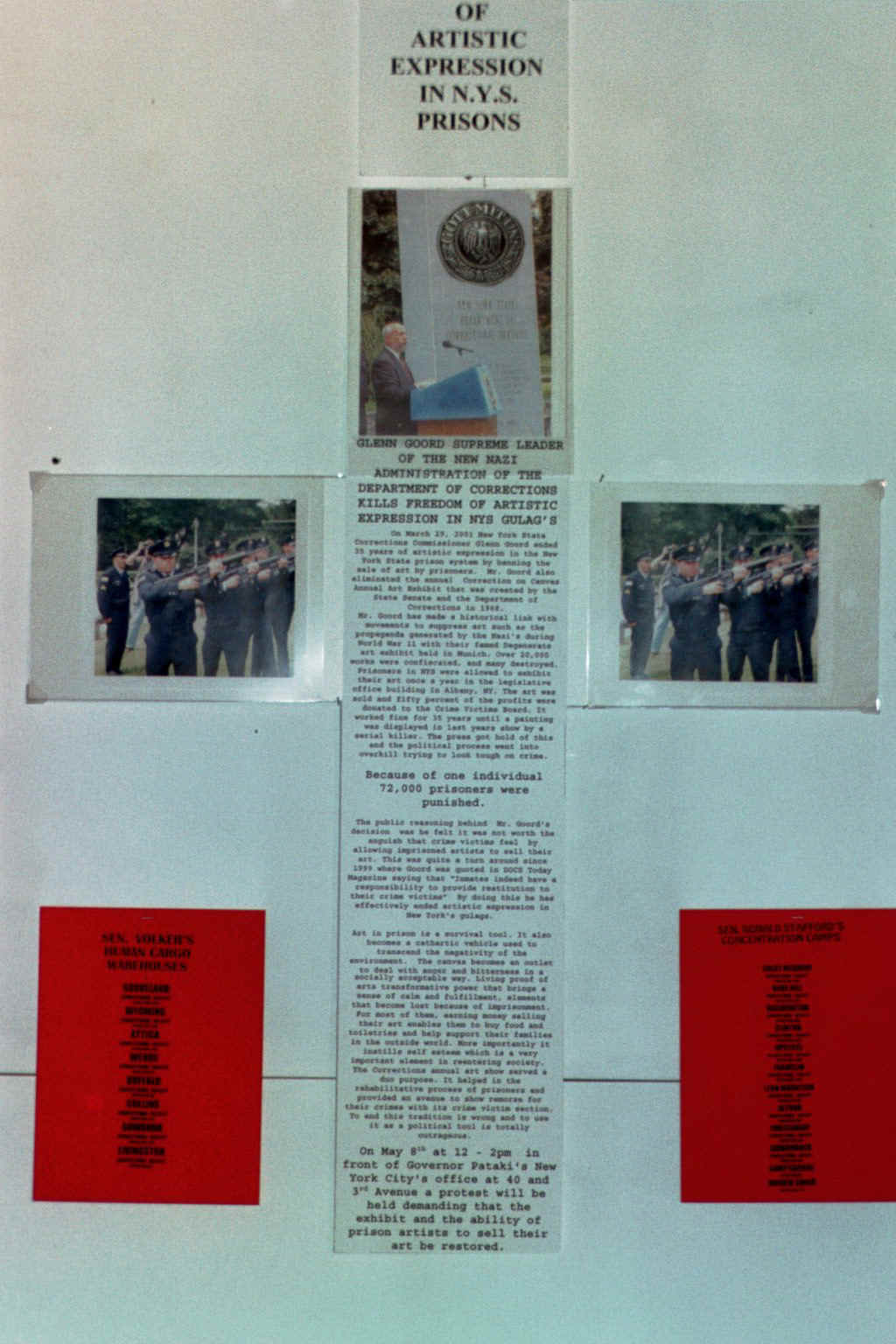
DEATH
OF ARTISTIC EXPRESSION IN NYS PRISONS
On
April 20, 2002 Anthony Papa created the installation below to express the
outrage of concerned citizens and imprisoned artists. Commissioner Glenn Goord
was crucified on a cross made of mat board obtained from Sing Sing prison when
the artist was a prisoner there (1985-1997) Goord who is the supreme
leader of the new Nazi administration of the NYS Department of Corrections has
led the department on a downward spiral to become the worst prison system in
the America. From the recent release of a report by the Correctional
Association which outlined the tragedy of the mentally ill in NYS prisons to
the in adequate health care scandal this administration continues to abuse its
prisoners with eerie similar actions taken by the Nazi's in Germany. The
departments logo (below) was replaced by an image taken from a photo of a Nazi
officer's belt which displayed the new order. The officers below firing
their rifles signifies the death of artistic expression in NYS prisons that are
housed in human cargo warehouses (lists of them are in red)
___________________________
FELONY DISENFRANCISEMENT
"Vote" by Anthony Papa
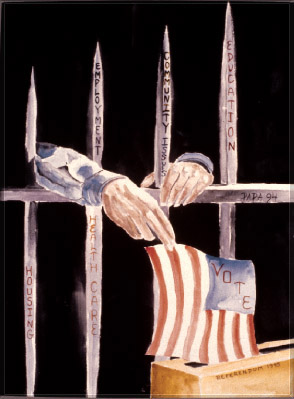 "The Vote"
appeared in the Syracuse Post Standard with the op-ed below.
"The Vote"
appeared in the Syracuse Post Standard with the op-ed below.
http://www.syracuse.com/opinion/ 10/8/2008
Right to Vote
Federal
law needed to protect ex-felon voting rights
By Anthony
Papa
Drug Policy Alliance
More than 5 million
people convicted of felonies will be barred from voting in the upcoming
presidential election. This is a mind-boggling number of people who will be
disenfranchised. The most alarming aspect is that many of them are eligible
to vote but don't know it.
In New York state, if
you are convicted of a felony, you automatically lose your right to vote.
According to the New York State Division of Parole, your right to vote is
restored once you have completed either parole or your maximum sentence. If
you are on probation, your right to vote is never taken away. But most
ex-felons do not know this.
When I was released
from prison after serving 12 years under the Rockefeller drug laws, I had no
clue about my eligibility to cast a vote. When I went to register to vote I
was shocked when they informed me that I had to wait until I was first
released from parole. I felt the pain of felony disenfranchisement since it
seemed I was being further punished for my crime.
I saw my Queens
neighborhood deteriorating around me but was powerless to do anything about
it by casting my vote. I was elated when, after waiting for five years, I
got off parole and was able to cast my first vote since being released from
prison. I felt then like I was fully welcomed back by society as a citizen.
According to the
American Civil Liberties Union (ACLU), in New York state more than 100,000
people are convicted of felonies every year. A record 115,573 people were
convicted of felony offenses in 2007. Nearly 62,300 of those who are
convicted are currently on probation for felonies. This amounts to hundreds
of thousands of individuals who probably think they cannot vote forever.
There is a growing
concern among the public and policymakers for these people to discover their
eligibility to cast a ballot. New York State Assemblyman Nick Perry of the
58th District of Kings County is one of those concerned. He currently is
sponsoring legislative bill A4107, which would require the Division of
Criminal Justice Services to notify former inmates that their right to vote
has been restored within 30 days prior to their release.
In addition, it would
require voter registration forms to be provided to these individuals. The
bill will help former inmates reintegrate more fully into society by
empowering them with the right to vote.
You may wonder why
prisoners are not notified of this right. I think the problem lies in the
voting system itself. In a report by the Brennan Center and the ACLU, based
on hundreds of interviews with New York election officials, they found that
one third of them did not know that individuals on probation could vote.
The report urged
states to better train election officials and to eliminate complicated
registration procedures and paperwork to make sure criminal defendants are
fully informed about their voting rights.
Even at the federal
level, legislation was introduced last week that would restore the right to
vote in federal elections to individuals who were previously convicted of a
crime, completed their prison terms and are living in the community. The
Democracy Restoration Act of 2008 (DRA, S. 6340, H.R. 7136) was introduced
in both chambers of Congress by Sen. Russ Feingold, D-Wisc., and Rep. John
Conyers, D-Mich.
Exercising the right
to vote should be an important part of a prisoner's rehabilitation. It's an
act that makes one feel whole again following years of losing those rights
as part of a punishment for crimes committed. If, through voting,
individuals can become involved in the political process, they have a much
better chance of fully integrating back into society.
Anthony Papa is the
author of "15 To Life" and communications specialist for the Drug Policy
Alliance in New York.
______________________________

October 17, 2002
Former Felons Have a Right to Vote
 criminal released from prison has paid his debt and we hope to integrate
him back into society. Yet in most states, released felons are deprived
of the right to vote, in some cases for the rest of their lives. In the
past five years, five states have rescinded or modified their laws,
restoring the vote to more than 450,000 people. Other states, and the
federal government, should join this trend. Disenfranchising felons is
an archaic practice, at odds with basic American values about both
punishment and democracy.
criminal released from prison has paid his debt and we hope to integrate
him back into society. Yet in most states, released felons are deprived
of the right to vote, in some cases for the rest of their lives. In the
past five years, five states have rescinded or modified their laws,
restoring the vote to more than 450,000 people. Other states, and the
federal government, should join this trend. Disenfranchising felons is
an archaic practice, at odds with basic American values about both
punishment and democracy.
The notion that former felons should not be allowed to vote dates
back to medieval Europe, where criminals were banished from the
community and deemed to have suffered "civil death." During
the Jim Crow era in the South, felony disenfranchisement at times had a
racial motive: white legislators in states like South Carolina and
Alabama tailored laws to deny the vote to blacks.
Felony disenfranchisement remains widespread. In some states, the
prohibition applies only while felons are in prison, or on probation or
parole. But in 14 states, ex-offenders who have completed their
sentences may not vote, usually for life. Nationwide, nearly four
million people are disenfranchised by these laws, with the impact most
severe on minority communities. According to a study by the Sentencing
Project, felony disenfranchisement among black men is seven times the
national average, and in Alabama and Florida, 31 percent of black men
are permanently disenfranchised.
Taking the vote away from people after their release from prison
permanently stigmatizes those whose misdeeds may be minor, and long in
the past. (A first offender who pleads guilty to a minor felony, with no
jail time, can end up disenfranchised for life.) This restriction on the
scope of the electorate also cuts against the principle that the
nation's government rests upon the consent of the governed.
There are movements afoot in several states, including Virginia and
Alabama, to extend the vote to former felons. Representative John
Conyers Jr., a Michigan Democrat, introduced a bill this month to grant
former inmates the right to vote in federal elections. And the United
States Court of Appeals for the 11th Circuit in Atlanta has a
class-action suit before it seeking to strike down Florida's laws, which
deny voting rights to more than 600,000 people. All of these efforts are
worthy of support. This nation still believes in rehabilitating
criminals who have served out their sentences. Restoring their right to
vote is an important part of this process.
Copyright
The New York Times Company | Permissions
| Privacy
Policy
|
Yearning To Vote
Date: 10/19/2002
Source: New York Times (NY)
Author: Anthony Papa
Details: http://www.mapinc.org/media/298
|
To the Editor:
|
Re "Former Felons Have a Right to Vote" (editorial, Oct.
17):
|
I was a first-time nonviolent offender who served 12 years under the
Rockefeller drug laws of New York State. When I was released on
parole, I could not vote. This was a great blow to my
self-esteem.
|
My South Bronx neighborhood was deteriorating, and there were many
community issues I wanted to voice my opinion on through the vote.
But I couldn't. I felt the pain of felony disenfranchisement and
was being further punished for my crime.
|
I waited five years until I got off parole to cast my first vote.
I felt elated to do so. I was finally accepted by society in my
capacity as a citizen. The right to vote is an important part of
the rehabilitation process and should be given to those who have paid
their debt to society.
|
Anthony Papa,
|
New York
|
|
Newsday.com
- Ex-Con Free to Vote His Conscience
... five on parole and one false start in September - Anthony
Papa, painter, ex ... He traveled
to Washington. ... Pataki courted Papa and his friends,
promising big changes ...
www.newsday.com/.../longisland/politics/
ny-nyhen062994010nov06,0,4008173.column?coll=ny-lipolitics-print - 27k - Nov. 9,
2002
COMMENTARY
Ex-Con Free to Vote His Conscience
Ellis Henican
November 6, 2002
He walked into the polling place in a dark-gray coat and
nicely shined
shoes.
Voting clothes.
This was a little after 9 o'clock yesterday morning at PS 78,
the Robert
Wagner Jr. Elementary School, which is tucked into the first
floor of one of
the new high-rises by the water in Long Island City.
The bright lights were humming. The sign said "Election
District 19."
Children's drawings were taped to the walls.
"Anthony Papa," he said to the woman at the table.
"Papa. P-A-P-A."
"Pappas?" the woman asked, looking up from her
computer printouts.
"Papa," he said again. "Like Mama. Papa."
The woman nodded and ran a finger down her list of names.
"Here you are,"
she said. "Sign your name and take this card to the man over
there."
After 17 years - 12 in prison, five on parole and one false
start in
September - Anthony Papa, painter, ex-felon and dedicated
drug-law reformer,
was finally exercising his constitutional right to vote. As far
as New York
State is concerned, he's finally paid his debt and is permitted
to vote
again.
That may not sound like much to some people. This is a
country, after all,
where two-thirds of the people don't even bother voting in most
elections.
But try telling that to a man who's had his right to vote
taken away. Watch
him turn into a voting zealot, right before your eyes.
"Actually, I tried to vote in the primary in
September," Tony Papa said
before he stepped inside the big booth yesterday. "I had
trouble with the
machine. It was kind of embarrassing, actually."
But that wasn't going to happen again.
Papa's troubles go back to 1985, when he went to prison under
New York's
Rockefeller drug laws. It was his first - and his last - criminal
conviction.
"I met a guy in a bowling alley where I used to
bowl," he recalled. "He
asked me if I wanted to make some money. He said he heard I was
having a
tough time, which I was.
"Business was slow. I had rented space in a garage,
installing car alarms
and radios. I was behind in my rent. I had a wife and a young
daughter.
"This guy told me, 'Bring this envelope to a place in
Mount Vernon. You'll
make 500 bucks.' I went into the place. Must have been 20
undercover cops
came out of nowhere."
Papa went to trial - stupidly. He was convicted after two
days. Obviously,
he was a tiny player in the drug business. But under the
mandatory
sentencing of the rigid Rockefeller laws, the judge had no room
for mercy.
He sent the defendant to Sing Sing for 15 years to life.
Papa did his time productively. He found inside himself the
talent to paint.
His artwork was praised by serious critics. He painted a
gut-wrenching
self-portrait he called "15 years to life."
"I looked into a mirror one day and saw an individual who
was spending the
most productive years of his life in prison," Papa said.
"Seven years later,
that painting was hanging in the Whitney Museum of Art."
That amazing prison achievement got some pickup in the media.
Art dealers
wrote letters, asking about other work. Pressure began to build.
He was a
first-time nonviolent offender. He had all this talent. Wasn't 12
years
enough? On Jan. 23, 1997, Gov. George Pataki signed a clemency
order,
releasing the artist-inmate three years early.
Papa stayed busy. He went to work as a legal assistant at a
large Midtown
firm. "From the Rockefeller Law to Rockefeller Center,"
he liked to say. He
joined the fight to reform the Rockefeller drug laws. He lobbied
in Albany.
He traveled to Washington. He helped to create a group called the
New York
Mothers of the Disappeared, adding the voices of family members
to the
drug-reform debate.
But reform has been slow.
Pataki courted Papa and his friends, promising big changes.
But the
proposals from the governor's office added up to tiny reforms.
"If he wanted to change these laws," Papa said,
"Pataki could go into an
office with Shelly Silver and come out in an hour with a
compromise."
When the governor's race heated up, Tony Papa made a
commercial for Tom
Golisano, the rich businessman from Rochester who wasn't a
natural fit on
many issues - but was dead-on with the issue of drug-law reform.
His
drug-reform commercials brought the issue millions of dollars in
publicity.
Now it was time for Tony Papa to vote.
He stepped into the booth. He pulled the curtain. He was in
there for
several minutes, making sure he did everything right. Then he
pulled the
curtain back.
"Some people have said to me, 'The governor gave you your
freedom. How could
you not vote for him?' It's a good question.
"I thank him for my freedom," Tony Papa said.
"But he's been selling us
nothing but a dream. It really breaks your heart to see these old
women on a
cane or a walker, dying while their son or daughter stays in
prison.
"So many other people are counting on us. I couldn't
waste my vote."
Copyright (c) 2002, Newsday, Inc.
This Columbia University Graduate School of
Journalism
<http://www.jrn.columbia.edu/studentwork/election2002/problems/booth-phillips.asp>
Election 2002
Voting Problems
Longing to Vote, A
Former Felon Returns to the Booth
By Susan Phillips
Nov. 5, 2002 -- Anthony Papa, 47, lost his right
to vote 17 years ago. Today, he cast his vote for the first time in over 25
years.
"It went well," said Papa, after
voting at the Robert F. Wagner Jr. High School in Queens. "Finally my
social debt is over. I resurfaced."
Papa is one of more than 100,000 New York State
residents who lost his voting privileges when he was convicted of a felony.
Although he had no prior record, Papa was sentenced to 15 years to life in 1985,
at the age of 30, for selling more than four ounces of cocaine to an undercover
cop in a sting operation set up by a bowling partner. Governor Pataki released
Papa in 1997 through an executive clemency.When Papa was released, he registered
to vote,eager toexercise a right he had done only once when he was 19 years
old.Instead he learned that casting a vote would cost him a parole violation. He
wouldn't be allowed to vote againuntil his parole was over.
The New York State Constitution eliminates the
voting rights of prisoners while serving time on felony convictions and while on
parole. Only two states, Maine and Vermont, permit prisoners to vote.
Nationwide, the voting rules for released prisoners vary enormously from state
to state. According to a report by the Sentencing Project, a criminal justice
watchdog agency, 3.9 million Americans, or one in 50 adults, have currently or
permanently lost their right to vote due to a felony conviction.
While doing time at Sing Sing prison in New
York, Papa became an artist and activist, studying the works of Diego Rivera and
liberation theology. One piece he painted, entitled "Vote" depicts
hands coming through the bars of a fence and dropping the American flag into a
ballot box. On the bars are written "education,"
"healthcare," "housing." He recently produced a commercial
in support of Independent candidate for governor Tom Golisano and actively works
toward repealing the Rockefeller drug laws. He said laws that prevent felons
from voting are racist and inflicts a stigma that is hard to shake.
"It’s like Jim Crow all over again,"
he said.
Robert Gangi, executive director of the
Correctional Association, an organization that works to repeal the Rockefeller
drug laws, agreed. "The key problem with these laws is that they foster an
assault by government on communities of color," he said. Gangi added that
an estimated 135,000 residents of New York State cannot vote in this election
due to felony convictions. More than half of these disenfranchised voters are
black men.
Although New York State felons lose their voting
rights while in jail, they are counted by the U.S. Census as citizens of the
counties in which they are held. Since 1982, 38 new prisons have been built in
upstate counties. The surge in the prison population, the majority of whom come
from New York City, has granted those upstate counties greater political clout
in terms of redistricting efforts and state per capita budget allocations.
"The prisoners are counted as residents of
a community without the ability to influence the governments of those
communities," he said. "The communities they come from lose out."
Voting rights activists say that these
communities, primarily urban with black and Latino populations, continue to lose
even after the prisoners are released. "There’s a lot of mis-information
about who can vote and who can’t," said Juan Cartegena, general counsel
for the Community Service Society, a social welfare agency that works to
encourage voter participation in New York City. Cartegena said that his
organization has been conducting street level voter registration drives for the
past two years. "It’s not uncommon for our volunteers run into people who
say they can’t vote because of a past conviction," he said. But more
often than not, said Cartegena, those people can vote. A misdemeanor conviction
does not eliminate voting rights. Felons who have received suspended sentences,
or are out on probation, do not lose their right to vote.
Papa finished his parole last February and said
the right to vote has restored him his full citizenship. "People say they
don’t vote because their candidate won’t win," he said. "But just
being able to cast my vote today, I was a winner."
READ MORE ABOUT THE ISSUE OF FELONY DISENFRANCISEMENT AT:
The Sentencing Project
... Prisoners Released in 1994." • Recent
reports: on the impact of lifetime welfare
ban for felony drug offenders; on states moderating sentencing policies;
on ...
Description: Information about crime, courts, sentencing,
criminal justice policy analysis, punishment, alternatives..