To the Editor:
“Brutal
Price Paid for Guard’s Injury, Inmates Say” (front page, Nov.
15) brought back bad memories of my 12 years doing hard time in Sing
Sing prison.
I can attest to the violence that occurs in prison. The violence
that occurred when I was there came from both prison guards and
prisoners. This is the way life in prison is. It’s a horrible place
that breeds a pervasive predatory environment that includes both
prisoners and prison guards.
I learned to adapt to my situation, but adaptation came at a cost. I
became desensitized to the violence that I witnessed around me. One
thing you learn on the inside is how easily the ugliness of prison
life seeps into your skin, souring the lives of everyone there,
including prisoners, civilians and guards.
ANTHONY PAPA
New York
The writer, manager of media and artist relations for the Drug
Policy Alliance, is the author of “This Side of Freedom:
Life After Clemency.”
To the Editor:
As someone who was sentenced to life in prison for a nonviolent drug
offense and who was granted clemency, I applaud President Obama for
commuting the sentences of 22 drug offenders (National
Briefing, April 1). Eight of these people were rotting away in
prison for life, sentenced under archaic draconian laws, and had no
other relief to regain their lost freedom.
The media often forget that the punishment reaches far beyond the
prison walls and affects the family and loved ones of those
incarcerated.
I hope that governors who have the power to grant clemency follow
the lead of Mr. Obama and use their executive power to save the
lives of prisoners who have served many years and who are fully
rehabilitated and stuck in prison because of the drug war.
ANTHONY PAPA
New York
The writer, manager of media relations for the Drug Policy
Alliance, is the author of “15 to Life.”
To the Editor:
Re “Gov.
Cuomo Drops the Ball” (editorial, April 9):
I was saddened by the resistance of many New York State politicians to Gov.
Andrew M. Cuomo’s proposal to give prisoners a college education.
I served 12 years in prison, and while there I acquired three college degrees,
so I can attest to their value. Not only is a college education lifesaving in a
prison environment, it is life-changing. Having my college degrees helped me
greatly in my re-entry into society.
When I got my first job, they helped me to walk on a straight and narrow road
that kept me in check. It is a crying shame that a program like college for
prisoners that is proved to reduce rates of recidivism is rejected because of
the same old political rhetoric based on looking tough on crime.
It’s time for all politicians to be smart on crime and, for the good of society,
put aside their personal agendas.
ANTHONY PAPA
New York, April 9, 2014
The writer is the author of “15 to Life” and the manager of media relations
for the Drug Policy Alliance.
http://www.latimes.com/opinion/letters/la-le-0817-saturday-drug-sentencing-20130817,0,275892.story
LA Times 8/17/13 in response to : Re
"Rethinking drug sentences," Editorial, Aug. 13
Letters:
Doing more on drug sentencing
It isn't clear what the administration's new policy on drug sentencing will
mean for people currently behind bars.
President Obama should use his authority to commute the sentences of the
roughly 5,000 people who were charged under the old 100-to-1 crack-to-powder
cocaine ratio who are not eligible for relief.
Society would be better served by not locking up people with extraordinarily
long sentences for nonviolent drug offenses.
I know because I was sentenced to 15-to-life under mandatory sentencing laws.
I wound up serving 12 years because I received clemency from the governor of New
York. It was a waste of human life and tax dollars that could have been used for
needy communities.
Anthony Papa
New York
The writer is the media relations manager for the Drug Policy Alliance.
NY Times Published: August 9,
2011
http://www.nytimes.com/2011/08/10/opinion/is-solitary-confinement-inhumane-or-indispensable.html
Is Solitary
Confinement Inhumane? Or Indispensable?
Published: August 9, 2011
To the Editor:
It’s probably surprising that someone who lived in Sing Sing, a
maximum-security prison, for a dozen years disagrees with the crux of your
argument in your Aug. 2 editorial “Cruel
Isolation.” But anyone who lived in my shoes would understand the need
for solitary confinement.
I was a nonviolent, first-time drug offender sentenced to two
15-years-to-life sentences under the Rockefeller drug laws of New York
State. I lived among many of the most dangerous men I have even seen. Some
of these violent, uncontrollable predators would cut your throat in a minute
for just bumping into them. Most of them had sentences in which they would
never see the light of freedom again.
These men came to have no concern for human life. In prison, you live
with the fear that your life could end at any moment. Without solitary
confinement, a prison within a prison, out-of-control prisoners would cause
havoc.
The situation at Pelican Bay State Prison in California needed to be
addressed because of the cruel and unusual conditions there. Improvements
surely are needed, but solitary confinement should not be abolished; it
plays an important role in maintaining security and safety within a prison.
ANTHONY PAPA
New York, Aug. 2, 2011
The writer is the author of “15 to Life.”
My LA
Times LTE/Balancing
California's budget
December 6, 2010
http://www.latimes.com/news/opinion/letters/
Balancing
California's budget
December 6, 2010
As a former prisoner who
served 12 years in a New
York state maximum-security
prison for a non-violent
drug crime, I know too well
the dangers of overcrowding.
To say that the gates of
hell will open if California
prisoners are released is
off-base.
Those incarcerated are
dying from medical neglect
and suicide, and corrections
officers' lives are in
danger. What more proof do
you need to fix a broken
system that is captive to
political fear-mongering?
The Supreme Court needs
to do the right thing and
uphold a judicial order that
California reduce its prison
population.
Anthony Papa
New York
The writer is manager
of media relations for the
Drug Policy Alliance.
http://query.nytimes.com/gst/fullpage.html?res=9501EEDB123CF932A3575BC0A96F9C8B63
LETTER; The Meth
Epidemic
Published: August 1,
2009
To the Editor:
In ''Methland vs.
Mythland'' (column,
July 21), Timothy
Egan talks about the
methamphetamine
epidemic that has
been created by
alarmist media
coverage. The meth
epidemic still
exists in the minds
of some small-town
citizens.
Recently the City
Council of
Washington, Mo.,
became the first
local government in
the country to
require a
prescription for
cold medications
that contain
pseudoephedrine, a
substance that can
be used to
manufacture
methamphetamine.
This action was the
result of the
Missouri
Legislature's
inaction to combat
the meth problem and
has attracted
interest from other
cities, setting a
dangerous precedent.
The war on drugs
creates convenient
vehicles of
seemingly being
tough on crime while
hiding behind the
shield of public
safety. But this
shield gets worn
down when our basic
rights are curtailed
through its use.
We need to invest
scarce public
resources into
educating the public
about the use of
meth and providing
high-quality
treatment options to
cure addiction, not
create needless
legislation.
Anthony Papa
New York, July 21,
2009
The writer is a
communications
specialist for the
Drug Policy
Alliance.
http://query.nytimes.com/gst/fullpage.html?res=9F0DE2D91230F931A15750C0A96F9C8B63&scp=25&sq=anthony%20papa&st=cse
LETTERS TO THE EDITOR; Time To
Get On Board Drug-Sentencing
Reform
Published: March
22, 2009
To
the Editor:
Re
''A $20 Bag, and What Might
Have Been'' (Dispatches,
March 1), about the
Rockefeller drug laws and
Louis Carrasquillo, who
served 12 1/2 years for
selling $20 worth of crack
cocaine:
Unfortunately, Mr.
Carrasquillo's story is a
typical one. When I arrived
at Sing Sing prison in 1985
to serve a 15-year-to-life
sentence under the mandatory
provisions of the
Rockefeller laws, I soon
found out that many of the
prisoners had drug habits
and were serving long
sentences for possessing
small amounts of drugs.
Most of them should have
gotten treatment instead of
incarceration but did not.
This was primarily because
of the design of the laws,
under which district
attorneys control who goes
to drug treatment and who
doesn't. In fact, district
attorneys are rewarded for
convicting someone, not for
placing them into treatment.
This is why judges should
maintain discretion in
determining who goes to
treatment, not district
attorneys.
This month, the Assembly
passed legislation that
would return judicial
discretion to judges and
offer treatment instead of
jail for low-level
offenders. It is time for
the Senate and Governor
Paterson to help reform
these laws.
Anthony Papa
Long Island City
The author is a
communications specialist
with the Drug Policy
Alliance.
LA Times LTE
http://articles.latimes.com/2007/dec/14/opinion/le-friday14.s7
A first change in drug sentencing
Re "Justices OK latitude on sentencing," Dec. 11, 2007
Finally, the Supreme Court has positively reacted to the cruelty of a bad
sentencing law that has been tossed around between legislatures and the courts
for 20 years. In that time, an alarming number of people's lives have been
destroyed by racially discriminatory crack-cocaine laws that disproportionately
sentenced people of color. However, the decision to give judges more power to
use sentencing discretion is only a first step in correcting these clearly
draconian laws that were constructed because of the politics of the drug war. I
hope it sends a clear message to prosecutors that mandatory minimum sentences
are a part of an archaic judicial structure that needs to be overhauled in the
name of justice.
Anthony Papa
Communications Specialist
Drug Policy Alliance
New York
Some
newspaper videos
NY Times articles I have
been in and some addtional Letters to
the Editor I have written
1.
The War on Drugs,N
ow in
Schools
...build trust between students and adults. Forcing
students to urinate in a cup is not the way to keep them
drug-free. Anthony Papa New York The
writer is communications specialist, Drug Policy
Alliance.
April 1, 2007 -
New York and Region - 152 words
2.
Spitzer's Prison Fight
...lead to a better functioning criminal justice system
that will be more cost-efficient for the people of New
York. Anthony Papa New York, Feb. 12, 2007
The writer is a communications specialist for the Drug
Policy Alliance.
February 18, 2007 -
Opinion
- 132 words
3.
Don't Misuse the Law To
Punish Kingpins
...has become a standard response by district attorneys
to block applications for re-sentencing under the new
reforms. Anthony Papa New York The writer,
a communications specialist for the Drug Policy
Alliance, is the author of a book about his
experience...
August 13, 2006 -
New York and Region - 255 words
4.
Don't Misuse the Law To
Punish Kingpins
...has become a standard response by district attorneys
to block applications for re-sentencing under the new
reforms. ANTHONY PAPA New York The writer,
a communications specialist for the Drug Policy
Alliance, is the author of a book about his
experience...
August 13, 2006 -
New York and Region - 255 words
5.
Time Eases Tough Drug Laws,
but Fight Goes On
...ounces of cocaine and sentenced to 20 years to life
for the crime, which was her first offense. In another
case, Anthony Papa, 49, spent 12 years in
prison for making a delivery of four and a half ounces
of cocaine, in 1984, in exchange for...
April 16, 2004 -
By AL BAKER -
Front Page - 1465 words
6.
Yearning to Vote
...do so. I was finally accepted by society in my
capacity as a citizen. The right to vote is an important
part of the rehabilitation process and should be given
to those who have paid their debt to society. ANTHONY
PAPA New York, Oct. 17, 2002
October 19, 2002 -
Opinion
- 171 words
7.
Commissioner's Ban on
Inmates' Art Sales Ends Annual Show
...in a far more positive state of mind,'' he said.
''It's puzzling to me that anyone would take that
away.'' Anthony Papa, a former convict who
studied art at the Sing Sing Correctional Facility and
who gained wide acclaim after his self...
March 30, 2002 -
By ROBERT F. WORTH -
New York and Region - 570 words
8.
Westchester Journal; Among
the Comfortable, Prison Issues Stir Unease
...victims.'' Among the ex-inmates at the conference,
called ''Can Anything Good Come Out of Prison?,'' was Anthony
Papa, whose painting talent helped
win him clemency on a drug conviction in 1997. A
recurrent issue was family ties...
March 27, 2001 -
By HUBERT B. HERRING -
New York and Region - 740 words
9.
Our Towns; Protesting Time
Served As Time Lost
...traffic jam. But there were no complaints about the
hour or two lost. These passengers measure wasted time
in years. Anthony Papa spent 12 years in
prison for making a delivery of four and a half ounces
of cocaine in exchange for $500. ''I was...
May 10, 2000 -
By MATTHEW PURDY -
New York and Region - 823 words
11.
SUNDAY: JUNE 21, 1998: THE
INTERNET; con.com
...to stuff best suited for motel velvet. Of the many
con artistes, one who seems the most ''ripe for
hanging'' is Anthony Papa, a harshly
angular stylist whose on-line gallery contains such
make-no-mistake-about-it works as ''Mandatory...
June 21, 1998 -
Magazine
- 550 words
12.
Critics Say Rockefeller Drug
Laws Pack the Prisons, Force Plea Deals and Hit
Small-Timers the Hardest
...convicted, leaving the judge with no alternative but
to impose the mandatory sentence. In one such earlier
case, Anthony Papa, a radio repairman, got
15 years to life for carrying four and a half ounces of
cocaine. He served more than 11 years...
January 19, 1998 -
By CHRISTOPHER S. WREN -
New York and Region - 1602 words
13.
WESTCHESTER GUIDE
Former Inmate's Art There has been no shortage of
accolades for Anthony Papa and his
paintings on exhibit at the Northern Westchester Center
for the Arts in Mount Kisco through Dec. 7. Articles
about him...
November 23, 1997 -
By ELEANOR CHARLES -
New York and Region - 1163 words
14.
Tony Papa's Creative Block
THE window opened and
Anthony Papa sniffed
the sultry air and looked out at the city through
his...time maybe it will not be about prison. Maybe it
will be about Anthony Papa's bright future
instead. ''I dislike the term prison artist...
July 6, 1997 -
By EDWARD LEWINE -
New York and Region - 3685 words
15.
Metro Digest
...repeatedly battered her throughout their seven-year
marriage. Six other inmates -- including an
award-winning artist, Anthony Papa, whose
work has been displayed at the Whitney Museum of
American Art -- were freed as part of a gubernatorial
tradition...
December 24, 1996 -
New York and Region - 632 words
16.
7 Prisoners Get Clemency
From Pataki
...as part of a tradition of commuting sentences at
Christmastime. The others -- including an award-winning
artist, Anthony Papa, whose work has been
displayed at the Whitney Museum of American Art -- had
been serving long prison terms because...
December 24, 1996 -
By RAYMOND HERNANDEZ -
New York and Region - 749 words
17.
Survival Found At the Tip Of
a Paintbrush;One Sing Sing Prisoner Uses Art as a
Defense
In his first weeks and months in a windowless cell,
Anthony Papa missed the sky. So he drew a
window on the wall, complete with a sylvan landscape.
Since then he has painted obsessively, through...
July 28, 1996 -
By DONATELLA LORCH -
New York and Region - 1701 words
18.
Minor Players, Major
Penalties; The Rockefeller Drug Laws Took Prisoners --
for 15-to-Life
...University of New York at Albany, he says, and then
ran an upstate drug gang. But there have been plenty of
people like Anthony Papa, who ran a small
automobile radio repair shop in the Bronx and says he
agreed to deliver a little more than four ounces...
March 5, 1995 -
By JOSEPH B. TREASTER, -
New York and Region - 1729 words
19.
Abroad at Home; Crime and
Politics
...brought home to me the other day by a letter to the
editor of The New York Times from a prison inmate in New
York State, Anthony Papa. "I'm a
first-time offender in my 10th year of a 15-year-to-life
sentence for passing an envelope containing...
February 20, 1995 -
By ANTHONY LEWIS -
Opinion - 677 words
20.
Treatment, Not Jail, Saves
Lives and Money; Let Rehabilitated Go
...good portion of their sentences and are ready to
return to society as productive citizens? I made a
mistake when I was young. I needed a wake-up call, not
to be thrown into a cage for 15 years. ANTHONY PAPA Ossining, N.Y., Jan. 30, 1995
February 6, 1995 -
Opinion
- 195 words
21.
To Let Jean Harris Go Sends
Wrong Message; Human Lives Wasting
...politicians. Why waste taxpayer money on men and
women who have already paid dearly for the crimes they
have committed; keeping them in the dark dungeons of New
York State is surely not the answer. ANTHONY PAPA Ossining, N.Y., March 21, 1992
April 9, 1992 -
Opinion
- 131 words
________________
My LA Times LTE/Balancing California's budget
December 6, 2010
http://www.latimes.com/news/opinion/letters/
Balancing California's budget
December 6, 2010
As a former prisoner who served 12 years in a New York state
maximum-security prison for a non-violent drug crime, I know too
well the dangers of overcrowding. To say that the gates of hell will
open if California prisoners are released is off-base.
Those incarcerated are dying from medical neglect and suicide,
and corrections officers' lives are in danger. What more proof do
you need to fix a broken system that is captive to political
fear-mongering?
The Supreme Court needs to do the right thing and uphold a
judicial order that California reduce its prison population.
Anthony Papa
New York
The writer is manager of media relations for the Drug Policy
Alliance.
LA Times LTE
http://articles.latimes.com/2007/dec/14/opinion/le-friday14.s7
A first change in drug sentencing
Re "Justices OK latitude on sentencing," Dec. 11, 2007
Finally, the Supreme Court has positively reacted to the cruelty of a bad
sentencing law that has been tossed around between legislatures and the courts
for 20 years. In that time, an alarming number of people's lives have been
destroyed by racially discriminatory crack-cocaine laws that disproportionately
sentenced people of color. However, the decision to give judges more power to
use sentencing discretion is only a first step in correcting these clearly
draconian laws that were constructed because of the politics of the drug war. I
hope it sends a clear message to prosecutors that mandatory minimum sentences
are a part of an archaic judicial structure that needs to be overhauled in the
name of justice.
Anthony Papa
Communications Specialist
Drug Policy Alliance
New York
________________________
BELOW FIND EXAMPLES OF
PROJECTS ANTHONY PAPA HAS HELPED
OTHER ORGANIZATIONS SPIN
____________
Environmental Justice
www.lohud.com/article/20121024/.../Ex-prisoner-testifies-nuke-pane...
1 day ago – U.S.
judges hear safety worries as part of Indian
Pt. relicensing ... for
other prisoners but also for guards,” said Tony
Papa, who served 12 years ...
www.clearwater.org/.../clearwater-to-provide-testimony-in-indian-poi...
10/23/12– Tony
Papa – A former inmate in
Sing Sing prison — about eight miles from Indian
Point — on a first-time drug
possession offense, now a drug .
CRIMINAL JUSTICE
MCI phone scam
Marion
Rodriguez,
Organizer
The
New York Campaign for
Telephone Justice
212 614
6421 646 667 9417
mrodriguez@ccr-ny.org
www.telephonejustice.org
New York
Daily News
November 18, 2005
Captive
customers
Bronx: Re Errol Louis' column "Dial R for ripoff"
(Opinions, Nov. 15): I spent 12 years as a prisoner at Sing Sing and remember
all too well the pain of seeing my poor mother spend her entire Social Security
check to pay the phone bill. Without those calls, I never would have survived my
sentence. I think MCI should be where its ex-CEO Bernie Ebbers is today.
Anthony Papa, Drug Policy Alliance
___________________
Death Penalty : Save Stan Tookie Williams
Lee Wengraf
Campaign to End the Death Penalty-NYC
518/253-5029
Stop the Execution of Stan Tookie Williams
Featuring Anthony Papa, activist against the Rockefeller
Drug Laws, Yusef Salaam
... DECEMBER 1 - Columbus, Ohio Speakout for Stan Tookie Williams
Including ...
savestantookiewilliams.blogspot.com/
- 164k -
Cached -
Similar pages
__________________________
Mental
health alternatives to solitary confinement
http://www.boottheshu.org/
Emily Benedetto
MHASC Coordinator
212.780.1400 X7723
mental
health alternatives to solitary confinement presents:
the
SHU don’t fit!
a
night featuring
live music
from
damian quinones
 also taking the stage:
Jamie Fellner,
Human Rights Watch
Anthony Papa,
Author of “15 to Life”
Thomas Duane,
New York State Senator
WHEN:
6:00pm - 9:00pm:
wednesday, november 30th
WHERE:
bowery poetry club, 308 bowery (at bleecker st.)
TIX:
admission is $10
TIX PLUS: $20 gets you in with a signed“Stories from
the SHU” book
SCOOP:
to RSVP or donate to this
event, please contact emily at (212) 780-1400,
ext. 7723
·
funds
raised from this unique event will support activities aimed at ending the
placement of psychiatrically disabled prisoners into solitary confinement
·
if you
cannot attend, please direct donations to: emily
benedetto, c/o mhasc, 666 broadway, 3rd floor,
new york city, 10012
-__________________________
Prison Art Ban in Boston
Taking away prisoners� art 
 ... , which is a very important element in re-entering
society,�Anthony Papa said. �Instead of attacking programs like this, we should
be expanding them.� Tony Newman, Director of
Communications, Drug Policy Alliance For more information, see
www.15yearstolife.com/Artban.htm on the Web. Home page | Current storylist
...
... , which is a very important element in re-entering
society,�Anthony Papa said. �Instead of attacking programs like this, we should
be expanding them.� Tony Newman, Director of
Communications, Drug Policy Alliance For more information, see
www.15yearstolife.com/Artban.htm on the Web. Home page | Current storylist
...
http://www.socialistworker.org/2005-2/568/568_08_PrisonersArt.shtml
Foundation displays talents, woes of the incarcerated
Prison arts show runs on Dec. 10 and 17
|
|

Media Credit: Kenny Tracy/District Chronicles
Anthony Papa was granted clemency by New York Gov. Pataki after
his self-portrait was hung in the New York Whitney Museum.
[Click to enlarge]
|
|
|
|
Privatization of US Prisons
...Anthony Papa, a former inmate of the infamous Sing Sing prison and author
of the bestseller "15 to Life: How I Painted My Way to Freedom," stands at
his display table at the show, with copies of his books and sketchings on
hand. "The prison system is not rehabilitative in nature," Papa maintains.
"Instead, they are Republican territories …towns are built around prisons.
This is a cash cow." Ina, Illinois, population 450, is an example of one
of many small-town cities that are home to a prison that receives massive
tax revenue. "Before [Ina's] prison was built, the city took in just
$17,000 a year in motor fuel tax revenue. Now the figure is more like
$72,000. More than half of that money is prison revenue."
Papa, who was arrested in 1985 for four ounces of cocaine, was granted
clemency by New York Gov. Pataki after his self-portrait was hung in the
New York Whitney Museum . He strives to inform the public of what is
developing into the norm. However, he does a lot of his activism regarding
U.S. prisons from a distance or during brief visits to the States. "My
wife didn't want to be in the States anymore," he shares. He now lives in
Brazil with his 4-year-old son and wife who is a practicing Yogi and
dancer. He returns occasionally for shows like this one and other
opportunities to shop his wares and speak on prison privatization and
urban exploitation.
He recently teamed with the organizers of the Hip Hop Youth Summit Council,
leading workshops that promote artistic expression. Papa also maintains he
keeps young people aware of the prison system's design to keep urban youth
enslaved and dependent on a system that promotes "individuals spending
their most productive years of life in prison."
Papa, of Puerto Rican descent, maintains that government and corporations
will protect the concept of prison because, "it's not rehabilitative; it's
a master plan. It's about the prison industrial complex." This system,
says Papa, is one that has grown from the image of striped-shirt wearing
prisoners making license plates to men and women, mostly of color, who
work in factories, do telemarketing, administrative work and create many
products that were, in the past, fashioned overseas in sweat factories
operated by foreign faces working for pennies a day.
State and private industry has found a new way to bring jobs home to the
United States without having to pay minimum wage dollars, says Papa. The
Virginia Department of Corrections boasts on its web site that inmates,
through Virginia Correctional Enter-prises work as upholsterers, furniture
builders, printers and commercial laundry workers. In addition, inmate
work crews work as highway crews maintaining rural highways through the
department's contract with the Virginia Department of Transportation.
The Private Industry Enhancement program enables private businesses to
manufacture within prisons using inmate labor. Inmates working in PIE jobs
are paid prevailing wages and are required to return the majority of
earnings to pay court costs, restitution, child support and a portion of
prison housing costs.
"Joint ventures in manufacturing between VCE and private entities increase
the quality and value of VCE products while expanding the market for
community businesses," reads the VDC Web site.
"Prisons are a corporate asset," Papa says. "The prisoner is fuel for the
machine."
As art buyers and gaze stupefied at the museum-quality model of a pirate
ship and purchase intricate mosaic art and simple colored pencil
sketchings by convicted men and women scattered throughout the U.S., one
wonders and is fascinated by how the machine-one that so contradictory and
confusing-- is capable of creating artistry so beautiful.
To learn more about the Prisons Foundation, visit www.Prisons- Foundation.org.
To learn more about Anthony Papa, visit www.15yearstolife.com.
Additional reporting by Norrelle P. Combest.
|
FELONY DISENFRANCISEMENT
The Sentencing Project
514 Tenth Street, NW
Suite 1000
Washington DC 20004
Phone: 202-628-0871
Fax: 202-628-1091
Yearning To Vote
I felt the pain of felony disenfranchisement and was
being further punished for
my crime. ... Anthony Papa, New York, Oct. 17, 2002 - --- MAP
posted-by: Jo-D.
www.mapinc.org/drugnews/v02/n1947/a05.html?36053
- 2k -
Cached -
Similar pages -
Remove result
Democracy Now! | 15 To Life: Artist, Prisoner and Author Tony Papa ...
ANTHONY PAPA: I vote. Definitely, I voted. I
vote -- my right to vote was taken
... ANTHONY PAPA: That was called, "A Vote." I painted that
while I was in ...
www.democracynow.org/article.pl?sid=04/11/08/1513258
- 30k -
Cached -
Similar pages -
Remove result
_________________________________________
COUNTER
PUNCH / AMERICAS BEST POLITICAL NEWSLETTER
http://www.counterpunch.org/herschel12042004.html
Weekend
Edition
December 4 / 6, 2004
An
Interview with Artist Anthony Papa
"Art
Can be a Weapon of the Oppressed"
By
LUCY HERSCHEL
Anthony
Papa served 12 years of a 15-years-to-life sentence as a first-time, nonviolent
felony drug offender under New York state's Rockefeller Drug Laws (RDLs). In
prison, he became an artist and a political activist. Since his release in 1997,
Papa has fought tirelessly along with others to repeal New York's draconian drug
laws, cofounding the group Mothers of the New York Disappeared.
Now, Feral House has published his book 15
Years to Life: How I Painted My Way to Freedom. In October, the
Whitney Museum of American Art held a party to launch the book. LUCY HERSCHEL
spoke with Anthony.
THE SUBTITLE of your book is "How I
Painted My Way to Freedom." Can you explain how that happened?
I WAS sentenced to 15-to-life in
maximum-security prison in Ossining, N.Y. I was lost. I really didn't know how I
was going to survive, until one day I discovered my talent as an artist. My
discovery of my art was life saving, it maintained my humanity, my self-esteem,
it gave me meaning in my life and helped me transcend the negativity of the
prison environment.
Sing Sing was a cesspool. Parts of the prison
were like the old Times Square--you could buy any type of weapon, TV sets, any
form of contraband, drugs. There were more drugs in Sing Sing than in the
streets.
The point I like to make is, if you can't
control drugs in a maximum-security prison, how can you control drugs in a free
society?
More importantly, my art helped me discover my
political awareness--who I was in society. I discovered the Mexican muralist
Diego Rivera and Picasso's "Guernica"--those were my influences where
I saw that art could be used as a weapon of the oppressed against the oppressor.
I began painting social statements against the death penalty and the
prison-industrial complex.
One of my pieces, "Corporate Asset,"
portrays the prison-industrial complex before the term was even coined. It shows
how the family unit is taken away from the home, the prisoner becomes food for
the machine--the systematic dehumanization of the prisoner who becomes a
nameless statistic going through the revolving doors of justice on the road to
recidivism, only to be plucked in again at any time by the system.
It's a visual narrative of important social
concepts. For me, the greatest asset of an artist is using art as a social
commentary.
WERE YOU ever afraid that the political
message in your work would hurt your chances at clemency?
ACTUALLY, MANY times I debated this. While my
clemency petition was pending, my counselor came to me and told me to slow down.
Although he personally agreed with what I was doing, he thought I was
jeopardizing my chances at freedom. Apparently, the warden had come to him and
had wanted to withdraw the letter of support he had sent to the governor for me,
because I was so outspoken.
But I felt I had an obligation to speak out
against the atrocity of imprisonment through my art.
For example, I painted one series called
"Contraband Search." Coming back from a visit one day, I was put
through a body cavity search three times, and I felt very dehumanized by it. I
went to the library and I found policies and directives on how C.O.s are to
conduct body cavity searches, and I was appalled by the 20 pages of directives
describing the methods of all types of searches.
So I painted a series of six-page paintings
about this issue, and I tried to send them out--but the work was confiscated.
I called my lawyer to say that I wanted to sue
them because they took away my right to create--first they want me and now they
want my mind. He said, "Look, slow down, don't sue them, you have you
clemency petition pending, and you're going to hurt your chances at clemency.
Handle it internally."
So I was forced to strip down the directives
off the paintings. But when I went back to my cell I thought, "Now they
have my mind." So I made diagrams of where the directives were on the
painting and sent the directives out separately in the mail.
Later, I got a call that the deputy of
security wanted to see me, and I thought, "Now I'm in trouble, they must
have found the directives in the mail. I just blew my shot for freedom."
Instead, he told me that he just got off the phone with the governor, and he
said, "You're free." I just broke down crying. That was an amazing
experience.
So even though I did jeopardize my freedom, I
thought it was my duty and my obligation. Because I had this vehicle, I became a
kind of cause celebre, and a lot of people wanted to come in the prison and
interview me. I used my art as a vehicle to talk out against the system.
I thank Governor Pataki for my clemency, but I
have become an activist against him and his stance on Rockefeller reform, which
is nonexistent. Three years ago, for the first time in 28 years, the governor
openly came out and spoke against the drug laws. Then the Senate and State
Assembly leaders also came out.
So you have all three top dogs of New York
State government wanting to change the laws, but for three years, they've just
argued about what changes to make. So throughout all this political rhetoric,
people are still wasting away in prison. I will continue to use my art to fight
the governor to compel him to change these laws.
SO IF the top three legislators all agree,
why hasn't there been reform?
BECAUSE OF the prison-industrial
complex--money raised at local, state and federal levels through the business of
the prison. Since 1982, 33 prisons have been built in up-state, rural Republican
territories. It's about the dollar. That's why people are still in prison,
that's why these laws have not changed. That coupled with the disfunctionality
of the legislative process in Albany.
The "war on drugs" is a war on
people itself and primarily people of color. It's about controlling a certain
population. If you look at New York State, 75 percent of the 19,000 people who
are locked up under these laws come from seven inner-city neighborhoods. So this
is about institutionalized racism.
It's very hard to change the system when it's
run by politics that are dictated by personal gain. All politicians are thinking
about is their own political careers. They don't care about people locked up in
prison; they don't care about anything else.
YOU TOLD me about a new district attorney
who, with the support of activists, won a big upset victory in Albany by running
strictly on an anti-Rockefeller Drug Law platform, beating out an incumbent who
was a strong supporter of these laws. How do you think he won?
MY GROUP, the Mothers of the New York
Disappeared that I cofounded in 1998 through the William Kunstler Fund for
Racial Justice, laid the foundation by going to Albany dozens of times, meeting
with officials, protesting in the street and getting tremendous publicity up in
Albany, so the people in Albany were educated about the draconian nature of the
RDLs.
They saw it was a waste of tax money, of human
life, money that could be better spent on needy communities, to feed the
homeless, put shoes on shoeless children.
When I came out in 1997, I went to Albany with
different groups to lobby politicians, and I saw that I was wasting my time
trying to change the laws from the top down. All these politicians had dual
opinions about the laws. The public opinion was: "We support these laws.
They work." But behind closed doors, they said would say, "Look, I
know these laws don't work, they cost a lot of money, but I can't look soft on
crime because I don't want to loose my job."
From that point, I said to myself, "We
aren't going to win it up here. We're going to have to develop a plan to work it
from the bottom up."
That's why I started the Mothers of the New
York Disappeared. We actually changed public opinion by taking the issue to the
street and putting a human face on it. We formed the group based on the
Argentine mothers. They fought the military when they overtook the government in
the 1970s and '80s. Some 30,000 people were murdered--they disappeared. They
held candlelight vigils and the Plaza de Mayo, and got a lot of public sympathy
and public pressure from around the world to seek justice.
We met May 8, 1998, the 25-year anniversary of
the RDLs, right across from St. Patrick's Cathedral, and we staged our first
rally, and all the New York press was there. We saw that this was how we were
going to change these laws--by getting the press involved and reaching the
masses with these human interest stories.
And from a small, dedicated group of maybe 25
people, in five years, we changed the face of the war on drugs and how it was
fought in New York. What we did is we took to the grassroot street level. Now
that model has expanded to other groups that hold rallies now across the
country.
WHERE DO you think the fight against the
Rockefeller Drug Laws should go from here?
WE NEED to continue to put pressure on the
governor, and we need to do it in a variety of ways. I had a meeting with Larry
Fisher, LL Cool J's former manager, who runs an organization called Hip Hop for
Youth, about going to Albany in January during Pataki's State of the State
address and having an event with different rappers.
The governor's proposed legislation is
watered-down reform. It's a slap in the face to activists and to the people in
prison.
In 2002, Pataki pushed through the Senate a
reform bill that would have affected some of the loved ones we were advocating
for. The next day, the governor met with the Mother of the New York Disappeared
and said, "If you support us, your loved ones will be free."
So that was hanging like the carrot dangling
on a string. And we actually rejected it, and it was hard for a lot of
mothers--some of these women are disabled, in wheelchairs, dying of cancer,
their loved ones stuck in prison.
But we thought about the whole group. Instead
of letting a few hundred people out, we want to build a movement to save
thousands and thousands and thousands of lives in the long run.
AFTER THE election, Bush is claiming a
mandate for all this policies, including the "war on terror." Do you
see a connection between the "war on drugs" and Bush's "war on
terror"--the locking up of immigrants, Guantánamo Bay and the prison
scandals in Iraq?
IF YOU go to Times Square, they have a Drug
Enforcement Administration exhibit, "Drug Traffickers, Terrorists and
You," in which they are basically saying, "If you smoke a joint,
you're supporting the terrorists." It's total propaganda.
Drug users today are demonized--they're
treated today as Communists were during the McCarthy era, the same way groups of
people suspected of terrorism are treated today. This goes with the whole
philosophy of controlling certain populations of people with propaganda.
I don't think Bush has a mandate, I think he
stole the election again. But that won't effect my fighting against the war on
drugs. I will continue to create ways to fight the government around these
draconian laws that lock up certain disenfranchised or marginalized populations
in the U.S.
Lucy Herschel
writes for the Socialist Worker.
For more information about Anthony Papa's artwork, his book or the fight against
the Rockefeller Drug Laws, visit his Web site at www.15yearstolife.com.
Inmate freed by governor does ad for
Pataki foe
By JOEL STASHENKO
Associated Press Writer
October 17, 2002, 9:44 PM EDT
ALBANY, N.Y. -- A drug offender released from state prison under a grant of
clemency from Gov. George Pataki is appearing in a television commercial on
behalf of one of Pataki's campaign foes.
Anthony Papa said he supports Independence Party candidate B. Thomas Golisano
because of the Rochester businessman's opposition to the state's mandatory drug
sentencing laws that carry former Gov. Nelson Rockefeller's name.
In a new commercial, Papa says he spent 12 years in a "6-by-9 cage" because of a
youthful indiscretion with cocaine. He was caught with 4.5 ounces of the drug.
"It was the only time I got in trouble," Papa said in the ad.
Papa declared his support for Golisano because the candidate advocates a plan to
eliminate the mandatory minimum sentences under the Rockefeller drug laws with a
system that allows more sentencing latitude by judges and prosecutors.
Golisano said his plan would provide treatment instead of incarceration for many
offenders, with a 75 percent savings in cost for the state.
In his commercial, Papa called Golisano's plan "true reform" and said it would
eliminate the way the current system is allowed to "waste money, break lives and
destroy families."
"That's why I'm supporting him," Papa said of Golisano.
Papa, released because of a good prison record and professional artistic
abilities, has been a constant advocate of easing the drug laws since he was
allowed the chance at early freedom before a parole board by a Pataki clemency
decree in 1997. The parole board granted him his freedom.
Earlier in the 2002 campaign, Papa said he supported Andrew Cuomo, because he
liked Cuomo's drug offender reform plan better than the one put forward by
Cuomo's foe for the Democratic nomination for governor, state Comptroller H.
Carl McCall.
Papa said in August, "We need somebody with a track record of getting things
done like Andrew Cuomo."
McCall won the Democratic nomination.
Pataki has advanced reform packages for the drug laws, but Democrats have
complained that they do not go far enough. County prosecutors around the state
say the drugs laws may be harsh, but that they have been given the tools through
special drug courts and other programs to direct offenders with the best chance
of recovery into treatment.
Prosecutors generally support Pataki's approach and oppose those from Democrats.
Asked about the Papa ad Thursday, Pataki campaign spokesman Michael McKeon said
the governor has a "comprehensive and sensible plan" to change the harshest
elements of the drug laws. Though seldom invoked, those elements allowed for
offenders to receive up to life in prison.
When asked about Pataki's decision that led to Papa's freedom, McKeon said,
"It's a great country."
Papa could not immediately be reached for comment.
Copyright © 2002, The Associated Press
US NY: OPED: Rockefeller's Legacy
http://www.mapinc.org/drugnews/v98/n523/a13.html?1778
URL:
http://www.mapinc.org/drugnews/v98/n523/a13.html
Newshawk: Jerry Sutliff
Source: In These Times
Pubdate: 12 July 1998
Contact: itt@inthesetimes.com
ROCKEFELLER'S LEGACY
The women, maybe 200 in all, waited in small groups. They carried
bulky old pocketbooks and frayed overnight bags stuffed with food and
water and blankets for the long ride upstate. Several had sleepy
children in tow.
It was 9 p.m. on a Saturday in May at Columbus Circle in midtown
Manhattan, where the Operation Prison Gap buses pick up weekend
passengers headed for places like Attica, Auburn, Elmira and Ogdensburg.
"Get down off that bench before you fall," Violet Vargas barks
at her 4-year-old daughter. "Her father's in Riverview,"
Vargas says. "Five-to-15 for drugs. I try to see him
every weekend."
The bus ride to Riverview Correctional Facility takes 10 hours one way.
It costs $45 round trip. "We get there in the morning and my
daughter gets to spend most of the day with him," Vargas says.
"The guards at Riverview are nice. It's a big sacrifice for
me, but he's been a good father."
A few feet away, Anthony Papa passes out leaflets to the waiting women.
"Is your man in jail for drugs?" Papa asks them.
"Fill out this sheet. We've got to change these Rockefeller
Drug Laws."
Papa is practically a Ph.D. on the Rockefeller laws. In
1985, he was a successful middle-class businessman. He owned an
auto-repair and radio business in the Bronx. He was married with a
family and had never been in trouble with the law. Every week, he
played in a bowling league in Yonkers.
A member of his team turned out to be a drug dealer who distributed
cocaine at bowling alleys across suburban Westchester County. One
day, the guy asked if Papa wanted to make some easy money. He
offered him $500 to deliver an envelope of cocaine to the town of Mt.
Vernon. Papa foolishly agreed. The courier who gave him the
envelope turned out to be an undercover police informant. When
Papa delivered the 4.5 ounces of coke, 20 cops were waiting.
The guys who set up Papa copped a plea. Papa went to trial and was
convicted on two counts, sales and possession. The judge gave him
a break: He sentenced Papa to one 15-to-life sentence instead of two.
Papa served 12 years in Sing Sing.
In prison, he earned two bachelor's degrees and a master's from the New
York Theological Seminary. He became a recognized artist, even
exhibiting some paintings at the Whitney Museum.
He would still be in jail if Gov. George Pataki hadn't granted him
clemency in December 1996. Pataki, following the tradition of past
governors, pardons a handful of Rockefeller Law inmates every Christmas.
Papa now works as a legal assistant at a patent and trademark law firm.
In his spare time he is trying to build a movement to restore some
sanity to our justice system.
When the New York drug laws were enacted 25 years ago by then Gov.
Nelson Rockefeller, they were the toughest in the nation. Even
today, a first-time offender convicted of selling 2 ounces of cocaine in
New York gets a mandatory sentence of 15 years-to-life. Drug
offenses are treated as harshly as murder, rape and kidnapping.
As a result, the jails have exploded with drug felons. In 1973,
there were 12,500 inmates in the New York state prison system.
Today there are more than 69,000. In 1980, 57 percent of prison
inmates were there for violent crimes, only 11 percent for drugs.
By last year, those rates were almost reversed. "The
Rockefeller laws were the prototype," says Robert Gangi, director
of the Correctional Association of New York. "During the '70s
and '80s, virtually every state in the nation adopted mandatory
sentencing laws based on the Rockefeller model for drug and repeat
felony convictions."
Pataki and many other law-and-order Republicans admit the mandatory drug
sentences haven't worked, but they don't dare look soft on crime by
overhauling them. Some, like Warren Anderson, who was Republican
majority leader in the state Senate when Rockefeller pushed through the
original laws, are now campaigning quietly to restore some discretion to
judges. Other groups, like the Correctional Association of New
York and the William Moses Kunstler Fund for Racial Justice, are seeking
total repeal of the laws, a far less likely possibility.
Rockefeller has been dead a long time. But thousands are living
out his legacy behind bars. Children of Rockefeller law convicts
are left to grow up without their fathers or mothers whose sentences are
obscene compared to some violent felons. Robert Chambers, for
instance, who strangled Jennifer Levin in Central Park a decade ago, got
five-to- 15 years. Joel Steinberg got eight-to-25 for the
cocaine-induced killing of his daughter Lisa. Wilfred Letlow, who
fatally stabbed his wife 92 times in their Queens home., was sentenced
to eight-to-25 years for manslaughter.
But sell 4 ounces of cocaine, and you'll get 15-to-life.
|
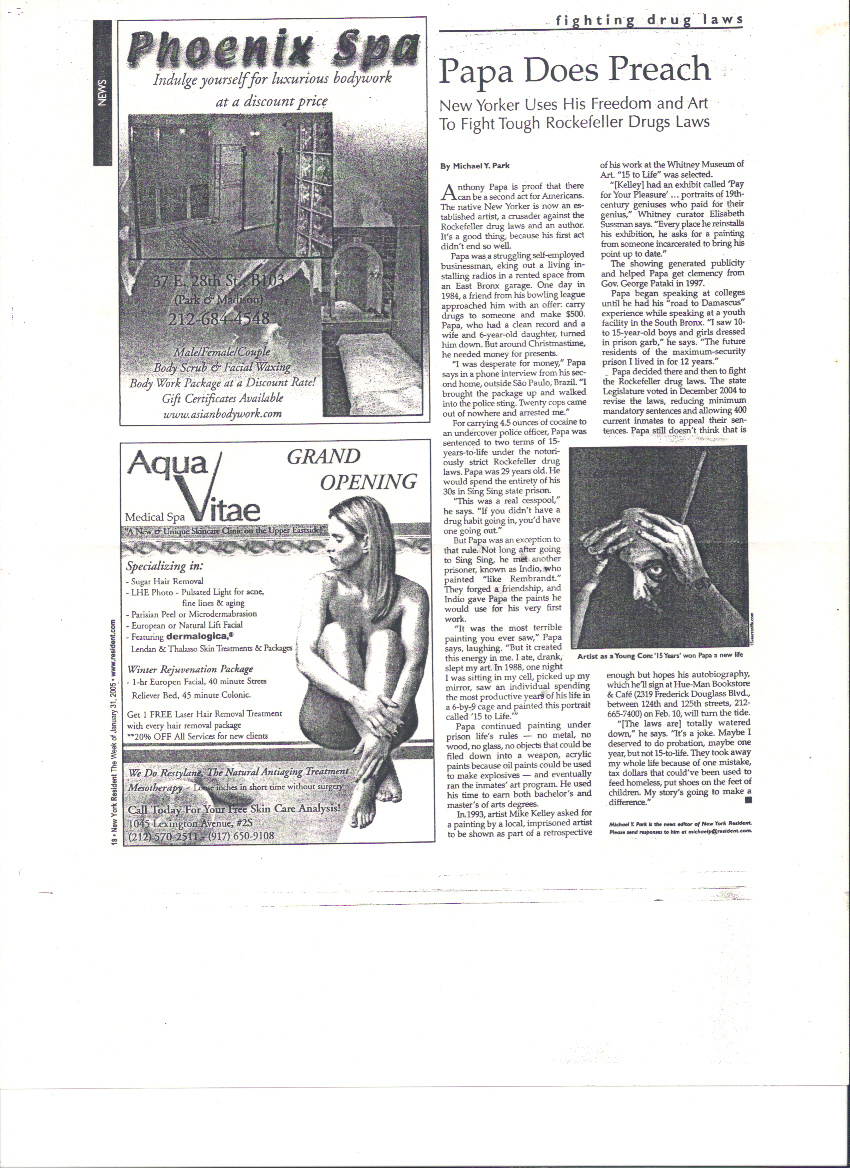
____________________________
The District
http://www.washingtonpost.com/wp-dyn/content/article/2006/09/29/AR2006092901341.html
The District
Saturday, September 30, 2006; Page C12
FESTIVALS Out From Behind the Bars Anthony Papa, a prison inmate who
became a writer and activist and was ultimately granted clemency by New York
Gov. George E. Pataki, is the featured speaker at the first Taste of Justice
Fair, which will spotlight the prison system and life within it. The fair
will also include arts and crafts created by prisoners. Free. 10 a.m.-5 p.m.
Martin Luther King Jr. Memorial Library, 901 G St. NW. 202-393-1511
THE
CHRIS FABRICANT SHOW
Criminal Justice Counter
Spin with Defense Attorney Chris Fabricant
Author
of Busted: Drug War Survival Skills
Monday, July 24 at 7.30 pm; rebroadcast saturday, july
29 at 7:00 am
| |
Rockefeller Drug Law Special
WLIW Channel 21
Guests Anthony Papa, Judge Leslie Croker
Synder, Special Narcotics Prosecutor Bridget Brennan
Airs mondays at 7.30 pm; rebroadcasts saturdays at 7.00 am
|
Hon. Bridget Brennan, Special Narcotics Prosecutor, New York City
Anthony Papa, Communication Specialist, Drug Policy Alliance, and author
of 15 to Life
Hon. Leslie Crocker Snyder, former New York State Supreme Court Judge
For more than thirty years, the Rockefeller Drug Laws have been used as a
tool against the war on drugs, imposing 15 years to life sentences for first
time offenders. In 2004 these laws were reformed. However, questions have been
raised about who really benefits from these reforms. Some people believe that
these reforms have allowed drug kingpins--the most serious offenders--to serve
lighter sentences instead of first time offenders, who the reforms were intended
to protect. Tonight, we speak with Anthony Papa, a former first time offender
who served 12 years of a 15 year sentence, and is now an advocate for drug
policy reform. We then speak with former New York State Supreme Court Judge
Leslie Crocker Snyder and New York City's Special Narcotics Prosecutor Bridget
Brennan on how the reforms to the Rockefeller Drug Laws affect New York's war on
drugs.
COLUMBIA LAW SCHOOL March 22, 2005
-----
CUNY LAW SCHOOL March 3 2006
------------------------------------------------------------------------
**FOR
IMMEDIATE RELEASE**
DRUG WAR REFORM
NOW!
AUTHOR AND DRUG
WAR ACTIVIST ANTHONY PAPA IN L.A. TO SPEAK AT
KEY DRUG POLICY
ALLIANCE CONFERENCE, L.A. URBAN POLICY ROUNDTABLE
November 2005—Anthony Papa, author of the acclaimed 15 to
Life: How I Painted My Way to Freedom (Feral House), noted advocate
against the war on drugs and co-founder of the Mothers of the New York
Disappeared, will be appearing and signing books in Los Angeles.
• Thursday
November 10
(1:00 p.m.)
• Friday
November 11
(1:00 p.m.):
Drug Policy
Alliance Conference
Westin Long
Beach
333 E. Ocean
Blvd., Long Beach, CA
(562) 436-3000
Building a
Movement for Reason, Compassion and Justice
-- The 2005 International Drug Policy Reform Conference (November 10–12;
reception on the evening of November 9): More than 1,000 people from across the
country and around the world will gather to learn more about drug policy reform
issues. No better opportunity exists to strategize and mobilize for reform.
About Anthony
Papa and
15 to Life:
15
to Life
is the
remarkable true story of how one prisoner of the war on drugs painted his way to
freedom. Convicted of his first and only criminal offense in a police sting
operation, Anthony Papa discovered painting while at Sing-Sing. His 15-year
sentence was cut short when one of his works was selected for exhibition at the
Whitney Museum, and he was granted clemency by Governor Pataki. Since his
release, he has become a noted activist against New York’s outdated draconian
drug laws. By using his first-hand prison experience and acclaim as an artist as
vehicles of protest, Mr. Papa has been instrumental in bringing drug war reform
and awareness to mainstream America. He has been interviewed by a wide range of
print and broadcast media, including The New York Times, The Washington Post,
National Public Radio, Court TV, C-Span, among others, and is a frequent
public speaker and college lecturer on critical criminal justice issues.
--------------------------------------------------------------------
Los Angeles Urban Policy Roundtable: Upcoming Events
Nationally acclaimed author and artist Anthony Papa will
discuss his battle ...
Moderated by Earl Ofari Hutchinson, President, LAUPR. Required donation
$15 ...
l
NATIONALLY ACCLAIMED AUTHOR AND ARTIST ON DRUG LAW REFORM
Nationally acclaimed author and artist Anthony Papa will discuss his
battle
against New York's draconian Rockefeller drug laws and his personal fight
for
freedom after being sentenced to life imprisonment in a New York state
prison.
His art has been displayed in New York's Whitney Museum. He is the author of
15 to Life.
WHEN:
Saturday, November 12 at 10 A.M.
WHERE:
Lucy Florence Coffee House
3351 West 43rd Street, Leimert Park, Los Angeles, CA 90008
Moderated by Earl Ofari Hutchinson, President, LAUPR
-----------------------------------------------------------------------------
NOVEMEBER 26, 2005
Prisons Foundation Art Exhibit
1718 M Street NW, #151
Washington, DC 20036
www.PrisonsFoundation.org
for more info contact:
Dennis@PrisonsFoundation.org
202-393-1511
cell 202-492-FREE(3733)
_____________________________________
NOVEMBER 30, 2005
mental health alternatives to solitary confinement presents:
the SHU don’t fit!
Anthony
Papa, Author of
“15 to Life”
Thomas
Duane, New York
State Senator
Jamie
Fellner, Human
Rights Watch
WHEN:
6:00pm -
9:00pm:
wednesday, november 30th
WHERE: bowery poetry club, 308 bowery (at
bleecker st.)
SCOOP: to RSVP or donate to this
event, please contact emily at (212) 780-1400,
ext. 7723
·
funds raised
from this unique event will support activities aimed at ending the placement of
psychiatrically disabled prisoners into solitary confinement
·
if you cannot
attend, please direct donations to: emily benedetto, c/o
mhasc, 666 broadway, 3rd floor,
new york
city, 10012
_________________________________________
November 30th, 2005
wbai.org
Stanley Tookie Williams (co-founder of the Crips Gang) is
scheduled for ...
November 30)- with Anthony Papa, activist against the Rockefeller Drug
Laws, ...
New York City - Columbia University -- Press conference and protest for Stan
at John Ashcroft's New York City appearance. Featuring Anthony Papa, activist
against the Rockefeller Drug Laws, Yusef Salaam, exonerated in Central Park
jogger case, and others. At 5:45 pm at 115th and Broadway. Sponsored by Save
Tookie Committee NYC (Vieques Brigade, Free Mumia Coalition-NYC, Justice
Committee, Campaign to End the Death Penalty, NYers Against the Death Penalty,
Green Party, International Socialist Organization).
_________________________________________
December 6th 2005
wbai.org
Tues., Dec. 6 - Harlem Rally and Benefit for Stan
'Tookie' Williams ... Anthony Papa.
Anthony Papa was imprisoned under New York's Rockefeller Drug Laws.
...
NYU Livewire | Tookie's Clemency Campaign Gathers Steam
According to tookie.com, a pro-Williams Web site,
the prosecutor who ...
Anthony Papa, who was imprisoned under New York’s infamous Rockefeller
Drug Laws ...
journalism.nyu.edu/pubzone/livewire/000484.php
- 13k -
Cached -
Similar pages
_____________________________________________________________________
------------------------------------------------------------------------------------------
LISTEN TO SOME INTERVIEWS
DEMOCRACY NOW WITH AMY GOODMAN
270 STATIONS NATION WIDE Monday, November 8th,
2004
http://www.democracynow.org/article.pl?sid=04/11/08/1513258
15 To Life: Artist, Prisoner and Author Tony Papa Tells How
He Painted His Way to Freedom
We speak with painter and anti-drug-war activist Tony Papa about his new book,
"15 To Life: How I Painted My Way to Freedom" which tells the story of
how he spent 12 years in prison for his first and only criminal offense.
[includes rush transcript]
We are joined today by celebrated anti-drug-war activist, author, painter and
ex-convict Tony Papa.
He has a new book out called "15 to Life: How I Painted My Way to
Freedom." It tells the story of how Tony Papa agreed to deliver an envelope
of cocaine in a police sting operation in return for $500. His first and only
criminal offense cost Papa a 15-year sentence to Sing-Sing, New York State's
maximum-security prison. He began painting in prison. When one of his works was
selected for exhibition at the Whitney Museum, Papa received intense media
attention. After 12 years of hard time, he was granted clemency by Governor
Pataki. Since his release, Papa has become a noted activist against draconian
drug laws. He joins us in our studio today.
CULTURAL BAGGAGE 11/16/04
Hosted by Dean Becker
Guests:
Anthony Papa – author of 15 Years to Life, How I Painted
My Way to Freedom
(Audio Track) Intro – My name is Dean Becker; Steve
Nolin is our engineer. We invite you to join us as we examine the unvarnished
truth about the drug war.
Dean: Welcome to this edition of Cultural
Baggage. Tonight we’ll hear from Anthony Papa, the author of
15 Years to Life, How I Painted My Way
to Freedom. We’ll
also hear from Sanho Tree from the Institute for Policy Studies about the drug
war in Central and South America; and we’ll hear from a medical marijuana
patient who lives in the gulag city of Houston, Texas. Her name – we’ll call
her Marsha. But first up: Poppygate.
|
Richard Johnsons Page Six
New York Post
December 17, 2004
SIMMONS RIPPED ON DRUG LAW
THE man who founded the movement to get the Rockefeller Drug Law
penalties repealed has blasted rap mogul Russell Simmons as a "nightmare"
who "destroyed" the movement.
Some of the penalties were merely reduced earlier this week �
dashing the dream of Anthony Papa, co-founder of Mothers of the
New York Disappeared, who spent over a decade in state prisons
after a Rockefeller Law conviction and launched the campaign to
have the law repealed.
Simmons, who has gotten a lot of publicity for campaigning
against the tough laws, was present at a bill-signing ceremony
Tuesday with Gov. Pataki, where he called the reform "a giant
step forward." The laws, passed by Gov. Nelson Rockefeller in
1973 and 1974, meant that some low-level drug dealers went to
jail for longer sentences than rapists or murderers.
Papa, now an artist and author of the recently published "15
to Life: How I Painted My Way to Freedom," says he was
responsible for getting Simmons involved in the movement through
Andrew Cuomo.
"At first it was a dream come true," Papa told The Post's
State Editor Fredric U. Dicker in an e-mail, "but it became our
worst nightmare. Simmons the businessman's only concern was to
cut a deal � he did not care a hoot about human lives."
Papa is seething that Simmons gave up the initial goal of
total repeal in favor of "watered-down reform." He fumes, "Now
people like Simmons are patting themselves on their backs along
with the governor, [Sen. Majority Leader Joseph] Bruno and [Assembly
Speaker Sheldon] Silver . . . I should have dogged him . . . but
[I] figured he would help us. Instead, he destroyed the movement."
Simmons declined to hit back at Papa, saying that in his
opinion, the reforms were a "good deal." "In my experience as a
businessman, a good deal usually means everybody has to
compromise," he says. "I'm sorry everybody's not happy. I'm glad
that something was done.
"I'm not the reason the deal got made," Simmons states. "My
name is not on the paper. But the governor did give me the pen
he used, which is an honor . . . I respect and appreciate the
hard work Anthony Papa did. I'm sorry he's upset with me."
|
|
|
|
SIMMONS ATTACKED OVER DRUG LAW
|
|
|
|
DEF JAM founder
RUSSELL SIMMONS has been branded a "nightmare" who "destroyed"
attempts to get the Rockefeller Drug Law penalties repealed, by the man
who led the movement.
Governor NELSON ROCKEFELLER passed the controversial laws in 1973 and
1974, which means many low-level drug dealers like ANTHONY PAPA,
co-founder of MOTHERS OF THE NEW YORK DISAPPEARED, are given longer jail
sentences than rapists or murderers.
Papa enlisted Simmons' help in campaigning against the laws and is
devastated the rap mogul attended a bill-signing ceremony on Tuesday
(14DEC04) and called the small penalty reductions "a giant step
forward", website PAGESIX.COM reports.
Papa complains, "Now people like Simmons are patting themselves on
their backs along with the governor and the Assembly Speaker SHELDON
SILVER.
"I should have dogged him but I figured he would help us. Instead, he
was a nightmare and destroyed the movement."
Simmons counters, "In my experience as a businessman, a good deal
usually means everybody has to compromise. I'm sorry everybody's not
happy.
"I'm glad that something was done. I respect and appreciate the hard
work Anthony Papa did. I'm sorry he's upset with me."
17/12/2004 17:34 |
|
Def Jam Founder Accused
December 18, 2004, 9:12:04
|
|
SIMMONS ATTACKED OVER DRUG LAW
DEF JAM founder RUSSELL SIMMONS has been branded a "nightmare" who
"destroyed" attempts to get the Rockefeller Drug Law penalties repealed, by
the man who led the movement.
Governor NELSON ROCKEFELLER passed the controversial laws in 1973 and
1974, which means many low-level drug dealers like ANTHONY PAPA, co-founder
of MOTHERS OF THE NEW YORK DISAPPEARED, are given longer jail sentences than
rapists or murderers. |
Papa enlisted Simmons' help in campaigning against the laws and is devastated
the rap mogul attended a bill-signing ceremony on Tuesday (14DEC04)
and called the small penalty reductions "a giant step forward", website
PAGESIX.COM reports.
Papa complains, "Now people like Simmons are patting themselves on their
backs along with the governor and the Assembly Speaker SHELDON SILVER.
"I should have dogged him but I figured he would help us. Instead, he was a
nightmare and destroyed the movement."
Simmons counters, "In my experience as a businessman, a good deal usually
means everybody has to compromise. I'm sorry everybody's not happy.
"I'm glad that something was done. I respect and appreciate the hard work
Anthony Papa did. I'm sorry he's upset with me
The Nation
|
article |
Posted December 9, 2004
Talking With Anthony Papa
by Rebecca Tuhus-Dubrow
|
n 1985 a bowling partner asked
Anthony Papa if he'd deliver an envelope containing a small amount of cocaine
in exchange for $500. Papa agreed--and was subsequently arrested as part of a
police sting operation.
For his first-time, nonviolent offense, thanks to the Rockefeller drug
laws, he was sentenced to fifteen years to life. In prison at Sing Sing, Papa
studied art and began creating paintings that embodied the despair and
isolation of prison life. In 1994 his self-portrait was displayed at the
Whitney Museum. Parlaying his artistic success into publicity for his case,
Papa was granted clemency by Governor George Pataki in 1997 after serving
twelve years.
ADVERTISEMENT

Now, he is using his art to publicize the injustice of the drug laws that
put him away. He has campaigned tirelessly on behalf of their repeal,
collaborating with other activists such as hip-hop artist Russell Simmons and
co-founding Mothers of the New York Disappeared, a group of prisoners' family
members.
Just this week, new legislation was agreed on in Albany that would modify
certain provisions of the Rockefeller laws for the first time. The
legislation, which Governor Pataki says he will sign, reduces minimum
sentences for some first-time offenses and increases the amount of narcotics
necessary to qualify possession as a serious felony. It also allows inmates
already serving time for these offenses to apply for a reduced sentence. But
most anti-Rockefeller advocates consider these changes far from sufficient,
and fear they could temper demands for more fundamental reform.
Aside from his legal work and activism, Papa also recently published a
memoir, 15 to Life, telling the story of how he painted his way out of
prison. He spoke recently with The Nation in New York.
Q: In your book you mention that you had almost
spiritual experiences in your cell. In prison you also pursued your education
and discovered your passion for art. Would you say that prison served a
beneficial purpose for you?
It was a positive experience in regard to the changes. Besides my gift of
art, I also discovered my political awareness. Prison is a very spiritual
place. There's something mystical about spending time in a 6-by-9 cage for
fifteen years. You discover who you are.
Q: But you seem to be an exception. How would
you describe prison's effect on most inmates' consciousness?
If you're serving a sentence of fifteen years in prison, eventually, you're
going to fall to the negative aspects of imprisonment, unless you find
vehicles to transcend the experience, like I did through my art. The way the
system is set up now, rehabilitation is not even considered anymore. People
can change their lives if you have restorative programs available. Prisons
should be resocialization centers. But they're not. They're designed to
dehumanize.
Q: When you were incarcerated, there were more
of these rehabilitative programs than there are now.
They took away college education in 1995. State and federal funding were
eliminated. Society went toward the strictly punitive mode of justice. The
type of justice that sleeps in the shadows of life itself--lock-'em-up,
throw-the-key-away type of mentality--doesn't think of the future of the
incarcerated individual, the same individual who eventually has to return and
interact with society.
Q: Governor Pataki granted you clemency after
you'd served twelve years. Is it awkward for you to participate in a campaign
that's so critical of him?
I thank the Governor for giving me my freedom, but he's an expert in
dancing around the issue. His office knows about my book. I don't have a
problem with it, and I hope he doesn't. For three years in a row, the Assembly
and the Senate wanted to change the laws, but for three years they've been
bickering on what changes to make. Meanwhile, people are wasting away in
prison. My job is to keep pushing the issue, keep it in the news, and keep the
Governor informed that I will not give up until these laws are changed.
Q: Do you think he regrets giving you clemency?
I think he definitely regrets it.
Q: What is the organization you co-founded,
Mothers of the New York Disappeared, doing to raise consciousness about the
issue?
Family members of the incarcerated work with us to bring the message to the
Governor. When we go up to Albany with our group, these women--mothers in
wheelchairs, canes, dying of cancer--they [the politicians] cringe. They're
like, please. Every time we go there, they're afraid of the photo ops. I got
the idea for the group from the Argentine mothers of the disappeared. They
fought for over twenty-seven years against the government that murdered their
children. Maybe I'm not dealing with 30,000 deaths, like what occurred in
Argentina, but there are tens of thousands of people who disappear, who are
socially dead, when they go to prison.
Q: The new reform deal does address some of the
harshest consequences of the laws, but it's certainly not the repeal you've
been advocating.
I applaud the change giving prisoners who have already served long
sentences an opportunity to be reunited with their families. But the proposed
changes are watered-down reform.
Q: What do you find most lacking in the reform?
It will not change the power structure of the Rockefeller drug laws, which
is controlled by the district attorneys. Right now, the prosecutor controls
the case from its beginning. And prosecutors live and die by their rates of
conviction. Judges should have discretion. In my case, my judge didn't want to
sentence me to fifteen to life, but he had to because of the law. Without
judicial discretion incorporated, this is a feeble attempt by the legislature
to satisfy activists who have fought for repeal. I vow never to stop fighting
until we get true repeal and help the many, many other prisoners who will be
left behind in this whirlwind of false celebration.
Q: In the book you say that when you got out,
it was extremely disorienting at first, after having been in prison for twelve
years. Have those feelings lingered?
Only when I dream. Now, I'm out seven years. What I felt when I got out
should have been bottled. Everything had a Zen-like feeling, and life was just
amazing. I floated when I walked. But I've been out now for seven years, so
I've kind of settled down.
Q: Do you have any messages for the prisoners
you met while you were doing time, who are still there?
I would say, don't give up hope. Seven years ago I was sitting in a cell,
and today I got my book published, soon to be made into a major motion
picture. I sold the film rights to the book already. It's going to
Hollywood--another
Traffic. We're going to get this issue out.
Q: Whom do you want to play you?
First it was Al Pacino, but now he's too old. Tom Cruise, but he's too
short. I don't know...he's got to be a young, sexy-looking guy.

|
|
October 21, 2004 --
THE Rockefeller Drug Laws will be repealed if Anthony Papa can reach
enough people. Papa, who had a radio repair business in The Bronx and a young
daughter, did 12 years in Sing Sing after one of his bowling teammates asked him
in 1985 if he wanted to make $500 delivering an envelope. It turned out the
package was cocaine. Papa wrote "15 To Life: How I Painted My Way to Freedom,"
about becoming an artist while in prison. He co-founded Mothers of the N.Y.
Disappeared in 1998 to bring attention to the unfairness of the 1973 laws which
send low-level drug dealers to jail for longer sentences than rapists or
murderers. On Monday night, after an opening of his show at the Whitney, Papa
was feted at the Waldorf Towers by hedge fund wizard Lawrence Goldfarb
and such guests as Andrew Cuomo, art dealer Donald Rosenfeld,
Vanity Fair writer Frank DiGiacomo and groom-to-be Al Reynolds,
looking rellaxed as his Nov. 13 wedding to Star Jones approaches.
ELLIS HENICAN NEWSDAY
Portrait of the artist as free man
Oct 24, 2004
It took a while, a whole lot longer than it should have. But Tony Papa finally
got to see his painting hanging where it belonged.
Thirty-five miles and 16 years from the prison cell where he painted it.
Displayed in a gallery at the Whitney Museum of American Art.
This wasn't the first time that Papa's self-portrait, which he titled "15 to
Life," was shown at the Whitney. But the last time Papa wasn't able to make
the museum show. He was otherwise detained, serving an absurdly long prison
term at the Ossining Correctional Facility on a nonviolent drug conviction
under the state's harsh Rockefeller laws.
"That portrait changed so much for me," Papa said. "I was sitting in my cell,
three years into my sentence. I picked up a mirror. I looked in the mirror. In
the mirror I saw an individual who was gonna spend the most productive years
of his life in a six-by-nine-foot cage. Then I went to the canvas, and I
captured that look."
The picture Papa painted was foreboding and dark, acrylic paint on an
18-by-24-inch canvas. He was holding a paintbrush. His fingers were spread.
His hands were resting on his head. His right eye was in a shadow. His left
eye was wide open, staring ahead.
"I created this painting, and seven years later an angelic letter arrived from
the Whitney Museum, asking me to put a piece of my work in an upcoming show,"
he said. "From that point on, I knew that was the key to my freedom. If I
could show my work at the Whitney, I could paint myself free."
It wasn't quite that easy, of course. People inside and outside the prison
admired Papa's talent and recognized the injustice of these counterproductive
laws. Various friends interceded on his behalf.
And in that roundabout fashion, Papa's confidence in the power of his art was
ultimately borne out.
The painting was shown, him still at Sing Sing. The story got some media play.
That generated a second look at the drug conviction and his long prison term.
Finally, in 1997, Gov. George Pataki signed the executive-clemency order that
set Papa free. For a single cocaine sale, his first conviction, he'd served 12
years of his 15-to-life.
"I really did paint my way out of prison," he said.
He never gave up on the broader cause. He has spent the past seven years
working to change the law that locked him up. He co-founded a group the New
York Mothers of the Disappeared, organizing relatives of Rockefeller-law
inmates, trying to push Pataki to expand his one-man clemency into a more
sensible drug plan.
It's slow going, but the signs of hope are real. Again this year, Papa and his
drug-reform allies will take their case to Albany.
He's written a book about it, being published next month by Feral House, "15
to Life: How I Painted My Way to Freedom" by Anthony Papa with Jennifer Wynn.
There's a Web site, www.15tolife.com, and the story's already been optioned
for Hollywood.
But Tony Papa had one piece of unfinished business. He had never been able to
see his portrait on the museum wall.
So the other night, there was a party at the Whitney to celebrate the new
book. Hors d'oeuvres were passed. Wine was served. Mario Cuomo turned up. So
did most major players in the drug-reform movement. Several of Papa's
paintings, including the famous self-portrait, were hanging in a beautifully
lit space on the gallery wall.
People kept saying what an inspiration Tony Papa is.
"Tony is the human face of these inhumane laws," said Andrew Cuomo, the former
federal housing secretary who has been championing the drug-reform cause in
New York. "Here is what a Rockefeller prisoner looks like. Here is his art. He
was locked in a cage for 12 years. Was he really such a threat to us?"
Miele Rockefeller, the granddaughter of Gov. Nelson Rockefeller, for whom the
laws were named, was there to support Papa. "The Rockefeller laws should be
renamed the Pataki laws," she said. "My grandfather would have changed them by
now, and George Pataki won't."
After the museum show, the group retired to an after-party in the Waldorf
Towers apartment of hedge-fund director Lawrence Goldfarb, a Republican.
Wealthy Wall Streeters mixed with freshly released ex-prisoners. It was about
as far as you could get from Sing Sing.
"I'm a Republican businessman," said Goldfarb, whose company is called Baystar
Capital. "In dollars and cents and in social devastation, these laws make no
sense at all."
All evening long, Papa, who is 49 now, looked humbled but also energized. "So
many people are reaching out with love," he said. "They're walking up to me,
crying, asking, 'What can I do?' "
He had an answer for all of them. "Speak to your political leaders. Put
pressure on the governor. We have to change these laws for everyone.
"One person really can make a difference," he'd say each time. "Believe me. I
know."
Portrait Of a
Free Man
AlterNet, CA - Oct 27, 2004
... He's written a book about it, being published next
month by Feral House, "15 to Life: How I Painted My Way to Freedom" by
Anthony Papa with Jennifer Wynn. ...
http://www.socialistworker.org/2004-2/522/522_09_AnthonyPapa.shtml
Artist and activist
Anthony Papa speaks out:
“Art can be a weapon
of the oppressed”
December 3, 2004 |
Page 9
ANTHONY PAPA served
12 years of a 15-years-to-life sentence as a first-time, nonviolent felony
drug offender under New York state’s Rockefeller Drug Laws (RDLs). In
prison, he became an artist and a political activist. Since his release in
1997, Papa has fought tirelessly along with others to repeal New York’s
draconian drug laws, cofounding the group Mothers of the New York
Disappeared.
Now, Feral House has published his book 15 Years to Life: How I
Painted My Way to Freedom. In October, the Whitney Museum of American
Art held a party to launch the book. LUCY HERSCHEL spoke with Anthony.
- - - - - - - - - - -
- - - - -
THE SUBTITLE of your book is “How I Painted My Way to Freedom.” Can
you explain how that happened?
I WAS sentenced to 15-to-life in maximum-security prison in Ossining,
N.Y. I was lost. I really didn’t know how I was going to survive, until one
day I discovered my talent as an artist. My discovery of my art was life
saving, it maintained my humanity, my self-esteem, it gave me meaning in my
life and helped me transcend the negativity of the prison environment.
Sing Sing was a cesspool. Parts of the prison were like the old Times
Square--you could buy any type of weapon, TV sets, any form of contraband,
drugs. There were more drugs in Sing Sing than in the streets.
The point I like to make is, if you can’t control drugs in a
maximum-security prison, how can you control drugs in a free society?
More importantly, my art helped me discover my political awareness--who I
was in society. I discovered the Mexican muralist Diego Rivera and Picasso’s
“Guernica”--those were my influences where I saw that art could be used as a
weapon of the oppressed against the oppressor. I began painting social
statements against the death penalty and the prison-industrial complex.
One of my pieces, “Corporate Asset,” portrays the prison-industrial
complex before the term was even coined. It shows how the family unit is
taken away from the home, the prisoner becomes food for the machine--the
systematic dehumanization of the prisoner who becomes a nameless statistic
going through the revolving doors of justice on the road to recidivism, only
to be plucked in again at any time by the system.
It’s a visual narrative of important social concepts. For me, the
greatest asset of an artist is using art as a social commentary.
WERE YOU ever afraid that the political message in your work would
hurt your chances at clemency?
ACTUALLY, MANY times I debated this. While my clemency petition was
pending, my counselor came to me and told me to slow down. Although he
personally agreed with what I was doing, he thought I was jeopardizing my
chances at freedom. Apparently, the warden had come to him and had wanted to
withdraw the letter of support he had sent to the governor for me, because I
was so outspoken.
But I felt I had an obligation to speak out against the atrocity of
imprisonment through my art.
For example, I painted one series called “Contraband Search.” Coming back
from a visit one day, I was put through a body cavity search three times,
and I felt very dehumanized by it. I went to the library and I found
policies and directives on how C.O.s are to conduct body cavity searches,
and I was appalled by the 20 pages of directives describing the methods of
all types of searches.
So I painted a series of six-page paintings about this issue, and I tried
to send them out--but the work was confiscated.
I called my lawyer to say that I wanted to sue them because they took
away my right to create--first they want me and now they want my mind. He
said, “Look, slow down, don’t sue them, you have you clemency petition
pending, and you’re going to hurt your chances at clemency. Handle it
internally.”
So I was forced to strip down the directives off the paintings. But when
I went back to my cell I thought, “Now they have my mind.” So I made
diagrams of where the directives were on the painting and sent the
directives out separately in the mail.
Later, I got a call that the deputy of security wanted to see me, and I
thought, “Now I’m in trouble, they must have found the directives in the
mail. I just blew my shot for freedom.” Instead, he told me that he just got
off the phone with the governor, and he said, “You’re free.” I just broke
down crying. That was an amazing experience.
So even though I did jeopardize my freedom, I thought it was my duty and
my obligation. Because I had this vehicle, I became a kind of cause celebre,
and a lot of people wanted to come in the prison and interview me. I used my
art as a vehicle to talk out against the system.
I thank Governor Pataki for my clemency, but I have become an activist
against him and his stance on Rockefeller reform, which is nonexistent.
Three years ago, for the first time in 28 years, the governor openly came
out and spoke against the drug laws. Then the Senate and State Assembly
leaders also came out.
So you have all three top dogs of New York State government wanting to
change the laws, but for three years, they’ve just argued about what changes
to make. So throughout all this political rhetoric, people are still wasting
away in prison. I will continue to use my art to fight the governor to
compel him to change these laws.
SO IF the top three legislators all agree, why hasn’t there been
reform?
BECAUSE OF the prison-industrial complex--money raised at local, state
and federal levels through the business of the prison. Since 1982, 33
prisons have been built in up-state, rural Republican territories. It’s
about the dollar. That’s why people are still in prison, that’s why these
laws have not changed. That coupled with the disfunctionality of the
legislative process in Albany.
The “war on drugs” is a war on people itself and primarily people of
color. It’s about controlling a certain population. If you look at New York
State, 75 percent of the 19,000 people who are locked up under these laws
come from seven inner-city neighborhoods. So this is about institutionalized
racism.
It’s very hard to change the system when it’s run by politics that are
dictated by personal gain. All politicians are thinking about is their own
political careers. They don’t care about people locked up in prison; they
don’t care about anything else.
YOU TOLD me about a new district attorney who, with the support of
activists, won a big upset victory in Albany by running strictly on an
anti-Rockefeller Drug Law platform, beating out an incumbent who was a
strong supporter of these laws. How do you think he won?
MY GROUP, the Mothers of the New York Disappeared that I cofounded in
1998 through the William Kunstler Fund for Racial Justice, laid the
foundation by going to Albany dozens of times, meeting with officials,
protesting in the street and getting tremendous publicity up in Albany, so
the people in Albany were educated about the draconian nature of the RDLs.
They saw it was a waste of tax money, of human life, money that could be
better spent on needy communities, to feed the homeless, put shoes on
shoeless children.
When I came out in 1997, I went to Albany with different groups to lobby
politicians, and I saw that I was wasting my time trying to change the laws
from the top down. All these politicians had dual opinions about the laws.
The public opinion was: “We support these laws. They work.” But behind
closed doors, they said would say, “Look, I know these laws don’t work, they
cost a lot of money, but I can’t look soft on crime because I don’t want to
loose my job.”
From that point, I said to myself, “We aren’t going to win it up here.
We’re going to have to develop a plan to work it from the bottom up.”
That’s why I started the Mothers of the New York Disappeared. We actually
changed public opinion by taking the issue to the street and putting a human
face on it. We formed the group based on the Argentine mothers. They fought
the military when they overtook the government in the 1970s and ’80s. Some
30,000 people were murdered--they disappeared. They held candlelight vigils
and the Plaza de Mayo, and got a lot of public sympathy and public pressure
from around the world to seek justice.
We met May 8, 1998, the 25-year anniversary of the RDLs, right across
from St. Patrick’s Cathedral, and we staged our first rally, and all the New
York press was there. We saw that this was how we were going to change these
laws--by getting the press involved and reaching the masses with these human
interest stories.
And from a small, dedicated group of maybe 25 people, in five years, we
changed the face of the war on drugs and how it was fought in New York. What
we did is we took to the grassroot street level. Now that model has expanded
to other groups that hold rallies now across the country.
WHERE DO you think the fight against the Rockefeller Drug Laws should
go from here?
WE NEED to continue to put pressure on the governor, and we need to do it
in a variety of ways. I had a meeting with Larry Fisher, LL Cool J’s former
manager, who runs an organization called Hip Hop for Youth, about going to
Albany in January during Pataki’s State of the State address and having an
event with different rappers.
The governor’s proposed legislation is watered-down reform. It’s a slap
in the face to activists and to the people in prison.
In 2002, Pataki pushed through the Senate a reform bill that would have
affected some of the loved ones we were advocating for. The next day, the
governor met with the Mother of the New York Disappeared and said, “If you
support us, your loved ones will be free.”
So that was hanging like the carrot dangling on a string. And we actually
rejected it, and it was hard for a lot of mothers--some of these women are
disabled, in wheelchairs, dying of cancer, their loved ones stuck in prison.
But we thought about the whole group. Instead of letting a few hundred
people out, we want to build a movement to save thousands and thousands and
thousands of lives in the long run.
AFTER THE election, Bush is claiming a mandate for all this policies,
including the “war on terror.” Do you see a connection between the “war on
drugs” and Bush’s “war on terror”--the locking up of immigrants, Guantánamo
Bay and the prison scandals in Iraq?
IF YOU go to Times Square, they have a Drug Enforcement Administration
exhibit, “Drug Traffickers, Terrorists and You,” in which they are basically
saying, “If you smoke a joint, you’re supporting the terrorists.” It’s total
propaganda.
Drug users today are demonized--they’re treated today as Communists were
during the McCarthy era, the same way groups of people suspected of
terrorism are treated today. This goes with the whole philosophy of
controlling certain populations of people with propaganda.
I don’t think Bush has a mandate, I think he stole the election again.
But that won’t effect my fighting against the war on drugs. I will continue
to create ways to fight the government around these draconian laws that lock
up certain disenfranchised or marginalized populations in the U.S.
For more information about Anthony’s artwork, his book or the fight
against the Rockefeller Drug Laws, visit his Web site at
www.15yearstolife.com.
|
--------------------------------------------------------------------------------------------------------------------
Inside the Sing-Sing Prison [85031-1] : C-SPAN
Papa, Anthony - Inmate. Sessions, Jeff (R-AL) - US
Senator ... Any other use
requires a license and permission from C-SPAN. ...
Rights and
Wrongs: War on Drugs and
Human Rights, 28:30
Globalvision, 1997
Hosted by Charleyne Hunter-Gault,
Rights and Wrongs is a
weekly television program dedicated to exposing human
rights abuses around the
world. This episode focuses on the criminalization of youth and other abuses
perpetrated in the name of anit-drug
policies.
Court TV: Catherine Crier Live
RNN : Topic / New`York Drug Laws
Racist And Cruel
CNBC : Charles Grodin Show
Court TV : Inside Cell Block F debating
America's Toughest Sheriff
 |
America's toughest sheriff Gerald Hege who has his
prisoners ...
 ![]() Watch
video - 54 sec - Watch
video - 54 sec -

www.youtube.com/watch?v=yH5G659vETs |
MAY 8TH ON DEMOCRACY NOW WITH HOST AMY GOODMAN
WBAI.99.5
Democracy Now! is a national, listener-sponsored public radio and TV show,
pioneering the largest community media collaboration in the country. We air
Monday-Friday on over 120 stations including Pacifica radio stations, Pacifica
affiliates, WBIX.org, public access TV stations, Free Speech TV (DishNetwork
Channel 9415)
Athletes and Drug Addiction
https://www.addictiongroup.org/blog/athletes-drug-addiction/.
Why is Substance Abuse Common Among Athletes?
There are many reasons why substance abuse is so common among athletes.
Many face intense pressure to perform. Others are young and more likely to
experiment with substances as they explore their boundaries. Additionally,
some sports cultures contribute to substance abuse.
Other
reasons substance abuse is common among athletes include:
Injuries
Injuries are common in sports, and they can be very painful. Some athletes
turn to drugs or alcohol to cope with the pain.
Life on the Road
Athletes often travel a lot. They spend a lot of time away from their homes,
friends, and family. For some, this leads to loneliness, so they turn to
drugs or alcohol to cope.
While substance abuse is a serious problem among athletes, it is not
insurmountable. With the right prevention strategies, athletes can avoid
substance abuse and maintain healthy, successful careers.
While there are many factors that can contribute to substance abuse among
athletes, there are also several ways to prevent it. Education is one key
preventative method, as athletes who are aware of the risks associated with
substance abuse are less likely to engage in it.
Additionally, policies and procedures that discourage substance abuse, such
as drug testing, can also be effective in preventing athletes from using
drugs.
Student Athletes and Substance Abuse
Many of the same pressures that drive professional athletes to alcohol and
drug use also exist for student athletes.
Like professional athletes, student athletes may abuse drugs and alcohol to:
-
Cope with the pressure they feel to succeed
-
Improve their performance
-
Cope with the disappointment of not performing up to their standards
Additionally, student athletes might abuse drugs and alcohol because they
are easily accessible.
Party culture is common on college campuses. In some cases, student athlete
exposure to drugs and alcohol is more common than it is with other students.
This is due in part to their campus notoriety.
Finally, the culture surrounding college sports can be very competitive.
Student athletes often feel pressure to win at all costs, especially when
their performance is tied to scholarships and future career opportunities.
This pressure can lead them to abuse drugs and alcohol to gain an edge over
their opponents.
What Are Some Popular Substances Athletes Abuse?
Athletes often turn to banned substances to improve their performance. Some
of the most popular substances athletes abuse include:
Performance-Enhancing Drugs
There are several performance-enhancing drugs (PEDs)
athletes use to improve their athletic ability.
For instance:
-
Anabolic
steroids: Synthetic hormones that can help athletes build
muscle mass and strength. However, they can also have serious side
effects, including liver damage, high blood pressure, and heart
problems.
-
HGH: Hormone
that helps regulate growth and development. Some athletes use HGH in an
attempt to improve their athletic performance, but it can cause joint
pain, carpal tunnel syndrome, and enlarged breasts in men.
-
Stimulants: Increase
alertness and energy levels. They can improve athletic performance, but
they can also cause insomnia, anxiety, and heart palpitations.
Alcohol
There are many reasons why athletes may abuse alcohol. Some may turn to
alcohol to cope with the pressure of competition, while others may use it as
a way to celebrate successes. And others abuse alcohol simply because they
enjoy the feeling of intoxication.
In the U.S., alcohol is legal for people over 21 years old, and it’s one of
the most easily accessible drugs available.
Cannabis
Cannabis is a psychoactive drug that can improve focus and concentration.
However, it can also impair coordination and reaction time. Some use it to
relax and deal with the pressure and/or pain of their athletic career.
Athletes Who Have Struggled With Substance Use Disorder (SUD)
No athlete should feel shame or embarrassment if they struggle with
addiction. Some of the world’s most accomplished athletes have faced similar
challenges.
Michael Phelps
Michael Phelps is a former American Olympic swimmer. As of 2016, he holds a
variety of Olympic swimming records in categories including the men's
100-meter butterfly, 200-meter butterfly, and 400-meter individual medley.
In 2014, Michael Phelps was arrested for DUI after a night of partying.
Phelps has also admitted to using marijuana and other drugs in the past.
Phelps has said that he is now sober and has not used drugs in over a year.
Lawrence Taylor
Lawrence Taylor is a former National Football League (NFL) linebacker. His
achievements include winning NFL Defensive Rookie of the Year and NFL
Defensive Player of the Year during his first year in the league. Taylor
played in two Super Bowls and was selected ten times for the NFL Pro Bowl.
Taylor developed an addiction to cocaine during his NFL career. The public
learned of his addiction after Taylor failed a drug test in 1987. Following
another drug test failure the following year, Taylor sought professional
drug treatment. Unfortunately, his struggles continued and led to several
arrests, including a DUI in 2017.
CC Sabathia
Former Major League Baseball (MLB) pitcher CC Sabathia played for 19
seasons. Sabathia played on six MLB All Star teams and won the Cy Young
Award in 2007. He also won ALCS MVP in 2000 and was a part of the World
Series Championship team in 2009.
Sabathia developed an alcohol addiction during his career. He checked into
treatment in 2015.
Lamar Odom
Lamar Odom is an American former professional basketball player. He played
14 seasons in the National Basketball Association (NBA), winning two NBA
championships with the Los Angeles Lakers. As a member of the Lakers, he
also won the NBA Sixth Man of the Year Award in 2011.
Lamar Odom's drug problem has been well-documented. The former NBA star has
struggled with addiction for years, and it has taken a toll on his life and
career.
His drug problem first came to light in 2015, when he was arrested for
driving under the influence. He later revealed that he had been struggling
with an addiction to crack cocaine. In 2015, Odom was found unconscious in a
brothel after a drug overdose. He spent several weeks in a coma.
Despite several stints in rehab, Odom’s struggle continued, and in 2017, he
was hospitalized after suffering from an overdose.
What to Do About Substance Abuse Among Athletes
One of the most important factors in curbing athlete substance abuse is
education about the dangers of substance abuse. This should start at a young
age and continue throughout an athlete's career.
It should include information about the risks of using performance-enhancing
drugs, as well as the risks of abusing alcohol and other substances. It’s
also important to make sure athletes understand mental illness and how their
mental health plays a role in addiction.
Another important
step is to have strong policies in place that discourage substance abuse.
These policies should be clear and concise, and they should be enforced
consistently.
Providing support and addiction treatment to athletes who are struggling
with substance abuse is also critical. This support can come in the form of:
-
Detox
-
Rehabilitation
-
Therapy
-
Support from family and friends
-
Medication for withdrawal symptoms and ongoing care
-
Treatment for co-occurring mental health issues and disorders
-
Relapse prevention
By
providing this support, it’s possible to help athletes overcome their
addictions and get back on track.
One of the most important factors in handling athlete substance addiction is
recognizing the warning signs. These include:
-
Loss of control
-
Neglecting responsibilities and once-enjoyed activities
-
Risk-taking behavior
-
Secretiveness
-
Relationship issues
-
Developing tolerance
-
Family history of drug or alcohol abuse
-
Using substances despite negative consequences
-
Withdrawal symptoms
Updated on December
9, 2022
-
Reardon,
Claudia, and Shane Creado. “Drug
Abuse in Athletes.”
Substance Abuse and Rehabilitation, vol. 5 Aug. 2014, pp. 95–10..
-
Dandoy, C., and
R. S. Gereige. “Performance-Enhancing
Drugs.”
Pediatrics in Review, vol. 33, no. 6, 1 June 2012, pp. 265–272.5.
-
Green, Gary A.,
et al. “NCAA
Study of Substance Use and Abuse Habits of College Student-Athletes.”
Clinical Journal of Sport Medicine, vol. 11, no. 1, Jan. 2001, pp.
51–56.
-
“Doping
and Substance Abuse.”
NCAA.org.
-
“Mind,
Body and Sport: Substance Use and Abuse.”
NCAA.org.
-
National
Institute on Drug Abuse. “Are
Anabolic Steroids Addictive?”
National Institute on Drug Abuse, Feb. 2018.

Annamarie Coy, BA, ICPR, MATS
Medical Reviewer
Annamarie Coy spends her spare time studying current behavioral health
issues and the results of the treatments for mental health disorders and
addiction recovery. Her main goal in life is to end the stigmas
associated with mental health and addiction disorders.

Kelly Brown
Content Contributor
Kelly Brown is a content writer for Addiction Group. Her goal is to
share important information that people can use to make decisions about
their health and the health of their loved ones. From choosing the best
treatment programs to finding the understanding the long-term challenges
of managing addiction and mental health, she hopes to share what she
learns through informative content.