The Leonard Lopate Show
(audio)
The Leonard Lopate Show
(audio)
Published by
The Leonard Lopate Show

ANTHONY PAPA THANKING GOV. PATERSON FOR REFORMING THE ROCKEFELLER DRUG LAWS IN 2009
APRIL 2ND 2019 THE 10TH ANNIVERSARY OF THE HISTORIC 2009 REFORMS OF THE ROCKEFELLER DRUG LAWS
In 2009, New York reformed its notorious Rockefeller Drug Laws. Ten years later, veteran drug law reform activists Anthony Papa and Terrence Stevens join “Drugs and Stuff” to reflect on the destruction the draconian Rockefeller Drug Laws wreaked on so many New Yorkers and share their thoughts on the reforms.
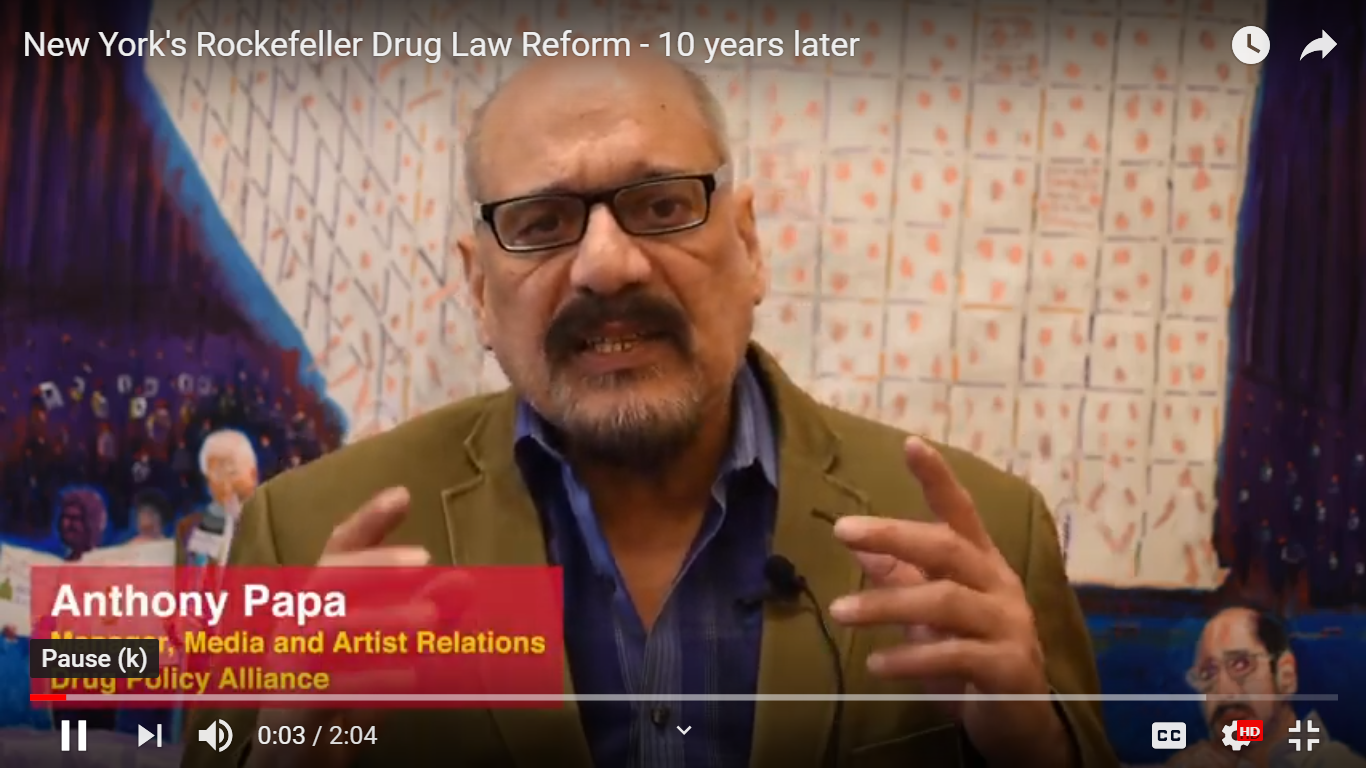
https://www.youtube.com/watch?time_continue=12&v=RGYlqnypKEU
NY Daily News
Ten years ago, New York started dialing back the war on drugs
By ANTHONY PAPA
APR 02, 2019
Today is the 10th anniversary of the historic reform of New York’s infamous Rockefeller Drug Laws. Many people have forgotten the decades-long struggle we went through to get meaningful reform of these laws. But I haven’t.
This is because in 1985, I made the biggest mistake of my life, which cost me my freedom. Desperate for cash to support my family, I was convinced by a bowling teammate to get involved with a drug deal. In exchange for $500, I transported an envelope containing four ounces of cocaine from the Bronx to Mt. Vernon, N.Y.
To my surprise, I walked into a police sting operation, with 20 undercover cops waiting for me. I did everything I could do wrong and I was convicted and sentenced to 15 years to life under the Rockefeller Drug Laws.
The history of these laws is rich and full of controversy. In 1973, two years after President Nixon declared a “war on drugs,” New York Gov. Nelson Rockefeller passed the toughest drug laws in the nation, demanding mandatory sentences for people convicted of drug law violations, while removing judges’ power to consider each case individually. The Rockefeller Laws turned New York’s prison complex into a merciless machine, destroying families and lives, and locking up tens of thousands of first-time offenders, many addicted to drugs.
Eventually these laws became the template for the federal government’s draconian sentencing laws passed in the 1980s, which imprisoned millions of Americans with mandatory minimum sentences.
Finally, after many years of struggling to achieve meaningful reform, on April 2, 2009, Gov. David Paterson signed reforms into law. I attended the historic bill-signing ceremony in Corona, Queens, at the Elmcor Community Center. Paterson was joined by legislative and community leaders to pay tribute to long-time Rockefeller reform champion Assemblyman Jeffrion Aubry, who was a drug treatment counselor at Elmcor before he entered the political arena.
Paterson stood behind a podium and spoke: “This is a proud day for me and so many of my colleagues who have fought for so long to overhaul the drug laws and restore judicial discretion in narcotics cases,” he said. “For years, thousands of New Yorkers have spoken out against the Rockefeller Drug Laws.” When he ended his speech, I ran to the podium and embraced the governor. His security private guards quickly surrounded me, not knowing if I was a threat or not. But they backed off when they heard me thank him.
The new bill enacted broad changes to New York’s disastrous drug laws, including restoring judicial discretion in most drug cases, expanding alternatives to incarceration, and investing millions in treatment. Activists pointed out that after years of ineffective mandatory minimums, mass incarceration, institutional racism and billions in wasted taxpayer dollars, these reforms were long overdue and essential for making a better New York.
This shows what is possible when people come together and work for change. While advocates applauded the changes to the law, they also pointed out that reforms should have gone even further and feared that outcomes would be hard to monitor and report. It’s been ten years since the historic Rockefeller reform passed and we are still far from where we need to be.
We’re in the middle of an overdose crisis and there still remains an overreliance on the criminal legal system. In the spirit of this 10th anniversary, it is my hope that with the help of Gov. Cuomo and the Legislature, we can go further to end the drug war in New York.
Papa is the manager of media relations for the Drug Policy Alliance and the author of “This Side of Freedom”.
The Leonard Lopate Show
(audio)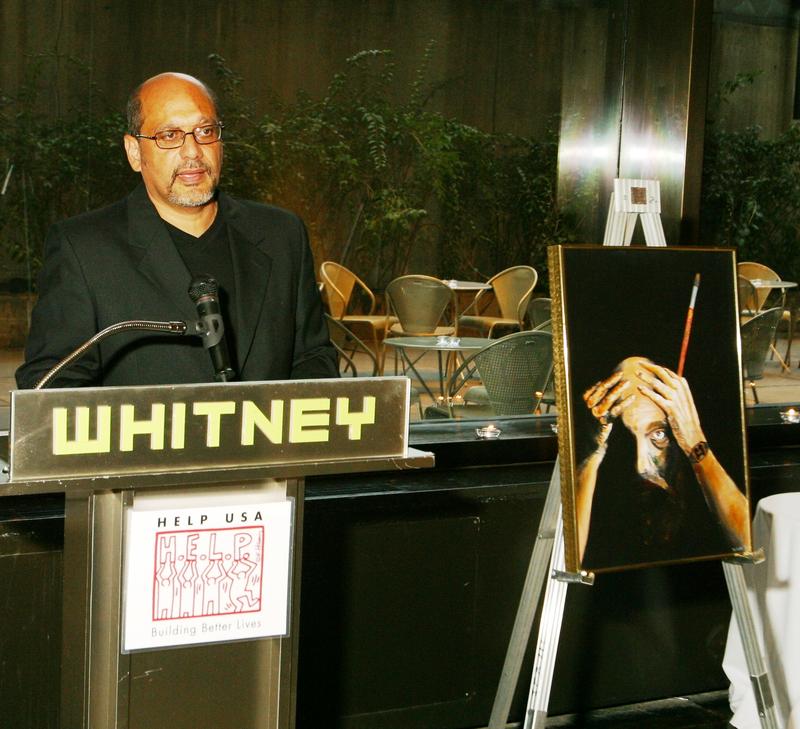
http://www.wnyc.org/story/anthony-papa/ (listen)
City & State New York / The Slant Pod Cast
Portrait of a Pardon: Criminal Justice Activist Anthony Papa
1/17/2017
Interviewed by Nick Powell & Gerson Borrero
Audio:
The Slant – Portrait of a Pardon
http://199.73.109.205/
Does 15 years to life for one drug deal sound excessive to you? Our guest this week, Anthony Papa, is a living example of the ineffectiveness of the Rockefeller drug laws. Papa served 12 years at Sing Sing for a nonviolent drug crime before Governor George Pataki commuted his sentence in 1996. Just last month, Andrew Cuomo officially pardoned Papa, clearing his record after 20 years of criminal justice activism fighting for criminal justice reform and against the excesses of the United States’ War on Drugs.
Democracy Now: NY: Anti-Drug-War Activist Anthony Papa Wins Pardon
Headlines Jan 10, 2017
In New York state, anti-drug-war activist, painter and author Anthony Papa has received a pardon from New York Governor Andrew Cuomo. In 1985, Papa agreed to deliver an envelope of cocaine in a police sting operation in return for $500. His first and only criminal offense cost him a 15-year-to-life sentence. In 1996, Papa won a sentence commutation from then-New York Governor George Pataki. He’s believed to be the first person in New York state history to receive both a sentence commutation and a pardon.
https://www.democracynow.org/2017/1/10/headlines/ny_anti_drug_war_activist_anthony_papa_wins_pardon (full clip)
https://www.youtube.com/watch?v=dlfaRriN-AA&feature=youtu.be (33 seconds)
State officials also believe Papa is the first person in New York history to receive both a sentence commutation — which then-Gov. George Pataki granted him in 1996 — and a pardon.
EXCLUSIVE: N.Y. drug reform activist Anthony Papa receives pardon from Cuomo
BY Glenn Blain
NEW YORK DAILY NEWS
Monday, January 9, 2017
Anthony Papa leads protests against Rockefeller-era drug laws.

(Andrade, Patrick)
[After nearly two decades of fighting to get other drug offenders released from prison, Anthony Papa finally received a pardon for himself.
A longtime activist in the fight to reform New York’s drug laws, Papa was among the more than 100 offenders granted a pardon or commutation by Gov. Cuomo on Dec. 30.
While Papa’s pardon has been largely overshadowed by the controversy over Cuomo’s decision to commute the sentence of former Weather Underground member Judith Clark, Papa and other advocates see it as a significant milestone.
State officials also believe Papa is the first person in New York history to receive both a sentence commutation — which then-Gov. George Pataki granted him in 1996 — and a pardon.
“The pardon . . . is both a vindication and a public proclamation that I have demonstrated exemplary behavior over the 20 years since I have been free,” Papa, a 62-year-old Brooklyn resident, told the Daily News.
Papa said it’s also a vindication of his belief that the 15-year-to-life sentence he received as a first-time drug offender in 1985 was overly harsh.
The sentence was typical of those handed out under New York’s Rockefeller-era drug laws, which were adopted in response to the heroin epidemic of the early 1970s.
“He is a living example of the inequities in the system that existed due to the Rockefeller-era drug laws and has spent more than a decade working in the pursuit of justice for others,” Cuomo said.
Anthony Papa shown with some of his art work. State officials believe Papa is the first person in New York history to receive both a sentence commutation and pardon.

(Roca, John)
“The power of clemency is one I take very seriously, and Tony Papa’s work and deeds made it clear to me he was deserving of a pardon.”
Papa was convicted on drug sale and possession charges after he was caught holding just over 4 ounces of cocaine a friend paid him $500 to take from the Bronx to Mount Vernon in Westchester County.
“It was Christmastime, I had no money, I had to pay my rent and I got desperate,” Papa said. “And when you get desperate, you do stupid things.”
While in prison, Papa focused on art, and one of his paintings — a self-portrait — was selected for an exhibition at the Whitney Museum.
After Pataki commuted his sentence, Papa became an activist for reforming the Rockefeller laws. He formed the group Mothers of the New York Disappeared to advocate for change and also went to work for the Drug Policy Alliance.
Papa wrote two books about his experiences, with his latest memoir, “This Side of Freedom: Life After Clemency,” now being distributed to prison libraries in New York as a reference for inmates to prepare for their release.
In 2002, Papa teamed up with Cuomo, who was then in the midst of his first campaign for governor, to press the issue of drug law reform.
People rally for the repeal of the Rockefeller Drug Laws outside the NYC Bar Association on west 44th st as the Sentencing Commission holds public hearings inside.Anthony Papa, a former inmate who wrote a book about his experience, talks to the crowd.

(Cataffo, Linda/New York Daily News)
“He used to come out in the street and rally with us,” Papa said.
Cuomo’s 2002 campaign flamed out, but the issue did not, and in 2009, lawmakers approved a package of drug law reforms that, among other things, gave judges more flexibility to sentence low-level offenders to treatment instead of prison.
Despite his relationship with Cuomo, Papa did not formally request a pardon for himself until last year, after he was shut out of an apartment he wanted in Parkchester, the Bronx.
“The same crap happened,” he said. “They looked at me like I had two heads.”
Papa said he is grateful to Cuomo for granting the pardon — calling him “a champion of the people” — and is looking forward to regaining rights he lost because of his conviction, especially the ability to serve on a jury.
He also plans to continue his work helping other nonviolent drug offenders get out of prison and adjust to life on the outside.
“There are many roadblocks that people face when they are released, from housing to getting a job, even relationships,” Papa said. “Prison does not end at the prison wall. It goes beyond the wall.”
The Fix
https://www.thefix.com/gov-cuomo-pardons-drug-reformer-anthony-papa-issues-dozens-clemencies
Gov. Cuomo Pardons Drug Reformer Anthony Papa, Issues Dozens of Clemencies
01/03/17
Since his release in the late '90s, Papa has published two books and works at the Drug Policy Alliance.
Mario Cuomo, Anthony Papa and Andrew Cuomo back in 2004. Photo used with the permission of Anthony Papa
Gov. Andrew Cuomo on Friday granted 101 conditional pardons and 12 other clemencies—including a pardon to drug-reform activist Anthony Papa.
Convicted of a first-time drug offense in 1985, Papa served 12 years under draconian Rockefeller Drug Laws before he was released and went on to work at the Drug Policy Alliance. Now with the newly announced pardon, the 62-year-old former prisoner will be able to enjoy the restoration of some of the many rights forfeited after a felony conviction.
“Being granted the pardon was a vindication for me in that it showed that my punishment did not fit the crime,” Papa told The Fix the day after news of the pardons broke.
End-of-year clemencies are a gubernatorial tradition in New York, but Papa’s pardon is unusual because the artist and writer was also previously granted a sentence commutation by former Gov. George Pataki in 1997.
Papa was initially convicted of Criminal Sale of a Controlled Substance in the First Degree after police used aconfidential informant to set up a sting. Under some of the nation’s harshest drug laws, the New York City native was sentenced to 15-to-life. He got out after 12 years, when Pataki commuted his sentence.
Since then, he’s published two books and spent more than 10 years working at the Drug Policy Alliance.
“Tony Papa broke the law but the real crime was committed by the State of New York when it locked him up for 15–to-life for a first time, non-violent drug transaction,” DPA Executive Director Ethan Nadelmann said Friday in a statement.
Papa thanked the governor, hailing him as a “champion of the people” in the release.
“The road to freedom was not an easy one, and maintaining that freedom is not easy because of the many roadblocks for formerly incarcerated individuals,” Papa said. “I have tried to set an example to show that people can become productive citizens upon release if given the opportunity.”
Another high-profile beneficiary of Cuomo’s annual goodwill is Judith Clark. Unlike Papa, who received a post-prison pardon, Clark was given a sentence commutation that will make her eligible for release decades sooner than expected.
Clark, 67, has served more than 35 years behind bars for her role as the getaway driver in an infamous 1981 Brinks armored car robbery that resulted in the deaths of three people, including two police officers.
She’s been locked up for longer than her six co-defendants, most of whom are either dead or out of prison. One, Kathy Boudin, had a similar role in the crime and is now a professor at Columbia University.
During her time in prison, Clark earned a bachelor’s and master’s degree, taught pre-natal parenting courses, founded an HIV/AIDS education program, trained service dogs, and served as a college tutor. Under her original sentence of 75-to-life, she wouldn’t have become eligible for parole till she was 106 years old. Now, she’ll be able to appear before the parole board in early 2017.
While Clark’s and Papa’s clemencies were part of a longstanding tradition, the Cuomo administration has frequently been stingy with the annual gubernatorial act of mercy, especially when it comes to commutations. But Friday’s actions could hint at a new approach to legal forgiveness.
The 101 conditional pardons also mark a new chapter in New York state’s approach to criminal justice and re-entry.
The first of their kind in the nation, the conditional pardons were granted to non-violent offenders who were convicted as minors and have been crime-free for at least a decade. Cuomo initially announced plans for large-scale conditional pardons back in 2015, but didn’t make good on them till the final days of 2016.
"New York is a state of opportunity and today, we are granting these individuals and others a second chance to live up to their full potential, provide for their families and give back to their communities,” Cuomo said in a statement Friday.
“With these actions, we have taken one more step toward a more just, more fair and more compassionate New York for all."
Huffington Post
What my Pardon from Governor Andrew Cuomo Means to Me
http://www.huffingtonpost.com/anthony-papa/what-my-pardon-from-gover_b_13928944.html
On Dec. 30, 2016 I received a call from Governor Andrew Cuomo’s office informing me that I was just granted a pardon. My knees shook and arms got numb as the news sunk in. It was the exact feeling I had in 1996 in Sing Sing prison when I was told by the Deputy of Security that I was granted executive clemency by then Governor George Pataki. But now was different than then. Back then I was on the tail end of serving a 15 to Life sentence for passing an envelope of 4 and a half ounces of cocaine to under-cover officers. I was to make a fast 500 dollars for the delivery. Being desperate I wound up doing a stupid thing to make some fast money. I not only ruined my life, I ruined the life of my 7-year-old daughter Stephanie who until this day has never recovered from the stigma generated from the crime that I committed.
When released I had to learn how to be free once again. I had served twelve years in prison and five years on parole and lived in total fear that I would violate my conditions of parole and be thrown back into prison. I found out quickly that a simple walk in my crime infested South Bronx neighborhood or a train ride in the NYC subway system could easily escalate into a situation that would cause me to lose my freedom. Overwhelming joy and happiness dominated my first few days’ home, but once these initial emotions began to fade, I realized the freedom I fought so long and hard to win was not what I imagined it to be. The way of life I once knew was gone, along with my friends and most of my support base. I discovered I was alone in a new world that had drastically changed without me.
Getting my life back on track was no easy matter especially finding out that governmental road blocks existed at almost every level of my re-entry. I searched for a solution to my problems and realized that when my cell door was shut behind me, I did not leave behind those twelve years of hard time. When those prison doors close behind you and you leave its confines, you are not free. You are still doing time—just doing it on the other side of the bars. I soon found out that prison life was deeply rooted into my present existence; a decade of life in an environment where survival mechanisms and behaviors were hardwired into daily existence had changed me profoundly.
Being hard-wired for survival was a good thing. In the free world, though, it was another matter, especially when these mechanisms would surface suddenly and without warning. The tools that were once lifesaving had become a tremendous burden as I tried to get my life back together. I had survived the prison experience and made my way to freedom by creative self-expression, painting, but I was soon to learn that freedom had its costs. I talk about this in my new memoir “This Side of Freedom: Life after Clemency. For many, including myself, carrying the stigma of being an ex-offender is often debilitating. From being denied employment and housing, to not knowing how to establish healthy relationships, life became exceedingly difficult.
With this pardon I become the first individual in New York State to receive clemency and a pardon which helps vindicate the draconian 15-to-life sentence I received as a fist time non-violent offender. It indicates forgiveness of my crime from the government because the punishment I received was not appropriate. It is also a public proclamation that I have demonstrated exemplary behavior since being released and it shows that people in prison can successfully re-enter society without negative results. I pray that Governor Cuomo continues to show compassion for those that deserve it and he continues to use his pardon power.
Wall Street Journal
Cuomo Pardons 101 New Yorkers Convicted as Minors
New York’s governor also commutes the sentences of seven, including the getaway driver in deadly 1981 robbery of a Brink’s armored car
by Corinne Ramey December 30, 2017
http://www.wsj.com/articles/cuomo-pardons-101-new-yorkers-convicted-as-minors-1483140011
New York Gov. Andrew Cuomo pardoned 101 New Yorkers who were convicted when they were 16 or 17 years old, in what state officials said was part of an effort to remove barriers to housing and employment for those who committed crimes in their youth.
The pardons by Mr. Cuomo, a Democrat, went only to those convicted of nonviolent felonies or misdemeanors who have remained conviction-free for at least 10 years, officials said. The pardons are conditional, meaning they can be withdrawn if a person is convicted.
He also pardoned five people who had been convicted as adults and commuted the sentences of seven still in prison.
Friday’s pardons are a notable departure from past years. In 2015, the governor pardoned three people and commuted the sentences of three others, and in 2014, he pardoned two. Alphonso David, the governor’s counsel, said those pardoned who committed crimes as young people had demonstrated they had been rehabilitated. “If you made a mistake at 16 or 17 you shouldn’t be affected by that mistake at 40 years old,” he said.
The state plans to continue issuing such pardons in the coming years, Mr. David said. State officials estimate 10,000 people fit the eligibility for such pardons. This year, about 260 applied, Mr. David said.
Ruthie Epstein, deputy advocacy director of the New York Civil Liberties Union, praised Friday’s pardons but said they are a stopgap measure for what she views as the state’s harsh sentencing laws. New York is one of only two states nationwide that treats 16- and 17-year-old offenders as adults, she said.
“It doesn’t rectify the underlying injustice that got them in prison in the first place,” Ms. Epstein said.
One of those whose sentence was commuted was Judith Clark, 67 years old, a political activist who was a member of the Weather Underground. She was convicted in 1983 for driving the getaway vehicle in a 1981 Brink’s armored car robbery, in Nanuet, N.Y., in which two police offers and a security guard were killed. Ms. Clark has served 35 years of a 75 years-to-life sentence, state officials said. Friday’s commutation makes her eligible to appear before the state parole board.
State officials said Ms. Clark had “made exceptional strides in self-development” while in prison. They said she had earned bachelor’s and master’s degrees, founded an HIV/AIDS education program and trained service dogs as part of the Puppies Behind Bars program.
Anthony Papa, who was pardoned Friday, was convicted of drug charges in 1985. While he has been out of prison since 1997, he said he views the pardon as a vindication. It also removes some barriers that come with a criminal record, he said.
“Every time I went for an apartment I was always terrified they would find out and throw me in the street,” said Mr. Papa, 62 years old, an author and artist who works at advocacy-group the Drug Policy Alliance.
Write to Corinne Ramey at Corinne.Ramey@wsj.com
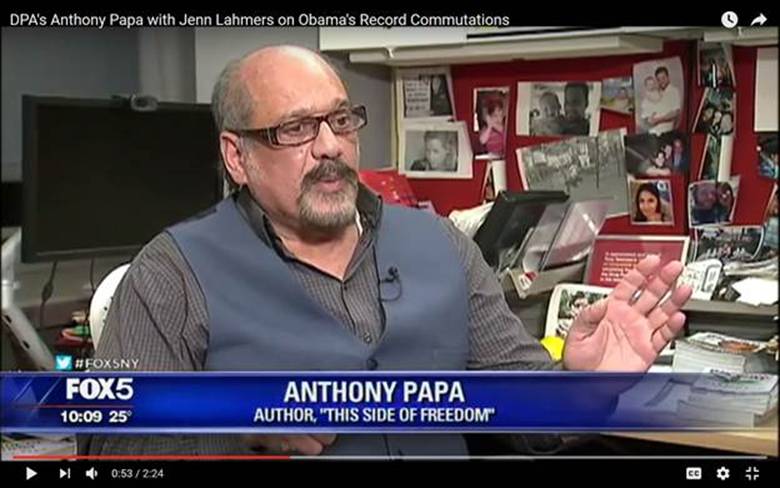
DPA's Anthony Papa with Jenn Lahmers on Obama's Record Commutations ( FOX 5 News Obama Clemency) https://www.youtube.com/watch?v=N8WzJPRgUHw (12/20/16)
FOX 5 reporter Jennifer Lahmers said "Anthony Papa is an example of how the presidential pardoning system works well. In the mid 80s Papa was strapped for cash and described doing what he said was the biggest mistake of his life-- agreeing to run an envelope with 4.5 oz of cocaine to someone he had never met. It turns out that someone was a participant in an undercover police sting, Papa was arrested and sentenced to 15 years to life in prison. While at Sing-Sing he earned 3 degrees and read as many books as he could. In 1997 he was pardoned by Gov. Pataki and for the last 10 years has remained one of the state's biggest advocates against mass incarceration. We sat down with him tonight as President Obama made history by granting the greatest number of clemencies in a single day by any US president."
Papa's new memoir "This Side of Freedom: Life after Clemency is available on Amazon goo.gl/GfVQC7 for more on the war on drugs www.drugpolicy.org to see Tony Papa's art go to his website www.15tolife.com
WBAI Radio Randy Credico interview 12/13/16/ goo.gl/OXEoA6 audio
Roger Stone famous political advisor and #1 author on the NY Times bestselling list on his new radio show "The Cold Stone Truth" interviewed Tony Papa says: "This Side of Freedom is a terrific piece of work. I am very excited about it and wish everyone can read it!"
https://soundcloud.com/anthony-papa-994912770 Nov. 14, 2016 goo.gl/alT1Ez audio
Rooster Magazine Interview Nov. 29, 2016 goo.gl/fCZ4LT
Tony Papa at the PEN
Prison Writing Awards 2016
goo.gl/wC7QZz
Cultural Baggage Radio Show / 5/6/16/Tony Papa, Mgr of Media relations at DPA has a new book This Side of Freedom
www.drugtruth.net/cms/audio/download/5813/FDBCB_050616.mp3
Let Them Talk 8/10/16/Anthony Papa advocate against the war on drugs ( video interview) https://www.youtube.com/watch?v=nOOjS431IW0
KBOO Prison Pipeline Radio Interview 8/1/2016 http://www.kboo.fm/media/51399-side-freedom
15 Years To Life – Anthony Papa – 12-Step Radio: Addiction, R ecovery. Steppin' Out Radio 6/25/16/ goo.gl/dhfwEZ
NY Times LTE Violence in Prison goo.gl/XQ4vcn Nov 22, 2016
Regaining life after prison a burden with new struggles By Anthony Papa, Commentary December 13, 2016
The Rooster
A former prisoner explains ‘what now’ for America
By Brian Frederick , November 29, 2016
http://www.therooster.com/blog/former-prisoner-explains-%E2%80%98what-now%E2%80%99-america
Vices November 29, 2016 By Brian Frederick
Anthony “Tony” Papa once spent 12 years behind bars for a small crime he committed in a time of weakness. He did so to come up on “some easy money,“ and readily admits it was one of the worst mistakes he’s ever made. He now spends every waking hour of his life as an activist against mandatory drug sentencing laws, with a concentration on educating ex-cons so they have a better chance of never landing in trouble again while they’re free — like so many of them often do.
And much like millions of others in America, he’s worried about the future of the country.
“We have to look at the reality of the situation,” Papa says of the election results. “This whole Trump thing took everyone by surprise, so now we just gotta deal with it.”
He says he and the Drug Policy Alliance (where he’s worked for over a decade now) have made tremendous strides in the fight against mandatory sentencing for non-violent offenders. It hasn’t exactly been easy doing so during the past two terms with Barrack Obama in office, but could grow even more difficult with the newly chosen sheriff in town.
That’s because President-elect Donald Trump has named a few worrisome men to fill key positions in his administration. One scares Papa the most. His name is Jeff Sessions, and he’s likely to become America’s next Attorney General. He’s also about the worst possible choice for anyone in the position of fighting for equal rights and lightening the load on non-violent drug offenders.
However, it’s a fight that Papa and his team plan on continuing, even in the face of extreme complications.
“We’re trying to rally the troops,” he explains. “We’re getting everybody we can in all realms of activism, of civil rights, against the drug war, and speak out and get everybody to rally to stop this guy from becoming the Attorney General.”
Sessions is frightening to many like Papa because of his hard stance on drugs and the law. He admits to hating marijuana, is cool with controversial “stop and frisk” laws (that have already been deemed unconstitutional) and relies heavily on misinformation about the dangers of drugs.
Bill Piper, senior director of the Drug Policy Alliance’s office of National Affairs in Washington D.C., agrees with Papa’s feelings toward Sessions. In a recent media teleconference, he points out the devastating effects a Sessions ran office could have on already structured policies helping battle the war on drugs.
“[Sessions] recently described marijuana as a dangerous drug, said ‘good people don’t smoke marijuana,’ and has criticized the Obama administration for respecting state marijuana laws,” he said. “If confirmed as U.S. Attorney General, Jeff Sessions could escalate the failed war on drugs. He will likely use his position to oppose any kind of sentencing or criminal justice reform. He could undo the important changes Eric Holder made including expanding the use of mandatory minimum sentencing and reversing course on important consent decrees.”
He scares many, but at this point, the fears all surround only speculation on what these men can and can not do with their positions. It won’t be until January, when all members are sworn in and given the keys to their respective offices, that the country will finally be able to feel the temperature of the pot it's gotten itself into.
Even still, Papa at least remains hopeful that a Trump administration would have little impact on the gray area that forever haunts the cannabis industry. He says it’s too locked into our culture right now for him to be able to do anything — at least that’s what he’s betting on anyway.
“Trump’s a businessman,” he says. “It’s so far into the American lifestyle. I mean, 7 more states voted it in. You’ll have a civil war if he tries to pull it back. So many people and businesses are in it.”
He’s just going to continue on with his many projects he’s working on right now, such as the Prison Letter Project (of which he says he has thousands of messages from prisoners telling their own stories about the failed justice system), and expanding his Prison Library Project after receiving a substantial grant to continue teaching men and women how to survive in a world built for them to fail.
“I’m trying to reduce massive incarceration by education, by educating prisoners before they come out, to prepare them and thus reducing recidivism,” he says. “That’s my attempt to reduce mass incarceration.”
He’s also altering his title at the DPA by incorporating art into the fight against injustice — something he learned while locked up himself.
“It’s a hard sell,” he admits, “but you know what, I’m doing it.”
Create. Educate. Fight. It’s all anyone can do at this point, says Papa.
- See more at: http://www.therooster.com/blog/former-prisoner-explains-%E2%80%98what-now%E2%80%99-america#sthash.u2gz68cn.dpuf
Anthony “Tony” Papa once spent 12 years behind bars for a small crime he committed in a time of weakness. He did so to come up on “some easy money,“ and readily admits it was one of the worst mistakes he’s ever made. He now spends every waking hour of his life as an activist against mandatory drug sentencing laws, with a concentration on educating ex-cons so they have a better chance of never landing in trouble again while they’re free — like so many of them often do.
And much like millions of others in America, he’s worried about the future of the country.
“We have to look at the reality of the situation,” Papa says of the election results. “This whole Trump thing took everyone by surprise, so now we just gotta deal with it.”
He says he and the Drug Policy Alliance (where he’s worked for over a decade now) have made tremendous strides in the fight against mandatory sentencing for non-violent offenders. It hasn’t exactly been easy doing so during the past two terms with Barrack Obama in office, but could grow even more difficult with the newly chosen sheriff in town.
That’s because President-elect Donald Trump has named a few worrisome men to fill key positions in his administration. One scares Papa the most. His name is Jeff Sessions, and he’s likely to become America’s next Attorney General. He’s also about the worst possible choice for anyone in the position of fighting for equal rights and lightening the load on non-violent drug offenders.
However, it’s a fight that Papa and his team plan on continuing, even in the face of extreme complications.
“We’re trying to rally the troops,” he explains. “We’re getting everybody we can in all realms of activism, of civil rights, against the drug war, and speak out and get everybody to rally to stop this guy from becoming the Attorney General.”
Sessions is frightening to many like Papa because of his hard stance on drugs and the law. He admits to hating marijuana, is cool with controversial “stop and frisk” laws (that have already been deemed unconstitutional) and relies heavily on misinformation about the dangers of drugs.
Bill Piper, senior director of the Drug Policy Alliance’s office of National Affairs in Washington D.C., agrees with Papa’s feelings toward Sessions. In a recent media teleconference, he points out the devastating effects a Sessions ran office could have on already structured policies helping battle the war on drugs.
“[Sessions] recently described marijuana as a dangerous drug, said ‘good people don’t smoke marijuana,’ and has criticized the Obama administration for respecting state marijuana laws,” he said. “If confirmed as U.S. Attorney General, Jeff Sessions could escalate the failed war on drugs. He will likely use his position to oppose any kind of sentencing or criminal justice reform. He could undo the important changes Eric Holder made including expanding the use of mandatory minimum sentencing and reversing course on important consent decrees.”
He scares many, but at this point, the fears all surround only speculation on what these men can and can not do with their positions. It won’t be until January, when all members are sworn in and given the keys to their respective offices, that the country will finally be able to feel the temperature of the pot it's gotten itself into.
Even still, Papa at least remains hopeful that a Trump administration would have little impact on the gray area that forever haunts the cannabis industry. He says it’s too locked into our culture right now for him to be able to do anything — at least that’s what he’s betting on anyway.
“Trump’s a businessman,” he says. “It’s so far into the American lifestyle. I mean, 7 more states voted it in. You’ll have a civil war if he tries to pull it back. So many people and businesses are in it.”
He’s just going to continue on with his many projects he’s working on right now, such as the Prison Letter Project (of which he says he has thousands of messages from prisoners telling their own stories about the failed justice system), and expanding his Prison Library Project after receiving a substantial grant to continue teaching men and women how to survive in a world built for them to fail.
“I’m trying to reduce massive incarceration by education, by educating prisoners before they come out, to prepare them and thus reducing recidivism,” he says. “That’s my attempt to reduce mass incarceration.”
He’s also altering his title at the DPA by incorporating art into the fight against injustice — something he learned while locked up himself.
“It’s a hard sell,” he admits, “but you know what, I’m doing it.”
Create. Educate. Fight. It’s all anyone can do at this point, says Papa.
- See more at: http://www.therooster.com/blog/former-prisoner-explains-%E2%80%98what-now%E2%80%99-america#sthash.u2gz68cn.dpufAnthony “Tony” Papa once spent 12 years behind bars for a small crime he committed in a time of weakness. He did so to come up on “some easy money,“ and readily admits it was one of the worst mistakes he’s ever made. He now spends every waking hour of his life as an activist against mandatory drug sentencing laws, with a concentration on educating ex-cons so they have a better chance of never landing in trouble again while they’re free — like so many of them often do.
And much like millions of others in America, he’s worried about the future of the country.
“We have to look at the reality of the situation,” Papa says of the election results. “This whole Trump thing took everyone by surprise, so now we just gotta deal with it.”
He says he and the Drug Policy Alliance (where he’s worked for over a decade now) have made tremendous strides in the fight against mandatory sentencing for non-violent offenders. It hasn’t exactly been easy doing so during the past two terms with Barrack Obama in office, but could grow even more difficult with the newly chosen sheriff in town.
That’s because President-elect Donald Trump has named a few worrisome men to fill key positions in his administration. One scares Papa the most. His name is Jeff Sessions, and he’s likely to become America’s next Attorney General. He’s also about the worst possible choice for anyone in the position of fighting for equal rights and lightening the load on non-violent drug offenders.
However, it’s a fight that Papa and his team plan on continuing, even in the face of extreme complications.
“We’re trying to rally the troops,” he explains. “We’re getting everybody we can in all realms of activism, of civil rights, against the drug war, and speak out and get everybody to rally to stop this guy from becoming the Attorney General.”
Sessions is frightening to many like Papa because of his hard stance on drugs and the law. He admits to hating marijuana, is cool with controversial “stop and frisk” laws (that have already been deemed unconstitutional) and relies heavily on misinformation about the dangers of drugs.
Bill Piper, senior director of the Drug Policy Alliance’s office of National Affairs in Washington D.C., agrees with Papa’s feelings toward Sessions. In a recent media teleconference, he points out the devastating effects a Sessions ran office could have on already structured policies helping battle the war on drugs.
“[Sessions] recently described marijuana as a dangerous drug, said ‘good people don’t smoke marijuana,’ and has criticized the Obama administration for respecting state marijuana laws,” he said. “If confirmed as U.S. Attorney General, Jeff Sessions could escalate the failed war on drugs. He will likely use his position to oppose any kind of sentencing or criminal justice reform. He could undo the important changes Eric Holder made including expanding the use of mandatory minimum sentencing and reversing course on important consent decrees.”
He scares many, but at this point, the fears all surround only speculation on what these men can and can not do with their positions. It won’t be until January, when all members are sworn in and given the keys to their respective offices, that the country will finally be able to feel the temperature of the pot it's gotten itself into.
Even still, Papa at least remains hopeful that a Trump administration would have little impact on the gray area that forever haunts the cannabis industry. He says it’s too locked into our culture right now for him to be able to do anything — at least that’s what he’s betting on anyway.
“Trump’s a businessman,” he says. “It’s so far into the American lifestyle. I mean, 7 more states voted it in. You’ll have a civil war if he tries to pull it back. So many people and businesses are in it.”
He’s just going to continue on with his many projects he’s working on right now, such as the Prison Letter Project (of which he says he has thousands of messages from prisoners telling their own stories about the failed justice system), and expanding his Prison Library Project after receiving a substantial grant to continue teaching men and women how to survive in a world built for them to fail.
“I’m trying to reduce massive incarceration by education, by educating prisoners before they come out, to prepare them and thus reducing recidivism,” he says. “That’s my attempt to reduce mass incarceration.”
He’s also altering his title at the DPA by incorporating art into the fight against injustice — something he learned while locked up himself.
“It’s a hard sell,” he admits, “but you know what, I’m doing it.”
Create. Educate. Fight. It’s all anyone can do at this point, says Papa.
- See more at: http://www.therooster.com/blog/former-prisoner-explains-%E2%80%98what-now%E2%80%99-america#sthash.u2gz68cn.dpufAnthony “Tony” Papa once spent 12 years behind bars for a small crime he committed in a time of weakness. He did so to come up on “some easy money,“ and readily admits it was one of the worst mistakes he’s ever made. He now spends every waking hour of his life as an activist against mandatory drug sentencing laws, with a concentration on educating ex-cons so they have a better chance of never landing in trouble again while they’re free — like so many of them often do.
And much like millions of others in America, he’s worried about the future of the country.
“We have to look at the reality of the situation,” Papa says of the election results. “This whole Trump thing took everyone by surprise, so now we just gotta deal with it.”
He says he and the Drug Policy Alliance (where he’s worked for over a decade now) have made tremendous strides in the fight against mandatory sentencing for non-violent offenders. It hasn’t exactly been easy doing so during the past two terms with Barrack Obama in office, but could grow even more difficult with the newly chosen sheriff in town.
That’s because President-elect Donald Trump has named a few worrisome men to fill key positions in his administration. One scares Papa the most. His name is Jeff Sessions, and he’s likely to become America’s next Attorney General. He’s also about the worst possible choice for anyone in the position of fighting for equal rights and lightening the load on non-violent drug offenders.
However, it’s a fight that Papa and his team plan on continuing, even in the face of extreme complications.
“We’re trying to rally the troops,” he explains. “We’re getting everybody we can in all realms of activism, of civil rights, against the drug war, and speak out and get everybody to rally to stop this guy from becoming the Attorney General.”
Sessions is frightening to many like Papa because of his hard stance on drugs and the law. He admits to hating marijuana, is cool with controversial “stop and frisk” laws (that have already been deemed unconstitutional) and relies heavily on misinformation about the dangers of drugs.
Bill Piper, senior director of the Drug Policy Alliance’s office of National Affairs in Washington D.C., agrees with Papa’s feelings toward Sessions. In a recent media teleconference, he points out the devastating effects a Sessions ran office could have on already structured policies helping battle the war on drugs.
“[Sessions] recently described marijuana as a dangerous drug, said ‘good people don’t smoke marijuana,’ and has criticized the Obama administration for respecting state marijuana laws,” he said. “If confirmed as U.S. Attorney General, Jeff Sessions could escalate the failed war on drugs. He will likely use his position to oppose any kind of sentencing or criminal justice reform. He could undo the important changes Eric Holder made including expanding the use of mandatory minimum sentencing and reversing course on important consent decrees.”
He scares many, but at this point, the fears all surround only speculation on what these men can and can not do with their positions. It won’t be until January, when all members are sworn in and given the keys to their respective offices, that the country will finally be able to feel the temperature of the pot it's gotten itself into.
Even still, Papa at least remains hopeful that a Trump administration would have little impact on the gray area that forever haunts the cannabis industry. He says it’s too locked into our culture right now for him to be able to do anything — at least that’s what he’s betting on anyway.
“Trump’s a businessman,” he says. “It’s so far into the American lifestyle. I mean, 7 more states voted it in. You’ll have a civil war if he tries to pull it back. So many people and businesses are in it.”
He’s just going to continue on with his many projects he’s working on right now, such as the Prison Letter Project (of which he says he has thousands of messages from prisoners telling their own stories about the failed justice system), and expanding his Prison Library Project after receiving a substantial grant to continue teaching men and women how to survive in a world built for them to fail.
“I’m trying to reduce massive incarceration by education, by educating prisoners before they come out, to prepare them and thus reducing recidivism,” he says. “That’s my attempt to reduce mass incarceration.”
He’s also altering his title at the DPA by incorporating art into the fight against injustice — something he learned while locked up himself.
“It’s a hard sell,” he admits, “but you know what, I’m doing it.”
Create. Educate. Fight. It’s all anyone can do at this point, says Papa.
- See more at: http://www.therooster.com/blog/former-prisoner-explains-%E2%80%98what-now%E2%80%99-america#sthash.u2gz68cn.dpufAnthony “Tony” Papa once spent 12 years behind bars for a small crime he committed in a time of weakness. He did so to come up on “some easy money,“ and readily admits it was one of the worst mistakes he’s ever made. He now spends every waking hour of his life as an activist against mandatory drug sentencing laws, with a concentration on educating ex-cons so they have a better chance of never landing in trouble again while they’re free — like so many of them often do.
And much like millions of others in America, he’s worried about the future of the country.
“We have to look at the reality of the situation,” Papa says of the election results. “This whole Trump thing took everyone by surprise, so now we just gotta deal with it.”
He says he and the Drug Policy Alliance (where he’s worked for over a decade now) have made tremendous strides in the fight against mandatory sentencing for non-violent offenders. It hasn’t exactly been easy doing so during the past two terms with Barrack Obama in office, but could grow even more difficult with the newly chosen sheriff in town.
That’s because President-elect Donald Trump has named a few worrisome men to fill key positions in his administration. One scares Papa the most. His name is Jeff Sessions, and he’s likely to become America’s next Attorney General. He’s also about the worst possible choice for anyone in the position of fighting for equal rights and lightening the load on non-violent drug offenders.
However, it’s a fight that Papa and his team plan on continuing, even in the face of extreme complications.
“We’re trying to rally the troops,” he explains. “We’re getting everybody we can in all realms of activism, of civil rights, against the drug war, and speak out and get everybody to rally to stop this guy from becoming the Attorney General.”
Sessions is frightening to many like Papa because of his hard stance on drugs and the law. He admits to hating marijuana, is cool with controversial “stop and frisk” laws (that have already been deemed unconstitutional) and relies heavily on misinformation about the dangers of drugs.
Bill Piper, senior director of the Drug Policy Alliance’s office of National Affairs in Washington D.C., agrees with Papa’s feelings toward Sessions. In a recent media teleconference, he points out the devastating effects a Sessions ran office could have on already structured policies helping battle the war on drugs.
“[Sessions] recently described marijuana as a dangerous drug, said ‘good people don’t smoke marijuana,’ and has criticized the Obama administration for respecting state marijuana laws,” he said. “If confirmed as U.S. Attorney General, Jeff Sessions could escalate the failed war on drugs. He will likely use his position to oppose any kind of sentencing or criminal justice reform. He could undo the important changes Eric Holder made including expanding the use of mandatory minimum sentencing and reversing course on important consent decrees.”
He scares many, but at this point, the fears all surround only speculation on what these men can and can not do with their positions. It won’t be until January, when all members are sworn in and given the keys to their respective offices, that the country will finally be able to feel the temperature of the pot it's gotten itself into.
Even still, Papa at least remains hopeful that a Trump administration would have little impact on the gray area that forever haunts the cannabis industry. He says it’s too locked into our culture right now for him to be able to do anything — at least that’s what he’s betting on anyway.
“Trump’s a businessman,” he says. “It’s so far into the American lifestyle. I mean, 7 more states voted it in. You’ll have a civil war if he tries to pull it back. So many people and businesses are in it.”
He’s just going to continue on with his many projects he’s working on right now, such as the Prison Letter Project (of which he says he has thousands of messages from prisoners telling their own stories about the failed justice system), and expanding his Prison Library Project after receiving a substantial grant to continue teaching men and women how to survive in a world built for them to fail.
“I’m trying to reduce massive incarceration by education, by educating prisoners before they come out, to prepare them and thus reducing recidivism,” he says. “That’s my attempt to reduce mass incarceration.”
He’s also altering his title at the DPA by incorporating art into the fight against injustice — something he learned while locked up himself.
“It’s a hard sell,” he admits, “but you know what, I’m doing it.”
Create. Educate. Fight. It’s all anyone can do at this point, says Papa.
- See more at: http://www.therooster.com/blog/former-prisoner-explains-%E2%80%98what-now%E2%80%99-america#sthash.u2gz68cn.dpufgoo.gl/XDYiSJ My activism loop ( 5 minutes)
Drug Policy Alliance
For Immediate Release: Contact: Tony Newman 646-335-5384
May 23, 2016 Anthony Papa 646-420-7290
Wednesday Event: Anti-Drug War Activist Anthony Papa Releases His New Book “This Side of Freedom: Life After Clemency”
Papa’s Timely New Memoir Addresses the Drug War, Mass Incarceration and Reentry Issues as President Obama and Congress Seek Criminal Justice Reform
Book Release Event Coincides with Celebration of Papa’s 10-Year Anniversary at the Drug Policy Alliance
Anthony Papa will release his new book,
This Side of Freedom: Life After Clemency at the New York office of the
Drug Policy Alliance (131 W. 33rd Street) on May 25th 2016.
This Side of Freedom: Life After Clemency is a riveting, compelling tale about the life of activist, writer and artist Anthony Papa. He tells firsthand of his experience of returning home after serving 12 years of a 15-to-life sentence for a non-violent drug law violation, sentenced under the mandatory provisions of the Rockefeller Drug Laws of New York State. While behind bars, Papa found his passion for art and his haunting self-portrait “15 to Life” ended up showing in the Whitney Museum. Papa used his art and personal story to generate a wave of media attention and in 1997 he was granted executive clemency by New York Governor George Pataki. Papa literally painted his way to freedom.
Papa says that the freedom he fought so hard to get smacked him swiftly in the face, overpowering him. He struggled with his own freedom while fighting to free those he left behind. Papa goes through heart-wrenching trials and tribulations as he seeks to rebuild his life and continue his fight to end the war on drugs. Along the way he meets an array of individuals from famous movie stars to politicians and the very rich, enlisting their help in doing away with mass incarceration and draconian sentencing laws that have destroyed America's criminal justice system.
Papa’s book launch event will coincide with a celebration for his 10-year anniversary at the Drug Policy Alliance, where he is manager of media and artist relations. His stinging editorials about the drug war have appeared in news sources across the country and world. He is a frequent public speaker and college lecturer on his art and criminal justice issues.
In addition to his new memoir, Papa is also author of “15
to Life: How I Painted My Way to Freedom” (2004) a memoir about his
experience of being sentenced to state prison for a first-time, nonviolent drug
offense under New York's draconian Rockefeller Drug Laws. He has been
interviewed by a wide range of national print and broadcast media, including The
New York Times, The Washington Post, The Nation, National Public Radio,
Democracy Now, and Court TV, among others. He has appeared on nationally
syndicated talk shows such as MSNBC's "Melissa Harris Perry", CNN's "Your
Money," Charles Grodin, Geraldo Rivera, and Catherine Crier Live. Papa's art has
been exhibited widely, from the Whitney Museum of American Art in New York to
many smaller cultural centers around the country. Papa has worked to end the war
on drugs through many mediums, including as an artist, writer, co-founder of
Mothers of the New York Disappeared and his ten years at the Drug Policy
Alliance.
Advance praise for This Side of Freedom: "Anthony Papa's work,
beginning with his incredible paintings, continuing with his ground-breaking
memoir, “15 to Life,” and now this new offering, “This Side of Freedom,” is
almost single-handedly documenting one of the greatest civil and human rights
disruptions in our nation's history: the human destruction caused by the war on
drugs policies. Papa brings us, in living color and painful authenticity, what
these gross violations of human rights do to the spirit, but more, how the
spirit can still soar despite mountains of adversity. His is truly on a hero's
journey and one we should all take with him," said, asha bandele, author of
“The Prisoner's Wife.”
What: Book Release Event for “This
Side of Freedom: Life After Clemency”
Where: The Drug Policy Alliance 131 W. 33rd Street, NYC Office 15th
Floor
When: May 25th, 2016 5-8pm
This Side of Freedom: Life After Clemency
by Anthony Papa
ISBN-978-1530731640 6 x 9 236 pages
$12.99
Paperback Pub Date: April 8, 2016
Anthony Papa¹s website:
www.15tolife.com
available on
Amazon
Link to Release: http://www.drugpolicy.org/news/2016/05/wednesday-anti-drug-war-activist-anthony-papa-releases-his-new-book-side-freedom-life-a
 We
cover a lot of ground, yet again, on today's
BradCast.
We
cover a lot of ground, yet again, on today's
BradCast.
First: More climate change dots connected out here in California, as another freeway is shut down (the third in the last couple of months) thanks to yet another extreme weather disaster.
Next: As Donald Trump correctly notes that George W. Bush did not "keep us safe" either before or after 9/11, Jeb tries again to come to his brother's defense and fails almost as much as his own campaign is now floundering.
Then: With federal sentencing reform for non-violent drug offenders about to result in freedom for 6,000 federal inmates (and another 40,000 likely in the near future), we are joined today by artist and author Anthony Papa of the Drug Policy Alliance.
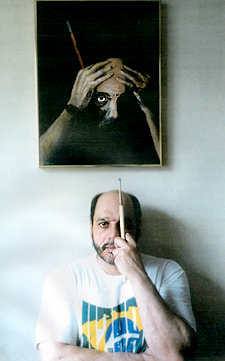
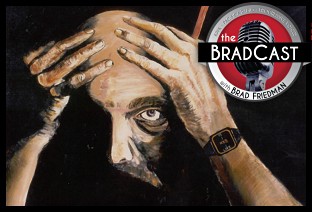
Papa (self-portrait seen above in today's BradCast logo) shares his amazing story about how he was sentenced to "15 years to life" for a first-time, non-violent, drug-related crime under New York's "tough on crime", "war on drugs" policies of the 80s. He served 12 years of hard time --- for delivering 4 ounces of cocaine in exchange for $500 --- before he was finally granted clemency by the Governor.
He follows his first book,
15 to Life: How I Painted My Way to Freedom

Papa was lucky enough to earn three degrees while serving 12 years in prison, where he also discovered he knows how to paint. He now serves as Artist in Residence at Drug Policy Alliance and has had his work exhibited at the Whitney Museum. On today's show, in addition to his personal story, he shared his optimistic thoughts on criminal justice reform ("mandatory minimum sentencing became the poison that literally broke the system"), some words of advice to those about to be released ("these men and women coming home into a society that is not ready for them, can be a problem"), and his opinions on the outrage of restrictions on voting placed on both current and former felons.
"The greatest thing for me being in prison, was my discovery for me of my political awareness," he tells me. But, after his release, he learned he would still not be able to vote for another five years, even though he had served his time under laws passed by officials he should have been able to vote against. "Before I went to prison, I didn't even bother to vote. I was a regular Joe. When I came out, discovering I couldn't vote was very painful for me. So it took five years, but when the time came, I cast that vote. I felt like I was whole again. It was a wonderful feeling."
Finally today: Wayne Simmons, the "former CIA operative" regularly featured on Fox "News" for more than a decade, where he has been cited by wingnuts time and again on everything from Benghazi to torture to ISIS and their "19 paramilitary Muslim training facilities in the United States" (which don't exist), turns out to have never worked for the CIA at all and has now been arrested on federal fraud charges.
Download MP3 or listen to complete show online below...
Leading the Way to Repeal of the Rockefeller Drug Laws! On this page you can read the history of the movement from 2002. Start at the bottom of the page.
Did you know that the 2 watered down changes in the Rockefeller laws of 2004/5 has equated to 576 prisoners* set free of the 1,000 prisoners that were eligible
for relief (see Report: Drug Law Resentencing:Saving Tax Dollars with Minimal Community Risk ) by The Legal Aid Society /William Gibney, Esq.
without freedom, reform is meaningless!!!! Also read the stinging op-ed's and letters by Anthony Papa on criminal justice issues
FLASH! December 6th, 2013 Papa talks about the new Human Rights Watch report titled "An Offer You Can't Refuse ."
The following article first appeared on the Drug Policy Alliance blog.
Today a new report by Human Rights Watch titled “An Offer You Can’t Refuse” revealed that only three percent of U.S. drug defendants in federal cases chose to go to trial instead of pleading guilty in 2012. The report explains that the reason only three percent go to trial is because prosecutors warn defendants that if they refuse the plea and go to trial, they will be charged with a more series crime and end up with a much longer sentence.
Prosecutors live and die for convictions and they use mandatory minimum sentencing as a prosecutorial tool to secure convictions and get people to plead guilty without getting their right to a fair trial.
People’s fear of angering prosecutors by going to trial is real. The reports shows that defendants who chose to exercise their constitutional rights to go to trial routinely face sentences three times greater than the original plea deals. This is an astounding revelation.
I know the pressure to take a deal and the disatroious consequences of taking my case to trial. In 1985 I refused a plea deal of three years and end up being sentenced to 15 years to life under the mandatory provisions of New York’s Rockefeller Drug Laws.
I was duped into delivering an envelope containing four ounces of cocaine for $500 by a bowling buddy. During the criminal proceedings the district attorney’s office discovered I was not a drug dealer but nevertheless, they wanted to secure a conviction.
During the trial the assistant district attorney approached me and asked how old my daughter was. I told him she was seven years old. He told me if I chose to go to trial the next time I would see my daughter was when she was 22, take the plea offer of three years to life because you will never win. I was afraid of being away from my wife and daughter for three years. I refused the offer and a few days later I was convicted and sentenced to 15 years to life. I could not believe it.
Not taking the plea deal of three years to life was the biggest mistake of my life. Because I refused the offer I was sentenced to more than five times the amount of time I was offered in the plea bargain. During my years of imprisonment I tried to commit suicide, I was stuck with a knife, and I was beat down with a pipe.
But nothing hurt me more than my separation from my daughter, Stephanie. Her child-like innocence gave me the will to live when I wanted to die.
Although I tried to keep a relationship with her, she suffered greatly from my prison sentence. No child should have experienced the horrible conditions she had to go through, such as body searches, long waiting lines and abusive correction officers.
Little by little, her beautiful child-like demeanor disappeared, and was replaced with a sadness and depression generally seen in a much older person. By the time she was 12, she had become psychologically damaged, and so traumatized by the prison experience that she could no longer visit me.
From my relationship with my daughter I learned that prison did not end at the wall that separated me from society. It went far beyond it, reaching loved ones and friends of those incarcerated. When I refused the plea offer my life changed forever.
I commend Human Rights Watch for exposing how prosecutors get drug defendants to accept plea bargains by charging them with extraordinary long sentences under mandatory minimums. It is time to end harsh mandatory minimums that both destroy lives and may a mockery of our “justice” system.
Flash!!! 12/4/13/
Papa says. "I mean, look, if you can give a turkey a second chance, why can't
you give a non-violent drug offender a second chance?"
https://www.youtube.com/watch?v=APDw8Cgc3Ro
Flash!!! 11/26/13 Papa gets on President Obama's case to grant clemencies and use his pardon power more
http://www.huffingtonpost.com/anthony-papa/president-obama-turkey-pardon_b_4345524.html
by Anthony Papa Manager of Media Relations of the Drug Policy Alliance
The National Thanksgiving Turkey Presentation, a ceremony at the White House, is where the president of the United States pardons a turkey and sets it free instead of slaughtering it and making it someone's Thanksgiving dinner.
As someone who has been called a turkey on more than one occasion, and who was granted executive clemency stemming from a drug conviction, I have found a spiritual connection to the subject of the turkey pardon. In 1985, I was arrested when I got caught up in a drug sting. I delivered four ounces of cocaine from the Bronx to Mount Vernon, New York. Twenty cops came out of nowhere and I was placed under arrest. I did everything I could do wrong and was sentenced to 15 years to life under the Rockefeller Drug Laws on New York State. I was set free in 1997 after serving 12 years.
I support and applaud President Obama's treatment of turkeys. But I have to ask the president: what about the treatment of the more than 100,000 people who are incarcerated in the federal system because of the war on drugs?
Surely some of these non-violent drug offenders deserve treatment equal to a turkey pardon? I would think so. But if you look at Obama's record on the use of executive clemency which includes pardons and commutation of sentences, you would have to say that he has more respect for turkeys than drug war offenders. President Obama has granted only 39 pardons so far, which ranks him at the bottom of the pile in presidents who have exercised this power.
A few weeks ago I had the pleasure of hearing a speech that Attorney General Eric Holder gave calling for criminal justice reforms which would ease certain drug sentences. It was nice to hear. But knowing how the criminal justice system works, I had my doubts on what effects it would have on prisoners who were serving long drug sentences and who were not eligible for judicial relief under the proposed changes suggested by Holder.
In particular, I pointed out the 5,000 or so prisoners who didn't get judicial relief under the changes Obama signed into law under the Fair Sentencing Act of 2010. I asked President Obama at that time to use his presidential authority to pardon and, in particular, commute the sentences of people who were charged under the old 100-to-one crack to powder cocaine ratio. It would be a great move by President Obama. With a swipe of his pen, the president could give a chance to those nonviolent drug offenders who are stuck in prison, and help them return to their families.
Many of us are praying that President Obama will show the same compassion he has for the turkey he will pardon this week and use that same compassion for those drug offenders who have fallen through the cracks of drug law reform who are ready to return to society.
This piece originally appeared on the
Drug Policy Alliance's blog.
Flash! October 4th, 2013 Tony Papa starts a Petition Urging Eric Holder to allow Michael Douglas to visit his imprisoned son!
PUBLISHED:| UPDATED:
He memorably used his Emmy winning speech last month to lament the U.S. prison system for not allowing him to visit his incarcerated son Cameron in jail.
And Michael Douglas has now received support in his quest from non profit organisation the Drug Policy Alliance who have a launched a petition urging Attorney General Eric Holder to change his tough stance on non-violent drug offenders.
The petition, posted by Alliance activist Tony Papa on Change.Org is trying to pressure Holder and Cameron's prison warden John Caraway to allow families like the Douglases to see their loved ones in prison.

Petition: Tony Papa from the Drug Policy Alliance has launched a petition urging the Attorney General to allow Michael Douglas to see his son Cameron in prison
Cameron, the only child of Michael and his first wife Diandra, was convicted in 2010 of selling methamphetamine and possession of heroin. A year later, his sentence was increased by Judge Richard Berman when he failed a drug test and pleaded guilty to possessing drugs in prison.
The 34-year-old is currently in incarcerated at the Federal Corrections Institute in Cumberland, Maryland.
'Cameron is currently serving nine and a half years of hard time for a nonviolent drug conviction and is being punished because of his drug addiction,' Papa writes in his post.
'District Court Judge Berman whacked Cameron with additional time for what is essentially Cameron's bad drug habit,' he adds.
Imploring: Michael Douglas gave a shout out to his son Cameron in his Emmy speech last month
Michael brought attention to Cameron's plight after winning won the award for Outstanding Lead Actor in a Movie of Miniseries for his role as Liberace in Behind The Candelabra.
'A shout-out to my oldest son Cameron, but hopefully I'll be able to see him soon,' he said in his speech.
The 69-year-old actor further explained his comments in a post-awards press conference.
'[Cameron] has spent almost two years in solitary confinement,' Michael said. 'Right now I’ve been told that I can’t see him for two years. It’s been over a year now.
'I'm questioning the system. At first I was certainly disappointed with my son, but I've reached a point now where I'm disappointed with the system.'
Papa, an advocate for Cameron, agrees - telling Radar: 'Every father should be able to see his imprisoned son. At first, Michael blamed his son for the mess he got into, but now, he is questioning the Bureau of Prisons and asking why he is being prevented from visiting his son for two years.
'Prison does not end at the prison wall… It severely affects the family members and loved ones of those who are incarcerated. Michael Douglas is being punished for his son’s drug addiction.'
Papa's post goes on to relay how the Alliance helped Cameron appeal the near-doubling of his sentence as 'excessive and unjust,' presenting a brief which argued that addiction treatment rather than jail time would be more helpful to him.
Harsh sentence: Cameron is still not allowed to have any visitors as part of his punishment, pictured with his father in LA in 2009
'In that brief, experts contended that Cameron’s drug relapse behind bars was not surprising, noting the lack of adequate drug treatment in the nation's prisons and jails, particularly for opioid-dependent persons,' writes Papa.
'They urged corrections officials to remedy this situation as a critical step to breaking the cycle of addiction that affects the great majority of people incarcerated in the U.S.'
Cameron's appeal was denied and he was taken into solitary confinement with 'many privileges taken away, including phone calls and visits with family,' adds Papa, bemoaning the government's policy of 'locking up inmates with drug addictions rather than giving them treatment.'
He continues: 'Hopefully Michael Douglas will be able to visit his son and the issue of punitive punishment such as this will change and individuals with similar circumstances will be provided relief.'
Cameron's mother Diandra has also questioned her son's treatment in prison, claiming to TMZ that he was 'treated like an animal' while in solitary confinement, and that she too wants to visit him.
Diandra told TMZ that when Cameron left solitary he had to stay out the sun because his skin would burn after he had spent so long underground.
She said his hair was also falling out as a result of his poor treatment.
Cameron himself has also spoken out against the policy, calling the system 'outdated' on a blog on the Huffington Post.
'This outdated system pays little, if any, concern to the disease of addiction, and instead punishes it more harshly than many violent crimes,' he wrote. 'And even more exasperating is that many of the people responsible for this tragedy disregard documented medical research and the reality of our country's unsustainable prison overpopulation.
He is due for release in 2018.
FLASH!! August 30th 2013 :My call to President Obama to commute crack/cocaine sentences
Posted: 08/26/2013 4:27 pm
Last week I listened with great interest to a speech Attorney General Eric Holder presented in front of the American Bar Association. Holder passionately spoke about halting the use of laws that have led to mass incarceration, which in turn, has broken the federal prison system. There are over 2.3 million incarcerated with about 500,00 drug offenders. The speech came after an interview with National Public Radio the week before saying that there had been a lot of unintended consequences in the war on drugs which included the decimation of communities of color.
What caught my attention most was his call for major federal sentencing changes, including dropping the use of mandatory minimum sentencing in certain drug cases. I've always had an interest in the subject of mandatory minimum sentencing laws because of the 15-to-Life sentence I had served under the Rockefeller Drug Laws of New York State. Even though I was a first time non-violent offender who delivered four ounces of cocaine for the sum of $500 dollars, the judge in my case was forced to impose a life sentence because of mandatory minimums. These laws had the distinction of being the precursor to the current federal mandatory minimums that Holder held responsible for breaking our criminal justice system.
Because of the media's focus on Holder's speech highlighting mandatory minimum sentencing it was a busy week for media coverage. Last Monday, the Associated Press released a video about Attorney General Eric Holder speaking about the proposed reforms and on Tuesday I was invited to appear on CNN's Your Money hosted by Christine Roman. The show was titled "Broken Justice" and was co-hosted by Ashleigh Banfield of CNN's Legal View. The host of the show used my case to point out the injustice of mandatory minimum sentencing laws that Attorney General Eric Holder highlighted in his speech.
Columnists
Karen McVeigh of the Guardian and
Neal Pierce of the Washington Post Writers Group both wrote
excellent articles on the subject. In Pierce's column he highlighted my plea to
President Obama. He went on to say:
And there's the question of pardons. Anthony Papa, media manager of the Drug Policy Alliance, who was imprisoned 12 years under New York State's Rockefeller drug laws before receiving clemency, says it isn't clear what the administration's new policy will mean for people now behind bars. His proposal: "Obama should use his presidential authority to pardon and, in particular, commute the sentences of people who were charged under the old 100-to-one crack to powder cocaine ratio. Society would be better served by not locking up people for extraordinarily long sentences for nonviolent, low-level drug offenses. It's a waste of tax dollars and human lives."
There are about
5,000 prisoners who did not receive judicial relief under the Fair
Sentencing Act of 2010 which President Obama signed into law because the law was
not applied retroactively. The revised law reduced the disparity between the
amount of powder and crack cocaine needed to activate criminal penalties from a
100:1 weight ratio to an 18:1 weight ratio and eliminated the five-year
mandatory minimum sentence for simple possession of crack cocaine. With a swipe
of his pen, President Obama could give a chance to those who are stuck in prison
and help them return to their families. I pray that he shows some compassion for
those who are worthy and ready to return to society. It would be the right thing
to do.
This piece originally appeared on the Drug Policy Alliance's blog
Follow Anthony Papa on Twitter: www.twitter.com/AnthonyPapa
LA Times
It isn't clear what the administration's new policy on drug sentencing will mean for people currently behind bars.
President Obama should use his authority to commute the sentences of the roughly 5,000 people who were charged under the old 100-to-1 crack-to-powder cocaine ratio who are not eligible for relief.
Society would be better served by not locking up people with extraordinarily long sentences for nonviolent drug offenses.
I know because I was sentenced to 15-to-life under mandatory sentencing laws. I wound up serving 12 years because I received clemency from the governor of New York. It was a waste of human life and tax dollars that could have been used for needy communities.
Anthony Papa
New York
The writer is the media relations manager for the Drug Policy Alliance.
Flash! 8/12/13 Major changes in federal drug law sentencing announced by Attorney General Eric Holder
http://www.theguardian.com/politics/2013/aug/12/drugs-policy-sentencing-eric-holder
Anthony Papa, who spent 12 years in Sing Sing for delivering 4oz of cocaine, says such sentences are 'a waste of human lives'
Anthony Papa was in debt and desperate for cash when he accepted an offer, from a bowling buddy, to get involved in a drug deal. In exchange for $500, the father-of-one was to deliver an envelope containing four ounces of cocaine from the Bronx to Mount Vernon, New York.
Papa delivered it into the hands of undercover police. Despite being a first-time, non-violent offender with no wider connection to any gangs or cartels, the radio repair man was sentenced to 15 years to life in New York's Sing Sing prison. His buddy, a lynchpin who organised the deal, was given three years to life.
Under Eric Holder's long-awaited overhaul of federal prison policy, unveiled on Monday, offenders like Papa will no longer be subjected to mandatory minimum sentencing, which the attorney general has said is unfair.
It is too late for Papa, who served 12 of his 15 years in state prison before being granted clemency. But as an advocate for state and federal reforms for the Drug Policy Alliance, he welcomed Holder's overhaul. Among the changes Holder announced is new guidance to federal prosecutors to omit listing quantities of drugs in indictments for low-level drug crimes, thus sidestepping the sort of mandatory sentences that led Papa to serve his 12 years.
"Society would be better served by not locking up people for extraordinarily long sentences for non-violent, low-level drug offences" said Papa. "It's a waste of valuable tax dollars and a waste of human lives."
Drug-related offences drive the vast majority of the US's bloated and expensive prison population, a point made by Holder in his speech in San Francisco. Around half of the 200,000 people in federal prisons are locked up for drug offences, and about 60% are serving time under mandatory sentencing provisions, according to The Sentencing Project, a campaign group for reform. Just under half of the 25,000 people incarcerated every year for drug offences are lower-level offenders, such as street-level dealers and couriers.
Mark Mauer, executive director of The Sentencing Project, said "thousands" of offenders fell into the category. Mauer described Holder's proposals as a "significant development" which would not only go towards reducing prison populations but would also have an effect on the treatment of drug offenders.
He said: "Since the 'war on drugs' there have been huge developments in drug courts and drug treatment but mandatory sentencing has acted against those. This represents a one way to open that up a bit and increase the potential scope of other options."
Mauer said that incarceration had little impact on the number or scale of drug crimes in the US. "Even more than other offences, prison has very little impact on drug crime overall. If you take someone from the street corner selling drugs, they are immediately replaced."
Holder's proposals are part of a wider debate on incarceration and the war on drugs that has been gaining support across the political divide. Ethan Nadelmann, the executive director of the Drug Policy Alliance, which has been advocating change for years, was disappointed that Obama's administration had not acted sooner.
Nadelmann said: "There's no good reason why the Obama administration couldn't have done something like this during his first term – and tens, perhaps hundreds of thousands of Americans have suffered unjustly as a result of their delay."
But he said Obama and Holder deserved credit for decisive action. Nadelmann added that while prosecutors cannot legally be required to refrain from enforcing the law, the new guidelines would allow them discretion or to have a "shred of humanity", in order to examine the circumstances of criminals such as drug mules and couriers. He said the new guidelines would also curtail cases in which, because of plea bargaining, "significant drug dealers" may be given a lower sentences than a courier, mule or "a girlfriend whose only job was to open the door".
The national politics of the issue have shifted significantly recently,
enabling cross party support for Holder's "bold" proposals, Nadelmann said.
Fuelled by a need to save money on prison costs, several conservative states
have sought ways to reduce the number of low-level drug offenders who are
incarcerated. Texas and Arkansas, for example, have examined a wave of measures
including reducing prison terms, diverting people into treatment programmes and
releasing inmates on good behaviour early. Republican governors and senators,
including Rand Paul of Kentucky and Mike Lee of Utah, have worked to allow
judges to depart from mandatory minimum sentencing when circumstances merit.
Bipartisan bills are being introduced on the issue.
Advocates for reform say that changes that affect sentences for offenders, such as the Fair Sentencing Act, which was passed by Congress in 2010 to address racial disparities in the sentencing laws on cocaine, should be applied retroactively.
With the U.S. facing massive prison overflow, Attorney General Eric Holder called Monday for major changes to the criminal justice system that would scale back harsh sentences for certain drug related crimes.
Associated Press Video: http://www.youtube.com/watch?v=lxPHBu7QqEw (Papa interviewed)
.
Flash! May 8th is the 40th Anniversary of the Rockefeller Drug Laws!
http://www.poughkeepsiejournal.com/apps/pbcs.dll/article?AID=2013305100032&nclick_check=1
In 1973, two years after President Nixon declared a “war on drugs,” New York Governor Rockefeller passed the toughest drug laws in the nation. It was then that the Rockefeller Drug Laws were created, demanding mandatory sentences for people convicted of drug law violations, while removing the Judge’s power to consider each case individually. The Rockefeller Laws made New York’s prisons become a merciless machine, destroying families and lives, and locking up tens of thousands of first-time offenders, many addicted to drugs. Eventually these laws became the template for the federal government’s draconian sentencing laws passed in the 1980s that imprisoned millions of Americans with mandatory minimum sentences.
In 1985, I made the biggest mistake in my life – and it cost me my freedom, my soul, and my humanity. Because I was desperate for cash I was convinced by a bowling teammate to get involved with a drug deal. In exchange for $500, I transported an envelope containing 4 ounces of cocaine from the Bronx to Mt. Vernon, NY. To my surprise I walked into a police sting operation where 20 undercover cops were waiting for me. I did everything I could do wrong and I was convicted and sentenced to 15 years-to-life under the Rockefeller Drug Laws. I served 12 years in a maximum security prison until I was granted executive clemency by Governor George Pataki in 1997.
Upon my release, I struggled with my newly found freedom and realized that the freedom I fought so long and hard to win was not what I imagined it to be. The way of life I once knew was gone, along with my friends and support base. I discovered I was quite alone in a new world that had drastically changed. Despite this I could not forget those I left in prison and decided to go on a rescue mission to save them and change the laws that had imprisoned me.
I become an activist and traveled to Albany New York with groups like the Drug Policy Alliance to meet with politicians. After having several conversations with elected officials I soon realized that change would not occur from the top down. Instead I knew that any change that would occur would have to be done from the bottom up - with a street movement that would unite the masses and legitimize our cause. I then co-founded the NY Mothers of the Disappeared with Randy Credico, the director of the William Kunstler Fund for Racial Justice. The group soon became leading advocates for the reform of the Rockefeller Drug Laws. With a motley crew of crippled and sick family members of those imprisoned under the drug laws, we began to generate tremendous press, press that put a human face to the Rockefeller Drug Laws. Soon after, celebrities and politicians like Andrew Cuomo and hip-hop entrepreneur Russell Simmons joined the movement. After 30+ years of struggle, some minor reforms were made in 2004 and 2005, and then in 2009 broader reforms were made under Gov. David Paterson.
Yet much more needs to be done. A comprehensive new report – Blueprint for a Public Health and Safety Approach to Drug Policy – by The New York Academy of Medicine and the Drug Policy Alliance presents an all-inclusive set of wide-ranging recommendations to implement a health-based approach to drug policy. It calls for strong, effective leadership to seize this once-in-a-generation opportunity. The report demonstrates how New York’s drug policies remain largely split between two different and often contradictory approaches – criminalization and health – despite the historic 2009 reforms of the notoriously draconian Rockefeller Drug Laws.
The draconian Rockefeller Drug Laws, signed May 8, 1973, became the model for the failed “war on drugs” as states around the country adopted New York’s approach, leading the U.S. to incarcerate more of its own citizens than any other country in the world. It is our hope that New York can lead the nation in a new direction that would embrace the true meaning of justice.
Anthony Papa is the manager of media relations for the Drug Policy Alliance in New York.
Groundbreaking Gathering in Buffalo Brings Together Community Groups and Experts in Law Enforcement, Treatment, Prevention and Harm Reduction to Discuss New Approaches
National Experts to Discuss Best Practices From New York and U.S.; International Speakers to Discuss Toronto and Vancouver’s Four Pillars Drug Strategies and Portugal’s Decriminalization Approach
PAPA in the NY Times!
http://www.nytimes.com/2012/12/17/opinion/life-sentences-for-low-level-crimes.html
To the Editor:
Your article pointed out that there are 500,000 people in prison or jail for drug crimes. This is a staggering statistic that is compounded to the point of amazement by the fact that most of those serving these draconian sentences are nonviolent.
I speak from the vantage of someone who served a mandatory 15-to-life sentence under the Rockefeller drug laws of New York State for a first-time nonviolent drug offense in 1985.
I wound up serving 12 years of that sentence before Gov. George A. Pataki granted me executive clemency.
The bottom line is that mandatory minimum sentencing laws have proved to be a failure. It’s time that we abolish these laws and instead institute a system that protects society and is cost-efficient and fair for all.
ANTHONY PAPA
Manager of Media Relations
Drug Policy Alliance
New York, Dec. 12, 2012
FLASH! 11/3/12/ Anthony Papa testifies at Nuke Hearing to save lives of prisoners at Sing Sing.
http://www.lohud.com/article/20121024/NEWS/310240069/Ex-prisoner-testifies-nuke-panel
TARRYTOWN — The tiers of cells and the large, often-broken
windows of the housing units at the Sing Sing Correctional Facility in Ossining would provide no protection during a radiological accident at nearby Indian Point, a former inmate testified Tuesday.
“There would be total chaos. The danger element would be elevated not only for other prisoners but also for guards,” said Tony Papa, who served 12 years in Sing Sing on a drug charge before Gov. George Pataki granted him clemency in 1997.
“People’s survival instinct would kick in,” he continued. “Predatory prisoners would try to take advantage, they would try to escape (or) cause a riot.”
Papa spoke before three federal administrative judges who are examining technical, environmental and safety issues related to the relicensing of the nuclear power plant in Buchanan.
The licenses for the two reactors expire next year and in 2015 and Indian Point’s owner, Entergy Nuclear, has applied to the Nuclear Regulatory Commission for 20-year extensions.
Tuesday’s testimony focused on environmental justice matters raised by the Hudson River Sloop Clearwater and how a radiological emergency at Indian Point might impact the county’s minority communities and those housed in nearby hospitals, jails and other institutions.
Patricia Milligan, an NRC health physicist, told the judges that prisoners in Sing Sing faced no undue danger in terms of radiation exposure. The judges are part of the Atomic Safety and Licensing Board, an independent arm of the NRC.
“While it is possible that special populations, such as those incarcerated at Sing Sing, could receive radiation doses higher than other populations that are immediately able to self-evacuate, any doses received would be within (federal) dose guidelines,” she said.
Milligan said she has met with high-level state correction officials who are “absolutely confident they can evacuate Sing Sing.”
The state and Riverkeeper have also filed several “contentions” as to why the NRC shouldn’t renew the licenses. They have questioned Entergy’s maintenance of aging plant components and whether the company had correctly estimated evacuation costs.
The relicensing hearing started last week, will continue through Thursday and then break until December.
The NRC will use the judges’ recommendations when deciding whether Indian Point should operate for another 20 years.
Several expert witnesses speaking for Clearwater employed the specter of New Orleans immediately following Hurricane Katrina, when residents were trapped and public order crumbled.
Dr. Erik Larsen, an emergency medicine physician, said the less affluent who don’t own cars might be unable to leave the area following a nuclear accident at the plant. Hospitals, he said, might be short-staffed “because people would be concerned about their families.”
Entergy has said its emergency plans are regularly reviewed and Indian Point has received top NRC safety ratings.
FLASH! 1/3/12 Anthony Papa went on a rescue mission to ask Gov. Cuomo to grant clemency for the holiday season for Rockefeller Drug Offenders who are still stuck in prison. He pitched the story to the media which resulted in massive media coverage of the issue including two articles by the NY Times. The results of this :
The governor’s advisers are now conducting
intensive reviews of requests for pardons or clemency from people serving severe
sentences for drug offenses that are no longer punished so harshly -
NY Times
http://www.timesunion.com/local/article/Power-to-pardon-remains-unused-2431920.php
Governors have traditionally announced pardons around the winter holiday season, dovetailing on its air of joy and charity. Gov. David Paterson, for example, pardoned 24 people on Christmas Eve 2010.
But Cuomo let the holiday pass, and his aides offer no indication that any announcement is in the works. Advocates for judicial reform and immigrants' rights, however, hope the freeze won't be permanent.
"We've been telling them that there are a lot of minor pardons that could have life-changing consequences, and they're looking at how to set that up. They're just not ready to announce that this year," said Chung-Wha Hong, executive director of the New York Immigration Coalition.
Paterson's 2010 pardons focused on immigrants in the country on work permits who couldn't apply for citizenship because they'd been convicted of criminal offenses.
Under a hard line taken by federal immigration officials, the convictions are grounds for deportation proceedings.
He set up a special panel that reviewed over 1,000 cases, and pardoned several dozen people before leaving office.
Many of those files remained in the governor's office after Cuomo — a Democrat like Paterson — took office.
Cuomo spokesman Matt Wing said administration lawyers are reviewing hundreds of applications, but offered few details on whether any would result in pardons. The governor has the power to either commute a sentence, which lets a criminal conviction stand while releasing an inmate from prison, or offer executive clemency, expunging an offense from someone's record either during or after their sentence.
"The granting of pardons and clemencies plays a vital role in the administration of fair and equal justice," said Wing in an email. "It is a power that the governor will use practically and methodically to help ensure everyone is treated fairly under the law."
Hong said her organization was pushing Cuomo to set up a system similar to Paterson's. The governor has won praise from her group for speaking out against the federal Secure Communities program, and for establishing a hotline for residents to get government information in languages other than English.
Over the past decade, governors faced pressure to stay the sentences of offenders convicted under Rockefeller-era drug laws that allowed judges to send people to prison for up to life for drug possession.
While the laws were rolled back in 2004 and again in 2009, Tony Papa, an ex-offender pardoned by Gov. George Pataki who now serves as spokesman for the Drug Policy Alliance, said some offenders are unable to apply for reduced sentences because of "procedural roadblocks."
"Gov. Cuomo, before he was attorney general, stood on the front lines with us trying to reform these laws," said Papa. "When he ran for the governorship for the first time in 2002, he used my case as an example of the injustice. ... There are many people still lingering."
Reach Vielkind at 454-5081 or jvielkind@timesunion.com.
-----------
When Mr. Cuomo became governor last year, he arrived with as strong a set of credentials in criminal justice as any New York governor since Thomas E. Dewey, who served from 1943 to 1954. He also arrived with knowledge that no governor before him could have had: the results of 20 years of DNA testing that had not only freed innocent people — New York is second or third in the nation in wrongful convictions, depending on how you do the counting — but had also provided an X-ray of the invisible, broken bones of criminal justice.
DNA tests got innocent people out of jail and, just as important, showed how they got there in the first place, exposing the parade of mistaken eyewitnesses and the chorus of false confessions.
But Mr. Cuomo made no promises about cashing in on the lessons of the DNA era for reforms during his first year, and didn’t. The state was in the red, the health care system was financially decrepit, and his biggest legislative initiative involved marshaling votes for the legalization of same-sex marriage.
He did not lay a glove on a world that he knows well. In addition, it now appears that he will end his first year as chief executive as many other governors and presidents of the last three decades have, by keeping his distance, at least publicly, from the granting of pardons and clemency.
On both fronts, insiders say, that is likely to change. The governor’s advisers are now conducting intensive reviews of requests for pardons or clemency from people serving severe sentences for drug offenses that are no longer punished so harshly, from immigrants who faced deportation over relatively minor crimes in their distant past, and from others who may have been justly convicted but who are serving prison terms that will hollow out their lives, at no benefit to society. For those able to get their cases before the governor’s staff, his power to pardon and grant clemency can be a magical and restorative bullet.
Mr. Cuomo does not intend to let that authority lie dormant, his chief spokesman, Josh Vlasto, said on Thursday. “It is a power that the governor will use practically and methodically to help ensure everyone is treated fairly under the law,” Mr. Vlasto said.
The power to pardon, which is a rare and absolute authority granted to the executive, has fallen into disuse since the early 1980s, the chief federal judge in New York, Dennis Jacobs, said in October in a speech at the New School.
A turkey is granted presidential clemency at Thanksgiving. President Ronald Reagan used the power to pardon a stock car racer with an ancient conviction for moonshine-making. The first President George Bush erased the record of a man convicted of stealing six-packs of beer when he was a teenager. President Bill Clinton doled out a pardon to a wealthy man who had gone on the lam from tax evasion charges.
In New York, the only pardon George E. Pataki granted during his 12 years in office was to the comedian Lenny Bruce, 37 years after his death, for his conviction on the use of obscenities in his nightclub act.
The frittering away of such a mighty power, Judge Jacobs said, was a wasted opportunity to fix what the court system could not. “What a shame that it should lie neglected or be put to trivial uses when it is the easiest way to improve law and justice decisively and at one stroke,” he said.
A pardon takes care of one person’s problem but gets nowhere near the taproots of error from which injustice grows. For much of the last decade, the Legislature and various governors have been unable to agree on how to apply the lessons of the DNA era, like finding new ways to show suspects to eyewitnesses, and taping all interrogations of people in custody.
Every time there’s a wrongful conviction, the state loses a chance at a “rightful” conviction. The guilty go free. The case that Mr. Cuomo talked about at that debate in 2006 is a prime example. While an innocent man was in prison for a murder that he falsely confessed to, the real criminal was on the street, and killed another young woman.
-------------
Mr. Cuomo can grant pardons to people who have been convicted of a state crime, or commute their sentences through an act of clemency. The only negotiations are with his own conscience. But it is “the power nobody wants,” as it was described in the title of a panel discussion on the subject at the New School in October.
So far, Mr. Cuomo has granted no pardons or clemency, and his office would not say if there were plans for any. By custom, governors often announce their decisions at this time of year. His predecessor, David A. Paterson, said that the last weeks of his term were his most gut-wrenching in office because of an avalanche of requests. People who had been in prison but gone on to live productive lives wanted the stains lifted from the official histories of their lives. Others were looking for help before their cases were over.
“There’s a pizza parlor I no longer go into because the owner wanted one,” Mr. Paterson said on Tuesday. “I have a doctor I no longer see because he wanted a pardon for his son in a Medicaid fraud case. The son had been convicted but he hadn’t even been sentenced yet. In another case, a prominent entrepreneur wanted a pardon for an employee who also hadn’t been sentenced yet.”
Mr. Cuomo has received hundreds of requests, but only a small fraction of them meet the requirements to be examined in depth, his spokesman, Josh Vlasto, said on Tuesday. “It’s a methodical and thought-out process,” Mr. Vlasto said. “We have ongoing reviews.”
The power to dispense official mercy was given to New York governors by the State Constitution in 1777, a way to temper excesses in the justice system. A governor may give a pardon or commute a sentence any day of the week, for any reason whatsoever. Or not. As it happens, New York State publishes a list of requirements, but if a governor chooses to ignore them, the decision cannot be overturned by the Legislature or the courts.
The practice of official mercy went into steep decline in the 1980s, in New York and elsewhere. Gov. Hugh L. Carey granted 155 pardons and commutations during his two terms, from 1975 through 1982; his successor, Mario M. Cuomo, who served 12 years, from 1983 through 1994, commuted the sentences of 37 people; in the next 12 years, George E. Pataki commuted the sentences of 32 individuals and granted one pardon, to a dead man, the comedian Lenny Bruce. During Eliot Spitzer’s 13 months in office, he gave one pardon.
Then Mr. Paterson took office.
Articles in The New York Times and elsewhere reported on the cases of people who, because of changes in immigration law and enforcement practices, were suddenly facing deportation for crimes they had committed years earlier. Mr. Paterson recited a few examples from memory: “A woman who committed a minor crime suddenly ends up in indefinite detention, and she has a 5-year-old child,” he said. “A man who would have been a treasurer at CUNY was facing deportation.”
He also heard a plea from advocates on behalf of Judith Clark, who is serving a 75-year sentence as the getaway driver in the armed robbery of a Brinks truck in Rockland County that resulted in the murders of two police officers and a Brinks guard.
Mr. Paterson was candid about his political considerations. Heavily criticized for much of his time as governor, he had burnished his reputation with newspaper editorial boards during his final months by imposing fiscal discipline. “This is still very raw in Rockland, there’s a memorial, and if I do this, I will get tarred and feathered,” Mr. Paterson said.
He set up a panel to review pardons based on immigration hardships, and asked for advice from Mr. Pataki. “He said, for the most part, he avoided it, that there were few cases that warranted it,” Mr. Paterson said. About 1,900 applications came to Mr. Paterson. In all, he pardoned 35 people and commuted the sentences of three.
“My counsel staff and I were completely overwrought,” Mr. Paterson said. “We made a final decision on the last day; one we decided not to do. When I went to the governor’s inauguration on Jan. 1, I breathed a sigh of relief.”
One of the powers that the Governor of New York has is the ability to grant clemency or outright pardons to prisoners. Over the years, many people have seen their sentences reduced, most of them victims of the stiff Rockefeller Drug Laws.
One of them was Anthony Papa, who in his book 15 to life wrties that he was offered a chance to make a quick $500 dollars for delivering an envelope, but ended up getting busted as part of a sting operation. It was his first offense. And he ended up getting sentenced to 15 years in Sing Sing prison. After 12 years in prison, Papa was granted clemency by Governor George Pataki. And now Papa is writing to Governor Cuomo to ask him to show leniency in his first year in office.
Tony Papa joined Liz from New York City. he’s the Manager of media relations for the Drug Policy Alliance.
-----------
The holiday season is a traditional time for executives to use their power of clemency or pardons to show mercy to individuals that are imprisoned under unjust laws. These are individuals who have already served enormous amounts of time but are stuck in prison and have no legal remedies to regain their freedom. This year I am making the request to Governor Andrew Cuomo who at the present time has his highest approval rate since in office (68 percent). In the past, Governor Cuomo has worked with me and others to reform these laws so he is someone who knows first-hand about their draconian nature.
I have made this request to several other NY Governors. The first time was to Governor George Pataki while I was rotting away in a 6x9 cell in 1994. I was serving a 15 to life sentence for a first time non-violent drug offense when I delivered an envelope containing four ounces of cocaine for the sum of $500.00. It was the worst mistake I ever made in my life and I paid dearly for it. To my surprise he granted me executive clemency in 1996. When I got out I decided to save the many individuals that I had left behind. I became an activist and dedicated my life to change the laws that wasted valuable tax dollars and have destroyed so many lives.
I lobbied Governor Pataki for years to reform these laws and grant clemency to those who deserved a second chance in life. Pataki was a tough on crime politician but to his credit he managed to give 32 clemencies, with 28 of them to Rock Law offenders. After he left office I made the same request to Governor Elliot Spitzer in 2007 who in response granted zero clemencies.
It was an insult to those many men and women who were rehabilitated and had served many years in prison under the mandatory minimum sentencing provisions of the Rockefeller Drug Laws. This prompted massive criticism from prisoner advocates who argued that his failure to show mercy to worthy prisoners was unacceptable.
His denial to grant any clemencies was counter to a promise Spitzer made during his 2006 campaign to continue to support efforts to reform the Rockefeller Drug laws. Bob Gangi of the Correction Association compared Spitzer to Ebenezer Scrooge before he was visited by the ghost of Jacob Marley. Spitzer's approval ratings sharply declined after this and in 2008 he left office in disgrace.
Governor Spitzer was replaced by Governor David Paterson who as a Senator from Harlem New York understood the ineffectiveness of the Rockefeller Drug Laws. For years he also stood by our side advocating for change of these laws and in 2009 he pushed through historic Rockefeller reforms. While in office he granted 37 clemencies and pardons and followed the trend set by Governor Mario Cuomo who granted 33 and Governor Hugh Carey who granted 155.
I recently sat on a panel discussion at the New School and learned a lot about this issue of governors granting clemencies and pardons to individuals. The former Governor of Maryland Robert L. Ehrlish spoke frankly about this and was disappointed with the lack of use of the power to grant pardons and clemencies. He wrote about this in the NY Times in an op-ed titled "A Broken System, and Too Few Pardons."
He blamed the lack of use of the powers of clemency and pardons on the "Willie Horton syndrome." This refers to the early release of a prisoner who then committed a murder and the case was used against Governor Michael Dukakis of Massachusetts when he ran for president in 1988 against George H. W. Bush. His lost to Bush was blamed on Dukakis's support of a prison furlough program that was responsible for Horton's release. This one bad apple forever ruined the way executives would use the powers of clemency and pardons.
Despite the "Horton syndrome" Gov. Ehrlish granted an amazing 249 pardons and commutations. When interviewed by the Baltimore Sun he said that by granting individuals their freedom he was met with neither moral outrage nor wild cheering. But on a personal level Governor Ehrlish was extremely gratified to hear from those who received clemency from him and had expressed their gratitude for giving them a second chance in life by restoring their freedom and the many civil rights that were taken away. It was this sense of restoration that drove the process for Governor Ehrlish.
Perhaps this sense of restoration might be an example for Governor Cuomo to follow while in office. To be sentenced under unjust laws to a tremendous amount of time is unconscionable. I know because it happened to me. There will be many families praying this holiday season that Governor Cuomo shows his compassion for those who are have fallen through the cracks of the criminal justice system and have no alternative means of escaping the living hell they and their families face every day.
______________________
Flash! 12/ 16/11/ The Right to vote for all protest at the united nations
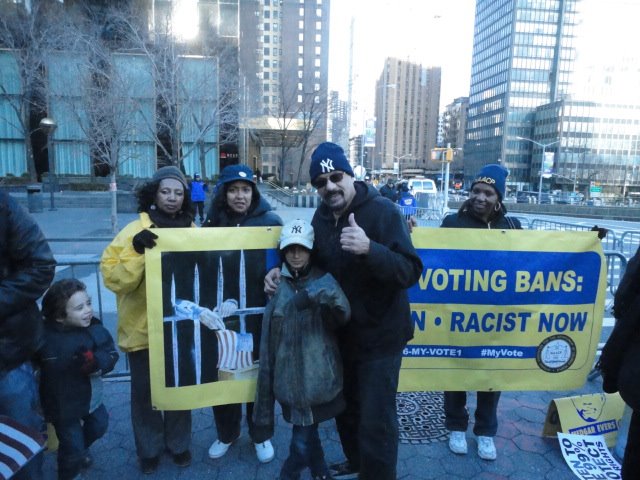
The Vote used by the NAACP http://www.examiner.com/public-policy-in-cincinnati/standing-for-freedom-with-you-2012-and-beyond
http://www.huffingtonpost.com/anthony-papa/the-right-to-vote-for-all_b_1137222.html

Pardons: The Power Nobody Wants
Wednesday, October 26, 2011 at The New School in NYC
The Hon. Dennis Jacobs, chief judge of the U.S. Court of Appeals for the Second
Circuit, and a distinguished panel of experts explore the history and real-world
application of the power of pardon at the state and federal level.
Following opening remarks by New School president David E. Van Zandt, Judge
Jacobs explains the history of the power, its role in correcting injustice in
the application of criminal law, and the way the decline in its use reflects a
missed opportunity, lack of imagination, and failure of courage.
Our panel then examines the critical historical, legal, economic, and ethical
issues surrounding the pardon power and the implications of its greater or
lesser use. Panelists include:
Moderator: Senator Bob Kerrey, President Emeritus, The New School.
Hon. Dennis Jacobs, Chief Judge, U.S. Court of Appeals for the Second Circuit.
Hon. Robert L. Ehrlich, Senior Counsel, King & Spalding; former Governor of
Maryland; former Congressman (R-MD), U.S. House of Representatives.
Julie Stewart, President and Founder, Families Against Mandatory Minimums.
Margaret Colgate Love, Attorney; former Pardon Attorney, Office of the Pardon
Attorney, U.S. Department of Justice.
Anthony Papa, Manager, Media Relations, Drug Policy Alliance; clemency recipient
following imprisonment for first-time, nonviolent drug offense under New York's
draconian Rockefeller Drug Laws.
This is an excerpt of the full 1 hour 28 minute panel discussion which can be
found here
http://www.youtube.com/watch?v=DqEO5vJhZ3Q
FLASH! 9/10/11/ Attica's 40th anniversary
In September of 1971, one of the bloodiest prison riots in the history of the United States took place at Attica Correctional Facility in Attica, New York. The uprising was brought on by prisoners living in terrible conditions who wanted to fix a broken system of justice.
The prisoners negotiated with state officials and called for improving their living conditions and the implementation of educational programs. But in seeking positive changes for those that lived in the darkness of Attica, they were met with cruel and unusual resistance by their keepers. Soon after their negotiations failed, National Guard troops and state police stormed Attica on orders by then-Governor Nelson Rockefeller. On September 13, when the five-day prison rebellion was over, 39 individuals were dead (29 prisoners and 10 civilians).
To many, the uprising at Attica was the start of an American movement that sought to bring to light the horrible conditions of imprisonment and to confront the growing prison-industrial complex. Surprisingly many of the horrid conditions that existed back then still plague the present prison system today as seen by the recent hunger strikes in Georgia and California protesting dehumanizing conditions.
I gained a personal experience of these conditions when I entered the system in 1985 to serve a 15-to-life sentence for a drug crime at Sing Sing Correctional facility. My first stop was the maximum security reception and classification unit at Downstate Correctional Facility in Fishkill, New York. The guards marched us off the bus and through a massive steel door in the center of a lethal electric fence surrounding the prison compound. Coils of razor wire wrapped and looped through the top of the fence, banishing the thought of escape. We were led through a series of gates and checkpoints and into a building, where we were packed like cattle into room for processing.
Ten prison guards sat behind gray iron desks and summoned us individually to approach. Each prisoner was told to place his bag of belongings on the desk. The guard dumped the contents and examined them. Just about everything was tossed into the garbage. One prisoner complained when a guard chucked his love letters into the trash; when he didn't let up, the guard pulled a pin on his radio and sat back in his chair while the distraught prisoner continued to complain. "You got no right," the prisoner said. "Those letters are from my wife, man! You can't throw them out." He shut up when he saw what was coming through the double-doors; a dozen guards in helmets and body armor, wielding clubs. "Fuckin' goon squad," whispered the guy behind me. "Racist bastards," said another. The complaining prisoner held up his hands in surrender but it was too late. The goon squad went right for him, tackling him to the floor. They beat him down to a bloody pulp and dragged him away. The guard who had summoned the goon squad smirked and paused to look at the rest of us before he called, "Next!"
This Friday, September 9th, a thousand people will gather at historic Riverside Church in Harlem to commemorate the 40th anniversary of what has come to be known as the Attica prison uprising. The organization "Attica is All of Us" will remember the unjust conditions that spurred the Attica uprising. It will also serve as a call to bring attention to the alarming rate of incarceration in the United States, the highest in the world, still with conditions similar to those that brought on the tragedy of Attica riot. Event organizer Sarah Kunstler, whose late father, civil rights attorney William Kunstler served as an observer at Attica, said: "The prison population of the United States has grown exponentially in the 40 years since the Attica rebellion and massacre. At the time of Attica the American prison population was around 300,000 - today it is over 2.4 million and growing."
Speakers will include survivors, scholars and activists, including Cornel West, who invites us to recognize that "this occasion celebrates the heroic courage and sacrificial love of the Attica prisoners in the name of justice."
"Attica is All of Us" will be held on Friday September 9, 2011 at 7 p.m. in the Nave of Riverside Church in Harlem. The event is free and open to the public. For more information: http://atticaisallofus.org/
Anthony Papa, author of 15 To Life: How I Painted My Way To Freedom, is a communications specialist for the Drug Policy Alliance.
Flash! 8/20/11/ Oklahoma's life without parole for non -violent drug offenses challenged!
http://newsok.com/in-nonviolent-drug-cases-life-without-parole-too-costly/article/3595983
State Sen. Connie Johnson, D-Oklahoma City, thinks Larry Yarbrough should be free. Yarbrough, a model prisoner, is in his 17th year of a life-without-parole sentence for a nonviolent drug crime. On Wednesday, Johnson successfully spoke on behalf of Yarbrough at an Oklahoma Pardon and Parole Board hearing where the board commuted Yarbrough's drug trafficking sentence to 42 years. Now if Gov. Mary Fallin signs off, Yarbrough will be eligible to be released in a year.
Johnson says Yarbrough's case is an excellent example of disproportionate and unfair sentencing. Compared with sentences received by others for similar amounts of the same drugs (an ounce of powder cocaine and three marijuana cigarettes), Yarbrough's life without parole sentence is clearly excessive.
The Legislature's original intent in enacting life without parole was to create an alternative between life imprisonment and the death sentence in capital cases. However, unlike death penalty cases where in order to impose such a sentence the jury is required to find aggravating circumstances, a jury recommending life without parole needs no reason whatsoever. This fact guarantees disproportionate and inherently unfair sentencing.
Life without parole sentences for drug crimes have not resulted in decreased drug trafficking. Instead, they have committed Oklahoma taxpayers to paying $23,000 per year, per person (at present rates) to lock up a growing number of people for life. Taxpayers also are committed to covering prisoners' medical expenses as they age, get sick and die.
These are tough times for state governments as well as most Americans. For these reasons, continuing to incarcerate Yarbrough is poor stewardship of the state's limited resources.
The New York Times pointed out recently that fanned by the financial crisis, a wave of sentencing and parole reforms is gaining force across the United States, reversing a trend of “tough on crime” policies that lasted for decades and drove the nation's incarceration rate to the highest — and most costly — levels in the developed world. While liberals have long complained that harsh mandatory minimum sentences for nonviolent offenses like drug possession are unjust, the push to overhaul penal policies has been increasingly embraced by elected officials in some of the most conservative states in the country. And for a different reason: to save money.
Life without parole for drug crimes is a policy we can ill afford, especially since it has done nothing to deter drug trafficking. Hopefully, these facts will result in ending the injustice of life without parole, Together we can demonstrate the power of the people, step up, and help make the right thing happen.
Papa is manager of media relations for the Drug Policy Alliance, based in New York.
Flash! Papa Breaks open nypd lab tech scandal! after this story was written the ny post published a update of the case (read about it below this Huff Post piece)
http://www.huffingtonpost.com/anthony-papa/nypd-mariem-megalla_b_867063.html
Given the length of her tenure at the NYPD, it was reported that potentially hundreds, if not thousands, of cases would have to be reviewed. In one example, Megalla was accused of labeling a crack pipe positive for cocaine when it actually tested negative because she didn't want to walk to another building to fill out the required paperwork. Megalla's slacking on the job led to a probe by the both the NYPD and the Queens District Attorney's Office.
One year later, a lot of questions remain unanswered about this case. It's not even clear whether Mariem Megalla is back on the job or not. I contacted the NYPD's Public Affairs Office and was told to email my questions to them. No response. I contacted the Queens District Attorney's office and spoke to Helen Peterson who declined to talk about their investigation of the case. I then talked to several reporters who had covered the story and most everyone seemed like they were in the dark about current news of it. Although one reporter told me that he thought Megalla is back on duty full-time.
The public has a right to know the outcome of this investigation. There's a possibility that thousands of people's lives were adversely affected by Megalla's actions, and the absence of any real information after an entire year is suspicious, at best. Especially when you consider the very different outcome of a similar case in nearby Nassau:
Recently, it was pointed out that 3,000 convictions were in question due to possible tainted evidence in the Nassau County crime lab. After a flurry of press coverage, District Attorney Kathleen Rice responded to the discovery in the same way the NYPD did in the Magella case -- by making a public announcement of a meeting with top-level officials to deal with the issue. But that's where the similarity stops. In the Nassau County crime lab case, Governor Andrew Cuomo quickly intervened and appointed State Inspector General Ellen Biben to lead an investigation, which led to the lab's demise. In turn, Rice was compelled to send letters to hundreds of potential defendants which eventually led to many filing motions to overturn their convictions.
But in the Megalla case it seems to be totally the opposite. Recently, I was contacted by Diana Collins, whose son is in NY state prison serving an eight-year sentence for possession of less than one gram of crack. D' Juan Collins was sentenced in 2008 and has been fighting his conviction ever since. He claims to be wrongfully convicted, and has been denied exculpatory evidence by the NYPD that would show Megalla's mishandling of the drugs used to convict him. But far worse for him than his sentence is the fact that he is now in jeopardy of losing parental rights to his four-year-old son Isaiah, who is currently in foster care. My question is how many D' Juan Collinses have been denied evidence that could be used to challenge their convictions?
The NYPD needs to alert the public to the outcome of the Mariem Megalla case and assure that justice has been served.
Follow Anthony Papa on Twitter: www.twitter.com/AnthonyPapa
Last Updated: 10:52 AM, June 27, 2011
Posted: 12:40 AM, June 27, 2011
NYPD laboratory technician Mariem Megalla made more than 100 mistakes in 50 of her most recent drug-evidence tests, including what appear to be clear examples of records fraud, according to shocking internal police memos, but she has continued to collect her $69,000 salary and remains criminally uncharged.
Most of the documented screw-ups appear to be of little consequence to the outcome of drug cases, simply amounting to galling sloppiness. Decimal points are misplaced; drug names and item numbers are switched; three bags are listed as one bag; a vial crashes to the floor; data sheets go missing from files.
But police memos obtained by The Post from as recently as last month reveal even more substantial errors as an 18-month investigation by cops and the Queens DA unspools and Megalla continues at full salary in a civilian, nonlab job.
"There should be no inaccuracy at a lab. I mean, people's lives and freedom are at stake," complains Manhattan lawyer Darius Wadia, who is representing a Harlem man accused of selling crack cocaine.
In that case, more than 200 milligrams of the drugs Megalla tested have gone missing.
"More than a quarter of the sample disappeared, as if two of the eight crack rocks they charged him [with dealing] have vanished," Wadia said.
Manhattan Supreme Court Justice Ruth Pickholtz said on Friday that she would rule today on whether to dismiss the evidence in the case against Wadia's client, Kasien Adderley, 27.
Megalla's worst errors, according to a massive, ongoing retesting effort dubbed the "Megalla Corrective Action," include:
* Some 30 heroin and marijuana samples Megalla said she tested but, in fact, did not.
In the worst example, Megalla wrote she tested all 31 bags of pot from a '07 bust in Queens, but only tested 13. She also only tested one of eight bags from a Nov. '08 seizure in the Bronx, according to the internal memos. Fortunately for prosecutors, Megalla guessed right each time, retesting showed.
* Some 15 instances of drug-weight disparities, including two Bronx cases where approximately a gram of coke remains unaccounted for and a 2008 Brooklyn case where Megalla was two grams off in weighing a sample that proved to not be a controlled substance.
"We cannot find any reasonable scientific explanation for the loss of the 912 milligrams," Thomas Hickey, manager of the police laboratory's controlled substance analysis section, wrote prosecutors in October regarding an especially grievous case of missing cocaine from one of those Bronx cases.
* Samples of heroin, alprazolam, cocaine, PCP, THC and oxycodone were missed by Megalla entirely as she tested bulk seizures of multiple drugs.
She failed to find the PCP and THC dust on a scale seized by the city-wide Special Narcotics prosecutor, and in one 2009 Staten Island case, she missed a hydrocodeinone pill mingled in a stash of oxycodone pills.
* Drugs were misidentified by name in paperwork. Megalla mislabeled the dust on two drug sifters in a Brooklyn case as cocaine when it was heroin; in another case, she said a sample contained cocaine, heroin and morphine when it contained only cocaine.
For at least six of the 60 defendants mentioned in the memos, Megalla's accuracy will never be known. Those cases involve drug dust on baggies, envelopes, a straw, even a dealer's calculator that was entirely consumed by Megalla's testing, with no residue remaining to be retested.
That includes residual evidence -- purportedly of hydrocodone and Zolpidem -- from the ongoing murder case of Gigi Jordan, the psychotic millionairess charged with giving her autistic, 8-year-old son a fatal overdose of prescription drugs.
It is unclear if any of the alleged mistakes have resulted in the dismissal of charges.
"While accused of taking shortcuts, I'm not aware of any errors being uncovered beyond the shortcuts themselves, which were not acceptable," police spokesman Paul Browne said.
She was suspended for 30 days in May, 2010 when the improprieties first surfaced, but has been back on the payroll as required by state civil service law, Browne said.
Megalla's lawyer, Benjamin Lieberman, insisted, "She never did anything [criminally] wrong. That's evidenced by the DA never bringing back any charges."
flash! 6/11/11/
Central Police Detective of Columbia University Drug Bust Arrested: Egg on the Face of Ray Kelly and Bridgett Brennan
Last week Detective Richard Palase, a NYPD Detective was arrested by federal authorities and charged with conspiracy to operate an illegal gambling business. Palase was a central figure in the Columbia University drug bust last year, which special Narcotics Prosecutor, Bridgett Brennan and Police Commissioner, Ray Kelly blew up to be a major narcotics arrest.
But in reality it was a small time arrest that netted five students for selling drugs on their school campus. In a press release distributed by the Office of the Special Narcotics Prosecutor, headed by Brennan, the bust was dubbed "Operation Ivy League." It was described as the culmination of a five-month police sting where they planted a baby-faced looking undercover cop to purchase drugs from the students.
The undercover detective visited
Palase was arrested for allegedly heading up a $6,000-per-day gambling operation
in
While the "Ivy League" bust generated a wave of media for Brennan and Kelly, the reality is that the headline-seeking bust has blown up in their faces with the arrest of Det. Palase. Now let's see what happens to the students who were arrested and whose lives were ruined because of the overzealous police policies.
Anthony Papa, author of 15 To Life: How I Painted My Way To Freedom, is a communications specialist for the Drug Policy Alliance.
Flash! 4/13/11/ Gov. Cuomo Shutting down the gulags! Buffalo news!
http://www.buffalonews.com/editorial-page/from-our-readers/another-voice/article391514.ece
Anthony Papa: Cuomo making a difference with facility closures
Gov. Andrew M. Cuomo was successful during budget negotiations in finding more ways to reduce economic waste. His plan to revamp New York State’s juvenile system by reducing the capacity of juvenile centers by 30 percent became a reality when he pushed it through, along with the budget.
But besides the savings associated with closing these facilities, there is another reason they must be shut down. It’s because of their draconian nature, unleashed upon young people. Several years ago, I went to speak to young prisoners in a creative writing class at Spofford Juvenile Center. Spofford was the focus of criticism and controversy for many years. For a variety of reasons, it became known as a place that exacerbated the problems of juvenile delinquents.
When I arrived at Spofford, it reminded me of a miniature Sing Sing Prison where I spent 12 years for a nonviolent drug crime. I was not prepared for what I was about to see. There, sitting in the audience, were about 50 boys and girls, 10 to 15 years old, dressed in their prison uniforms.
In front of me sat a Latino boy who appeared about 8 years old. I found out later he was 12 and was doing time for assault. I tried to keep my composure, even though I was in a state of shock. I found out that most of the children had first-to third-grade reading levels, almost the same as grown prisoners in the system I was in. The little kid in the front row was amazed and asked if I did 12 straight years. I said yes, and then he dropped a bomb on me. “Did you ever get raped in there?”
All the kids in the room grew quiet in anticipation of my answer, sitting on the edge of their seats. I told them that someone had tried but didn’t succeed.
They continued to ask me many questions about my life in prison. I guess they were interested because many of them would eventually go to prison when they became old enough. For some of them, cycling in and out of jails would become a way of life. It was, sadly, a routine implanted deep within their souls at an early age.
While talking, I could not help but think I was standing in front of the future residents of maximum prisons like the one I languished in. Faces on kids in prison don’t tell a story like faces on adults in prison. Back in Sing Sing you could look at imprisoned men and their faces told vivid tales. These kids looked so innocent, so needful for love and understanding. I prayed that I had made some sort of connection that would prevent just one of them walking the road I had taken. I left Spofford a different person. The experience had secured my need to confront my demons head-on and to make a difference, not only in my life but the life of others.
Cuomo is making a difference by revamping the state juvenile system and saving valuable tax dollars by shutting down troubled facilities. He is on track to make New York State great again.
Anthony Papa is the author of “15 to Life” and the manager of media relations for the Drug Policy Alliance.
-------------------
FLASH! 3/11/2011 ROCKEFELLER REFORMER RETIRED SUPREME COURT JUSTICE JERRY MARKS HAS PASSED ON
There are heroes and then there are heroes. My good friend Judge Jerry Marks, a former New York Supreme Court Justice, was a hero’s hero. On March 9, he died at age 95. Judge Marks had a long and distinguished career as a New York elected official and jurist. He served as state representative for six years beginning in 1963, and later as a Supreme Court Justice until he retired in 1992. In his retirement, Marks devoted his life to change New York's draconian Rockefeller drug laws and helped secure clemency for prisoners rotting away in prison for their roles in minor drug crimes.
I knew Judge Marks from my work as a Rockefeller Drug law activist and the tireless work he did to help Rock Law offenders receive their freedom. Both as a friend and a mentor, Judge Marks influenced me to follow his path to become a freedom fighter and to fight for justice for the marginalized and disenfranchised.
In 1999, New York Times columnist Bob Herbert wrote a beautiful piece titled “Angela’s Champion.” One of the cases that caught Justice Marks's attention in The New York Law Journal was that of Angela Thompson, who was arrested in 1988 at age 17 for selling two ounces of cocaine to an undercover cop. She had no previous record and was acting at the direction of her uncle and legal guardian, who was a drug dealer. Nevertheless, under the strict terms of the Rockefeller drug laws, Ms. Thompson was sentenced to 15 years to life in prison. When Judge Marks read about the case he knew it was a case of injustice and immediately began the process of successfully launching a campaign to acquire executive clemency for Angela from former New York Gov. George Pataki.
His close friends called him “The Judge.” He had a quick wit, even in his late years. He was also a poet and from time to time, especially in front of an audience; use to love to recite his often political laced poetry. Political comedian, Randy Credico, who recently ran against Sen. Charles Schumer, and I were honored to have dinner with The Judge every Friday night for years. We often discussed the concept of justice over a martini and he schooled us well. Credico, in remembering The Judge told me, “Judge Marks used his power to save rather than destroy lives and was the embodiment of the word justice. He was a servant and not the master of concept of justice. Unlike the men and women who wear robes who hypocritically pass judgment of the poor, the disaffected and the hopeless in the current base, corrupt and Kafkaesque world of criminal justice. Judge Marks served God's natural law rather than man's artificial law”.
Terrance Stevens’ case was another that Judge Marks took on. The Judge helped Stevens, who at the time of his arrest was paralyzed from muscular dystrophy, secure clemency from Gov. Pataki. But being confined to a wheel chair did not stop the State of New York from sentencing him to 15 years to life. The judge in Stevens’ case did not want to sentence him under the mandatory provisions of the law but he had no choice. While serving his sentence at Green Haven Correctional Facility in Stormville, an article appeared in the NY Times detailing Stevens’ plight. Judge Marks wrote him and a friendship developed, leading Marks to champion his cause.
Judge Jerry Marks had a great impact, not only on the people he helped but also the hundreds of lives that were saved through the Rockefeller reforms he advocated for. He is gone but his good deeds as a procurer of justice will let his spirit live on forever.
Judge Marks was the loving husband of Julie and the devoted father of Gail and the late Lorna and dear father-in-law of Neil and Joseph and cherished grandfather of Kyle, Kane and Casey. Funeral services will be held at Frank E. Campbell Funeral Home, 1076 Madison Avenue (81st St. NYC) on 3/13/11/ at 3:30pm.
Follow Anthony Papa on Twitter: www.twitter.com/AnthonyPapa
Flash! 2/17/11/ Nassau county DA rice might have to retry thousands of rock law cases!

Experts say that it is very hard or impossible to prosecute cases that involve the dealing and possession of drugs when an incorrect analysis is conducted. Attorneys for defendants say that innocent people could have been jailed because of this. William Gibney, a lawyer with the Legal Aid Society who was instrumental in reforming the Rockefeller Drug Laws, said, "These convictions have a serious problem."
DA Rice said her office is prepared to give information about cases affected to defense attorneys but it will be up to defendants and their lawyers to request re-testing. But when I asked Roland Acevedo, a practicing criminal defense attorney based in NYC, he told me that "a prosecutor has a responsibility to do the right thing. The DA's office should take the steps to notify all potential defendants or their counsel who may be impacted by the discovery of this incident."
In an appearance on Good Day New York on Wednesday, DA Rice admitted that it's possible that an individual currently in jail may not belong there due to problems in the drug testing lab. "We believe there may be errors in the quantitative analysis. A lot of drugs are cut with other substances," said Rice.
According to news sources, the lab troubles were known but unreported. The problems started back in December of 2010 when the Mineola crime lab at police headquarters was placed on probation. A state forensic oversight agency found 15 serious failures to comply with storing and testing procedures.
The Nassau County DA has said that that only 16 defense motions seeking judicial reviews or reopening of drug cases have been filed. But this is understating the magnitude of the problem. If the crime lab was tainted for dozens, the scandal is likely much larger than just the sixteen cases identified so far. Just last year, the crime lab in San Francisco was shut down because of evidence tampering and theft of drugs from the lab. The scandal undermined public trust in both the police and the office of the prosecutor.
Defense attorneys believe that this is just the beginning and the discovery of many cases will occur that could in theory lead to procuring new trials for a majority of those convicted by the tainted evidence. New trials are a very costly procedure, especially at a time when Nassau County's economic health is so bad the state has seized control of the county's finances.
DA Rice recently ran for Gov. Cuomo's former position as state Attorney General, and in appearance after appearance she strongly defended her support of the Rockefeller Drug Law reforms. What will happen if hundreds or thousands of people are found to be wrongfully convicted because of tainted evidence? Will DA Rice pursue justice for dozens, hundreds, perhaps thousands of people who may be wrongfully incarcerated? Can Nassau County afford retrials? And can New York afford to allow people wrongfully convicted to remain incarcerated? Stay tuned.
Follow Anthony Papa on Twitter: www.twitter.com/AnthonyPapa
fLASH! 1/3/11 iNTERVIEW WITH lAURA fLANDERS ON grit tv ABOUT THE SCOTT SISTERS
Body Parts for Freedom http://www.youtube.com/watch?v=xNgTV_97MT8 (1 MINUTE)
The price of freedom from an overly harsh sentence in Mississippi? Apparently, one kidney. That's the promise Mississsippi governor Haley Barbour extracted from Gladys Scott--that she would donate a kidney to her sister Jamie in order for both of them to have their sentences commuted. The sisters had served nearly 17 years in prison for an armed robbery worth $11, and a prolonged grassroots effort finally paid off in achieving their freedom--though it may have more to do with Barbour's attempt at making up for his recent approving comments about the White Citizens' Councils. Joining us to discuss are Anthony Papa, author of 15 to Life and manager of media relations at the Drug Policy Alliance, and from Mississippi, Jaribu Hill, executive director of the Mississippi Workers' Center for Human Rights.
Flash! papa goes on a rescue mission to save the scott sisters!
Governor Haley Barbour suspended the life sentences of Gladys and Jamie Scott, two African-American sisters who had served 16 years in prison for taking part in an $11 armed robbery. The women have always maintained their innocence. For many years civil rights advocates have called for the release the sisters. The case was brought to my attention a few years ago by Nancy Lockart, who spearheaded the campaign to free the Scott sisters.
Although I give thanks to the Governor for this act I have to question the stipulation that in order for Jamie Scott to be free she must donate a kidney to her ailing sister. An estimation was made that determined that dialysis treatments would cost the state of Mississippi $200,000 a year which did not include other treatments. If the operation could not be performed because of medical reasons they would revisit Jamie's stipulation but she would not go back to prison. In a radio interview Barbour described the suspension of sentences as the equivalent of parole. Any violation of the law could therefore land them back in prison.
So, in my view the act of compassion turns out to be a cost efficient way of ridding Mississippi with an astronomical medical bill. Barbour's twisted view of compassion and moral sleight of hand should not come as a surprise. Recently Barbour found himself in hot water after his attempt to revise the shameful legacy of the segregationist, Council of Conservative Citizens, originally called, White Citizen's Councils.
Medical ethicists say suspending a prison sentence on the
condition that one sister give the other a kidney is a "quid pro
quo" and threatens the ethical underpinnings of living donation
laws. So in reality Gov. Barbour might have broken the law.
Gov. Barbour, who by the way aspires to run for President of the United States confirmed my thoughts by saying "The Mississippi Department of Corrections believes the sisters no longer pose a threat to society, Their incarceration is no longer necessary for public safety or rehabilitation, and Jamie Scott's medical condition creates a substantial cost to the State of Mississippi."
Bob Herbert of the New York Times recently wrote about the case of the Scott Sisters in a piece titled "'So Utterly Inhumane." He said, "This is Mississippi we're talking about, a place that in many ways has not advanced much beyond the Middle Ages." I agree one hundred percent. instead of giving the Scott Sisters their freedom through a true compassionate act of clemency, Governor Barbour instead used the barbaric stipulation that freedom in this case is the cost of a kidney.
I wish the Scott Sisters the best in their regaining their freedom and hope they lead fruitful and productive lives. And I pray that Governor Barbour does not use the freedom for organs tradeoff anymore in the future to save the state of Mississippi tax dollars.
Anthony Papa is the author of 15 to Life and the Manager of Media Relations for the Drug Policy Alliance
Follow Anthony Papa on Twitter: www.twitter.com/AnthonyPapa
----------
Flash! 12/30/10 Tony Newman on Tony Papa!
Huffington Post
http://www.huffingtonpost.com/tony-newman/reading-charlottes-web-as_b_802717.html
Tony Newman is the director of media relations at the Drug Policy Alliance (www.drugpolicy.org)
Follow Tony Newman on Twitter: www.twitter.com/TonyNewmanDPA
Flash! Interview with Initative Radio!
LISTEN HERE: http://www.archive.org/details/IR-09-51 (audio)
ANTHONY PAPA
is an artist, writer, noted advocate against the War on Drugs and co-founder
of the Mothers of the New York Disappeared. His opinion pieces about the
drug war have appeared in news sources across the country; he's a frequent
public speaker and college lecturer on his art and criminal justice issues
and he is currently a communications specialist for Drug Policy Alliance in
New York City.
In the early 2Ks there was a great deal of mainstream media attention and
celebrity participation from the likes of Sting, George Soros and Russell
Simmons in the Drug Policy Alliance's campaign to repeal the outdated
Rockefeller Drug Laws, which subjected first-time, non-violent drug
offenders to lengthy or even lifetime prison sentences. In spite of the lull
in media buzz around the issue these days, advocates like Anthony Papa
remain vigilant in their commitment to repeal Rockefeller.
On today's show Anthony shares his personal experience serving twelve years
at Sing Sing prison in upstate New York, for carrying a small amount of
narcotics and how discovering his artistic talent for painting while in
lockup eventually led him to freedom and a life of great purpose.
http://www.archive.org/details/IR-09-51
If all the radio stations are following the syndication schedule to a T, the
program should broadcast as follows:
Sunday WEOS (Geneva, NY) 6-7 PM
Monday WXOJ (N. Hampton, MA) 7-8 AM
Monday WYAP (Clay, WV) flex time check local listing
Tuesday WRFN (Nashville, TN) 3-4 PM Central Time
Tuesday WYAP (Clay, WV) flex time check local listing (encore broadcast)
Wednesday WSIA (Staten Island, NY) 10-11 AM
Wednesday WUOW (Oneonta, NY) 10-11 AM
All the best!
Angela
Initiative Radio with Angela McKenzie
Food for the Mind & Music for the Soul
http://www.facebook.com/pages/Initiative-Radio-with-Angela-McKenzie/106581202712373
---------------------
FLASh! July 16, 2010 : Social Activist rev. bill webber passes on (May 2, 1920 – July 10, 2010)
(this piece also appeared in CounterPunch http://counterpunch.org/papa07152010.html and the Huffington Post http://www.huffingtonpost.com/anthony-papa/remembering-rev-bill-webb_b_644479.html
In 1985 I was sentenced to 15
years to life under the Rockefeller Drug Laws of New York State.
I struggled to survive in the maximum security hell hole, Sing
Sing, and did many things I was not proud of to stay alive.
Being in prison for many years had drained me spiritually and
emotionally. There were times when the only emotion I was aware
of was a quiet, smoldering rage. Because of the barriers I'd
built to survive, I'd become desensitized, and I knew it. There
was still a part of me that could see myself from the outside
in, and what I saw I didn't like: a callous, bitter individual
consumed with the injustices of the world. I knew that I needed
to heal if I ever wanted to interact normally with people upon
release. I had some insight into human behavior because of the
bachelor's degree in Behavioral Science I'd earned from Mercy
College in 1993. The problem was, the program was over and I had
to serve an additional 7 years.
The walls of negativity were beginning to close in on me again
when a friend told me about a unique program he'd recently
joined known as the New York Theological Seminary, a one-year,
42-credit program that afforded a select group of Sing Sing
prisoners the opportunity to earn a Masters of Professional
Studies in Ministry. Opened in Sing Sing in 1983, the New York
Theological Seminary was the only program of its kind in the
country, a graduate-level religious studies program that
required a four-year degree from an accredited university to
join. The program demanded intense academic scholarship and a
commitment to personal growth. Each year, hundreds of prisoners
applied but only fifteen were accepted. I was fortunate to be
chosen by Dr. George "Bill" Webber, the longstanding director of
the program that was a fearless champion of prisoners' rights.
Under his leadership, the seminary program provided theological
education to prisoners at Sing Sing.
The program has graduated hundreds of men, many of whom are now
social workers, pastors, prison reform advocates and educators.
Few have ever returned to prison. Of those serving life
sentences, many have devoted their lives to teaching and
ministry in prison. When state funding for College programs
ended, Dr. Webber organized Rising Hope, a program which
provides college level education to inmates who have received
their GED.
Rev. Webber brought together men of diverse religious and ethnic
backgrounds to this program. A recurrent theme was that of "koinonia,"
or authentic community. Koinonia encompasses the belief that we
must reject the differences between us to create a society where
class distinction is nonexistent and the poisons of racism,
sexism and nationalism disappear. He taught me that the core of
the seminary teachings was based on liberation theology, rooted
in "praxis," or action as an essential ingredient in all
theological method. Its hermeneutical approach argues that we
cannot begin to understand, criticize, or verify the meaning of
scripture or tradition unless we are approaching it from the
actual practice of liberation, from concrete involvement in
trying to make the world better.
For the first few months of the program, I struggled to find a
foothold. I considered dropping out, but Bill Webber urged me to
persevere. He suggested that I sharpen my skills as an observer
of human behavior because in learning how to deal with others, I
would gain mastery over myself. I would learn to understand my
emotions, he said, and to feel again. In every confrontation I
faced, whether with a prisoner, a correction officer or an
outsider, I tried to apply what I was learning in the seminary
to gain insight into my fellow man and the world around me. For
the first time in years, I felt empathy. Bill had successfully
taught me how to be a human being once again. In 1997 I received
executive clemency from Governor George Pataki. Upon my release
I became an activist and have fought endlessly for reform of
draconian drug laws that put hundreds of thousands of
non-violent individuals in prison for many years.
In 2004, the New York Theological Seminary established the
George W. Webber Chair in Urban Ministry in his honor. On May
19, 2000, he received the Union Medal from Union Theological
Seminary. The award included these words: "George Webber, your
passion for faith-based justice has helped shape the perspective
of several generations of Protestant clergy engaged in urban
ministry. Your imaginative grasp of the problems that confront
an embattled urban church in an expanding and often violent city
has given new meaning to the concept of Christian mission."
Bill Webber, a spiritual father to many men behind and beyond
the walls, will be surely missed. Memorial services are
tentatively planned in Sorrento , Maine in August and in New
York City in October.
Anthony Papa, author of 15 To Life: How I Painted My Way To Freedom, is a communications specialist for the Drug Policy Alliance.
© 2010 Independent Media
Institute. All rights reserved.
View this story online at: http://www.alternet.org/story/147542/
FLASH! June 28, 2010 - Special Narcotics Prosecutor Tries TO ROLL BACK ROCKFELLER REFORMS ANYWAY SHE CAN
Sunday, June 27th 2010, 4:00 AM
Special Prosecutor Bridget Brennan says dealers sell 'cocaine and heroin, but say they are 'addicted.''
·
The revamped Rockefeller drug laws have let hardened drug dealers escape jail by claiming they're marijuana addicts, the city's top drug prosecutor says.
The goal was to help addicts who sold drugs or committed petty crimes to support their habits, but Special Prosecutor Bridget Brennan said dealers with multiple convictions for non-violent offenses are taking advantage of the reforms.
A Bloods member with two felony drug convictions was charged last October with overseeing a cocaine operation in a Brooklyn housing project. Instead of prison he's in a drug treatment program for marijuana abuse, after years of denying he ever used drugs.
A couple arrested for major cocaine dealing was recorded in a phone call discussing smoking pot to buttress their claim of marijuana addiction.
"If they do wanna be dumb and do offer you a program, you urine need to be dirty," the man says to his wife in the call from Rikers Island. "What they don't realize that they revised, revised Rockefeller drug law, that's why therefore selling drugs is almost legal."
Brennan said her office fought treatment for people who were "not addicts, but businessmen drug dealers, major managers, gang members ...
"It's sending the wrong message, not only to the individual defendant who thinks he may be able to game the system, but to the community at large."
Drug law reform advocates say Brennan is using a few examples to make the program look bad.
"She's tooth-and-nail against the Rockefeller laws being changed," said Anthony Papa, communications specialist for the Drug Policy Alliance. "She is taking one case and blowing it up ...to affect thousands of other people who should get treatment instead of jail."
"Special Narcotics still measures success by the number of people they put in jail rather than effectiveness in reducing crime," said William Gibney of the Legal Aid Society.
Last year, the state repealed most of its mandatory minimum sentences for drug offenses imposed in the 1970s under the tough Rockefeller laws.
That allowed the resentencing or release of some prisoners serving exceptionally long sentences, and expanding treatment as an alternative to incarceration.
Judicial diversion, as it is called, allows a judge to dismiss a case against a drug defendant as long as the offender pleads guilty and completes treatment.
Brennan said 217 defendants applied for judicial diversion since the law took effect Oct. 7.
Of those, 158 were referred to a judge, and her office objected to 90 of them. Twenty-seven were granted diversion anyway.
Almost half the people who asked for judicial diversion claimed to be marijuana abusers.
"They are selling cocaine and heroin, but say they are 'addicted' to marijuana," Brennan said.
Nestor Ferreiro, chief of the Bronx district attorney's narcotics bureau, said "some people are trying to take advantage of the law." But, he added, "the judges and the diversion staff are pretty good at catching it."
In Queens, 11 people sought diversion. Prosecutors objected successfully to eight of them, a spokeswoman said. The majority claimed to be pot addicts.
Police sources said the Bloods gang member in the Brooklyn case was arrested with 49 others in Operation Tidal Wave, a three-month probe launched after some gang-related shootings near the Coney Island Houses.
A cop involved in the investigation was shocked the man was allowed to go to treatment.
"He was a manager on the street," the officer said. "If you wanted to purchase narcotics you had to go through him."
Brennan, who said she wanted the man to get at least two years in jail, doesn't blame the judges, saying they are dealing with "a very vague statute."
Although the couple recorded in the phone call were ruled ineligible for diversion, she called the conversation "troubling."
"The assumption was all you do is smoke weed and get a program," she said. "It shows people on the street know how the law changed."
-----------
FLASH! JUNE 21, 2010 - Nassau County DA Kathleen Rice IS NOT A GOOD CHOICE FOR NYS ATTORNEY GENERAL
June 14, 2010 11:40 AM 7 Comments
Nassau DA and state Attorney General hopeful Kathleen Rice is taking more heat over her past views on the repeal of the Rockefeller Drug Laws, a subject she's tangled on with rival fellow Democrat Eric Schneiderman.
Schneiderman and Rice traded barbs on the subject over the past few days after Schneiderman sent Rice a letter highlighting their "divergent" views on the issue (read: I'm right; you're wrong) and Team Rice struck back by calling Schneiderman's broadside a mere political stunt.
The letter below, addressed to Rice, is signed by Anthony Papa of the Drug Policy Alliance, Assemblyman Adriano Espaillat, Councilman Robert Jackson, Chairman of the Council's Black, Latino and Asian Caucus and Councilwoman Melissa Mark-Viverito, Co-Chair of the Council's Progressive Caucus, as well as state Sen. Jose Peralta and Councilman Ydanis Rodriguez. (Some of the aforementioned have endorsed Schneiderman, btw.)
The takeaway:
"We are writing because we have been dismayed by your effort in recent days to mislead voters about your record and position on Rockefeller Drug Laws, and are respectfully asking that you cease claiming to have been a strong supporter of the landmark 2009 Rockefeller Drug Law reforms.
The truth is that not only did you lobby your Republican senator to oppose these measures, but as recently as last month, you even continued to oppose the core provision of the reform package: giving judges discretion in sentencing decisions."
The letter comes as state Sen. Craig Johnson offered his stalwart support of Rice (read his statement after the jump.)
---------------
http://dyn.politico.com/blogs/maggiehaberman/index.cfm/tag/Schneiderman
State Sen. Eric Schneiderman is firing back at his Attorney General primary rival, Nassau County DA Kathleen Rice, in their ongoing battle over the Rockefeller Drug Laws, a key issue for many liberal Democratic primary voters that opponents of the law say unfairly targets people of color.
Rice had said Schneiderman distorted her words and is getting validation from other lawmakers about whether she fought against reforms to how first-time non-violent felony drug offdenders to shift sentencing from prosecutors to judges.
But Scheiderman's camp sent out a letter from a group of anti-RDL
activists, including reform-fighter Anthony Papa, who was convicted
under the laws.
"The truth is that not only did you lobby your Republican senator to
oppose these measures, but as recently as last month, you even
continued to oppose the core provision of the reform package: giving
judges discretion in sentencing decisions," the letter says.
"After a watered-down version of reform without the judicial
sentencing provision was passed by the Republicans in 2004, Andrew
Cuomo called the bill 'half-a-loaf,' saying, The pressure is for
Rockefeller reform and that's not what this is. This is not judicial
(sentencing) discretion. This is not significantly reducing the
burdensome length of punishment...This is simply not what we've been
working for all these years.'
"However, on May 17 of this year, your campaign continued to defend
these onerous sentencing rules, saying, 'As we have said, the
District Attorney was concerned that removing prosecutors from the
process would weaken the community's voice in these decisions. As
the community's advocate, the District Attorney often knows the most
about a defendant's background and is in a unique position to
represent the community in determining which defendants receive
treatment and which for-profit drug dealers go to jail.'
"Stated simply, your opposition to this key judicial sentencing
provision means that you did not – and indeed, currently do not –
support the historic Rockefeller Drug Law reform package of 2009."
The letter was signed by three City Councilmembers, as well as State Sen. Jose Peralta, a Schneiderman backer, and Assemblyman Adriano Espaillat, who's running for Schneiderman's seat.
The line about Cuomo is not accidental, since much has been made of reports that the current AG prefers Rice to succeed him (although he has insisted this isn't so).
State Sen. Eric Schneiderman, who's in a field of five looking to be the Democratic nominee for Andrew Cuomo's current Attorney General job, came out swinging today at rival Kathleen Rice over the Rockefeller Drug Laws - a key issue with a swath of Democratic primary voters.
Schneiderman described their "divergent" positions on the issues, and said the Nassau County DA "lobbied Senate Republicans to oppose the reforms" he has helped work for to the laws, which many advocates have called draconian.
Schneiderman challenged her to a debate on the "honest disagreement on policy," including a central reform proposal about giving judges discretion to decide on prison sentences for first-time, non-violent drug offenders convicted on felony counts. That duty used to lie totally with prosecutors.
And late in the day, he claimed success.
Rice - who is widely believed to be Cuomo's preferred successor, although he's denied he's made a choice - responded through a campaign staffer, saying she "supported the reforms and she looks forward to continuing to discuss their shared beliefs on jail diversion" for non-violent first-time drug offenders.
Her team added that she was recommending treatment over jail for drug offenders "long before the legislature passed these reforms....people see this distortion of the District Attorney's record for exactly what it is: a desperate political attack."
But Schneiderman did a round robin, saying the "look forward" portion of the letter was an agreement to the debate and his team said he would "immediately work with the other campaigns now...to arrange logistics."
--------------
Flash! May, 21, 2010
A new video featuring Sting, George Soros and Montel Williams and Tony Papa <http://www.youtube.com/watch?v=P0A1XTlJAio> Each of them - like so many of us - believes that our drug policies must be grounded in science, compassion, health and human rights.
FLASH! MArch 3, 2010 Gov. Paterson who helped us tremendously in reforming the rockefeller drug laws is getting a raw deal my the media who want him to resign - just say no Gov. paterson!!!!!!!
http://www.huffingtonpost.com/anthony-papa/emtimesem-misses-mark-gov_b_471730.html?ref=fb
While I agree with Kurtz's analysis, I also think the article touched on an extremely important issue. It talked about Gov. Paterson's closest confidant in his administration, David Johnson, a top aide, who the New York Times painted as someone with a criminal record who should not be in the position he is. Johnson sold cocaine to a undercover cop when he was 18 years old. Gov. Paterson responded, saying "David Johnson has demonstrated, over the course of his adult life, that people can change their personal circumstances and achieve success when given a second chance. I will not turn my back on someone because of mistakes made as a teenager."
As an ex-offender who served hard time, I believe that Gov. Paterson should be applauded for giving David Johnson the opportunity to excel. There are many roadblocks that exist when people with criminal records, mostly ex-offenders, try to reenter society. Statistically, it is well known that if you wind up in prison and you are fortunate enough to regain your freedom, odds are, you will be going back sometime soon.
According to the Bureau of Justice Statistics, 67 percent of those set free return to prison within three years. There are many obstacles one meets that can contribute to this startling statistic. Carrying the stigma of being an ex-offender is often debilitating. From obtaining employment and housing, to establishing relationships, life becomes difficult at best.
Ex-offenders struggle to shed the memories of imprisonment after paying their debts to society. But the stigma of having a criminal record follows them around for life. They face a daunting array of counterproductive and frustrating legal and practical barriers, including state and federal laws and policy that hinder their ability to quality for a job or get a higher education. But these policies that stigmatize those with criminal records are now being challenged, as is the case in New Mexico, where legislation has passed that will remove unfair barriers to employment for those who have criminal convictions. That bill now awaits Gov. Richardson's signature. No longer will job applicants have to check a box on a job application alerting potential employers that they have a criminal conviction.
Upon reentering society ex-offenders will find a host of problems preventing them from successfully reintegrating. These include not being able to find employment or secure housing, dealing with substance abuse and mental health problems, difficulty in reestablishing and developing relationships. All of these make life exceedingly difficult and often debilitating. This, coupled with dealing with issues such as institutional dependency and carrying the baggage of incarceration, results in the ex-offender returning to prison either on a parole violation or a new sentence.
All these above mentioned factors results in preventing the returning prisoner to become lawful tax paying citizens and inhibit their ability to take care of themselves and their families.
David Johnson's ability to overcome the circumstances of his past is remarkable and should be attributed to the help he received from people like Gov. Paterson who believe in second chances. The Times, the paper of record, released a "bombshell" that turned out to be nothing more than a dud.
Anthony Papa is the communications specialist for the drug policy alliance and author of a forthcoming book "This Side of Freedom - Life after Lockdown"
--------
Cameron has a serious heroin addiction and emotional problems that stem from "notoriety that is not due to any acts of his own but by dint of birth and a difficult upbringing," his defense lawyer Dan Gitner argued.
The judge did not buy the story and denied bail last week at his hearing. Cameron Douglas has to wait until April 14 when his sentencing hearing is scheduled to find out what his future holds for him. Cameron is facing a 10 year sentence for dealing methamphetamine.
In the April issue of Vanity Fair Magazine Michael Douglas admits that he put his own career over fathering his son Cameron. The piece goes on to say that though Douglas isn't one for public hand-wringing, he can't help but see his own role in Cameron's fate.
We may never know what caused Cameron's addiction. Maybe he did suffer because of a dysfunctional upbringing because of his father's fame, or maybe not? But one thing is for certain -- Cameron needs treatment not prison. It's a waste of tax dollars and human life to place non-violent drug addicted individuals like Cameron Douglas in prison.
Our 40-plus-year war on drugs has stifled the open debate this country should be having about addiction and how best to deal with it. Treatment is valid for fighting the demons of addiction. It is also an effective tool in overcoming the government's use of incarceration and punitive measures in response to nonviolent drug law offenses stemming from addiction.
Join the Facebook cause to send a message to Cameron's sentencing judge to give him treatment instead of prison
http://apps.facebook.com/causes/441324/16688602?m=9e4cc0c7&ref=mf (click here)
---------------------------
Flash! 12/11/09/ Despite the recent reforms the district attorneys led by Special Narcotics Prosecutor Bridget G. Brennan keep feeding trash papers like the NY Post and the Daily News nonsense that the flood gates of hell have opened because eligible drug offenders are being released. This is not the case.
http://www.huffingtonpost.com/anthony-papa/rockefeller-drug-law-refo_b_384366.html
The dismantling of the Rockefeller Drug Laws is picking up steam. The New York State Assembly held a key hearing on Dec. 8 to press forward with implementation of the reforms, soliciting feedback from courts, treatment providers and community-based programs on their readiness and resource needs to carry out the groundbreaking new law.
The reform, which took effect on Oct. 7, eliminated mandatory minimum sentences for most drug offenses, restored discretion to judges to sentence individuals to probation, drug treatment or other alternatives to incarceration, and allows approximately 1,000 people convicted under the old Rockefeller Drug Laws to apply for resentencing.
At the hearing, lawmakers explored a wide range of issues related to the Rockefeller reform, including: What steps has the court system taken to prepare for and implement the new judicial diversion program, and to ensure that persons who are resentenced have access to community-based reentry programs? Are there sufficient community-based treatment programs available to serve individuals sentenced to treatment or probation, or those released from prison? What are the barriers faced by formerly incarcerated individuals with a history of substance abuse in obtaining public benefits, medical assistance, employment and affordable and stable housing?
"These reforms will allow people to reclaim their dignity as we shift from a punitive criminal justice model to a much needed holistic public health framework," said Shreya Mandal, Mitigation Specialist for the Legal Aid Society. "Now it is time to see this reform through by empowering formerly incarcerated individuals with comprehensive re-entry planning. Reform also calls for revamping outdated modes of drug treatment, both in and out of prison, and for making progressive changes in how we respond to addiction."
Under more limited reforms to the Rockefeller laws signed by Gov. George Pataki in 2004 and 2005 - which authorized resentencing and eliminated life sentences for individuals convicted of certain drug felonies - 584 individuals were released from prison, and just 9 percent of these people returned to jail, far lower than the state's 39 percent overall recidivism rate. These results counter claims made by district attorneys and law enforcement officials that sentencing reform leads to disaster.
"Opponents of reform try to scare the public with claims that the 'sky is falling' every time individuals with substance abuse problems are sent to treatment instead of prison," said Glenn Martin, Vice President of Development and Public Affairs for The Fortune Society. "But by working collaboratively among treatment providers and Alternatives to Incarceration programs, stakeholders can ensure the success of New York's movement toward a public health and safety approach to drug use."
Enacted in 1973, the Rockefeller Drug Laws were intended to target drug kingpins, but instead the laws led to the incarceration of thousands of individuals, mostly people of color, for low-level, nonviolent offenses, many with no prior criminal records. Approximately 12,000 people remain locked up for drug offenses in New York State prisons, at a cost of roughly $45,000 per year to incarcerate a single person, compared to an average cost of $15,000 per year for drug treatment, which is proven to be 15 times more effective at reducing crime and recidivism.
As someone who spent 12 years behind bars on Rockefeller charges and another 12 fighting the inhumane laws, I am thrilled that the law has been changed, but Rockefeller reform will only be real when those who are behind bars are allowed to come home and those who need help get treatment instead of a jail cell.
Anthony Papa is the author of 15 to Life and a communications specialist for the Drug Policy Alliance
Follow Anthony Papa on Twitter: www.twitter.com/AnthonyPapa
http://www.theepochtimes.com/n2/content/view/26224/
12/10/09
NEW YORK—The Rockefeller Drug Law Reform took a step forward Tuesday at a
public hearing in City Hall. Four committees of the State Assembly received
testimony from community-based programs, treatment providers, and courts as
it moves forward with implementation.
The reforms increase judicial oversight of drug cases, says an Assembly
notice. According to the notice, the previous law really wasn't effective in
targeting drug lords, as was intended, but instead affected lower level and
nonviolent drug offenders.
The original legislation was introduced in 1973 under Governor Nelson
Rockefeller. It prevented judges from giving sentences, which allow for
people to go into community-based programs for drug treatment.
Approximately 14,000 people are in New York state prisons incarcerated for
drug offenses, with the costs totaling in the hundreds of millions to
taxpayers.
The reforms place special emphasis on allowing treatment via community-based
programs for people incarcerated on drug charges, as an alternative to
minimum prison sentences.
Anthony Papa, a communications specialist for Drug Policy reform, spent 12
years in Sing-Sing prison. Papa, who wrote "15 to Life," which is an account
on his life in prison, spoke at the event.
In a follow-up press statement, he said he "spent ... another 12 [years]
fighting the inhumane laws," adding that he is "thrilled that the law has
been changed." He feels the Rockefeller laws were unfair to him because he
was convicted of only one drug charge and got a 12-year sentence in prison
as a result.
Legal Aid Society Mitigation Specialist Shreya Mandal commended the reform,
saying it can "allow people to reclaim their dignity" through "empowering
formerly incarcerated individuals with comprehensive re-entry planning."
State Senator Frank Padavan said in September that the reform is problematic
because a section in the provision makes it so drug offenders and dealers
can get up to three offenses on their record and it does not have to be
"disclosed during criminal background checks for positions of trust," he
posted on his Web site.
As a result, Padavan sponsored legislation, dubbed "Repeal the Seal," that
requires criminal transparency in the reform provision.
The reforms could reduce the prison population, potentially costing the
state less money.
A 2008 report released by the Pew Center of the States found that
approximately 1 in 100 people in the U.S. were incarcerated. In 2007, the
state spent $2.6 billion on corrections expenditures. New York's higher
education received $3.5 billion in 2007.
FLash! Rockefeller reforms officially kick in on october 7th, 2009
http://www.huffingtonpost.com/anthony-papa/david-paterson-does-the-r_b_313058.html
David Paterson Does the Right Thing and Drops the Rock
By Anthony Papa
Today is a historic day for New York, the day that the Rockefeller Drug Law reforms kicked in, setting in motion the release of 1,500 low-level nonviolent drug offenders. The new law also gives judicial discretion back to judges, who can now determine whether someone should get treatment for their addiction instead of a jail cell.
I went to Brooklyn's Supreme Court and attended a public event to mark the milestone. The court room was full of activists, politicians and service providers that have been working for years to make this reform happen.
As an activist who has felt the sting of the Rockefeller laws firsthand -- serving 12 years under a 15-years-to-life sentence for a first time nonviolent offense -- I understand the full meaning of these changes. For years the Rockefeller Drug Laws became a political hot potato that was thoroughly debated, but nothing was ever done. Bills were submitted, arguments were made and each political party blamed the other for the impasse. In the meantime, those imprisoned were rotting away in the gulags of New York State. No better off were the family members of the incarcerated, whose hopes and aspirations slowly died as nothing was done.
Governor Paterson deserves thanks and praise for getting the job done. He has been instrumental and worked tirelessly, first as a state senator from Harlem and then as governor, to make these reforms happen. He said that "today was a day for second chances." For me, the governor's statement summed up the purpose of the new reforms. For years the Rockefeller Drug Laws were a symbol of a purely punitive approach to the problems of the drug war in New York state, one based on the archaic and outdated criminal justice mentality of "lock 'em up and throw away the key." Now, under the guidance of Governor Paterson, New York has abandoned that failed strategy and committed itself to a new approach that emphasizes addiction treatment instead of incarceration.
Now that the laws have been reformed, we have to make sure the changes are done right. Advocates and service providers have jumped in and have been working diligently to prepare for implementation. Legal aid and public defender agencies are providing legal counsel. Hundreds of social service agencies around the state have volunteered to provide a broad range of services to individuals who will be released from prison as a result of drug law reform. In New York City alone, more than 100 social service groups have agreed to work with legal aid and public defender agencies to provide services such as housing, job training and drug treatment to people returning from prison as a result of the reform.
For 35 years, New York was known as the state with the worst drug laws. It's time to change directions and make New York known for having the best practices, based on public health and safety.Anthony Papa is the author of 15 To Life and a communications specialist for the Drug Policy Alliance
Join us in New Mexico for our International Reform Conference!
-----------------------------
Associated Press
NY drug law reforms kick in, treatment stressed
October 7, 2009
MICHAEL VIRTANEN (Associated Press Writer)
ALBANY, N.Y. (AP) — Hundreds of low-level drug offenders in New York prisons became eligible Wednesday for shortened sentences or release under recent changes in state law.
Gov. David Paterson and lawmakers agreed in April to revise the Rockefeller-era drug laws, once among the harshest in the nation and in the vanguard of a movement more than 30 years ago toward mandatory prison terms. They argued that lower-level offenders would be better served by addiction treatment rather than prison.
"Under the Rockefeller Drug Laws, we did not treat the people who were addicted. We locked them up," Paterson said Wednesday at the Brooklyn Court House. "Families were broken, money was wasted, and we continued to wrestle with a statewide drug problem."
The changes that took effect Wednesday allow resentencing some inmates and give judges discretion to start sending some new offenders to drug treatment or shock programs instead of prison.
In 1973, then-Gov. Nelson Rockefeller persuaded lawmakers to pass tough mandatory sentencing laws, saying they were needed to fight a drug-related "reign of terror." The strictest provisions were removed in 2004.
New York Legal Aid Society lawyer Bill Givney said Tuesday his office has about 270 New York City cases among the roughly 1,100 inmates statewide identified by state officials as eligible for resentencing and has been examining records to verify their status. "We're certainly ready to file quite a number of petitions in the near future," he said.
Once petitions are filed at the defendants' original criminal courts, prosecutors have a chance to respond, then it's up to the judge to schedule a proceeding and rule, Givney said.
The Drug Policy Alliance, which advocated the changes, has been meeting with agencies and treatment providers to try to ensure released inmates get the addiction, mental health and other services they need to return to life outside prison, said Gabriel Sayegh, director of the alliance's state organizing and policy project.
New York's prisons had 59,053 inmates Wednesday, with another 708 at the Willard Drug Treatment Center and 80 at a residential treatment facility for parole violators, corrections spokeswoman Linda Foglia said. Under another change that took effect in July, more than 100 inmates, including some in their 40s, were transferred from general prison populations to six-month military-style boot camp programs.
---------------------
State News Magazine 10/09
http://www.csg.org/pubs/statenews/pages/focus5_punishmenttotreatment.aspx
From Punishment to Treatment
This year, New York reformed its landmark Rockefeller drug laws and experts say the reforms mark a shift in the states from a strictly punitive drug policy to more of a treatment model.
By Mikel Chavers
Anthony Papa did hard time in Sing Sing, New York’s maximum security prison, after the judge handed him a 15 years to life prison sentence for a first-time, nonviolent drug offense under New York’s notoriously harsh Rockefeller drug laws in 1984.
That was the mandatory minimum sentence for a drug offense under the laws, the same sentence as for second-degree murder.
“I was a first-time nonviolent offender who made the biggest mistake of his life in 1984,” Papa said. Desperately needing money to pay rent, Papa agreed to deliver a package for a man he met at the bowling alley he frequented.
“I delivered a package of four and a half ounces of cocaine from the Bronx to Mount Vernon, N.Y., for $500,” he said. “I was a mule for 500 bucks.”
Papa walked right into a sting operation and was caught by police.
At the time, New York’s Rockefeller drug laws, enacted in 1973 and named after then-Gov. Nelson Rockefeller, were some of the harshest in the country and many states followed in New York’s footsteps enacting harsh drug laws.
“It really started a trend in 1973,” said Gabriel Sayegh, who directs the State Organizing and Policy Project with the Drug Policy Alliance advocating for drug law reform.
But for Papa, the laws were more than a trend of the times; they offered little leeway in a sentence that would ultimately determine more than a decade of his life.
“Because of mandatory minimum sentencing, the judge didn’t want to, but he had to sentence me to 15 years to life,” Papa said.
He wound up serving 12 years before former Gov. George Pataki pardoned and released him in 1996, largely based on Papa’s talent for painting developed while he was in prison. Papa wrote a book in 2004 about his ordeal.
He’s been an advocate for Rockefeller drug reform movement ever since.
His efforts—and those of many others—met with success when the Rockefeller drug laws were changed in April. Experts say New York’s reform signals a shift from a strict policy of jail time and punishment for drug offenders to more of a treatment model. That’s something experts say is catching on—particularly in this down economy when states simply can’t afford to lock up as many offenders.
“Basically the trend now (is) to more of a treatment model than a punitive model, where in my case I was treated strictly punitively,” Papa said. “And now it’s different. Judges have more discretion. This to me is really big and it’s significant.”
Harsh Drug Laws No Longer Economical
Experts say the Rockefeller drug laws cost the state billions to lock up hundreds of thousands of drug offenders. Some of those offenders are still in the state’s prisons and jails serving out their sentences.
The reforms to the Rockefeller drug laws eliminate the mandatory harsh sentences under the original laws by giving judges total authority to instead divert some nonviolent drug addicts to treatment, according to New York Gov. David Paterson’s office.
The reforms also beefed up drug treatment programs, according to New York Assembly Member Jeffrion Aubry, chair of the Assembly Corrections Committee.
The reforms in New York were enacted April 24 as part of the state’s 2009-2010 budget.
The old laws did not emphasize treatment and “led to huge disparities,” Aubry said. “We felt they skewed the justice system and ultimately in the 1980s and 1990s led to a huge prison population.”
And New York was spending a whopping $2 billion to $3 billion a year on corrections, according to Aubry.
In fact, the budget pressures were part of what sparked the need for reform, according to Sayegh with the Drug Policy Alliance.
“New York and many other states were more than willing to spend gobs and gobs of money on prisons that were bursting at the seams,” Sayegh said. But that is slowly changing.
“It cost New Yorkers $45,000 a year to incarcerate someone for drug offenses,” Sayegh said.
“The legislature had to find savings.”
In May 2008 on the 35th anniversary of the Rockefeller drug laws, a meeting signaled a turning point, according to Sayegh. The legislature’s criminal justice and corrections committees joined three public health committees. The six committees held joint hearings on drug law reform.
“No longer did you have a debate that was essentially turning on criminal justice language,” Sayegh said. Public health and drug treatment was now in the debate.
The options, Papa said, would have benefited people with drug habits who, under the old Rockefeller drug laws, sat in prison for long sentences. “They definitely would have significantly made out better getting treatment than being put in jail,” he said.
The new reforms put “the judge in the driver’s seat and not the prosecutor who had previously been in the driver’s seat,” Aubry said. This way, judges have discretion and can divert drug offenders to treatment instead of incarceration. The practice is evident in New York’s use of drug courts, where judges have specialized training to deal with drug offenders and their unique issues. (Please see sidebar.)
“This year we were able to restore a lot more discretion to judges so they could make decisions based on the individuals who were in front of them,” Aubry said.
Reform Spreads to Other States
That same kind of reform is catching on in other states. One example is Connecticut, where similar drug laws were passed in the wake of the Rockefeller drug laws.
Connecticut’s drug laws in the 1980s and 1990s were “right on par with New York,” said Lorenzo Jones, executive director of A Better Way Foundation, a nonprofit advocacy group focusing on drug law reform.
“Like almost every state, we had a huge amount of people doing time for drug-related offenses. The prisons are loaded up with drug offenders—there’s no doubt about it. At the end of the day, you had a lot of people in prison,” said Connecticut Rep. Mike Lawlor.
“Connecticut, like a lot of other states, our prisons are bursting at the seams and we’re trying to figure out ways to bring that prison population down.”
Lawlor thinks mandatory minimum sentences along with harsh penalties for even trace amounts of drugs had a lot to do with the problem.
“My sense is that the existence of the mandatory minimums gave the prosecutors quite a bit of leverage in the plea bargaining process. So a lot of people ended up pleading to jail or prison time mainly because if they didn’t, then they went to trial and they’d get much longer,” Lawlor said.
Lawlor used to be a prosecutor and saw the effects firsthand.
For instance, under Connecticut’s old drug laws, a person caught selling as little as half a gram of crack cocaine—the solid form of the drug—could face a potential life prison sentence. But the laws treated other forms of the same drug differently. Selling 1 ounce of cocaine in powder form—that’s equal to 28.3 grams—triggered the same potential life prison sentence.
The mandatory minimum sentence was also different for the two forms of cocaine. Half a gram of crack cocaine triggered a mandatory five-year minimum prison sentence while an entire ounce of powder cocaine triggered the five-year minimum prison sentence.
Half a gram of crack cocaine—which equals roughly half a packet of sugar substitute—amounted to about $30 if sold on the street, while 1 ounce of powder cocaine would amount to about $700 if sold on the street, according to Jones.
But in 2005, Connecticut reformed the laws and balanced the punishment for the two forms of the drug, raising the quantity threshold for crack and lowering the threshold for the powder form of cocaine. The new threshold is half an ounce for either drug.
The state’s drug laws also include increased penalties for school zone laws—those that address possessing or selling drugs within a certain distance of schools, day care centers and public housing projects. What began in the late 1980s as a minimum sentence triggered by selling drugs within 1,000 feet of a school in all directions, increased over the years to a 1,500-foot radius from
schools, day cares and public housing projects, according to Lawlor.
The problem was, in the state’s urban areas like New Haven, the school zones encompass virtually every location in the city.
“So you start drawing those circles and it pretty much covers every square inch of the town,” Lawlor said.
So drug offenders caught virtually anywhere in the cities are charged under the school zone laws, which often come with increased penalties. And consequently, many residents of the state’s urban areas are from various racial backgrounds, as compared to the nonurban areas of the state, which are mostly white, Lawlor said.
He would like to see the school zone laws reformed, because based on his observations, the school zone laws are resulting in racial disparities in the state’s prisons.
And even though the Rockefeller reforms signal a shift in drug law policy in the states, it’s not over yet. That’s evident when it comes to the school zone laws in Connecticut, Lawlor said. Drug law reform touches on many issues including budget, justice issues and issues of racial disparities, he said.
But right now, it just may be the budget pressures that are speaking the loudest.
“The budget reality in a lot of states is forcing people to say, alright do you really need to put all these people in jail … it gets really expensive at one point, like the point we’re at now, it’s really expensive. Unless you make a change, it’s going to keep on getting worse,” Lawlor said.
—Mikel Chavers is associate editor of State News magazine.
------------------
http://blackstarnews.com/news/135/ARTICLE/6013/2009-09-21.html
WHY VOTERS REJECTED CROCKER SNYDER
By Anthony Papa
September 21st, 2009
On Tuesday September 15, Cy Vance Jr. overwhelmingly beat Leslie Crocker Snyder in the race to be Manhattan's next district attorney. Since there is no Republican challenger, Vance will be voted into office in November.
Snyder, who built her career as a ruthless prosecutor and judge, was beaten so bad that the Village Voice quoted her on election night saying that she was retiring from politics and going to China.
In my view, Snyder lost because of her over-reliance on a misguided
tough-on-crime approach, and because of her inability to balance her decisions
with common sense and compassion.
In the past Snyder portrayed herself as a John Wayne type of crusader of justice
who kicked butt and took no names. Yes, I know she says she only aimed the
barrels of her gun at the bad apples of society. But the main problem with that
was she could not tell the difference between apples and oranges.
In her run for Manhattan District Attorney Snyder completely revamped her image
and attempted to portray herself as a progressive thinker. She suddenly flipped
her position on issues like the death penalty and the Rockefeller Drug Laws.
Not long ago she was such a strong supporter of the death penalty that she said
she would insert the needle herself to deliver the death sentence. She also
suddenly claimed to be a leader in the epic struggle to reform the Rockefeller
Drug Laws. Her record as a judge told a different story, sentencing low level
offenders to tremendous amounts of time for drug convictions.
The office of District Attorney demands a competent leader that possesses a
balanced view of justice predicated on the concept of being tough on crime, but
also being smart on crime. Recently this approach broke into the national
landscape thanks to a smart and tough politician named Jim Webb, a senator from
Virginia.
He called for an overhaul of the U.S. prison system - stating that the American
system for the prosecution and incarceration of criminals not only needs reform,
but has become a "national disgrace".
Webb also sees the drug war as the primary cause for the overpopulation of our
prison system, and recently told CNN that marijuana legalization is one of the
policy changes that should be considered: "Well, I think what we need to do is
to put all of the issues on the table ... If yougo back to 1980 as a starting
point, I think we had 40,000 people in prison on drug charges, and today, we
have about 500,000 of them," the first-term Virginia lawmaker said. "And the
great majority of those are nonviolent crimes-possession crimes or minor sales."
Any discussion of being smart on crime in New York must broach the subject of marijuana arrests. New York City now leads the world in low level marijuana arrests. Even though surveys show half of American adults have used marijuana and a similar amount want to see marijuana made legal, arrests are at all time high in NYC. Since 2002, there have been over 255,000 arrests for misdemeanor possession. As District Attorney, Cy Vance Jr. should find solutions to this costly and ineffective policing policy.
The voters of Manhattan spoke out and elected Cy Vance Jr. as their district attorney. Vance said he will try new approaches to cut crime and I wish him luck. The message I give to Mr.Vance is that if he adopts a balanced approach to justice that incorporates compassion, he will go a long way.
And as for Judge Snyder, I bid her farewell and I wish her ride on a slow boat to China is a good one.
Anthony Papa is the author of 15 To Life and a communications specialist
for
the Drug Policy Alliance Network
FLASH! See the video where former drug law offender TERRANCE STEVENS slams ex-judge snyder in her bid to become nyc'S NEXT DISTRICT ATTORNEY "Leslie Crocker Snyder Exposed"
http://www.youtube.com/watch?v=iHAeArKI-iA
While Snyder is campaigning that she advocates for
reform of the Rockefeller Drug Laws and only sentenced kingpins to harsh
sentences this is not true. She only does so seeking the black and Latino vote.
Jose Garcia was a low level offender who was sentenced to 15 years to life by
Snyder. He was 69 years old when he died in prison leaving behind his wife and
children
Now two former Rockefeller offenders Terrance Stevens (founder of In Arms Reach
http://inarmsreach.net )and Anthony Papa speak out. Stevens was sentenced to
15 to Life and did time with and was Garcia's friend. Anthony Papa a leading
Rockefeller reform advocate who was also sentenced to 15 to Life led a prayer
vigil in front of former Governor Patakis NYC office in Jose Garcia's name when
he died.
Papa and Stevens started a facebook cause titled Leslie Crocker Snyder Should
Not be the Next NYC District Attorney
http://apps.facebook.com/causes/34999...
Read Papa's stinging op-ed
http://www.huffingtonpost.com/anthony...
-----------------------
FLASH! September 7th 2009
Former Judge Leslie Crocker Snyder and I have a history. Most would say it's a parallel relationship. Crocker was a "hang em' high" judge who was infamous for handing out stiff drug sentences under the Rockefeller Drug Laws. I served a 15 to life sentence under these laws. Crocker wrote a book, 25 to Life, that documents her career as a tough prosecutor and judge. I wrote a book, 15 to Life, a memoir about doing hard time under the harsh Rockefeller Drug Laws.
I met Snyder years ago when I was asked to be a guest on "Full Nelson," a talk show on Fox hosted by Rob Nelson. When I found out that she was also on the show I contacted Randy Credico, who co-founded the Mothers of the New York Disappeared with me. Our group advocated for those who had fallen through the cracks of the Rockefeller Drug Laws. Many of us were deemed kingpins by individuals like Judge Snyder. But in reality many of us were not. One individual who Synder sentenced was Jose Garcia, who at 69 years old died in his prison cell in upstate New York. As a graduate of New York Theological Seminary, I was chosen to perform the eulogy in a special prayer we conducted in front of Governor Pataki's NYC office. Hundreds of people attended along with Jose's elderly wife Hilda. We all prayed that the Rockefeller Drug Laws would be reformed in the name of Jose Garcia.
I made a plan to put Judge Snyder in the hot seat and thought it would be a rare opportunity to confront her for her actions. I contacted the producer and asked him for three guest tickets to the show. I called Randy and asked him to bring two family members of loved ones who were sentenced by Judge Snyder to sit in the audience. Doreen Lamarca's brother, Mike Lamarca, was sentenced to 25 years to life. Evelyn Sanchez's son, Junior Gumbs, was sentenced to a 33 to life term under the Rockefeller Drug Laws.
Snyder and I got into a heated debate on the show. Attempting to quell our differences, Rob Nelson turned to the audience for questions. Randy Credico raised his hand and furiously waved. He was chosen. My plan was working. Credico, who is now running against Charles Schumer for Senate this year, began a rant against Snyder, asking her why she had sentenced Doreen and Evelyn's loved ones to such an extraordinary amount of time behind bars. Ms. Sanchez, who was dying of cancer and had spent her life savings to obtain legal representation for her son, began to cry. Snyder turned red and was flabbergasted by the event. After the show she complained to producers that she was set up. The show never aired.
A few years later I did a pilot reality show about prison. One of the guests was Judge Leslie Crocker Snyder. She was rather cocky when she began bragging about how criminals called her "The Princess of Darkness." I remember asking her to explain her position on the Rockefeller Drug Laws. She said she supported 90 percent of them. At that time over 90 percent of those incarcerated were black and Latino. This alarmed me. I thought, "How could she support a law that was obviously racist?" It told me something about her.
Nowadays there is a new and improved Leslie Crocker Snyder. She is running for New York City District Attorney and, remarkably, now supports Rockefeller Drug Law reform. I almost fell off my chair when I heard this. She sounded nothing like the old "Princess of Darkness." Do I think Snyder really supports drug law reform? No, I don't. She knows that she needs the black and Latino vote. And she knows that public opinion has shifted, as the wastefulness and ineffectiveness of harsh sentences for drug law violations has been brought to light over the past decade. I guess running for a political office has a way of changing a person's thinking.
Anthony Papa is the author of "15 To Life" and a communication specialist for the Drug Policy Alliance Network.
Follow Anthony Papa on Twitter: www.twitter.com/AnthonyPapa
Flash ! August 10th 2009 / Rock Laws Reformed
http://www.ipsnews.net/news.asp?idnews=48022
Copyright © 2009 IPS-Inter Press Service
RIGHTS-US:
Struggle to Reform Draconian NY Drug Laws Continues
Maite
Ventura Oloriz
NEW YORK, Aug 10 (IPS) - Before making the biggest mistake of his life, Anthony Papa lived a normal life with his wife and seven-year-old daughter, working in his own radio repair shop in the Bronx. He’d never gotten into any trouble with the law and took pleasure in simple things, like bowling.
In 1984, his whole life changed when one of the guys on his bowling team offered him some ‘easy money’ in exchange for delivering an envelope with cocaine to the neighbouring town of Mount Vernon, Westchester County. At first, he turned him down, but as the man insisted, Papa saw a way out of his debts and finally agreed.---------------------------
flash! aPRIL 24 2009
Governor Signs Rockefeller Drug Reform Laws
qUEENS, ny APRIL 24, 2009
Anthony Papa of the Drug Policy Alliance thanks Gov. Paterson at today’s Rockefeller Drug Law Reform bill signing ceremony in Corona, Queens, at the Elmcor Community Center. Mr. Papa served 12 years in prison under the draconian Rockefeller Drug Laws.
The event honored longtime reform champion, Assemblyman Jeffrion Aubry, who was a drug treatment counselor at the community center for many years.
“After many years of fighting these laws from behind bars and as a free man, I am grateful that we have finally achieved meaningful reform” said Anthony Papa, communications specialist for the Drug Policy Alliance who once spent 12 years in prison under the Rockefeller Drug Laws. “Now, it’s time to embrace the changes and set free those who have been imprisoned under harsh and unjust mandatory sentencing, allowing those who are eligible for judicial relief to be reunited with their families and start productive lives as citizens of New York.”
Photo taken by: Robert Etropolszky
flash! april 21, 2009
In April 2009, Governor David Paterson signed legislation enacting real reform of the draconian Rockefeller Drug Laws. The changes include: eliminating mandatory minimums and returning judicial discretion in most (but not all) drug cases; reforming sentences; expanding drug treatment and alternatives to incarceration; and allowing resentencing of some currently incarcerated people who are serving sentences under the old laws. With these reforms, New York begins its shift away from the Rockefeller Drug Law regime, and moves towards a public health and safety approach to drug policy.
The 2009 reforms include the following:
Restores judicial discretion and eliminates mandatory prison in low-level drug cases
Expands drug courts and other alternatives to incarceration, and reduces penalties
Allows retroactive resentencing for approximately 1,500 currently incarcerated people
Drug Policy Alliance | 70 West 36
th St., 16th fl. | New York, NY 10018 www.drugpolicy.org | nyc@drugpolicy.org | phone: (212) 613-8020Creates new, more serious drug crime statutes
Background on New York’s Rockefeller Drug Laws
Using prison to address drug abuse:
The Rockefeller Drug Laws, enacted in 1973 under then-Governor Nelson Rockefeller, mandated extremely harsh mandatory-minimum prison terms for the possession or sale of relatively small amounts of drugs. Supposedly intended to target major dealers (kingpins), most of the people incarcerated under these laws were convicted of low-level, nonviolent offenses, and many had no prior criminal records. The laws marked an unprecedented shift towards addressing drug abuse through the criminal justice system instead of the medical and public health systems. It was a shift that New Yorkers would soon discover didn’t work and come to regret.Waste of taxpayer dollars:
Approximately 12,000 people remain locked up for drug offenses in New York State prisons, representing nearly 21% of the prison population. The state spends over $525 million per year to incarcerate people for drug offenses – 66% have previously never been to prison, and 80% have never been convicted of a violent felony. It costs approximately $45,000 to incarcerate a person for one year, while treatment costs average $15,000 per year, and is proven to be 15 times more effective at reducing crime and recidivism.Extreme racial disparities:
The laws have led to extraordinary racial disparities in the state’s criminal justice system. Studies show that rates of addiction, illicit drug use and illicit drug sales are approximately equal between racial groups. But while Black and Latino people make up only 32% of New York State’s population, they comprise nearly 90% of those currently incarcerated for drug felonies. This is one of the highest levels of racial disparities in the nation, and is widely considered a human rights disgrace.Limited changes in 2004 and 2005:
After years of vigorous advocacy, in December 2004 the NY State Legislature passed limited reforms of the laws, including some sentence reductions, increases in merit time, and improvements to parole. These reforms were a small step forward, but did not constitute real reform—for instance, the changes did not restore judicial discretion or provide funds for community-based drug treatment. As then-Republican Senate Leader Joseph Bruno admitted: "This is only a small step, and we need to do more."Today: Towards a Public Health and Safety Approach to Drug Policy in New York
Real reform of the Rockefeller Drug Laws sets the stage for the development of a public health and safety approach to drug policy in New York City and State – policies that can successfully reduce the death, disease, crime and suffering associated with drug dependency and abuse. New Yorkers are ready and have already begun outlining the best practices of this new approach: In January of 2009, DPA and The New York Academy of Medicine convened the historic conference,
New Directions for New York. Hundreds of stakeholders from the community, from NY City and State government, and the fields of public health, treatment, and criminal justice assembled to explore a coordinated public health and safety approach to drugs. Lessons from that gathering will continue to help shape the future of drug policy in New York.
----------------------
FLASH!
Anthony Papa featured
http://www.youtube.com/watch?v=k1E8bTUbquM
__________________
The New York State Assembly is set to pass legislation to repeal much of what remains of the '70s-era drug laws.
Featuring Anthony Papa
http://video.nytimes.com/video/2009/03/04/nyregion/1194838345272/the-rockefeller-drug-laws.html
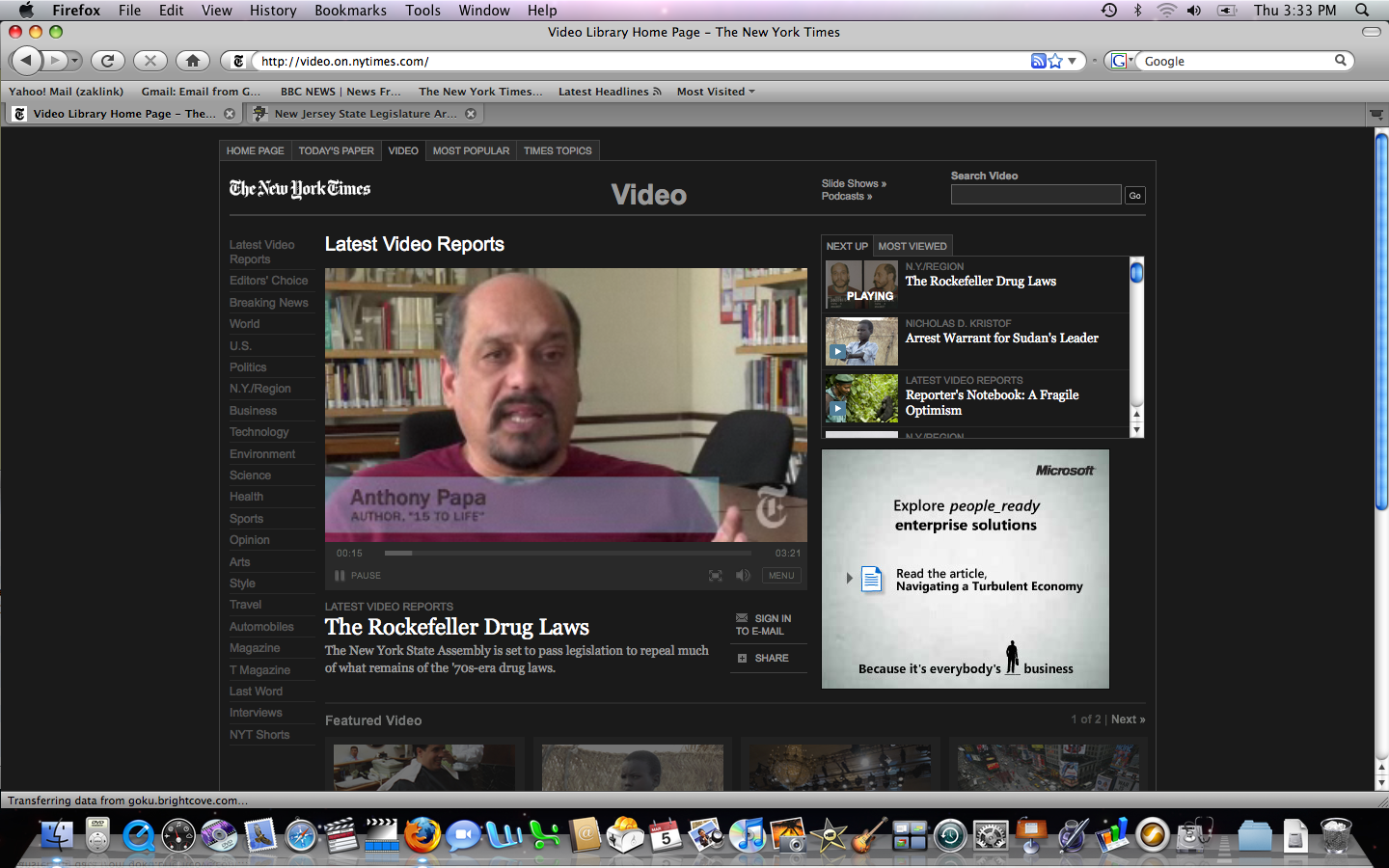
http://news.newamericamedia.org/news/view_article.html?article_id=5bb1982be79fb8d44ab6e06b9f559f5b
Tony
Papa's Vindication
NY
Reforms Rockefeller Drug Laws
New
America Media, News feature, by
Marcelo Ballvé, Posted: Mar 27, 2009
NEW YORK -- As hard as he
fought for it, Tony Papa sometimes thought this day would never come.
Now that it has, he's still not quite sure how to handle it.
An hour after the announced deal on Friday to reform the so-called
Rockefeller drug laws, New York statutes that routinely lead to long
prison sentences for nonviolent drug offenders, Papa sits in his office
cluttered with memorabilia from half a lifetime fighting the laws, and
can't shake the disbelief. "I'm actually still in a daze, really," he
says.
Papa, who had no prior criminal record, was arrested in 1985 as he was
delivering four ounces of cocaine, something he said he did only because
he was desperate for the promised $500 payoff, and sentenced to 15 years
to life. Under the Rockefeller laws, enacted in 1973, the judge had no
discretion to hand down a more lenient sentence. So, like thousands of
young drug offenders sentenced under the laws, the Bronx-born and raised
Papa went straight from the streets to Sing Sing Maximum Security
Prison, with no stops in between. He wasn't given a shot at probation,
counseling or treatment.
The reforms will allow judges more discretion when sentencing and allow
them to order more alternatives like treatment and probation. They also
will eliminate mandatory prison sentences for first- and second-time
drug offenders and retroactively allow more than 1,000 nonviolent
inmates to apply for re-sentencing.
In a recent column at the Huffington Post, a kind of open letter to
Bernard Madoff, Papa describes his time in prison so that the Ponzi scam
artist might know what to expect: "It's about learning how to live in
the present, no matter how bleak the present is. Dwelling on your past
and hoping for the future will become as painful as it is futile. You
will have to forget about life on the outside in order to maintain your
sanity on the inside."
For 12 years, Papa remained on the inside, and it was only the
paintbrush that saved him from more time. He took up art in prison, and
one day the Whitney Museum chose one of his paintings for an exhibit. In
the painting, Papa grips his bald head, a gesture of desperation, while
an inky blackness swirls in the background. A paintbrush points outward,
and a digital watch on his wrist alludes to that common denominator of
prison sentences, however unjustified: time.
He became something of a minor celebrity, an embodiment of what critics
perceived as the laws' fundamental unfairness. Finally, in 1997, Gov.
George Pataki granted him clemency. In the years since, Papa has been
featured in hundreds of articles, news programs and documentaries. He
wrote a memoir about his experiences, “15 to Life: How I Painted My Way
to Freedom,” and co-founded Mothers of the New York Disappeared, which
lobbies on behalf of those trapped in what some activists call the
"Rockefeller Gulag."
Bits and pieces of Papa's career as an artist-activist decorate his
office at the Drug Policy Alliance or DPA, where along with other
staffers he lobbies for an end to the drug war and criminal justice
reform. There are parts to his art installation, "The Drug War," built
around a banner that reads, "According to DPA Zogby poll 45 percent
support making cigarettes illegal within 10 years: Time to build more
prisons?" He also has a binder full of photos with celebrities and
politicians who have supported him, including Def Jam founder Russell
Simmons and, notably, New York Gov. David Paterson.
According to the DPA, 20 percent of the state's prison population was
sentenced for drug violations, and 90 percent are black or Hispanic.
Paterson became governor early last year, when former Gov. Eliot Spitzer
was forced to resign after it was found he was a client of a
prostitution ring. Paterson, the state's first black governor, is highly
unpopular right now, but Papa credits him with loyalty to the movement
for a reform of the Rockefeller laws.
"I knew something positive would happen with him as governor," says
Papa, 49, who wears a salt-and-pepper goatee and glasses. "He's stood by
us for many years. I'm glad that the stars finally aligned."
Prosecutors and some Republican legislators opposed a reform of the
Rockefeller laws. They pointed out that parts of the laws had already
been eased in 2004 and 2005, and argued that further softening of drug
sentencing could lead law enforcement to lose control of crime in the
state and New York City.
Legislators in some upstate districts of New York dependent on prisons
for employment and revenue also tried to oppose the deal. But with the
governor's office and both houses of the legislature controlled by
Democrats, and a budget crisis creating demands for cost cutting,
opponents lost the battle. Democrats say the announced reforms will save
the state $250 million a year.
Although the political will to reform the Rockefeller laws had been
building for months, as recently as three weeks ago Papa still wasn't
sure a deal would go through, since similar efforts had been blocked
before by political maneuverings. "I have a little faith," he said
uncertainly then.
Now, the laws seem headed for the history books, and Papa has another
reason for satisfaction: Three days before, producers of Will Ferrell's
Broadway show on President George W. Bush had optioned his memoir for a
feature film. "I've been waiting a long time for this day," says Papa.
How will he celebrate? "I'm definitely going to have a couple of
drinks."

The project marks Swibel's first
foray into feature film after producing Broadway shows "Xanadu" and Will
Ferrell's "You're Welcome America: A Final Night With George W Bush."
"15 to Life" centers on Papa's
sentence in a New York maximum-security prison for a nonviolent drug
offense. During his 12 years in prison he became an artist whose work
was shown at the Whitney Museum, leading to then-Gov. Pataki granting
him clemency.
Jones, a former
Variety reporter, recently
sold his adaptation of Steven Sherrill's "The Minotaur Takes a Cigarette
Break" to the Gotham Group.
Read the full article at:
http://www.variety.com/article/VR1118001620.html
Flash! 1/7/2009 Paterson Calls for Reform of the Rockefeller Drugs Laws in his State of the State Speech!
|
Flash! Paterson Grants Clemency! A little media pressure works wonders!



ALBANY—Will this actually be the year for Rockefeller Drug Law reform?
"I think we have a better shot than ever if Paterson takes a leadership role," said Anthony Papa, who served 12 years under the laws before he was granted clemency by George Pataki in 1997.
David Paterson mentioned the need to reform the laws in his speech yesterday, saying he "cannot think of a criminal justice strategy that has been more unsuccessful" in its purpose. He was a supporter of reforming the laws as a state senator.
"Even to have the issue addressed in the State of the State is big news. It shows he has some compassion for Rockefeller offenders," said Papa. He noted that a week ago, the laws didn't appear to be on Paterson's radar. The governor eventually granted clemency to one inmate serving a drug crime sentence.
Assembly Speaker Sheldon Silver said he was glad to hear the call for reform in the speech, and called the laws "draconian."
The real shift lies in the State Senate. The laws have been held up there for years, with State Senator Dale Volker leading the charge. Malcolm Smith has said he supports reforming the laws. Skelos was asked about it:
"I'm going to rely on Dale Volker working on that with our conference," he said. "I want to see what reforms we're talking about, but we have to be very careful in terms of any changes that anybody that's been a real drug dealer, they deserve to be in jail."
Another factor is the State Commission on Sentencing Reform, created by Eliot Spitzer to look at the laws. It's unclear how closely Paterson will mirror the commission's recommendations, which Papa doesn't believe will go far enough.
Flash!! 12/30/08 Paterson May Be Scrooge Number Two!
NY Daily News
Elizabeth Benjamin: The Daily Politics
Begging You For Mercy
December 29, 2008
If you count today, there are exactly three days remaining in 2008 and Gov. David Paterson has so far yet to uphold the holiday tradition of doling out executive clemencies to New York prison inmates deemed deserving of early release.
Granted, Paterson, who is in NYC with no public schedule today and hasn't made any public appearances since his Christmas Day visit with the Rev. Al Sharpton, has a lot on his mind these days, what with the whole budget crisis thing and the fight for Hillary Clinton's US Senate seat.
Paterson's press office was mum on the topic of whether he will be granting any clemencies this year, but it seems possible he might follow in the footsteps of his predecessor, ex-Gov. Eliot Spitzer, on this particular issue (as he has in so many areas) and take a pass altogether.
This possibility has drug law reform activists like Anthony Papa, a former drug offender to whom ex-Republican Gov. George Pataki granted clemency in 1997, very worried.
"We are going to get on
Paterson for not granting anyone clemency," Papa wrote in a recent e-mail,
noting that the governor was a big supporter of drug law reform back when he
was a liberal state senator from Harlem.
"He's in Iraq, which is nice for the press," Papa added (the governor was
still traveling on his
Iraq/Afghanistan CODEL at the time). "To forget the war in his own state
is not acceptable."
To illustrate his point, Papa sent over this photo of Paterson speaking at a book party thrown for Papa at the Whitney Museum of Art in 2004 by AG Andrew Cuomo, who has spoken out numerous times about the need to further reform the draconian Rockefeller Drug Laws.
The 1970s-era laws were amended during the Pataki administration to do away with life sentences for the worst, Class A, felonies. But the bulk of offenders are doing time on B-level charges, and the sentence structure for those remains largely unchanged, as does the lack of judicial discretion in most cases to sentence clearly addicted offenders to substance abuse treatment centers rather than prison.
One of Paterson's first acts upon taking over the governor's office from Spitzer was to issue a pardon for Ricky "Slick Rick" Waters, a hip-hop artist convicted in 1991 on attempted murder and weapons charges who was facing deportation to the UK.
Spitzer granted a pardon request, too. But, as Papa noted, he provided no clemencies to drug offenders, leading activists to label the former governor a "Scrooge."
Prior to Spitzer's pardon of Frederick Lake, a Brooklyn man who faced deportation to Jamaica due to his conviction of a 1989 robbery, the last gubernatorial pardon granted in New York occurred in 2003. It was posthumously awarded by Pataki to the comedian Lenny Bruce, who had been convicted of "using foul language in public."
Unlike a pardon, which erases a conviction from the records, a clemency merely reduces an offender’s sentence. The Parole Board must sign off on clemencies, but historically it has rarely opposed a governor’s wishes.
Flash! Over 5 million individuals that were convicted of felonies will be barred from voting in the presidential election!
http://www.syracuse.com/opinion/ 10/8/2008
|
The Post Standard (Syracuse) |
|
Right to Vote Federal law needed to protect ex-felon voting rights Wednesday, October 08, 2008 By Anthony Papa More than 5 million people convicted of felonies will be barred from voting in the upcoming presidential election. This is a mind-boggling number of people who will be disenfranchised. The most alarming aspect is that many of them are eligible to vote but don't know it. In New York state, if you are convicted of a felony, you automatically lose your right to vote. According to the New York State Division of Parole, your right to vote is restored once you have completed either parole or your maximum sentence. If you are on probation, your right to vote is never taken away. But most ex-felons do not know this. When I was released from prison after serving 12 years under the Rockefeller drug laws, I had no clue about my eligibility to cast a vote. When I went to register to vote I was shocked when they informed me that I had to wait until I was first released from parole. I felt the pain of felony disenfranchisement since it seemed I was being further punished for my crime. I saw my Queens neighborhood deteriorating around me but was powerless to do anything about it by casting my vote. I was elated when, after waiting for five years, I got off parole and was able to cast my first vote since being released from prison. I felt then like I was fully welcomed back by society as a citizen. According to the American Civil Liberties Union (ACLU), in New York state more than 100,000 people are convicted of felonies every year. A record 115,573 people were convicted of felony offenses in 2007. Nearly 62,300 of those who are convicted are currently on probation for felonies. This amounts to hundreds of thousands of individuals who probably think they cannot vote forever. There is a growing concern among the public and policymakers for these people to discover their eligibility to cast a ballot. New York State Assemblyman Nick Perry of the 58th District of Kings County is one of those concerned. He currently is sponsoring legislative bill A4107, which would require the Division of Criminal Justice Services to notify former inmates that their right to vote has been restored within 30 days prior to their release. In addition, it would require voter registration forms to be provided to these individuals. The bill will help former inmates reintegrate more fully into society by empowering them with the right to vote. You may wonder why prisoners are not notified of this right. I think the problem lies in the voting system itself. In a report by the Brennan Center and the ACLU, based on hundreds of interviews with New York election officials, they found that one third of them did not know that individuals on probation could vote. The report urged states to better train election officials and to eliminate complicated registration procedures and paperwork to make sure criminal defendants are fully informed about their voting rights. Even at the federal level, legislation was introduced last week that would restore the right to vote in federal elections to individuals who were previously convicted of a crime, completed their prison terms and are living in the community. The Democracy Restoration Act of 2008 (DRA, S. 6340, H.R. 7136) was introduced in both chambers of Congress by Sen. Russ Feingold, D-Wisc., and Rep. John Conyers, D-Mich. Exercising the right to vote should be an important part of a prisoner's rehabilitation. It's an act that makes one feel whole again following years of losing those rights as part of a punishment for crimes committed. If, through voting, individuals can become involved in the political process, they have a much better chance of fully integrating back into society. Anthony Papa is the author of "15 To Life" and communications specialist for the Drug Policy Alliance in New York. © 2008 The Post-Standard. Used with permission. |

A coalition of concerned citizens in Alabama is shaking up the GOP with their goal of registering voters in the most unlikely of places -- state prisons. A voter registration drive led last week by Rev. Kenny Glasgow, began registering prisoners to vote, a right guaranteed under Alabama's State Constitution, so they could cast absentee ballots.
The drive was originally embraced by Richard Allen, the commissioner of corrections in Alabama, but it was stopped when he received a letter on Thursday from the Alabama Republican Party opposing the drive. Its chairman, Mike Hubbard, told Mr. Allen that the party supports voter registration but not for prisoners, citing a need for safeguards against possible voter fraud.
Rev. Glasgow challenged this statement and said, "Voter registration drives are an essential part of our democracy. This action by the GOP and the Department of Corrections smacks of voter intimidation. Our focus isn't politics, its restoration. We're just doing what the Bible says, visiting people in prison and ministering to them. The chairman of the Republican Party and the chairman of the Democratic Party can go into prisons with us and monitor the registration process to make sure it's nonpartisan, if that's a concern."
In Alabama, nearly 250,000 people have been stripped of their right to vote due to a felony conviction. But, in a 2006 court ruling which was the result of a lawsuit by Ryan Haygood of the NAACP Legal Defense Fund, a judge found that only those persons convicted of felonies of "moral turpitude" lose their right to vote. The judge found that certain felonies -- such as drug possession -- do not constitute crimes of moral turpitude and, therefore, individuals convicted of those crimes do not lose their voting rights, even during incarceration.
Rev. Glasgow's organization, Alabama-based The Ordinary People's Society (TOPS) and their national partner, the Drug Policy Alliance, estimate that more than 50,000 people convicted in Alabama of felonies falling outside the "moral turpitude" definition have been wrongly denied their right to vote, or anyway believe they lost that right due to a felony conviction.
While drug use is proportionally equal across all racial lines, African Americans are incarcerated for drug crimes at much higher rates than whites. Blacks make up only 26 percent of Alabama's population but are nearly 60 percent of the prison population. And, for every white person in an Alabama jail, there are about four black people.
"We've got to start restoring people's lives by providing treatment, by restoring the right to vote," said Reverend Kenneth Glasgow, TOPS executive director and state coordinator of their New Bottom Line campaign. "When a person gets a felony conviction, they can lose more than their voting rights; they can lose public assistance, public housing and financial aid for school. The drug war has become a war on people and we now spend more on incarceration than on treatment. Why do we spend more on producing criminals than producing citizens? We need a new bottom line."
The right to vote is an important part of the rehabilitation process and should be given to those who have paid their debt to society. An estimated 5.3 million Americans are denied the right to vote because of laws that prohibit voting by people with felony convictions. A few years ago, I was one of those Americans. I was on parole and could not vote after serving 12 years of a 15-to-life sentence for a nonviolent drug crime under New York's draconian Rockefeller Drug Laws. After my release, I felt the pain of felony disenfranchisement since it seemed I was being further punished for my crime. I was elated when, after waiting for five years, I got off parole and was able to cast my first vote. I felt I was fully welcomed back by society as a citizen.
"Alabama state law makes it clear that people incarcerated for simple drug possession never lose their right to vote, even while incarcerated," said Glasgow. "The GOP and the Alabama Department of Corrections cannot decide on their own which constituencies are going to have access to the vote, and which will be barred from it. We live in a democracy, after all."
Anthony Papa, author of 15 To Life: How I Painted My Way To Freedom, is a communications specialist for the Drug Policy Alliance.
--------------------------
http://www.huffingtonpost.com/anthony-papa/susan-sarandon-stop-the-e_b_128086.html
By Anthony Papa Posted September 21, 2008
On September 23rd at 7pm Troy Davis
is set to be
executed by lethal injection by the State of Georgia. He maintains his
innocence in the 1989 murder of police officer Mark Allen MacPhail. Davis
was convicted on August 19, 1989. Since then several major witnesses
recanted their testimony. Their statements were the crux of the
prosecutorial evidence used to convict Davis, since no other significant
evidence such as a murder weapon, DNA or fingerprints were found.
The quest to save Troy Davis has received worldwide attention. Pleas from
important and respected leaders such as Pope Benedict XVI, former president
Jimmy Carter and Nobel Peace Prize-winner Desmond Tutu have been heard. His
pleas for clemency have been turned down twice by the Georgia State Pardons
and Parole Board.
Amnesty International conducted an extensive examination of the case,
documenting the many recantations, inconsistencies, contradictions and
unanswered questions. Its report on the case drew widespread attention, both
in the U.S. and overseas.
Georgians for Alternatives to the Death Penalty and the NAACP said they
are planning a rally at 11 a.m. on September 22nd in front of the State
Capitol to stay the execution of Davis. What might be too little too late,
the United States Supreme Court will hear an appeal on September 29th.
Actor/Activist Susan Sarandon in a recent letter she wrote to the Georgia
State Board of Pardon and Parole stated
"Despite mounting evidence that Davis may be in fact be innocent of the crime, appeals to the courts to consider this evidence have been repeatedly denied for procedural reasons. Instead, the prosecution based its case on the testimony of purported "witnesses," many of who allege police coercion and most of whom have since recanted their testimony. One witness signed a police statement declaring that Davis was the assailant then later said "I did not read it because I cannot read." In another case a witness stated that the police "were telling me that I was an accessory to murder and that I would...go to jail for a long time and I would be lucky if I ever got out, especially because a police officer got killed...I was only sixteen and was so scared of going to jail." There are also several witnesses who have implicated another man in the crime but the police focused their efforts on convicting Troy.
It is deeply troubling that Georgia
might proceed with this execution given the strong claims of innocence in
this case. It has been repeatedly demonstrated that our criminal justice
system is not devoid of error and we now know that since 1973, 129
individuals have been released from death rows across the United States due
to wrongful conviction. We must confront the unalterable fact that the
system of capital punishment is fallible, given that it is administered to
demonstrate your strong commitment to fairness and justice and commute the
death sentence of Troy Anthony Davis."
Thank you for your consideration.
Sincerely, Susan Sarandon
Even family members of those who were violently murdered speak out against the execution of Troy Davis. Derrel Myers, a bereaved father who lost Jojo, his 23 year old son, speaks eloquently about his son's death and how he came to terms with it in a interview on Raising Sand Radio
You can protest this travesty of
justice by calling the Georgia Board of Pardons and Paroles to reconsider
its clemency decision, telephone board chair Gale Buckner at
More information on the case can be found at www.gfadp.org and www.troyanthonydavis.org. Please support the Campaign to End the Death Penalty Martina Correia, sister and advocate of Troy Davis is scheduled to speak at the Critical Resistance Conference in Oakland on September 27, 2008
Listen to or download today's show:
http://www.radio4all.net:8080/files/sgalleymore@hotmail.com/3035-1-papa_mix.mp3
Tony Papa spent 12 of 15 years
of his youth in Sing Sing Prison for a minor drug offense. While there, he
learned about art and to paint. Today, he is active against the prison
system and draconian drug laws while also working to highlight the nature of
prison. He is communications specialist for the
Drug Policy Alliance and regularly exhibits his artwork.
Raising Sand live Monday from 2 - 3 pm Pacific time, FM 90.1
streaming from 2 - 3 pm Pacific at http://kzsulive.stanford.edu/
Listen anytime to the archived show onwww.raisingsandradio.org or http://raisingsandradio.blogspot.com.
(Note:if the server becomes too busy and does not download the show, log on
and listen later.)
Last week's show:
Dr. Michael Parenti is an
internationally known award-winning author and lecturer and one of the
nation’s leading progressive political analysts. As author of 20 highly
informative and entertaining books - his latest is Contrary Notions- and
innumerable talks his ideas have reached a wide range of audiences in North
America and abroad.
Listen:
http://www.radio4all.net:8080/files/sgalleymore@hotmail.com/3035-1-capitalism2_mix.mp3
Thanks for listening and let us know what else you'd like to hear on Raising
Sand.
Susan Galleymore
Raising Sand Radio
KZSU Stanford, FM 90.1
susan@raisingsandradio.org
www.raisingsandradio.org
http://blogs.kansascity.com/unfettered_letters/2008/09/database-wont-s.html
Database won’t stop meth labs
The war on drugs has created convenient vehicles of looking tough on crime while hiding being the shield of public safety. But that shield gets worn down when our basic rights are curtailed through its use. It’s not enough that federal laws were created forcing cold sufferers to jump through ridiculous hoops to purchase what were originally over-the-counter medications.
Now it seems that costly electronic tracking systems will soon be implemented in Kansas and Missouri with the possibility of spreading to other states across our country (9/9, A-1, “Database aims to foil meth ‘smurfers’; A pilot program seeks to stop meth cooks from going from store to store to buy cold medications”).
We need to invest scarce public resources into educating the public about the use of meth and providing high quality treatment options to fight addiction. This is a much better idea that creating more law enforcement tools that are downright intrusive and layer on ineffective bureaucratic busywork.
It might not be apparent now, but neither was our right to not be hassled when buying cold medicine before the law changed.
Anthony Papa
Communications specialist, Drug Policy Alliance
New York

The artist's role as social commentator and activist has historically been engrained in our culture. Art and its creation as a response to social and political issues can become powerfully influential in raising public awareness that results in positive change.
Art as a social weapon has been around for a long time. Recall the great German expressionist painter Kathe Kollwitz, who created works of art that centered on themes such as poverty, unemployment and worker exploitation. Diego Rivera and the other Mexican muralists used their art as a tool for the oppressed against their oppressors. They expressed their opinions and got their message across to the literate and illiterate alike, and earned worldwide recognition. In April 1937, the world learned the shocking truth about the Nazi Luftwaffe's bombing of Guernica, Spain -- a civilian target; Pablo Picasso responded with his great anti-war painting, Guernica.
Few public policies have undermined fundamental human rights and civil liberties, social justice and public health for so long and to such an extent as America's 35-year-long drug war. Today almost two and a half million people are behind bars because of this "war." In 1988 while serving a 15-to-life sentence under the Rockefeller Drug Laws, I discovered my talent as an artist. One night while sitting in my 6 x 9 cell I picked up a mirror and saw the face of individual that was to spend the most productive years of his life in a cage. I picked up a paintbrush, put color to canvas and painted the image I saw. About seven years later that piece, titled "15 to Life," was exhibited at the Whitney Museum of American Art. Two years later I was granted executive clemency by the governor of New York.
On Wednesday, September 3rd, the Drug Policy Alliance (DPA) will host re:FORM, an art auction and cocktail party benefit at Cheim & Read gallery in New York. re:FORM will benefit DPA, the nation's leading organization promoting alternatives to the drug war that are grounded in science, compassion, health and human rights. re:FORM represents the second installment in a groundbreaking partnership between the art world and the drug policy reform movement, following DPA's first successful event in 2005. DPA will use the occasion to honor three dear friends of the organization: Donald Baechler, Dr. Mathilde Krim and Fred Tomaselli.
Proceeds from the art exhibit and auction will benefit DPA and be used to respond to the destructive consequences of the war on drugs. The U.S. now has the highest incarceration rate in the world -- one American adult out of every 100 is currently behind bars. More than 700,000 Americans were arrested last year for simple marijuana possession. The drug war even targets sick and dying Americans, thousands of whom are regularly denied access to medical marijuana, a medication with proven medical benefits for the treatment of a wide range of serious illnesses.
Works of 50 visual artists, among them Louise Lawler and Kara Walker, will be auctioned off. The benefit's co-chairs are John Cheim, James Cohan, Jason Flom, Howard Read and George Soros. Honorary co-chairs are Darren Aronofsky, Alba Clemente, Walter Cronkite, Peter Lewis and Russell Simmons. "We are amazed and grateful that so many leading artists are willing to support our work," says Ethan Nadelmann, executive director of DPA. Their donations of time and their work will empower our efforts to reform the draconian drug laws that cause so much more harm than good."
This art auction benefit is inspired by past artists who have used art as a vehicle for social change. I hope this show will enlighten others to join us in our attempt to stop the madness of the war on drugs.
For more information please visit drugpolicyevent.org September 3 , 6-8pm, at the Cheim & Read Gallery 547 W 25th St, New York, NY 10001
http://www.huffingtonpost.com/anthony-papa/mayors-dogs-gunned-down-b_b_117329.html
On July 29, police burst into the home of Berwyn Heights Mayor Cheye Calvo and immediately shot to death his two Labrador retrievers. They were there to conduct a search for drugs. The raid was conducted by county police narcotics officers and a sheriff's office SWAT Team.
The incident occurred after Calvo carried in a package that was addressed to his wife. The mayor's mother-in-law had told the deliverymen, who were actually undercover police officers, to leave the package outside of his house. When Calvo arrived home that night, he brought the package inside. That's when the police broke down the door and immediately opened fire on the mayor's two dogs as they ran away from the narco-cops.
Police began tracking the package at a Midwest post office where drug sniffing dogs had discovered that the package contained 32 pounds of marijuana. Calvo said he had no idea how the package arrived at his home and that the sheriff's deputies entered without knocking. Then they immediately executed Payton, his 7-year old dog first, followed by Chase, a 4-year-old Lab, as he ran to another room.
Upon further investigation, it was found that the police did not even bother to secure a needed no-knock search warrant. Timothy Maloney, the mayor's attorney described the incident as a lawless act by law enforcement.
Calvo has not been charged, though police said he, his wife and his mother-in-law are all "persons of interest" in an ongoing investigation. The mayor said, "These were two beautiful black Labradors who were well-known in the community. We walked them twice a day; little kids knew their names and would come up to them and pet them," he said.
What makes this case unique is that this raid happened to a well known elected official. What is not unique is that these gestapo-like tactics happen every day in communities across America.
The drug war is an endless crusade by our government to promulgate its senseless zero-tolerance drug policies by any means necessary. This war on drugs has created convenient vehicles for appearing "tough on crime" behind a shield of public safety. But that shield gets worn down when our basic rights are curtailed through its use. We need to promote policy alternatives to the drug war that are grounded in science, compassion, health and human rights. In doing so we can reduce the harms of both drug misuse and drug prohibition, and seek solutions that promote safety while upholding the sovereignty of individuals over their own minds and bodies.
Anthony Papa is a communications specialist for Drug Policy Alliance
_______________________
|
Flash! NY Times to governor - rockefeller reform now!
May 27, 2008
Enacted in 1973, New York’s Rockefeller drug laws penalized some first-time drug offenders more severely than murderers. Named for Nelson Rockefeller, who was governor at the time, the laws tied the hands of judges and mandated lengthy sentences for young offenders who often deserved a second chance. The laws, which were supposed to ensnare “kingpins,” have filled the prisons with drug addicts who would have been better dealt with through treatment programs. They also undermined faith in the fairness of the justice system by singling out poor and minority offenders while exempting wealthy ones.
New York has made incremental changes in laws in recent years but has failed to restore judicial discretion. A sentencing commission appointed by Eliot Spitzer, the former New York governor, pretty much ducked the issue in an interim report issued last fall. But criminal justice advocates have higher hopes for Mr. Spitzer’s successor, David Paterson, who spoke out vigorously for Rockefeller reform as a state senator. He was arrested while demonstrating against the laws in 2002.
If Governor Paterson is looking for motivation to take on this issue, he can find it in a recent report from The Correctional Association of New York, a nonprofit group that monitors prison conditions. According to the report, New York is currently paying $500 million a year to house its drug offenders. The costs are rising as more people go to prison for minor, nonviolent drug offenses.
The law often metes out long prison terms to addicts, petty dealers or people only peripherally involved in the trade. Indeed, 4 in 10 drug offenders in the state’s prisons were locked up for possession as opposed to selling. These are hardly kingpins. In fact, nearly half the drug offenders in the state’s prisons were convicted of the lowest level crimes.
Many of these people are clearly addicts who would benefit from treatment. But the mandatory sentencing guidelines limit the courts’ ability to choose the treatment option. It is long past time for New York to overturn these laws and to return judicial discretion. Governor Paterson, who can cite chapter and verse on this issue, should to take the lead in this important fight.
__________________________________

May 15, 2008 Rewrite New York's
Rockefeller drug laws It's positive on two fronts that the state Assembly plans to be in
Rochester today for hearings on the outdated and draconian Rockefeller
drug laws. Speaker Sheldon Silver should do more to combat the impression that he and his conference don't appreciate the severity of upstate's struggling economy. On such questions as the revitalization package, school tax caps, consolidation and others, he should work harder to understand this region's particular concerns. Two, the Rocky drug laws, on the books for 35 years, have proved ineffective in halting drug-related crime in New York. The need for reform was evident 20 years ago, and if the hearing helps to move the Legislature off the dime on this, it will have achieved much. The Senate has been a long-standing obstacle, in part because emptier prisons could hurt some upstate communities. The chief problem with the existing drug laws is that they employ incarceration and rigidity in sentencing as an answer to the drug crime problem. Tough laws are important — they have helped reduce crime in New York as well as the prison population. But current laws focus far too much on slapping long prison sentences on low-level drug sellers or buyers. That doesn't get to the kingpins and pushes people into prison who should be getting treatment. The cost to the state is sizable — $35,000 to keep someone in prison for a year as opposed to a residential drug treatment program at about $20,000 a year. The thought 35 years ago was that tough medicine would cure all ills.
That hasn't worked. |
Towards Rockefeller Drug Law Reform
The AWEARNESS Blog provides daily updates under four socially-aware pillars of discussion: Social Rights, Well-Being, Political Landscape and Hard Times.
http://awearnessblog.com/2008/05/towards-rockefeller-drug-law-r.php
On May 3, 1973, when murder and robbery
rates were
significantly higher than they are now,
then-Governor Rockefeller signed the bill
containing some of the harshest drug laws in
the nation. Rockefeller, a moderate
Republican, was, at the time, mulling a
White House run and wanted to toughen up his
country club image among the party's
red-meat base. The Rockefeller drug laws
have largely remained, despite protests from
so many
disparate organizations and
individuals, because of law-and-order
electoral realities at the local level.
"Under these laws," wrote
Anthony Papa, an ex-convict, in the
Gotham Gazette, "people convicted of
drug offenses face the same penalties as
those convicted of murder, and harsher
penalties than those convicted of rape."
Papa spent a dozen years in the New York
prison system under the Rockefeller Laws on
a first-time non-violent drug offense. He
has devoted his life to reforming those
laws. Papa's prison autobiography is called
"15 to Life: How I Painted
My Way Top Freedom." That title comes
from the fact that Rockefeller Drug Law
statutes generally require judges to impose
minimum 15-years to life sentences for
anyone convicted of selling two ounces, or
possessing four ounces of a "narcotic drug
(marijuana included)."
Democrat Assemblyman Joseph R.
Lentol, who voted against the laws
in 1973, told Clyde Heberman
of
The New York Times, "We're on the
precipice of real Rockefeller law reform."
As of 2008, at a cost of hundreds of
millions of dollars, 14,000 people, or
nearly 38% of state prisoners, are
incarcerated for drug offenses. Last
Thursday was 35th anniversary of the
Rockefeller Law.
May 13, 2008
New York governors come and go (some more swiftly than others). State lawmakers tend to hang around longer, but most of them eventually move on as well. For true endurance, the statutes known as the Rockefeller-era drug laws are hard to beat. The same may be said about attempts to scrap those laws, which came into being in 1973, so long ago that disco was just beginning to be hot.
Nelson A. Rockefeller was governor then. Drug criminals had New York by the throat in one of the city’s periodic heart-of-darkness phases. Rockefeller wanted to show he could be tough as nails with dope dealers. The result was statutes that eternally bear his name in common idiom. Their essence was to send drug felons to prison for very long stretches, with sentences made mandatory and leniency rendered unacceptable even for first-time offenders.
The laws were amended in 2004 and 2005, to ease some of the most severe sentences. By then, they had been deemed overly harsh by most New Yorkers, save perhaps those with portraits of Torquemada on their walls. Occasional polls, like one for this newspaper in 2002, show that New Yorkers overwhelmingly would grant judges more of a free hand in sentencing. That includes a chance to send drug-addicted small fry into treatment rather than to prison.
We are now in a moment when the laws are being scrutinized again, in public hearings organized by a consortium of six New York State Assembly committees. A first round was held in Manhattan last Thursday, on the 35th anniversary of the laws’ signing by Rockefeller, and a second round is planned for Rochester on Thursday.
Judging from the remarks of Assembly members at last week’s session, they want major change, in particular to expand “judicial discretion” over the fate of convicted drug offenders. “We’re on the precipice of real Rockefeller law reform,” said Assemblyman Joseph R. Lentol, a Brooklyn Democrat. Mr. Lentol is among half a dozen lawmakers who were in the Legislature back in 1973. He voted against the laws then, and doesn’t like them any better now.
But it is far from clear what, if anything, lies beneath that precipice. The State Senate, dominated by Republicans, albeit with a weakened grip, has not been eager to join the Democratic-led Assembly in tossing the Rockefeller laws over the edge.
Indeed, positions have shifted little over the years.
Those who raise cries of “drop the Rock” say that mandatory sentences are mindless and unfair to nonviolent offenders, that they give too much power to prosecutors and not enough to neutral judges, that they steer too many low-level schnooks away from relatively inexpensive rehab that would serve them (and the state treasury) well, and that they are directed disproportionately hard toward African-Americans and Latinos.
A leading critic of the laws, the Correctional Association of New York, says that their effect is to give elected officials from 35 years ago, many of them dead, more power over today’s narcotics cases “than the judges who currently sit on the bench and hear all the evidence presented.”
In the same camp, you would probably find the present governor, David A. Paterson. He has not spoken up on the subject of late, but he got himself arrested in an anti-Rock protest six years ago, when he was a state senator.
On the other side are those, including many of the state’s district attorneys, who say that the threat of tough sentences is enough to induce some addicted drug violators to seek treatment. And don’t kid yourself, prosecutors say; street-corner dealers, even if not necessarily “drug kingpins,” are violence-breeding menaces. Neighborhoods, they say, are well rid of these lowlifes.
On the laws’ 35th anniversary, each side went to the hearing armed with anecdotes and statistics. A figure that stood out, though, was one that went unmentioned.
Bridget G. Brennan, the special narcotics prosecutor for New York City, noted that in 1970 there were 1,146 homicides in the city. (Police records put the number at 1,117, but that’s not the point.) In 2007, that figure had been sliced to 496. The implication was that we could thank the Rockefeller laws for this marvelous result.
Unmentioned was another number: 2,245. That’s how many homicides the city recorded in 1990, our most blood-soaked year.
So for 17 years, starting with 1973, the murder rate grew and stayed implacably high, even with the Rockefeller laws. Then, over the next 18 years, the rate dropped sharply. The roller-coaster statistical ride is enough to make one wonder, at least in regard to murder, if the Rock really had anything to do with the numbers going up or down.
Flash! May 8th 35th Anniversary of the Rockefeller Drug laws
http://www.youtube.com/watch?v=FhYUZ5o9dx8
Anthony Papa interview on RNN /Rockefeller Drug Laws
Anthony Papa Communication Specialist for the Drug Policy Alliance on RNN talking about the 35th anniversary of the Rockefeller Drug Laws...RockefellerDrugLaw DrugPolicyAlliance cocaine drugwar ondcp mandatorysentencing
http://www.ny1.com/ny1/content/index.jsp?stid=3&aid=81357
|
Politics |
|
|
|
|
|
|
State Assembly Reexamines Drug Policy |
|
May
08, 2008
|
|
Regional News Network (RNN TV)
Rockefeller Drug Laws: Marking 35 Years
Interview with Anthony Papa:
Rockefeller Drug Laws: Marking 35 Years
Capital News 9
Re-examining Rockefeller drug laws
Updated: 05/08/2008
09:08 PM
By: Josh Robin
NEW YORK STATE -- Juan Jordan calls them lost years.
"They could have helped me to address my problem. Instead they sent me to jail," Jordan said.
Hooked on heroin, the Bronx man was caught selling drugs in the early ‘80s. As soon as he got out, he would be back dealing again, serving in all 12-and-a-half years.
“I was selling drugs to support my habit. And that was everything that I know to do,” Jordan said.” I was a heroin addict."
His travails mirror many since May 8th, 1973, when Governor Nelson Rockefeller signed bills stiffening punishment for drug crimes. It made New York safer, but at a huge cost, say those marking the anniversary.
"Thirty-five years of Rockefeller drug laws means that tens of thousands of people's lives have been wasted. People who have might justly have served two or three or four years went behind for 12 or 13 or 14 years," said Ethan Nadelmann of the Drug Policy Alliance.
"For major crimes like murders, judges have the final say. When it comes to drug cases, he has to defer to the district attorney. What kind of justice is that?" asked Joe Lentol.
Governor Paterson is a strong opponent of the laws, even getting arrested at a 2002 rally when he was a state senator. He and State Senate Majority Leader Joe Bruno deferred to a commission examining the state's sentencing.
But despite all of the passion, critics pose a question -- how much reform is actually needed?
"When you're looking at the Rockefeller drug laws, keep in mind the problems that they were looking to address and they were very successful and addressing those problems," said Bridget Brennan, a special narcotics prosecutor.
That was a scourge of heroin, followed by crack.
Drug crimes are now dropping. From more than 23,000 state inmates in 1996 to a little more than 13,000 thousand this year. It’s the lowers it has been in 20 years and only accounts for a fifth of the prison population
New York's special narcotics prosecutor criticizes recent changes in the last few years, which she says aided high-level traffickers.
"We also don't want to start to see crime escalate in neighborhoods in the city that are still overrun with drug dealing," Brennan said.
She advocates drug treatment for addicts, a goal also pushed by those opposing the law.
Copyright ©2007 TWEAN News Channel of Albany, L.L.C d.b.a. Capital News 9
http://www.empirestatenews.net/News/20080509-6.html
| Empire State News: NYCLU claims Rockefeller Drug Laws cause racial disparities, huge taxpayer burden |
|
NEW YORK
- At a legislative hearing held in Manhattan, the New York
Civil Liberties Union presented testimony illustrating the stark
racial disparities and enormous financial burden generated by
the Rockefeller Drug Laws in New York City.
Robert Perry, the NYCLU’s legislative director, testified at the joint hearing of the State Assembly’s standing committees on codes, judiciary, correction, health, alcoholism and drug abuse, and social services. “We urge you, as legislative leaders, to advance the critique of a sentencing structure that ties the hands of judges, grants prosecutors enormous and essentially unreviewable powers, and results in the routine miscarriage of justice,” Perry said. Using maps created by the NYCLU and Justice Mapping Center, Perry showed legislators that 25 percent of adults sent to prison from the city come from areas, black and Latino communities, with only 4 percent of the city’s adult population. More than half are incarcerated on drug offenses and 97 percent are black or Latino. A second map showed that state taxpayers will spend more than $1.1 billion to imprison New York City residents convicted of drug offenses in 2006 over the course of their prison terms. Drug offenses will account for more than 40 percent of prison costs for all city residents sent to prison that year. “The Rockefeller Drug Laws are unjust, inhumane and ineffective,” said NYCLU Executive Director Donna Lieberman, who did not testify. “Our lawmakers can end this chronic injustice. They must muster the courage to restore judicial discretion to drug sentencing and explore alternatives to incarceration that treat non-violent drug offenders instead of locking them away for years.” Enacted in 1973, the Rockefeller Drug Laws mandate extremely harsh prison terms for the possession or sale of relatively small amounts of drugs. Supposedly intended to target drug kingpins, most of the people incarcerated under these laws are convicted of low-level, nonviolent offenses, and many of them have no prior criminal record. Despite modest reforms in 2004 and 2005, NYCLU says the Rockefeller Drug Laws continue to deny people serving under harsh sentences the ability to apply for shorter terms, and restrict the power of judges to place addicts into treatment programs. |
|
|
BY ZACHARY R. DOWDY
May 9, 2008
As
spectators booed and cheered, defense attorneys, prosecutors, treatment
providers and reformers testified before state lawmakers yesterday about the
ongoing battle of approaches in enforcing drug laws and rehabilitating
offenders.
The daylong hearing in Manhattan marked to the day the 35th anniversary of
the enactment of the Rockefeller Drug Laws, a set of mandatory sentencing
measures that made New York one of the most punitive states.
Speakers urged the panel to build on amendments to the laws in 2004 and
2005, with most calling for a more public-health based approach over a
criminal justice strategy. Those alterations lifted the most draconian
elements of the laws, such as lifetime incarceration for the most severe
offenses.
The hearing is part of a process to determine what else should be done.
"The city bar believes more should be done," said Robert Gottlieb, an
attorney in Commack and Manhattan, speaking for the criminal justice council
of the bar association of New York. "Allow them into drug treatment, not
prison."
Judy Whiting, of the city bar's corrections committee, said the Rockefeller
Drug Laws have wreaked "collateral consequences" on people convicted of drug
offenses and their families and communities.
"People convicted of drug-related felonies face really serious obstacles to
joining society once they are released," she said.
Lisa Schreibersdorf, president of the state Association of Criminal Defense
Attorneys, said legislators should adopt laws to "wipe away" a first-time
offender's record for minor drug offenses.
Bridget G. Brennan, special narcotics prosecutor for New York City, said
reforms to the drug laws have reduced the amount of time people serve in
prison and the number of inmates in for drug offenses without lifting the
threat of incarceration that motivated many to kick the habit.
"The threat of incarceration is critical to the success of our programs -
and it is a critical element in the success of our efforts to keep dealers
from taking over buildings, blocks and neighborhoods," she said.
Brennan echoed prosecutor Rhonda Ferdinand, who runs alternatives to
incarceration (ATI) programs for the city. "The plain and unvarnished truth
is that for the ATI process, the harsh sentences of the Rockefeller Drug
Laws was the backbone of our success," she said, drawing hisses and boos in
response.
"Drug cases are on the wane, so somebody's doing something right," said
Assemb. Joseph Lentol (D-Brooklyn). "The answer may lie somewhere in
between" reducing penalties and giving incentives for treatment and curbing
the drug trade.
Copyright © 2008, Newsday Inc.
Piden tratamiento médico a cambio de una celda
Alexandra Ochoa / Alexandra.ochoa@hoynyc.com |
2008-05-09
Luego de 35 años de la aplicación de las leyes Rockefeller, ayer la Asamblea Estatal de Nueva York sostuvo la primera audiencia, de dos, con miras a cambiar los castigos excesivos por una política de salud pública para los ofensores por narcóticos.
Un grupo de manifestantes, entre activistas, políticos electos, ex convictos y sus familias sostuvieron ayer una protesta frente a las oficinas de la Asamblea para apoyar una reforma a las leyes que durante décadas ha enviado a miles de adictos a las cárceles por porte de dosis mínimas en lugar de ofrecerles un tratamiento para superar su adicción.
"Estar en la cárcel fue una pesadilla que pude superar por mi fe en Dios", dijo Anthony Papa, quien estuvo 12 años en prisión por llevar 4 onzas de cocaína en 1985. "Yo se que estar en la cárcel no le ayuda a nadie a dejar las drogas por eso estamos pidiendo un acercamiento diferente al problema".
Según los números de Drug Policy Alliance, un 90% de los presos por asuntos de drogas son afro americanos y latinos.
Un proyecto de ley introducido por el líder de la minoría del senado estatal el año pasado, Eric Schneiderman, se encuentra en estudio.
"La guerra contra las drogas ha sido sin duda la política social más devastadora y disfuncional desde la esclavitud", dijo Jack Cole, director de Law Enforcement Against Prohibition.
Journal News editorial
May 8, 2008
Happy anniversary - not!
New York state is as conflicted as they come when it comes to drug crime and punishment. Policy-makers loathe drug dealers but pursue anti-drug strategies that do little to reduce the number of users; they lament the inefficiencies associated with maintaining half-empty state prisons, but worry more about the job losses and lost political clout that would come with consolidating prisons; many acknowledge the unfairness of our so-called Rockefeller drug laws, which are responsible for imprisoning thousands upon thousands of relatively minor offenders, but fail to muster the political will to untangle the 35-year-old mess. Our drug laws not only are ineffective, but also hinder efforts to pursue policies that might rehabilitate people and whole communities.
Today marks the 35th anniversary of the drug laws passed on then-Gov. Nelson Rockefeller's watch, but there will be no celebrations, just Assembly hearings in Manhattan on their ineffectiveness, 10 a.m. in the Assembly Hearing Room, 250 Broadway, Room 1923. Long-touted legislative reforms enacted in 2004, with an eye toward shortening the sentences of the nonviolent offenders serving the longest mandatory sentences, resulted in freedom for just 400 offenders. Much more should be done to fix drug laws that Robert Gangi, executive director of the Correctional Association of New York, calls "outdated, wasteful, ineffective and marked by racial bias."
Long prison terms
The hallmark of the Rockefeller measures was long, mandatory sentences for those arrested for even small amounts of illegal drugs, curtailing the discretion exercised by judges. Possession of just 4 ounces of cocaine would bring sentences of 15 years to life in prison. The New York measures were among a spate of mandatory drug laws enacted across the nation in the 1970s, spurred in large part by rampant drug violence. Such related crime, though creeping up in some communities, has subsided in New York; what hasn't is the number of drug arrests, which have more than doubled since 1980, with the overwhelming number of arrests for possession, not distribution.
Over the years, several studies have pointed to racial disparities inherent in the measures, which have tended to mete out harsher punishment for offenders caught with small amounts of drugs like crack, more prevalent in minority communities, than even larger amounts of drugs like cocaine, more prevalent among white offenders. About 14,000 people are currently serving time in New York prisons for drug offenses, nearly 40 percent of the prison population, at an annual cost of approximately $36,000 per inmate. The imprisoned are disproportionately racial minorities.
Resisting change
More and more states, due to widespread fiscal problems, are looking to save money by reducing their prison populations. To the extent that those efforts divert at least some of the savings to treatment, communities will gain. But other interests come into play in New York; in some struggling upstate communities, the prisons are the local economy. Additionally, were it not for the prison populations in some upstate Republican Senate districts, there would be insufficient numbers of people to constitute a Senate district. No wonder Republicans, whose majority in the Senate survives by the barest of margins, haven't been clamoring for change. But that is what must come.
New York should celebrate the 36th anniversary of the Rockefeller drug laws with a drug policy that serves taxpayers, people and communities.
Ithaca Journal
Groups renew push to ax Rockefeller drug statutes
By Jay Gallagher
May 6, 2008
ALBANY — Five and a half years ago, David Paterson, then a state senator,
was arrested for blocking the entrance to then-Gov. George Pataki's office
in Manhattan in protest over inaction in changing the state's harsh
Rockefeller drug laws.
Now Paterson is governor, and advocates of overhauling the statutes are hoping he has retained his passion to alter them. So far, however, he has been mum on the issue, and a spokesman didn't respond to a request for comment Monday.
“He now has an opportunity to exercise the kind of leadership he was advocating for then,” Robert Gangi, executive director of the Correctional Association of New York, said Monday.
In advance of Thursday's 35th anniversary of the enactment of the laws, Gangi's group Monday issued a report claiming that despite some changes made to the laws in 2004, they still unjustly imprison thousands of mostly poor and minority men while doing little to fight the problem of illegal drugs.
The laws, adopted in 1973, were championed by then-Gov. Nelson Rockefeller as a way to fight the rapid rise of the use of illegal drugs.
The statutes mandated that anyone caught, for example, with as little as 4 ounces of cocaine would be sentenced to 15-years-to-life in prison, with the judge being given no discretion. The sentences were set according to how much drugs a person was caught with.
“The Rockefeller Drug Laws are outdated, wasteful, ineffective, and marked by racial bias,” Gangi said. “They distort law enforcement practices and foster imbalance in the adjudication of drug cases. It is time that Governor Paterson and legislative leaders achieved the long overdue objective of removing the 35-year-old stain of these statutes from New York's penal code.”
About 14,000 people are currently serving time in New York prisons for drug offenses — about 38 percent of the prison population. The state spends about $36,000 per inmate in state prison.
The law enacted in 2004 has allowed almost 400 hundred people serving the long mandatory minimum sentences to be freed.
It also raised the weight of cocaine that would spark the maximum sentence from 4 ounces to 8 ounces, and cut the minimum sentence to eight years. But it still left thousands more behind bars who ought to be freed, Gangi said.
The major changes still needed would restore discretion to judges about whether a drug criminal should go to prison and end the practice of having the weight of drugs in a person's possession — rather than his or her role in the transaction — as the sole factor in a sentence, he said.
But Senate Codes Committee Chairman Dale Volker, R-Depew, Erie County, doesn't think the laws should be tinkered with any further.
“The trouble with giving judges discretion in New York City is they'd just let everybody out,” he said. “I don't think that's a good idea at all.”
Flash! Byrne Justice Assistance Grant Program Must Go!!!
http://www.huffingtonpost.com/anthony-papa/anti-drug-task-force-fund_b_99219.html
Huffington Post by Anthony Papa
Anti-Drug Task Force Funding Leads to Police Corruption and Destruction of Lives
Posted April 29, 2008
In early March, a federally-funded narcotics task force struggling to increase its fiscal support carried out a crime sweep in 41 states. The sweep resulted in 4,200 arrests, with police seizing large amounts of cocaine, marijuana and methamphetamine. Why a massive raid? Was it the aim of the task force to eliminate street narcotics in the name of a drug-free society? Nope. The cops were merely trying to protect their bottom line.
The operation, called the "Byrne Blitz," was carried out, mostly, to show the importance of the Byrne Justice Assistance Grant Program. Byrne grants fund more than 4,000 police officers and prosecutors that support 750 drug enforcement task forces in 50 states. Fifty-six Attorneys-General joined twelve law enforcement groups, including the Fraternal Order of Police, to lead the charge for increased funding and gather support on Capitol Hill.The program's funds were drastically reduced by Congress in 2008 to $170 million--more than two-thirds of its 2007 funding and significantly lower than its 2002 budget of nearly $900 million.
The Byrne grant program has its critics, including the White House whose officials were quoted in the New York Times as saying that the program has not demonstrated results. I agree with the White House. In fact, I would take it a step further -- the Byrne program should not be funded at all. Dozens of major scandals exist, showing the pitfalls of the program that has clearly wasted billions of dollars and perpetuated racial disparities, police corruption, and civil rights abuses.
The most notorious example occurred in 1999 in Tulia, TX. Residents of this sleepy Texas town felt a mini version of a "Byrne Blitz" when 46 people were scooped up and arrested in a sting operation funded by the Byrne program. Tom Coleman, an undercover cop, conducted an 18-month, racially motivated sting that eventually earned him the "Outstanding Lawman of the Year" award from the Attorney General of Texas. The drug bust incarcerated almost 15 percent of the black population in Tulia, sentencing them to a total of 750 years in prison. Coleman was eventually discredited and found guilty of perjury. He was sentenced to 10 years probation. Thirty five of those arrested by Coleman were pardoned in 2003 by Texas Gov. Rick Perry and a $5 million settlement from an eventual civil suit was awarded to those arrested in the Texas sting.
In 2002, a report issued by the ACLU of Texas named 17 scandals involving Byrne-funded, anti-drug forces in Texas. The tainted cases were rife with instances of falsifying government records, fabricating evidence and other abuses of power. Recent scandals in other states include the misuse of millions of dollars in federal grant money in Kentucky and Massachusetts, and false convictions based on police perjury in Missouri. The list goes on with additional abuses in Alabama, Arkansas, Georgia, New York, Ohio and Wisconsin.
The Byrne grant program has been criticized for wasting tax dollars and failing to reduce crime. Several leading conservative groups, such as the American Conservative Union and Citizens Against Government Waste, have called on Congress to completely eliminate the Byrne program because it has been proven to be an ineffective and inefficient use of resources.
The original intent of the Byrne program was to provide financial support to state and local governments to make communities safe and improve criminal justice systems. This surely is not the case, based on its history of corruption and the destruction of human lives. In this struggling economy, misguided policies from the federal government need to be eliminated, not supported.
Anthony Papa is author of 15 To Life: How I Painted my Way to Freedom, and a communications specialist for Drug Policy Alliance (www.drugpolicy.org).
______________________________
Flash: April 24, 2008: Assembly Hearings on Rockefeller—May 8 in NYC, May 15 in Rochester
Dear Friends,
An important development has emerged in the last few days related to the Rockefeller Drug Laws. This email contains important information about this development and some potential next steps. Please read down, including the invitation to a conference call next Wednesday, April 30, at 2 p.m.
Over the course of the last year, many of us have worked together to advance a public health approach to drug policy in New York. We have generally agreed that getting rid of the failed Rockefeller Drug Laws is not enough—New York needs a coordinated drug policy guided by public health principles, not prison politics.
The Assembly has heeded our call. On Monday, the Assembly announced an invitation-only hearing held by six Assembly Committees: Codes, Corrections, Judiciary, Health, Alcoholism and Drug Abuse, and Social Services. I don’t know when there has been a six-committee joint hearing in the Assembly before, making this an unprecedented opportunity for us to advance our cause.
We have worked hard over the last many months to develop consensus on a range of critical issues related to real reform of the Rockefeller Drug Laws. People on this email list represent groups working in ATI’s, re-entry, drug treatment, sentencing reform, direct services, mental health, civil liberties, harm reduction, families and friends of the incarcerated, formerly incarcerated people, community members, and more. We make a remarkable team. The legislation we’ve crafted together will no doubt receive a significant boost as a result of these hearings. And the hearings are an opportunity to transform the way our drug policies are discussed, crafted, implemented, measured and evaluated. I believe this is a real chance for us to re-frame the issue—move it outside of the criminal justice paradigm, and into a public health paradigm. Put another way, this is an opportunity for us to change the game.
It is
important that we all sign up to testify at the committee hearings—and it is
equally important that we coordinate our efforts so that our collective
message is loud and clear, and that our individual voices can ring strong.
Next Wednesday, April 30, we will hold a conference call to discuss the
Hearings, coordinate a strategy for our testimonies, and make sure we’re
hitting all the right points. Can you join us on the call?
Conference Call
Wednesday, April 30 2 – 3 p.m. Conference Call in number: 877-306-8255
Conference ID 3297365
This call will be to:
· discuss the Assembly hearings
· coordinate our testimonies, to ensure that the Committee Chairs at the hearings hear about the need for a new paradigm in New York.
· Identify key action steps for May 8 and May 15, including media messaging.
· Coordinate follow up steps post-hearings.
I will be following up with most of you in advance of the call. I imagine there might be many questions, so please feel free to call me directly on my cell phone at 646-335-2264 if you’d like to talk. ~gabriel sayegh
Enclosed is the Assembly announcement. The Hearing dates are on Thursday May 8 in NYC—on the 35th anniversary of the Rockefeller Drug Laws—and on May 15 in Rochester.
ASSEMBLY STANDING COMMITTEE ON CODES
ASSEMBLY STANDING COMMITTEE ON JUDICIARY
ASSEMBLY STANDING COMMITTEE ON CORRECTION
ASSEMBLY STANDING COMMITTEE ON HEALTH
ASSEMBLY STANDING COMMITTEE ON ALCOHOLISM AND DRUG ABUSE
ASSEMBLY STANDING COMMITTEE ON SOCIAL SERVICES
NOTICE OF JOINT PUBLIC HEARING
Oral Testimony by Invitation Only
SUBJECT: The Rockefeller Drug Laws – 35 Years Later.
PURPOSE: To explore the impact of the “Rockefeller Drug Laws” on drug addiction, drug-related health problems and drug-related crime; to examine the impact of the 2004 and 2005 reforms of these drug laws in addressing drug abuse and the illegal drug trade; to examine the effectiveness of substance abuse treatment services as an alternative to incarceration and as a means to address offender recidivism; to determine the adequacy and effectiveness of existing substance abuse treatment services and resources; to explore whether the current criminal sentence structure should be continued or whether judges should have additional discretion to divert drug abusers into treatment as an alternative to incarceration; to examine access and barriers to social services for persons with a history of substance abuse released from incarceration.
|
DATE |
LOCATION |
TIME |
|
Thursday, May 8, 2008 |
Assembly Hearing Room 250 Broadway, Room 1923, 19th Floor New York, New York |
10:00 A.M. |
|
Thursday, May 15, 2008 |
City Hall Council Chambers 30 Church St., Room 302-A Rochester, New York |
10:30 A.M. |
May 8, 2008, is the 35th anniversary of the enactment of New York’s “Rockefeller Drug Laws.” The stated purpose of these laws was to deter the use and sale of drugs by imposing harsh mandatory prison sentences on drug offenders. There have been a number of amendments to those laws over the years. Recently, in 2004, New York amended the drug laws recognizing that a drug policy which focused purely on inflexible criminal sanctions was ineffective. At the time, both the Executive and the Legislature recognized that while significant, the 2004 reforms, as well as a 2005 amendment, represented just a first step towards meaningful reform and that other major changes to the drug laws were urgently needed. However, since 2004 only the Assembly has passed legislation to further reform New York’s drug laws.
Despite sentencing reforms, large numbers of drug offenders continue to be incarcerated in New York State prisons. As of January 1, 2008, 13,425 drug offenders were in state prison representing more than 21% of the male prison population and more than 33% of the female population. Statistics show that a large majority of this population has never been convicted of a violent offense and up to 40% are incarcerated for drug possession rather than for selling drugs. Notably, the Rockefeller Drug Laws have disproportionately impacted communities of color – more than 90% of all drug offenders in New York State prisons are Black or Latino.
After 35 years of a drug policy focused on punishment with concomitant spending of billions of dollars to put people in prison, the question raised is whether the effort has been worth it and if not, whether New York’s laws should be amended. Indeed, many argue that it may be time to broaden New York’s approach to addressing drug addiction.
Unquestionably, drug abuse is a serious public health problem that affects families and almost every community. Each year, even under the current scheme of drug law enforcement, drug abuse results in an estimated 40 million serious illnesses or injuries in the United States. Drug addiction is a treatable disease, so among issues raised is whether a system that focuses on preventing and treating drug addiction rather than simply incarcerating individuals will result in a reduction in the use and sale of drugs – something mandatory imprisonment laws have failed to accomplish.
In addition, another issue raised over the 35 years of experience New York has had under its drug laws is whether authorizing judges to sentence drug-addicted persons convicted of crimes to treatment as an alternative to incarceration would help break the cycle of addiction and crime and make our streets, homes and communities safer. Furthermore, more effective prison-based drug treatment programs may reduce the rate of recidivism among formerly incarcerated substance abusers and improve their prospects for successful reentry into the community. Such reforms may also produce significant fiscal savings by reducing correctional costs and the dependence on public assistance dollars thereby allowing the state to invest necessary resources in community-based alternative to incarceration and drug treatment programs.
This hearing will provide an opportunity to take a fresh look at New York’s drug laws and examine how the criminal justice, social service and health systems treat drug abusers.
Persons wishing to present pertinent testimony to the Committees at the joint public hearing should complete and return the enclosed reply form as soon as possible. It is important that the reply form be fully completed and returned so that persons may be notified in the event of emergency postponement or cancellation.
Oral testimony will be accepted by invitation only and limited to ten (10) minutes’ duration. In preparing the order of witnesses, the Committees will attempt to accommodate individual requests to speak at particular times in view of special circumstances. These requests should be made on the attached reply form or communicated to the Committees’ staff as early as possible.
Twenty (20) copies of any prepared testimony should be submitted at the hearing registration desk. The Committees would appreciate advance receipt of prepared statements. In order to further publicize these hearings, please inform interested parties and organizations of the Committees’ interest in receiving testimony from all sources.
In order to meet the needs of those who may have a disability, the Assembly, in accordance with its policy of non-discrimination on the basis of disability, as well as the 1990 Americans with Disabilities Act (ADA), has made its facilities and services available to all individuals with disabilities. For individuals with disabilities, accommodations will be provided, upon reasonable request, to afford such individuals access and admission to Assembly facilities and activities.
|
JOSEPH R. LENTOL Member of Assembly Chair, Committee on Codes |
HELENE E. WEINSTEIN Member of Assembly Chair, Committee on Judiciary |
JEFFRION L. AUBRY Member of Assembly Chair, Committee on Correction |
|
RICHARD N. GOTTFRIED Member of Assembly Chair, Committee on Health |
FELIX ORTIZ Member of Assembly Chair, Committee on Alcoholism and Drug Abuse |
KEITH L. T. WRIGHT Member of Assembly Chair, Committee on Social Services |
SELECTED ISSUES TO WHICH WITNESSES MAY DIRECT THEIR TESTIMONY:
1. Has New York’s drug policy over the last 35 years reduced drug use, drug-related health problems, and drug-related criminal behavior? If not, how should it change to more effectively reduce drug addiction and related problems?
2. Are mandatory sentences of imprisonment an effective part of a drug policy strategy? Should judges have discretion to sentence class B or above drug offenders and second felony drug offenders to drug treatment programs as an alternative to incarceration? Would expanding the number of drug offenders eligible for court ordered drug abuse treatment as a potential alternative to incarceration help break the cycle of addiction and crime and make our streets, homes and communities safer?
3. How many drug courts are currently operating in the state? Are there sufficient community-based treatment programs available to serve individuals participating in the drug court program? How are the community-based programs utilized by drug courts funded and what additional resources, if any, are necessary? What changes, if any, should New York’s court system make to better address drug abuse and drug abuse related crime?
4. What role should prosecutors and judges play in determining which offenders are diverted into alternative to incarceration programs?
5. How effective is substance abuse treatment at reducing the rate of recidivism among persons convicted of crimes? What kinds of programs, supervision and resources would most effectively reduce the incidence of drug use and drug-related crime?
6. How effective have existing programs (for example, Drug Treatment Alternatives to Prison and “Road to Recovery”) been in addressing substance abuse and dependency? Are there other prosecutor-sponsored and non-prosecutor sponsored initiatives that are as, or more effective?
7. What substance abuse treatment services exist within New York State’s prisons and jails and do they sufficiently meet the needs of inmates with a history of drug and alcohol abuse?
8. What pre-release procedures used by the Department of Correctional Services and the Division of Parole help ensure successful community integration of persons released from prison who have a history of substance abuse? What steps are taken to ensure that there is a continuity of treatment between prison and community substance abuse treatment?
9. What substance abuse treatment programs and resources are currently available in the community for persons released from jail and prison, and do they adequately meet the needs of the tens of thousands of persons released from jail and prison in New York each year?
10. What are the barriers faced by formerly incarcerated individuals with a history of substance abuse in obtaining public benefits, medical assistance, and affordable, suitable and stable housing? Is specific legislation needed to improve the process and assist these individuals in applying for and obtaining public benefits? Are employment, training, and/or educational programs available through local Departments of Social Services for formerly incarcerated individuals with a history of substance abuse? What impact do such programs have on drug abuse relapse and recidivism? What can be done to improve employment and training opportunities for this population?
11. What is the cost to taxpayers of the current mandatory incarceration laws? Are there potential cost savings that can be derived from diverting more defendants into substance abuse treatment as a potential alternative to incarceration?
12. Two proposals have been offered recently that proponents say are designed to encourage addicted persons to seek treatment. One would decriminalize the possession of a small, residual amount of a controlled substance in a hypodermic syringe when the syringe is given to an authorized needle exchange program pursuant to section 3381 (1) of the Public Health Law (A.6337). A second proposal would encourage addicted persons and others to seek emergency assistance for persons seriously ill from a drug overdose (A.8740). This proposal would restrict the use in criminal court of evidence concerning the possession of a controlled substance when such evidence is obtained as a result of the person seeking or receiving health care services. Are these proposals meritorious?
_____________________
Flash: March 28, 2008
http://www.theithacajournal.com/apps/pbcs.dll/article?AID=/20080328/NEWS01/803280350/1002/NEWS01
ALBANY — Advocates at the Capitol Thursday asked lawmakers to overturn the mandatory sentences required by the Rockefeller-era drug laws and instead let judges decide how long offenders should stay in prison.
Under current law, drug offenders are sent to prison when they would benefit more from drug treatment, which would also save the state money, said Robert Gangi, executive director of the Correctional Association.
Would you rather run into a drug user on the street who has been in a treatment facility for the last three years or that has done three years in Attica (prison)?” he said.
Members of the Correctional Association and other groups in the Drop the Rock coalition were among many advocates who took their issues to the Capitol in a last-minute effort to get their agendas reflected in the state budget. Lawmakers are supposed to have a spending plan before the new fiscal year begins — April 1 — but they are behind schedule.
Environmental advocates pushed for passage of the “bigger better bottle bill,” which would require non-carbonated beverages — water and juices — to carry the same 5-cent deposit as soda and beer containers. They also pushed for congestion pricing for New York City — an additional tax on those who drive into parts of Manhattan during peak travel hours during the week. The goal of the measure would be to discourage car use in the city, improve the environment and encourage more to use mass transportation.
Education advocates urged lawmakers to increase the income tax for people who earn $1 million or more a year to help fund the state's education system.
The Rockefeller-era drug laws, enacted in 1973, require long prison terms for the possession or sale of a relatively small amount of drugs, Gangi said.
Drop the Rock members said that reforms to the drug laws in 2004 and 2005 did not go far enough. Prison terms for non-violent offenders who don't buy or sell large amounts of drugs should be shortened, and the state should increase money for drug treatment and other alternatives to incarceration, they said.
There are about 13,400 drug offenders in state prisons at a cost of $500 million per year, or almost $37,000 per inmate per year, Gangi said.
The state should invest in alternative drug treatment, he said.
An outpatient drug treatment service can cost between $2,700 and $4,500 per person per year, and residential drug treatment centers can cost between $17,000 and $21,000 per person per year, Gangi said.
The number of drug offenders in prison is declining, according to the state Department of Correctional Services.
“For the 11th year in a row the number of drug felons under custody has been reduced,” correction department spokeswoman Linda Foglia said. “There were 10,084 fewer drug offendersunder custody than there were in 1996 when the number peaked at 23,511 drug offenders - that's a 43 percent reduction.”
However, there has been a recent spike in newly incarcerated inmates with drug charges, jumping from 5,657 in 2004 to 6,148 in 2007, she said.
Assembly Corrections Committee Chairman Jeffrion Aubry, D-Queens, has proposed a bill that would effectively dissolve the mandatory minimum sentencing laws and replace them with new, suggested sentencing guidelines for judges to follow when sentencing drug offenders.
Sen. Dale Volker, R-Depew, Erie County, said he thinks sentencing guidelines are a good idea but could allow too many dangerous offenders to slip through unpunished. Many drug offenders could benefit more from treatment than jail time, he said.
“I believe in treatment, I believe that we should not send low-level offenders to jail unless under extreme circumstances,” such as if they are repeat offenders, he said.
“Very, very few people go to jail under the Rockefeller Drug Laws,” Volker said, only the biggest drug dealers.
“It is the re-offenders, not the new offenders, that are creating the problems with prisons,” he said.
Flash: march 5, 2008 :russell simmons might finish what he started in 2003
http://www.ny1.com/ny1/content/index.jsp?stid=3&aid=79139
Governor Responds To Hip Hop Moguls Demand For Drug Law Reform
March 05, 2008
The governor responded Wednesday to some very heated language used by hip hop mogul Russell Simmons to describe his stance on the Rockefeller drug laws. Speaking out on NY1's "Inside City Hall" Tuesday, Simmons said Eliot Spitzer is failing to live up to promises to reform the state's strict drug laws. Political reporter Josh Robin filed the following report. “I'm very disappointed in the governor. I should say that the hip hop is getting ready to get in his ass,” Russell Simmons said on Tuesday night’s “Inside City Hall.”
Simmons says Governor Eliot Spitzer as a candidate talked a good game about reforming the Rockefeller drug laws. But 14 months after inauguration, some feel cheated. "He promised all of us that he would do something about this prison reform issue,” said Simmons.
The fiery issue is a set of laws among the strictest in the nation, demanding sentences for the sale or possession of drugs. African Americans and Latinos are hit especially hard, making up 91 percent of those behind bars. The laws account for 21 percent of the prison population, costing a half billion dollars a year.
Running for office, Spitzer impressed advocates. "As a candidate, Eliot Spitzer was enthusiastically in favor of reform of Rockefeller,” said Assemblyman Jeffion Aubry. “I will continue to support efforts to reform these laws," he said in a survey. It’s a position he reiterated Wednesday, but now with a caveat.
"We're trying to come up with something that is reasoned that will maintain safety. People should not forget, we have seen a dramatic drop in crime over the years in New York State,” said Spitzer. “And that's because – I can say this as a prosecutor – we prosecute crimes, we're tough, we lock up those that are guilty. And so we have to be very measured and reasoned in what we do.”
A recent spike in the release of violent criminals has Spitzer on the defensive, although aides noted a majority of the parole board's appointees are carryovers from the Pataki administration. Spitzer did set up a commission that recommended in some cases alternatives to prison, but only with the agreement of the court, the defense and the prosecution.
Some feel no real reforms will happen until the State Senate is stripped of its Republican control – a margin now at just one seat.
"We're really counting on 2009 when hopefully there will be the leadership in Albany across the board to push for major Rockefeller reform together, with a comprehensive reform of New York's drug policies,” said Ethan Nadelmann of Drug Policy Alliance, an advocacy group against the nation’s war on drugs.
As for Simmons' remarks, Spitzer still calls him a friend. – Josh Robin
__________________________
HUFFINGTON POST Posted March 4, 2008 | 06:25 PM (EST)
by Anthony Papa
Does former President Bill Clinton want to become a drug policy reform advocate? On its face, it would seem that way following President Clinton's keynote speech at the University of Pennsylvania last week commemorating the 40th anniversary of the Kerner Commission report that addressed the causes of racial disturbances in the 1960s. Clinton admitted his administration's failure to end the racial disparities in sentencing of powder and crack cocaine offenses. He said he regretted not doing more about it, and that he would be prepared to spend a significant portion of his life trying to make amends.
President Clinton's comments came on the heels of historic changes recently enacted by the U.S. Sentencing Commission that gives judges the ability to retroactively reduce the sentences of 20,000 crack cocaine offenders. The law went into effect on March 4, 2008 when 1,600 offenders became immediately eligible for release and thousands of others would be eligible in years to follow. Criminal penalties for possession and sales of cocaine are severe. But the penalties for crack cocaine are more severe, despite the fact that pharmacologically they are identical. Under federal law, 500 grams of powdered cocaine is equivalent to five grams of crack cocaine. Despite the majority of users being whites or Hispanic, the majority of those incarcerated for crack cocaine crimes are black. The 100-to-1 sentencing disparity has been condemned by a wide array of criminal justice and civil rights groups for its racially discriminatory impact.
Some critics would be quick to say Clinton's statement is nothing more than a political ploy to generate support for his wife's presidential run and his new-found concern is too little too late. I would give Clinton the benefit of the doubt and welcome him to tackle the tough drug policy issues that exist. This includes battling the draconian Rockefeller Drug Laws, which incarcerate a majority of blacks excessively long sentences. Out of the 12,000 or so drug prisoners in the state of New York, 91 percent are black and Latino. It makes sense for him to take interest in this issue since the Clintons live in Chappaqua, New York, not far from two maximum security prisons, Bedford Hills Correctional Facility and Sing Sing. Additionally, Clinton has his office headquartered in Harlem, a community heavily affected by these drug laws.
Clinton should read the recently released report by Pew's Public Safety Performance Project on incarceration rates. It found that one in 15 black adults is incarcerated and also one in nine black men between the ages of 20 and 34 is finding his way into our gulags. Clinton can be a valuable asset to the drug policy reform movement and help dismantle unfair drug laws that waste valuable tax dollars and destroy lives. Let's give him a chance to do right by New York's communities of color.
Anthony Papa is a communications specialist for the Drug Policy Alliance Network.
http://timesunion.com/TUNews/author/AuthorPage.aspx?AuthorNum=58
Flash! Governor Spitzer Grants No Clemencies in 2007!
Albany Times Union
Spitzer puts clemency in cooler
Advocates for inmates expected governor to show more compassion
By PAUL GRONDAHL Staff writer
First published: Saturday, December 29, 2007
ALBANY -- Going against gubernatorial tradition and the practice of his predecessors, Gov. Eliot Spitzer has not granted any executive clemencies this holiday season.
That's prompted criticism from prisoner advocates, who said he missed an opportunity to improve his plummeting approval ratings by showing mercy and letting worthy inmates out of prison early after they've served many years behind bars.
"He's behaving like Ebenezer Scrooge," said Robert Gangi, executive director of the Correctional Association of New York State. "We expected mercy and a big heart from him, with so many prisoners awaiting clemency. It's very disappointing."
A total of 333 of the 63,500 inmates in the state prison system met the requirements this year to apply for executive clemency, also known as a commutation of sentence. That power was granted to the governor in the state constitution of 1777.
Spitzer did grant a pardon last week, to Frederick Lake, a Jamaican immigrant who spent six years in prison for robbery. Lake has lived in Brooklyn with his wife and sons since 1997, and Spitzer's pardon spared Lake from deportation.
By comparison, the three previous governors, each of whom served multiple terms, used the clemency power freely: Pataki, 32 times; Cuomo, 37 times; and Carey, 155 times.
Spitzer does not have a formal policy on the practice, said Jennifer Givner, a spokeswoman. "We carefully review clemency and pardon requests on a case-by-case basis," she said.
Anthony Papa is disappointed by Spitzer's dearth of clemencies and pardons. He was granted clemency on Dec. 23, 1996, by Pataki, who was cast as a law-and-order Republican after winning election with a call to reinstate the death penalty.
Papa, who's now a prisoner advocate, said the conventional wisdom was that Spitzer, a Democrat, would be a kinder, gentler governor on matters of crime and punishment.
"It totally floored me that Spitzer didn't show some compassion and give clemencies," said Papa, who served 12 years of his 15-to-life sentence for a drug conviction.
"Spitzer could be countering his downward spiral in the polls by showing some mercy with clemencies. Instead, he's playing it safe politically," said Papa, author of a memoir, "15 to Life." He's a communications specialist for the Drug Policy Alliance, a national group headquartered in New York that is working to repeal the Rockefeller Drug Laws.
The director of Prison Families of New York, based in Albany was also disappointed.
"The governor knows there are many cases that were overly sentenced and this is his opportunity to make a political statement," said Alison Coleman.
Exercising the power of executive clemency carries a political risk, especially for those with presidential aspirations, as Cuomo and governors of other states discovered.
"The use of the pardoning power of a governor of a state is constantly subject to severe criticism from many sources," Edward G. Griffin, counsel to Gov. Al Smith, wrote in 1928.
When Smith ran for president that year, he was attacked for his record number of clemencies in 1924: 92 pardons and 79 commutations of sentences.
Gangi said Spitzer's approach is particularly vexing to prison advocates who applauded his campaign platform of repealing the Rockefeller Drug Laws and reforming Pataki's harsh stance on parole.
"We applaud the governor for appointing progressive people to key criminal justice positions in his administration," Gangi said. "But that has not yet translated into his taking progressive positions, and I hope this doesn't signal that he's taking a hard-line stance on criminal justice issues."
There are other avenues for inmates; Cheri O'Donoghue tried several ways on behalf of her son, Ashley, 24, who was denied clemency by Spitzer after serving four years of a 7-to-21-year sentence on a cocaine sale conviction while he was a student at Hamilton College.
"It's a shame because I expected a whole lot more out of Governor Spitzer based on his inaugural speech about Day One," said O'Donoghue, of Manhattan, who volunteers as a prisoner advocate.
Her son applied and was accepted for a work-release program. He'll be transferred in February to a Manhattan facility that allows furloughs and other privileges as a reward for good behavior.
"Luckily, we didn't pin all our hopes on Governor Spitzer because he's not the savior that prison families expected after all those years of Pataki," she said. Grondahl can be reached at 454-5623 or by e-mail at pgrondahl@timesunion.com.
__________________________
New York Daily News
The Daily Politics
Spitzer = Scrooge? (Updated)
By Elizabeth Benjamin
December 28, 2007
Drug law reform activists are furious at Gov. Eliot Spitzer for declining to grant any clemencies during his first year in office, saying that flies in the face of a promise his made during the 2006 campaign to "continue to support efforts to reform these laws."
"This is a cold-heart, hard-line approach to sentencing issues that we hope does not reflect whatever posture he ultimately takes on the drug laws," said Robert Gangi, executive director of the Correctional Association of New York, an organization chartered by the Legislature to monitor conditions in the state’s prisons and issue reports on prison-related issues.
Gangi compared Spitzer to Ebenezer Scrooge before he’s visited by the ghost of Jacob Marley."
That position that is shared by the George Soros-funded Drug Policy Alliance, which issued a press release yesterday that included quotes from Anthony Papa <
http://www.buffalonews.com/opinion/anothervoice/story/238256.html> , a drug-offender-turned-activist who was granted clemency by former Gov. George Pataki in 1996."I know first-hand how meaningful a holiday clemency can be," Papa said. "For the last ten years, I’ve been a productive member of society instead of being locked in a cage for a first-time, nonviolent offense, costing taxpayers nearly half a million dollars. The governor, with one stroke of his pen, can allow others to have the same opportunity that I had."
Spitzer did grant a single pardon this year <
http://www.nydailynews.com/blogs/dailypolitics/2007/12/spitzers-christmas-pardon.html> to Frederick Lake, a Brooklyn man who faced deportation back to his native Jamaica due to his criminal record. The governor stressed that he had acted in this case in the interest of preventing Lake from being forced to return home - not because he believed Lake’s claim of innocence, thereby injecting himself into an immigration debate (which didn’t work so well the last time <http://gothamist.com/2007/11/14/steamrolled_spi.php> ).Unlike a pardon, which erases a conviction from the records, a clemency merely reduces an offender’s sentence. The Parole Board must sign off on clemencies, but historically it has rarely opposed a governor’s wishes.
According to Spitzer spokeman Errol Cockfield, who confirmed the governor does not intend to grant any clemencies this year, the Spitzer administration received some 333 clemency requests as of Nov. 1, 2007.
NOTE: That number is updated with information from the state Division of Parole, which is the entry point for these applications.
"We review each clemency application carefully and come to a decision on a case by case basis," Cockfield said, noting that applicants must meet basic criteria such as having served a minimum of one year in prison and not already being eligible for parole.
Drug law advocates were particularly concerned about Spitzer’s failure to issue any clemencies because it comes on the heels of a preliminary report from his Commission on Sentencing Reform that included no drug law reform recommendations.
The governor could have "sent a message" by granting clememcy to one or more offenders serving time under the drug laws, Gangi said, but his decision not to, coupled with his virtual silence on the topic in general and the commission’s decision to bypass it, does not bode well for this issue in the future.
UPDATE2: The administration also helpfully provided some stats on clemencies past, which appear after the jump.
1990 1 1991 2 1992 2 1993 2 1994 4 1995 2 1996 7 1997 4 1998 0 1999 5 2000 5 2001 3 2002 4 2003 1 2004 0 2005 1 2006 0
The above are all commutation of sentence
2003 1 posthumous pardon (use of foul language in a public forum, given to comedian Lenny Bruce by former Gov. George Pataki).
_________________________
http://www.nytimes.com/2007/12/29/opinion/lweb29pardon.html?ref=opinion
The New York Times
A Lone Pardon This Year
By Anthony Papa December 29, 2007
To the Editor:
Re "Spitzer Pardons Ex-Convict to Spare Him Deportation" (news article, Dec. 22):
Gov. Eliot Spitzer’s attempt to show compassion this holiday season fell way off the mark. Mr. Spitzer’s single pardon to an individual set free 10 years ago, coupled with the fact that he did not grant one clemency, was nothing more than a safe political move.
There are many nonviolent Rockefeller drug law offenders who have already served lengthy sentences but are stuck in prison because of a continuing political quagmire. Traditionally, these offenders have been granted clemency at Christmastime.
Former Gov. George Pataki, who was known for his toughness on crime, granted clemencies to 28 of them, including me. To give none of those offenders who applied for clemency a chance to be united with their families is a crying shame.
Anthony Papa
New York, Dec. 24, 2007
The writer is a communications specialist at the Drug Policy Alliance.
_________________________
http://www.buffalonews.com/149/story/238256.html
Another Voice / Drug lawsSpitzer could recoup with an act of compassion
By Anthony Papa
|
FLASH!!!! December 19, 2007 A Call to governor spitzer to grant executive clemency to rockefeller offenders who have fallen in the cracks of a political Quagmire
Letters to the editor
December 14 2007
A first change in drug sentencing
Re "Justices OK latitude on sentencing," Dec. 11
Finally, the Supreme Court has positively reacted to the cruelty of a bad
sentencing law that has been tossed around between legislatures and the courts
for 20 years. In that time, an alarming number of people's lives have been
destroyed by racially discriminatory crack-cocaine laws that disproportionately
sentenced people of color. However, the decision to give judges more power to
use sentencing discretion is only a first step in correcting these clearly
draconian laws that were constructed because of the politics of the drug war. I
hope it sends a clear message to prosecutors that mandatory minimum sentences
are a part of an archaic judicial structure that needs to be overhauled in the
name of justice.
Anthony Papa
Communications Specialist
Drug Policy Alliance
New York
12/11/07
http://www.blackagendareport.com/index.php?option=com_content&task=view&id=446&Itemid=1
The U.S. Sentencing Commission has acknowledged the obvious: that penalties for possession of "crack" cocaine, as opposed to the powdered kind, amount to racist law designed to disproportionately incarcerate African Americans. Despite the Sentencing Commission's recommendation that Congress repeal its racist crack cocaine laws, the U.S. Justice Department resists righting the historical wrong, warning that release of crack offenders would open "the flood gates of hell." Rather, Bush's demonic bureaucrats rush to defend the citadels of the American Black Prison Gulag, an abomination unmatched on the planet - slavery's incarnation in the 21st Century.
by Anthony Papa
"Only the U.S. Congress can eliminate the racist sentencing disparity between powder and crack cocaine."
This article previously appeared in Counterpunch.

Does the number 1 equal 100? In common math it does not, but when you are talking federal drug sentencing it unfortunately does. If you distribute just five grams of crack, it carries a minimum five-year federal prison sentence. If you distribute 500 grams of powder cocaine, it carries the same sentence. This 100:1 sentencing disparity has been condemned for its racially discriminatory impact by a wide array of criminal justice and civil rights groups. Hispanics and whites make up the majority of crack cocaine users, but the majority of those convicted under crack cocaine offenses are African Americans.
After many years of heated debate over the issue of crack vs. powder cocaine sentencing disparities, the U.S. Sentencing Commission decided to ease the penalties for crack on November 1, 2007. A hearing was held on November 13 to determine whether or not to apply retroactively recommended revisions to the federal guidelines that lowered the minimum sentences for crack cocaine-related offenses. If recommended, about 4,000 prisoners will be released this year by shaving an average of two years off their sentences, with almost 16,000 to follow. In theory, it would be the largest single act to reduce the sentences of federal prisoners.
"The Justice Department quickly put out a statement saying that the proposed changes to the law would put thousands of violent criminals back on the streets."
Critics were quick to exploit the age-old defensive argument that the flood gates of hell would be opened if such an action were to become law. The Justice Department quickly put out a statement saying that the proposed changes to the law would put thousands of violent criminals back on the streets. The National Association of Assistant U.S. Attorneys warned that by freeing thousands of prisoners it would overburden prosecutors. Advocates rebutted saying that if the law is passed it will be a small step towards mitigating the sentence disparity between crack and powder cocaine, which disproportionately affects people of color. Even federal judges like Chief Justice Robert Pratt of Iowa, has said that talk of a sudden large amount of freed prisoners was inflated, and that workloads should not prevent creating fair sentencing in crack cocaine cases that serves the interests of justice.
Some say that Congress probably did not set out to pass racially discriminatory crack cocaine laws some twenty years ago. Whether or not these laws were created with the intention of targeting African Americans, let's make no mistake about it: it has. Jasmine Tyler, deputy director of national affairs for the Drug Policy Alliance, said, "We are encouraged by the U.S. Sentencing Commission's commitment to do what is in their power to address harsh crack cocaine sentences, and we are hopeful that the Commission will apply this relief retroactively. However, only the U.S. Congress can eliminate the racist sentencing disparity between powder and crack cocaine sentences and we implore them to do so now."
"Pharmacologically they are the same drug."
The unfair sentencing that is in effect was enacted based on the many myths that surround crack use. These included media stories that told of a "crack baby" epidemic in the 1980s, stories now found to be greatly exaggerated or flat-out lies. Research now shows that factors such as smoking and drinking, malnutrition, inadequate sleep, and poverty are responsible for the many pre-natal ailments associated with crack use. Criminal penalties for possession and sales of cocaine are severe. But the penalties for crack cocaine are much more severe, despite the fact that pharmacologically they are the same drug. If these suggested changes, take affect and are applied retroactively, it will do a lot to balance the scales of justice in reforming a bad law that has dished out unfair sentences to people convicted of crack cocaine offenses.
Anthony Papa is the author of "15 to Life" and a communications specialist for the Drug Policy Alliance. He can be contacted at tpapa@drugpolicy.org This e-mail address is being protected from spam bots, you need JavaScript enabled to view it .
____________
http://www.chicagosportsreview.com/inthemeantime/contentview.asp?c=204651
http://www.blackathlete.net/artman2/publish/Commentary_1/Barry_Bonds_And_The_Drug_War.shtml
tpapa@drugpolicy.org
POSTED: Nov 27, 2007
 |
Bonds is now facing up to 30 years in prison if convicted. Anti-doping advocates, including America’s deputy drug czar, are calling for jail time for baseball players who use steroids saying that it may be the only effective deterrent for curbing illegal use.
Let’s face it, while Bonds’s indictment for lying to a grand jury may have legal basis, the real underlying reason for this federal indictment four years after the BALCO investigation is their failure to get Bonds to admit he had used steroids or any other performance-enhancing drugs.
In that case a business named Bay Area Laboratory Co-Operative (BALCO) was alleged to be distributing illegal performance -- enhancing drugs was investigated by several governmental agencies. This resulted in a huge scandal which involved many major league baseball players and led to Major League Baseball initiating penalties for players caught using steroids in 2004.
Well now the government is ready to take down the home-run king along with the entire sport of baseball by pushing their personal agenda of a zero tolerance for drug use.
Travis Tygart, head of the U.S. Anti-Doping Agency thinks that Major League Baseball’s rules concerning the use of performance-enhancing drugs such as steroids don’t pack enough of a wallop in terms of functioning as a real deterrent. He is rooting for Bonds to be imprisoned so it sends a clear message.
Imprisonment of record-breaking hitters like Bonds will not solve baseball’s problem. I know this is true because of the failed war on drugs. The United States has the highest incarceration rate in the world.
It has 5% of the world’s population, but 25% of the world’s prisoners, with more than 2.3 million citizens sitting behind bars, a rate of one in every 136 U.S. residents.
About 55% of all federal and over 20% of all state prisoners are convicted of drug-law violations with many of them serving mandatory-minimum sentences for simple possession offences. And despite all of the incarceration drug use and drug availability are as prevalent as ever. Are we now going to add major league players to drug war statistics?
For the sake of argument, what if Bonds did use steroids? Does he belong in jail? He is not the first athlete to use them and he will not be the last. The pursuit for athletic superiority through the use of chemicals has been around a long time. Before steroids were officially banned in the early 1970’s, almost 70% of all Olympic athletes had used them.
Is it ethical and morally right to sentence someone to a lengthy prison term for putting substances in their own bodies? The premise for prosecuting the other war with no exit strategy – the drug war -- has slowly but surely infiltrated the public’s eye through different vehicles.
Now the feds attempt to bring their message through the sport of baseball. Bonds joins the ranks of the demonized including medical marijuana users, pain sufferers and their doctors who prescribe opioid analgesics, and students who are forced to urinate in cups. All of this in the name of a drug-free America without concern for individuals’ rights.
At one time baseball was our obsession. It was a sport that walked hand and hand with the American dream full of heroes of whom we could all be proud.
Now the federal government, with its crusade against any and all drug use, has begun a new mission to alter our way of thinking no matter what the cost or how many lives are ruined. I say no to the government for trying to destroy our national past time and no to imprisoning a baseball king.
Anthony Papa
is a communications specialist for the Drug Policy Alliance
and the author of “15 to Life”.
Flash! 11/20/2207 Putting Pressure on the Sentencing Commission/ The op-ed below was published in the three cities where the sentencing commission held public hearings sending them a message to address Rockefeller Drug Law reform
Buffalo NY/ Albany NY/ NYC!
chambers’ arrest highlights need for further reforms
Buffalo News, United States -
by anthony papa robert chambers spent 15 years in prison
for the notorious murder of jennifer levin, whom he claimed he accidentally
strangled during rough ...
no time to waste in sentencing issue
Albany Times Union, NY -
... details of his 1986 slaying case will have no
sympathy for chambers. what's most outrageous about this case, though, is that
chambers faces more time ...
'Isn't It Ironic, Don't You Think?'
BY ANTHONY PAPA
November 6, 2007
There has been an onslaught of press attention following the arrest of "Preppy Killer" Robert Chambers due to, this time, selling cocaine. One fact that has been omitted from the coverage is that Chambers now faces more time for selling drugs under the Rockefeller Drug Laws than he did for the murder he committed in 1986.
Chambers served 15 years in prison for the notorious murder of Jennifer Levin. He claimed that he accidentally strangled Levin during rough sex. Despite his horrific crime, Chambers was allowed to plead guilty to first-degree manslaughter instead of second-degree murder and was sentenced to serve between five and 15 years in prison. He wound up serving 15 years because of bad behavior, which included smuggling and selling drugs while in prison.
Now, 21 years later, Chambers has been arrested again, this time for selling cocaine to undercover officers. He faces top felony counts that can mean life in prison. As the case unfolds, it is evident that Chambers, along with his girlfriend, Shawn Kovell, who also was arrested, are both heavily addicted to drugs. They were described as "crackheads" by detectives who searched their disheveled Upper East Side apartment.
Despite significant evidence against him, Chambers has pleaded not guilty to multiple charges of selling cocaine that can land him sentences of between 15 and 30 years for each of the highest counts under the Rockefeller Drug Laws. So, if he is found guilty of the multiple charges, he could be spending the rest of his life in prison.
Those who remember the details of his 1986 case will have no sympathy for Chambers who has a history of drug addiction. A year after his release in 2003, he was arrested again while driving with a suspended license. Officers found drug residue in his car. He pled guilty to the charges and served 100 days on a misdemeanor charge. The most outrageous fact of all of Chambers's cases is that he faces more time for a drug offense under the Rockefeller Drug Laws than he did for taking Levin's life.
Despite two minor reforms made by the legislature in 2004 and 2005 that slightly reduced the length of most drug sentences, there are 14,000 individuals in prison sentenced under the Rockefeller drug laws. Many of them are nonviolent offenders and are serving longer sentences than people who commit rape or murder. There is something very wrong with this equation.
For example, Ashley O'Donoghue, a first time non-violent offender sold a small amount of drugs to two students at Hamilton College in upstate New York in 2003. The students got arrested, but worked out a deal with prosecutors that gave them probation. O'Donoghue, however, is serving a seven to 21-year sentence.
The reforms by the legislature, though, did not provide the needed relief for the vast majority of Rockefeller offenders. For example it reduced the highest sentences from 15 years to life to between eight and 20 years. The reforms also made some long-term drug offenders eligible for retroactive relief.
Since 1973 when the Rockefeller Laws were enacted, we have witnessed the creation of a drug-law gulag fed by a poorly conceived law that incarcerated many drug offenders from the inner city neighborhoods of New York. This helped to create smart upstate politicians who saw the Rockefeller Drug Laws as a tool to make the business of imprisonment a major industry in their districts
— creating a disincentive in the legislature to reform these laws.The recent reform did not provide funding to increase the availability of community based drug treatment. It did not increase the power of judges to place addicts into treatment programs. It also did not provide relief for the 4,000 B-drug felons: Out of the 1,000 individuals that became eligible for retroactive relief, only about 350 individuals have been freed to date because of procedural road blocks created by district attorneys.
Governor Spitzer recently put together a panel to study the disparity of sentencing guidelines in New York State. One of the issues was the Rockefeller Drug Laws. But in its recently released preliminary report, the commission failed even to address the issue of Rockefeller Drug Law reform. State commissioner of criminal justice services and chairwoman of the Commission on Sentencing Reform, Denise O'Donnell, said the issue would be addressed next time. The final report is due in March of 2008.
But the evidence is already in, and the issue does not need any more studies. It needs political will and action. The Spitzer panel must consider the families of those incarcerated, and the precious tax dollars being wasted on the court's archaic sentencing structure. Hundreds of nonviolent Rockefeller offenders in prison are serving longer sentences than those of convicted murderers.
Something is fundamentally wrong with a system that advocates serving more time for a nonviolent drug offense then for a hideous crime committed by a sociopath like Robert Chambers. On November 13, individuals affected by the Rockefeller Drug Laws will come together to speak at a public hearing conducted by the sentencing commission at the New York City Bar Association. Their message to the commission will be this: the problem needs to be fixed now
— not "next time."Mr. Papa, the author of "15 to Life," is a communications specialist for the Drug Policy Alliance.
_________________
Commission Urges Lawmakers to Appeal Sentencing Laws
by Patricia Willens http://www.wnyc.org/news/articles/88822
Commission Urges Lawmakers to Appeal Sentencing Laws
NEW YORK, NY November 13, 2007 —Former inmates and prison reformers were on hand today as the New York Sentencing Reform Commission held a hearing on possibly reforming the so-called Rockefeller drug laws.
REPORTER: The state has stiff sentencing rules that don't allow judges flexibility and put many people behind bars, who might be better served in treatment programs.
Anthony Papa speaks from experience. He says he was behind bars for 12 years for carrying 4 ounces of cocaine
PAPA: These laws don't work, they incarcerate too many blacks and latinos. It's costly, ineffective, treatment has been shown to be better and we need to change these laws.
REPORTER: There are two more hearings on sentencing reform in the state. They're in Albany and Buffalo over the next week. The Commission is tasked with making recommendations to the governor in the spring. There are nearly 14,000 people jailed for drug offenses in New York State prisons. They represent about 38 percent of the prison population.
____________________________
Albany Times Union
Time is now for drug sentencing reform
Wednesday, October 24, 2007
In response to your Oct. 15 editorial, "This time, real reform":
The state commission's preliminary report failed to address the issue of Rockefeller Drug Law reform. Denise O'Donnell, state commissioner of criminal justice services and chairwoman of the Commission on Sentencing Reform, said the issue would be addressed next time.
I am an activist who has been involved in fighting for reform since 1985, when I was convicted of a nonviolent drug offense and sentenced to 15 years to life. I have heard the same story from several governors and the Legislature for many years.
The evidence is in. The issue does not need any more studies. It needs political will and action. The panel must consider the families of those incarcerated, those rotting away in prison and the valuable tax dollars being wasted on its archaic sentencing structure. We are tired of hearing "next time."
ANTHONY PAPA
New York
The writer is author of "15 to Life."
_______________
Flash! October 17, 2007 Sentencing Commission fails to address the Rockefeller Drug Laws!
The state commission’s preliminary report failed to address the issue of Rockefeller drug reform. Denise O'Donnell, state commissioner of criminal justice services and chairwoman of the Commission on Sentencing Reform said that the issue would be addressed next time. I am an activist who has been involved in fighting for reform since 1985 when I was convicted of a non-violent drug offense and sentenced to 15 years to life. I have heard the same story from several governors and the legislature for many years. The evidence is in, the issue does not need any more studies, it needs political will and action. The panel must consider the families of those incarcerated, those rotting away in prison and the valuable tax dollars being wasted on its archaic sentencing structure. We are tried of hearing “next time”.
_________
Poughkeepsie Journal (New York)
October 17, 2007 Wednesday
Panel: Streamline sentencing laws
BYLINE: Cara Matthews
SECTION: NEWS; Pg. 2A
LENGTH: 591 words
ALBANY - New York needs to simplify its "virtually unintelligible" sentencing system and should permit community treatment rather than prison terms for certain non-violent felony drug offenders, a state sentencing-reform panel recommended Tuesday.
Sentencing laws have not received a thorough review and revision in more than 40 years and have developed into an "overly complex, Byzantine system that is fraught with opportunities for injustice," said Denise O'Donnell, state commissioner of criminal justice services and chairwoman of the Commission on Sentencing Reform.
O'Donnell said in the report the system has become "virtually unintelligible"
in many cases to judges, attorneys, defendants and victims.
"We could perform a significant service to the criminal-justice system if we could arrive at a consensus about how we could simplify the sentencing structure," she said Tuesday.
Spitzer formed the 11-member panel this year to study whether punishments fit the crimes and protect public safety in New York. Besides prison sentences, the panel has been reviewing community supervision, alternatives to incarceration and other parts of the criminal-justice system.
The report said the current system is the result of decades of "piecemeal amendments arising more often from political than criminal justice policy considerations." The complicated sentencing laws, the mix of determinate, or fixed, and indeterminate, or variable, sentences, and "back-door early release mechanisms" all contribute to the problem, it said.
The commission report released Tuesday is preliminary. The panel will hold public hearings before issuing a final report March 1. Any significant change would need legislative approval.
Recommendations include:
* End indeterminate sentencing for more than 200 non-violent felonies. With fixed sentences, a judge imposes a prison term with a minimum and maximum and the parole board decides when the offender is released.
* Allow courts to send certain non-violent drug-addicted felony offenders to community-based treatment instead of state prison if the judge, prosecutor and defendant agree.
* Consider a broader use of "graduated sanctions" - curfew, home confinement and electronic monitoring, for example - rather than prison for certain parolees who violate one or more conditions of release but don't commit a new crime.
* Pass new laws and step up enforcement of existing statutes to further protect crime victims.
* Help reduce recidivism and increase public safety by expanding educational and vocational training and improving employment and housing opportunities for offenders.
* Establish a permanent sentencing commission to advise the legislative and executive branches.
O'Donnell, Spitzer's assistant secretary for criminal justice, said the commission is mindful of the financial impact of its proposals. "I believe we are all operating on the understanding that if we could reduce recidivism, continue to reduce the prison population," then the state could invest money into other programs to help offenders, she said.
Gabriel Sayegh, program director of the Drug Policy Alliance, said his group is disappointed the report does not include any "substantive recommendations" on the Rockefeller-era drug laws.
The laws, which many people have called harsh and unreasonable, were passed in 1973 under then-Gov. Nelson Rockefeller. The Legislature made some changes to them in 2004 and 2005, but the Drug Policy Alliance and other groups have said lawmakers did not go far enough.
Reach Cara Matthews at clmatthe@gannett.com
____________________
http://www.counterpunch.org/papa09252007.html
http://www.alternet.org/drugreporter/63662/
Will Drug Lord Do Less Time Than the Average American Nonviolent Drug Offender?
Why Colombia's top drug lord may get off easier than small-time offenders in the U.S.
The U.S. government recently praised the arrest of Colombia's top drug lord
Diego Montoya when he was captured earlier this month. Law enforcement and
military officials say it was a powerful blow to Colombia's most powerful drug
cartel, comparing it to the capture of Al Capone during Prohibition.
Montoya, who had been on the FBI's top ten most wanted list, is said to be responsible for providing as much as 70 percent of all the cocaine in the United States. In 1999, a $5 million bounty for his capture and extradition was offered after he was indicted in a federal court in Miami.
There is much talk about how this capture will affect the drug trade and the flow of drugs into the United States. But the question on my mind is how much time will he serve when he is brought to the United States to stand trial for the death and destruction he has caused? I would be willing to bet that he will get less time than many Americans who are now serving extraordinarily long sentences, many for low-level, nonviolent drug law violations under the notorious mandatory minimum sentencing laws. Some would ask how would I come to this conclusion.
If you look at the recently completed federal sentence of former Panamanian dictator Manuel Noriega, who served a 17-year federal sentence for drug trafficking, it might give you a hint what is in store for Montoya. In Noriega's case the U.S. attorney negotiated deals with 26 high-level drug dealers, including drug lord Carlos Lehder. They in turn received a package of perks that included leniency and cash payments, and were allowed to keep their drug earnings in return for testimony against the infamous general who was once a strong United States ally before he fell from grace in 1989, when the U.S. invaded Panama.
There are many Americans in prison that are serving sentences of more than 17 years in prison for simple drug crimes. These are marginalized offenders that don't have the bargaining chips to establish deals. For example, Elaine Bartlett, a mother of four, served a 20-to-life sentence under the Rockefeller Drug Laws for seven ounces of cocaine. Her husband, Nathan Brooks, was sentenced to 25 years to life. The list goes on and on. There are an estimated 500,000 Americans locked up because of the drug war. Many of them are serving lengthy sentences because of a 30-year government campaign to demonize illicit drug use and implement mandatory minimum sentencing.
In 1986, mandatory minimum sentencing laws were enacted by Congress, which compelled judges to deliver fixed sentences to individuals convicted of certain crimes, regardless of mitigating factors or culpability. Federal mandatory drug sentences are determined based on three factors: the type of drug, weight of the drug mixture (or alleged weight in conspiracy cases), and the number of prior convictions. Judges are unable to consider other important factors, such as the offender's role, motivation and the likelihood of recidivism.
The push to incarcerate drug offenders has been further exacerbated through the current federal sentencing law that punishes crack cocaine offenders much more severely than offenders possessing other types of drugs, for example, powder cocaine. Distributing just five grams of crack carries a minimum five-year federal prison sentence while distributing 500 grams of powder cocaine carries the same sentence. This 100:1 sentencing disparity has been almost universally criticized for its racially discriminatory impact by a wide variety of criminal justice and civil rights groups, and in Congress. Although whites and Hispanics form the majority of crack users, the vast majority of those convicted for crack cocaine offenses are African Americans.
Because of the war on drugs, which mandates mandatory minimum sentencing, average drug offenders are routinely elevated to kingpin status and condemned to serve out long prison sentences that should be reserved only for actual drug kingpins, not individuals that are fabricated to that level. It's time to end these draconian laws and implement a sentencing structure that promotes fairness and justice.
http://ny.metro.us/metro/local/article/Group_wants_Rockefeller_law_reforms/9833.html
Group wants Rockefeller law reforms
by amy zimmer / metro new york AUG 29, 2007
MANHATTAN. Cheri O’Dono-ghue hopes Gov. Eliot Spitzer will make good on his campaign pledge to reform the state’s prison sentencing laws.
Her son Ashley already served four years of his seven-to-21-year sentence after being caught in a sting operation delivering roughly five ounces of cocaine to two Hamilton College students. O’Donoghue believes his sentence — meted out under the so-called Rockefeller drug laws — was excessive for the nonviolent crime of her 20-year-old, who had no record.
Spitzer established the New York State Commission on Sentencing Reform last March to review sentencing policies and study alternatives to incarceration. Examining the Rockefeller laws are high on its list for a closed-door meeting this week on a first round of recommendations it will make public in October. The final report is expected in March 2008.
“I am totally for a major overhaul because these laws are inhumane,” O’Donoghue said during a conference call yesterday with members of the Real Reform Coalition, a group of advocates, academics and families fighting to repeal the laws. “They destroy the lives of many New Yorkers, like my family.”
The coalition sent an open letter to the sentencing reform commission yesterday calling for restoration of judges’ discretion in drug cases rather than mandatory minimum sentencing. They want reduction in drug offense sentences, retroactive sentencing relief for prisoners locked up under Rockefeller laws and more community-based treatment and alternative-to-incarceration programs.
“Ashley is someone who deserves a second chance,” O’Donoghue said. “Certainly the two Hamilton College boys” — who were enlisted in the sting after getting caught buying 2.6 ounces of cocaine — “got a second chance.” Police asked them to buy twice that amount, she believes, so they could make a “trumped up charge.”
Many prosecutors oppose changing the laws, saying they’ve helped reduce crime and that many homicides are related to drug sales. They worry that any repeals could release kingpins to the streets.
“Drug kingpins will rarely carry drugs,” said Bob Gangi, executive director of the Correction Association of New York watchdog group, “whereas a teenage mother employed by a kingpin will carry a relatively small amount of drugs and will likely serve a long prison sentence.”
The breakdown
Since the Rockefeller drug laws were enacted in 1973, more than 14,000 people have been sent to prison — roughly 38 percent of the prison population. Some reforms were made in 2004 and 2005, and nearly 350 drug offenders were released.
Democrat and Chronicle
August 29, 2007
Advocates seek reform in 'unjust' drug laws
State panel meets today to work on proposed changes to Rockefeller rules
Cara Matthews
Albany bureau
ALBANY — As a state commission deliberates how to update New York's sentencing practices, a coalition of civil liberties and drug treatment and policy groups Tuesday asked for shorter terms and more community-based programs to help offenders.
The organizations, which include the Drug Policy Alliance and the New York Civil Liberties Union, said changes to the Rockefeller-era drug laws in 2004 and 2005 to reduce sentences and parole did not go far enough.
"They're unfair, unjust and cruel," Donna Lieberman, head of the Civil Liberties Union, said of the drug laws. "And ... they destroy lives rather than rehabilitating them. They are enforced with blatant racial and ethnic bias."
More than 14,000 people are in prison for drug crimes, 38 percent of the prison population. Black and Hispanic people comprise more than 90 percent of people current in prison for drug felonies, the groups said.
The state Commission on Sentencing Reform, formed earlier this year by Gov. Eliot Spitzer, is reviewing whether punishments fit the crimes and protect public safety in New York. The panel is also looking at community supervision, alternatives to prison and other aspects of the criminal-justice system.
The panel meets today to start hashing out recommendations of its subcommittees. Its preliminary report is due Oct. 1, and the final report, March 1.
"The sentencing commission is the best chance in many years to address the unfairness, inequity and outright incoherence of our current sentencing structure," said Sen. Eric Schneiderman, D-Manhattan, a member of the commission.
Schneiderman said he wants the state to expand judges' ability to order treatments proven to be effective for drug offenders and other non-violent offenders.
Members of the Real Reform Coalition, which submitted an open letter to the commission Tuesday, said they are hoping the panel will come up with significant recommendations on drug laws. They were passed in 1973 under then-Gov. Nelson Rockefeller to shut down drug "kingpins," but most people incarcerated are convicted of low-level, non-violent offenses. Many have no prior criminal records, they said.
The groups want the following:
Restoration of judges' ability to decide the length of sentences in drug cases, rather than go by mandatory minimum sentencing guidelines, which don't allow consideration of a person's special circumstances.
Expansion of alternative-to-incarceration programs, including community-based treatment. Treatment funding has been flat for two decades.
Reduction in the length of sentences for all drug offenses.
Expansion of eligibility for current prisoners
convicted of drug offenses to ask the courts to review and potentially
reduce their terms.
"There are many, many people still serving
unconscionably long sentences with no opportunity for a retroactive
review," said Anita Marton of the Legal Action Center.
But Rockland County District Attorney
Michael Bongiorno said it would be a mistake to roll back penalties.
"The drug laws have been weakened enough. Any further weakening of the
drug laws will only serve to foster more drug dealing and endanger the
public," said Bongiorno, chairman of the board of directors for the
state District Attorneys Association.
Other points Bongiorno made include:
Prosecutors are in a better position than judges to decide who should or shouldn't get drug treatment because they are closer to the community.
Reducing sentences for the weight of drugs people are arrested for has allowed drug dealers to run more drugs and receive lower penalties. There has been an increase in the amount of drugs being run upstate via the Thruway from New York City.
http://www.timesunion.com/AspStories/storyprint.asp?StoryID=615894
 |
|||||
|
|||||
· http://www.time.com/time/nation/article/0,8599,1653862,00.html
Friday, Aug. 17, 2007
Mandatory Sentencing: Stalled Reform
By Madison Gray/New York
The most painful thing to Cheri O'Donaghue about her son's incarceration on drug charges is not the imprisonment itself, but that he is serving the sentence that should go to a narcotics kingpin when all he committed, she says, was the crime of a small-time pusher. Her son Ashley was found guilty of delivering cocaine to two college students in upstate New York in 2003. He was sentenced to seven to 21 years in prison, a penalty mandated by New York's controversial Rockefeller Drug Laws. Ashley is among about 14,000 people sent to New York prisons under the Rockefeller laws, in force since 1973, which impose harsh mandatory minimum terms on even first time offenders — meaning they could get the same sentence as a person convicted of second degree murder.
O'Donaghue once had hope for a positive change in her son's situation. That was because there was a movement to change the Rockefeller laws. The momentum behind that reform, however, has now stagnated as prosecutors and legislators fear that changes in the law are being used as loopholes to free drug lords. With no light at the end of the tunnel, she and other activists fighting for a repeal feel the laws may never change and many of the state's imprisoned — her son included — continue to languish in jail. "The movement is definitely stalled, and we're trying to gain some momentum again, but it's very hard," said O'Donaghue. "I never would have dreamed in the beginning of this that it would have taken this long to get Ashley out."
Right now, the only hope for a change is a prison sentencing reform committee set up by Gov. Eliot Spitzer that has only recently begun to hold preliminary meetings and whose final report is not expected until early 2008. The activists remain committed in their cause, but for now can only deal with the frustration of having a loved one jailed under what they feel are unfair rules. Critics say that the law ignores major drug dealers and only imprisons minor players in the drug trade. For this reason, they argue, it incarcerates a disproportionate number of minorities. Indeed, since the laws were enacted, more than 90% of those sentenced have been black or Latino, according to the group Real Reform New York.
Over the last decade, activists, ex-convicts, families, politicians and even celebrities have become increasingly vocal about the laws. Reforms to the sentencing structure were enacted with the 2004 Drug Law Reform Act, which allows for reduced retroactive sentencing, and at first seemed to bring the laws closer to repeal. But they have only applied to about 1,000 people and only 350 have been released, says Anthony Papa, an official with the Drug Policy Alliance, an advocacy group committed to changing the nation's drug laws. The reforms, he says, were not enough because the change applies to too few of the people currently serving time.
"In my view as an activist who experienced the law, this was sort of a buy off to satisfy people who have been fighting for years," said Papa, who himself was sentenced to 15 years to life after selling cocaine to undercover cops, but granted clemency by then-Gov. George Pataki in 1997. "People saw it was watered-down reform because it really destroyed the movement, because now legislators have a tool they can use to say 'we have a law now, lets move on. said Papa .
Instead of new legislation, Gov. Spitzer's seven-member commission will conduct reviews of the state's toughest sentencing practices, under which the Rockefeller laws fall. But it is unlikely to bring about a full repeal of the laws, leaving O'Donaghue to wonder if a change will ever come. "These things keep carrying over and you just wonder when it's all going to be done," O'Donaghue asked. "When we get the final report? After the next legislative session?"
Activists like O'Donaghue and Papa, argue the stiffest penalties should be reserved for major narcotics traffickers, not small handlers. But the reason they have gained little in their fight is that some state legislators believe the changes in the law were enough and that many of those who have already been released are really major drug traffickers who should still be imprisoned, and further reform could prove dangerous.
"We did the reform and as a result, we provided for discretion and reductions in sentencing," said State Sen. George Winner, who explained that the changes that already resulted in loopholes for people who once controlled major drug operations. "I am not in favor of further weakening the drug law sentencing provisions. I agree that the drug kingpins should have the stiffest penalties, but some of them are using the reforms to their advantage and getting out. As a result of these things, I think we should go slow about it."
Bridget Brennan, a special narcotics prosecutor in New York City has the same fear as Winner that violent offenders and drug kingpins are beginning to win reduced sentences. "There was a mythology about who is serving these sentences," said Brennan, who was a homicide prosecutor during the height of the city's crack cocaine epidemic of the 1980s. "It was the image of a woman forced to be a drug courier. But when we looked at those applying to change their sentences, there were only two women: one who supervised the shipment of 155 kilos of cocaine and the other had more than a pound of cocaine in her apartment."
"There is no statute to address the narcotics trafficker who we commonly see in New York City," she said. "As a homicide prosecutor, 60% of my cases came from drug sales. I don't want to see this city again the way it was."
Until they win a change in sentencing guidelines, activists hope to win support for their cause simply by spreading the word. They hope a planned wide release of a documentary entitled Lockdown USA, which premiered at the Tribeca Film Festival in 2006, will help restart a push for reform. "The problem is that they are using a prison cell to address what should be public health issue," says Gabriel Sayegh, a project director at the Drug Policy Alliance. "This isn't the criminal justice system we're supposed to have in this country."
http://www.huffingtonpost.com/anthony-papa/country-in-distress-the-_b_59865.html
I am an American. I used to be a proud one. This was before a realization that hit me hard concerning the casualties of a dirty war. I am not talking about the war in Iraq. I am talking about the other war -- the war on drugs. Every day, we see news stories that expose the realities of drug use in America. From celebrities to politicians to athletes and even ordinary people purchasing cold medication, the drug war looms large.
Recently, I was invited to show my art at John Jay College of Criminal Justice in New York City. The venue was right up my alley. The two-day conference brought together art, music, film and spoken-word performances centered on the theme, "A New Criminology for the 21st century." I decided to create an art installation called, "The Drug War."
The art installation was a multimedia presentation of the most compelling drug war issues in the news. Its use of visual narratives reminds us of the war on drugs that ravages our communities. The installation began to take form, steeped in a motif of an upside down American flag, which signifies the universal concept of the state of distress during war. Several irate people stopped me to ask if I had permission from the administration to "disgrace" the American flag. I told them all I had a constitutional right to voice my opinion.
About two hours later a security team approached me. The leader of the team said "Mr. Papa, you must immediately take down the upside-down flags. I have been getting complaints from faculty and students saying that you are disgracing the flag." I looked at her and pointed out that I was doing nothing wrong. My art was not disrespecting "old glory" because I displayed the upside-down flag for the right reasons. According to the flag code section 36, U.S.C. chapter 10, I was correct in my intentions of stating a signal of dire distress in instances of extreme danger to life or property. She looked at me with indifference while the four men stood behind her standing in a military stance meant to intimidate me.
I immediately explained my position. I told her about the 500,000 Americans who were behind bars because of the war on drugs, and how this war ravages communities and destroys lives, all in the name of a drug-free society. I explained how billions of dollars are spent by the government to stop someone from putting substances in their bodies.
I looked at her and then the guards while pointing at the flags and said "I will not take the flags down."
The head of security huddled with her crew while several sympathetic professors came to my aid. A meeting took place and it was agreed that they had to take this to a higher authority. I was asked to stop building my art installation while we waited for a verdict from the president of the university. During that time, I had a flash back to 12 years ago when something similar occurred in a maximum security prison in New York when I was doing a 15-years-to-life sentence for passing an envelope containing four ounces of cocaine in return for $500. My art was confiscated by the prison guards, who told me I could not send out paintings to the free world that depicted the atrocity of imprisonment.
My mind snapped back to the present moment when one of the security guards tapped me on the shoulder. He said that a decision was made and I was allowed to display the upside down flags. I shook his hand and turned to the American flags and thought about the greatness of our Constitution, which guarantees the freedom to express our opinions, even if it meant turning the flag on its head to make a point.
http://www.detnews.com/apps/pbcs.dll/article?AID=2007708010304
Wednesday, August 01, 2007
Opinion
Drug treatment isn't a silver bullet
Anthony Papa
OK, so you're rich and famous and have a drug problem. You relapse and get arrested. What do you do?
It seems the latest trend in countering your likely conviction is not hiring a "dream team" of legal defenders but immediately enrolling in a rehab drug program.
Lindsay Lohan, the troubled Hollywood starlet, joins a host of other high-profile celebrities, including Paris Hilton, Nicole Richie and the son of the former vice president, Al Gore III, who have adopted this novel strategy.
Lohan's pal, Paris, just did a brief stint in jail for driving with a suspended license after a previous drunk-driving arrest.
Nicole Richie recently pleaded guilty to driving under the influence from an incident where she was caught driving the wrong way down a Los Angeles freeway last year. She was sentenced to four days in jail and mandated to enter a drug and alcohol program.
Gore was recently arrested for speeding down a highway in his Prius at 100 miles per hour with a small amount of marijuana and a pocket full of different prescription pills. He pleaded guilty to two felony counts of drug possession, among others, and was allowed to enter a drug diversion program. If Gore successfully completes that program, the charges may be dropped.
The role of drugs and drug addiction loom large over these individuals' criminal cases since each enrolled in rehab quickly after their brushes with the law.
Without question, rehab is an essential tool on the road to recovery. It is a multi-tiered, long-term process that enables changes to life patterns that typically trigger the urge to get high. This requires time and effort by the participant.
Lohan was only out of rehab for two weeks when she was busted again for driving under the influence and cocaine possession. Her father, Michael, himself a former addict, was recently released after serving a two-year sentence for a drunk-driving incident. He said his daughter needs a long-term treatment plan to successfully recover from her problems with alcohol and other drugs.
Many were quick to blame the rehab center Lindsay attended, saying it failed her. But no rehab center can produce miracles in such a short period of time.
What most fail to realize is that relapse is an expected part of recovery. Treatment is valid for fighting the demons of addiction and an effective tool in overcoming the government's use of incarceration and punitive measures in response to low-level, nonviolent drug law offenses stemming from addiction.
According to Justice Department statistics, the United States holds a firm lead in maintaining the most prisoners of any country in the world -- now at 2.2 million and rising, and last year recorded the largest increase in the number of people in prisons and jails since 2000. Criminal justice experts attribute the exploding U.S. prison population to harsh sentencing laws and record numbers of drug law offenders, many of whom have substance abuse problems.
Should we treat drug addiction as a criminal matter or a medical problem? For most people, treatment is much more effective than imprisonment for breaking their addictions, yet our prisons are full of drug addicted individuals.
Nonviolent drug offenders should be given an opportunity to receive treatment, not jail time, for their drug use. This would be a more effective (not to mention much more affordable) solution for the individual and the community.
Our 30-plus-year war on drugs has stifled the open debate this country should be having about addiction and how best to deal with it. It is time to treat addiction for what it is, a medical problem, not a criminal one.Even for celebrities who rely on a trend to bail them out and continue driving down that road to oblivion.
Anthony Papa is a communications specialist for the Drug Policy Alliance ( www.drugpolicy.org), a New York group working to reduce the harms of both drug misuse and drug prohibition. Please e-mail comments to letters@detnews.com
Newsday
Paris' jail lessons could lead to helping others
|
|
BY ANTHONY PAPA
Anthony Papa is author of "15 To Life" and a communications specialist for
the Drug Policy Alliance, which describes itself as an organization working
to reduce the harms of both drugs and drug prohib
June 30, 2007
Paris Hilton is free. Hooray! Sometimes it takes a traumatic experience to
awaken the hidden self. The 23 days she spent at the Century Regional
Detention Facility was far short of doing "hard time."
But it did give her a taste of life in the gulag. In that short time, I
gather she felt the reality of what it's like to lose your life as you know
it. Sitting in a small cell can be a most existential existence - I'm sure
Hilton saw the light.
There is something mystical about spending time in a cage. Since there is
nowhere to go, you pace the perimeter of your cell. Back and forth or around
in circles, all the while reliving the crime you committed that brought you
there.
When it gets really bad, you start reading the Bible and praying to the Lord
for forgiveness. For sure, Hilton has learned her lesson - or has she?
The problem she will now face as an ex-con is one that all ex-cons
experience, and one that can lead them down the road to recidivism. For the
most part, when you are released you want to forget the prison experience.
You do your best to block it out. In her case, I would bet that in a week
those feelings she has built up inside her brought on by her longing for her
freedom will disappear.
How do I know? I did a 12-year stretch at Sing Sing, and the first day I got
out I almost completely forgot all the feelings I had. I forgot about how my
existence was reduced to daily routines and calculations. I forgot about
measuring time in reference to the day at hand and the functions associated
with it - the head counts and bells that the prison used to maintain
security and order.
So, for sure, those 23 days will not mean much unless she is doing something
to remind her of her experience.
Hilton should follow up with her talk that she wants to find meaning in her
life. Because her jail time came from her arrest on a charge of driving with
a suspended license after a previous drunk-driving arrest, it would be
appropriate if Hilton now explored the subject of drugs and addiction. She
would have a great opportunity to become a noted spokeswoman for those less
fortunate. Think of how many lives she could save.
But let's not kid ourselves too much. Hilton comes from the part of the
privileged class that most of the time has justice applied in a kinder
fashion. She probably will go back to her home and drown herself in its lush
surroundings and surely forget all about the time she did.
I just hope Hilton keeps a memory of the redemption and forgiveness she
sought while sitting in her cell. Maybe then it will compel her to use her
fame for the good of society.
Copyright 2007 Newsday Inc.
http://www.timesunion.com/AspStories/storyprint.asp?StoryID=590779
Set free prison politics in New York state
By ANTHONY PAPA
Monday, May 21, 2007
Thousands of parole petitioners are ready to return to society as productive citizens of New York but remain stuck in prison because of the politics of incarceration. This unwritten policy of former Gov. George Pataki persists in spite of Gov. Eliot Spitzer's attempt to change the nature of the criminal justice system.
Offenders who commit crimes such as murder are actually less likely to return to jail than nonviolent offenders. Nevertheless, after coming to terms with their crimes, they are still wasting away in New York's prisons. Time and again, the parole board fails to weigh all of the relevant statutory factors together with the prisoner's positive accomplishments and productive behavior while incarcerated. Instead, the parole board focuses almost entirely on the nature of the petitioner's crime.
A case in point is the story of John Valverde, a 36-year-old Queens man who recently was denied parole for his third consecutive time. He has already served 15 years of a 10- to 30-year sentence for killing a freelance photographer, Joel Schoenfeld, a 47-year-old Manhattan man with a history of enticing young female models to his studio and sexually assaulting them. In 1991, Schoenfeld raped John's 19-year-old girlfriend. After unsuccessfully seeking help from the police -- powerless to act without the brutalized and traumatized victim coming forward -- John Valverde, then a 21-year-old student, confronted Schoenfeld. The ensuing argument turned violent and John shot and killed Schoenfeld.
The single bullet fired that night changed not only John's life forever but also that of his family. His mother, brother and sister have fought endlessly to free John and themselves from the nightmare of his continuing ordeal behind bars. John regrets the act he committed ending the life of an individual who took the honor away from his former girlfriend many years ago. I know this because I was with John during his time of remorsefulness at Sing Sing prison when I was serving a 15-to-life sentence under the Rockefeller Drug Laws.
In 1995, we both graduated from the New York Theological Seminary. I left John behind when I was granted executive clemency by Pataki in 1997. I became an activist against the Rockefeller Drug Laws making many trips to Albany to meet with state legislators to try and convince them to change the laws that had taken away 12 years of my life.
In 1998, I co-founded the Mothers of the New York Disappeared, a leading advocacy group consisting of family members of those incarcerated under the Rockefeller Drug Laws. We pleaded our case for years before those laws were partially reformed in 2004. I have dedicated my life to reforming a system that has been plagued by injustice. Our prisons are full of human beings like John who have made mistakes and are ready to return to society as law-abiding citizens, but are stuck there because of politics.
In denying John's freedom for the third time, the parole board had reasoned that despite his accomplishments as a model prisoner, the violence displayed by his crime outweighed everything else. Why are violent offenders, who seem to be ready to return to society, being hit by the parole board on a continuous basis?
The answer is simple. Politicians and parole officials are reluctant to grant parole to violent prisoners because they are afraid of falling from grace in the eyes of the public. In 2003 Brion Travis, the New York parole commissioner, was reassigned to another department by Pataki after causing an uproar with the release of a high-profile offender involved in the murder of two upstate police officers.
On April 20, about 50 supporters came to Albany to rally on John Valverde's behalf. John's brother Frank stood close to his parents while he explained to the crowd how they were all there to ask the court to overturn the parole board's latest denial through an appeal. If the judge who heard the appeal decides to overturn the denial, John would quickly receive another parole hearing, giving him another chance for freedom.
It is time for the parole board to free prisoners like him. We cannot minimize the seriousness of the crime he committed but neither can we minimize the tragedy of his plight to regain his freedom. He is just one of many individuals who have paid their debt to society for the crimes they have committed but kept in prison because of the politics of incarceration.
Anthony Papa is a communications specialist for the Drug Policy Alliance (http://www.drugpolicy.org and author of the book "15 To Life."
http://www.counterpunch.org/papa06192007.htm
http://www.huffingtonpost.com/anthony-papa/a-dying-wish-to-governor-_b_53019.html
Posted June 20, 2007 | 02:04 PM (EST)
On June 21, 2007 the New York State legislative session is expected to end without any reform of the Rockefeller Drug Laws. To most people it will not mean much. But to Veronica Flournoy it will.
Veronica spent eight years in prison for a first-time, nonviolent crime under New York's inhumane Rockefeller Drug Laws. Tragically, at the age of 39, Veronica is now dying. A spot discovered on her lung while in prison went untreated, which has led to cancer that spread to her brain. She had a terrible drug addiction that compelled her to deliver drugs for her boyfriend to fuel her habit. The district attorney's office pressured her to provide evidence against her boyfriend to help secure his conviction. Veronica was reluctant to cooperate out of fear for the safety of her family. The system rewarded her refusal to cooperate by throwing the book at her and handing her a sentence of 8-years-to-life.
She left behind her two-year-old daughter, Candance, and, while serving her sentence, she gave birth to her second daughter, Keyshana, who lived in the prison nursery until she was 13-months-old. Her elderly mother then cared for both children while Veronica did hard time at the Bedford Correctional Facility for women in upstate NY.
While in prison, Veronica overcame her personal demons and received the treatment she needed to deal with her drug addiction. Upon her release, Veronica reunited with her family and became a central figure in the Rockefeller reform movement. She worked hard to overturn the drug laws that had taken away her life as it had the many others that shared the "scarlet letter of addiction." Although struggling with her life as a single parent and having to bear the stigmatizing label of "ex-addict" and "ex-felon," she became a true champion of those with substance abuse problems who were sentenced to prison instead of treatment.
Her two daughters, now ages 10 and 12, along with her 84-year-old mother pray for a miracle. Their lives are in shambles---unable to support themselves, watching the life ebb away from a woman who was once so vibrant.
Just a few weeks ago, Veronica appeared on camera for a moving public service announcement calling on Gov. Spitzer to keep his word and deliver the reform he promised while campaigning for his governorship. Spitzer, who recently won his bid to become governor of New York, has sidestepped this issue since ascending to office, in line with the legacy of his predecessor, George Pataki, who danced around the issue of Rocky reform for more than nine years.
Veronica's story reminds us of the horrors of drug addiction. It destroys lives. But far worse is to condemn those with drug addictions to imprisonment, while withholding the treatment they so desperately need. Our prisons are filled with tens of thousands of individuals with all kinds of drug addictions and psychological problems. Addiction should not be treated as a criminal manner. Instead, we should treat addiction as a medical problem. Gov. Elliot Spitzer who has been silent on Rockefeller reform needs to address this issue now. No more stalling. No dancing around the issue. It is the least he can do for a dying woman, her heart-broken family, and the tens of thousands of others affected by these laws.
El Diario La Prensa
Rockefeller Drug Laws:
Still unfair, still inhumane
OPINION - 05/23/2007
BY ERIC T. SCHNEIDERMAN
The New York State Assembly just passed Bill 6663, introduced by Assemblyman Jeffrion L. Aubry, which if enacted into law would substantially reform the Rockefeller drug laws. This bill, which I have also introduced in the Senate (S4352), would end the use of mandatory minimum sentences, increase judicial discretion, expand drug treatment options for non violent drug offenders, and allow certain inmates serving long sentences to apply for re-sentencing. This common sense legislation should become law. But the problem, once again, lies in the Republican majority in the State Senate, which for decades have closed their eyes and ears to the obvious judicial, social and financial problems of these laws.
Legislation enacted in 2004 and 2005, which many opponents of real reform would tell you solved the problem, was is the equivalent of putting a temporary bandage over an open wound, instead of curing the injury once and for all.
I voted for this legislation, unwilling to turn down the opportunity to reduce mandatory minimum sentences from 15 to 8 years, and allow some offenders to return home to their families early. But these “reforms” applied to a small minority of those incarcerated under the Rockefeller Drug Laws, doing nothing to rectify the sentences of thousands of non-violent drug offenders still serving long mandatory minimums. They also failed to give judges reasonable power to apply sentences based on individual circumstantial evidence or decrease recidivism by supporting these individuals as they re-enter their communities. The disproportionate effects of these laws on African Americans and Latinos make the need for their reform even more urgent. Of the 15,500 people in prison, 92 percent are people of color, while studies have shown that whites comprise 72 percent of illegal drug users in the nation.
For years, the Democratic Conference of the State Senate has actively pursued a means to correct the damage of the Rockefeller Drug Laws and put in place laws that will apply proportional punishment to drug related crimes on an individual basis. I am calling on our Republican colleagues to put partisanship aside and join us in doing the right thing for all New Yorkers by enacting real reform of these shameful laws.
Because they are focused on drug possession, major drug traffickers can easily escape the hardship of the laws by using other people as “mules” to carry their contraband. The ineffective laws also target drug-addicts possessing small amounts of illegal substances.
In addition to being inhumane, the laws are also disproportionately expensive in comparison with community and professional alternatives, costing the state more than $500 million a year. Credible cost analysis has estimated that even the most expensive non prison alternative treatment will cost less than half that amount.
We can argue that back in 1973 governor Nelson Rockefeller was well intentioned when proposing harsh penalties to combat the illegal drug contraband, and its social consequences. But how can we justify that decades later, despite studies and persuasive economic arguments to the contrary? We can not. Let’s put an end to this draconian punishment, let’s repeal the Rockefeller drug laws once and for all.
State Senator Eric T. Schneiderman represents New York State Senate District 31st, that covers parts of Manhattan and the Bronx.
Flash! May 23, 2007 New Rockefeller Drug Law Song on UTube
http://vids.myspace.com/index.cfm?fuseaction=vids.individual&videoid=2030786088
Flash! Rock Law Survivor Veronica Flournoy speaks out against Governor Spitzer
http://www.youtube.com/watch?v=8g4uX7pObrY&eurl=
“My name is Veronica and I spent eight years in prison for a nonviolent crime under New York’s harsh Rockefeller Drug Laws. I spent eight years away from my family, and my daughters were left in the care of my elderly mother. While I was in prison, my lung cancer was undiagnosed. Now the doctors say I have six months to live.
There are thousands of people just like me in prison. Gov. Spitzer came into office saying Day One, everything changes. Gov. Spitzer, it’s time for real reform of the Rockefeller Drug Laws.”
Flash! May 20th 2007 Prison Politics of New York State!
Set free prison politics in New York state
Albany Times Union, NY -
I became an activist against the Rockefeller Drug Laws
making many trips to Albany to meet with state legislators to try and convince
them to change the ...
__________________________
Syracuse Post-Standard
May 20, 2007 Sunday
FINAL EDITION
UNFINISHED BUSINESS;
THERE'S STILL WORK TO DO IN REFORMING HARSH ROCKEFELLER DRUG LAWS
SECTION: OPINION; Pg. E2
LENGTH: 411 words
The 34th anniversary of the Rockefeller drug laws passed this month without fanfare. Yet the more than 15,000 mostly African-American and Hispanic offenders incarcerated under some of the harshest drug laws in the land would surely have liked someone to notice. Too many non-violent drug offenders remain imprisoned under laws that in some cases require stiffer penalties for possessing small amounts of cocaine than for committing rape or manslaughter.
And although almost every political leader, past and present (including those who drafted the lock-em-up-and-throw-away-the-key statutes in 1973), believes the laws are archaic, the momentum for change seems to have slowed considerably. Three years ago, the Drop the Rock campaign by celebrities such as hip-hop mogul Russell Simmons, and other efforts from lawmakers and advocacy groups like the Drug Policy Alliance, brought some changes, but they didn't go far enough. Under the reforms, which were further amended in 2005, some drug offenders with Class I and II felonies could apply for resentencing, which could make them eligible for release. Some sentence times were shortened. But many non-violent drug offenders did not benefit from the changes, and Gov. Pataki and legislative leaders agreed that the reforms were only a first step.The Assembly seems motivated to continue the work. Last month, it passed more reforms, including the much-needed provision that gives judges discretion in sentencing, which would allow them to send non-violent offenders to drug treatment programs, where many belong. The Assembly plan also lengthens sentences for drug kingpins.
But the Senate, which had resisted drug law changes for so long, has not moved on the issue. Some critics have suggested the Senate doesn't want to change the laws because Upstate communities would lose some of their prison populations, which are included in Census counts. Communities with lower Census counts could face redistricting. It is doubtful that senators are that callous or calculating. But whatevertheir reasons, they have not been pushing the reforms.
The Senate and Gov. Eliot Spitzer, who has backed drug law reform, need to re-engage in this effort. It would also be nice to hear Attorney General Andrew Cuomo's voice on this issue; he has a history of fighting for the cause. Next year, there should be no 35th anniversary commemoration of drug laws that have punished some non-violent offenders more than child rapists and killers.
Flash!! May 11, 2007 Looking to repeat the Russell Simmons Hip Hop Assault Against the Rockefeller Drug Laws - Jim Jones new record and video Lockdown USA hits hard and send a powerful message
http://stopthedrugwar.org/chronicle/485/turning_up_pressure_rockefeller_drug_law_reform_new_york
Printer Friendly Version Email this Article
from Drug War Chronicle, Issue #485, 5/11/07
On Tuesday, New York marked an ugly anniversary -- 34 years since the state's draconian Rockefeller drug laws were enacted. Now, three years after the legislature enacted the first, timid reforms of those harsh drug laws and one month after the State Assembly voted to broaden them, drug reform activists are seeking to heighten the pressure on Gov. Eliot Spitzer (D), Lt. Gov. David Paterson (D), Attorney General Andrew Cuomo (D), and the Republican-led state Senate to act.
Prisoners sentenced under mandatory minimum Rockefeller drug laws now number more than 13,000, and an astonishing 91% of them are black or brown. The reforms enacted in 2004 have resulted in the release of only 300, leaving thousands of prisoners serving mid-level mandatory minimum sentences still in purgatory.
Spitzer, Paterson, and Cuomo campaigned on Rockefeller law reform, but since they took office the silence has been deafening. In 2003, the hip-hop community, led by empresario Russell Simmons, put tens of thousands people on the street to rally for reform. Now, once again, the hip-hop community is calling out the politicians.
Working with Real Reform New York, a coalition coordinated by the Drug Policy Alliance, hip-hop superstar Jim Jones Tuesday released a new rap single, "Lockdown, USA," a powerful call to reform the Rockefeller laws which has so far run on dozens of radio stations around the country.
A Harlem native, Jones has seen the impact of the Rockefeller drug laws firsthand. Conversely, the politicians in Albany have seen the impact of a mobilized hip-hop nation first hand, too, and reformers report that the prospect of a new call to arms from the hip-hop community has them nervous.
"We're kicking up the pressure now, trying to revive the Russell Simmons coalition approach to Albany, and I'm hearing that they're starting to sweat," said Anthony Papa, a former Rockefeller law prisoner turned author and painter who now works to undo those laws. "They're getting flashbacks of 100,000 people on the street [for the 2003 Russell Simmons Countdown to Fairness], and it's good if that makes them nervous," Papa told the Chronicle.
He isn't just speculating. After publishing an op-ed in the widely-read Huffington Post blog last weekend, titled "Spitzer, Cuomo and Paterson: Where Did You Go?," Papa received a personal call from Paterson's office. "Not too happy," Papa characterized their feelings about it in an e-mail to DRCNet yesterday. And word is that the chatter in Albany about it all is far more extensive than that.
"These guys campaigned on Rockefeller law reform, and now Spitzer has been in office for more than 100 days, and it is nowhere in sight," Papa complained. "Hip-hop is now calling you out, Spitzer!"
It's time for change, said one prisoner's mother. "Small changes to the Rockefeller Drug Laws were clearly not enough. My son Ashley is a prime example of this, because he is serving a 7- to 21-year sentence for a first-time, nonviolent offense," said Cheri O'Donoghue, an advocate for Real Reform New York. "These inhumane, racist laws have been around for nearly 34 years. Enough is enough."
New York's Drug Law Reform Act of 2004 (DLRA) lowered some drug sentences but it fell far short of allowing most people serving under the more punitive sentences to apply for shorter terms, and it did nothing to increase the power of judges to place addicts into treatment programs. While advocates and family members are encouraged by these modest reforms, it is clear that the recent reforms have had a negligible impact on the majority of people behind bars. Most people behind bars on Rockefeller charges are charged with nonviolent lower-level or class-B felonies.
"Given the extraordinary racism associated with these laws, it's unbelievable they've been around for 34 years," said Gabriel Sayegh, project director at Drug Policy Alliance. "We hope that this powerful song will inspire the thousands who attended the 2003 Lockdown, USA rally -- and all outraged New Yorkers -- to pick up the phone and step into the streets to put heat on Governor Spitzer and State Senator Joe Bruno -- to make them keep their word and reform these inhumane laws."
But even if the Democratic administration starts moving on real reform, a huge political obstacle remains in the Republican-dominated Senate, with its strongholds in the prison country of upstate New York. Seven upstate Senate districts held by Republicans depend on prisoner numbers to reach their required population size and would have to be redrawn if large numbers of prisoners were released or the US Census Bureau counted them as residents of their home towns.
Prisons are also a growth industry in Republican-dominated upstate, which has seen dozens of new prisons in the past two decades. It is no surprise that two of the most vocal reform opponents, Sens. Dale Volker (R) of suburban Buffalo and Michael Nozzolio (R) of Finger Lakes have 17% of the state's prison population in their districts.
Spitzer ran on his record as a crusader against waste and corruption. Now, he has the opportunity to undo the Rockefeller drug laws. But will he, or will he bow to political pressure from powerful special interests who benefit directly from the mass incarceration of their nonviolent fellow citizens? The reform community is now turning up the heat to help him do the right thing.
________________________________________
© 2007 blackandbrownnews.com.
May 13, 2007 by Anthony Papa, Writer (View Source)
_________________
 |
http://www.politicalaffairs.net/article/articleview/5249/1/258/
Governor Spitzer: Hip Hop Is Calling You Out! |
|
|
|
5-09-07
|
flash: MAY 8TH : THE 34TH ANNIVERSARY OF THE ROCKEFELLER DRUG LAWS!

http://www.counterpunch.org/papa05052007.html
Weekend Edition
May 5 / 6, 2007
By ANTHONY PAPA
May
8 marks the 34th anniversary of New York's Rockefeller Drug Laws. Despite a few
recent reforms, which in theory would fix the draconian nature of these laws,
little has been done and the campaign for meaningful reform continues. In fact,
out of the current 13,000 Rockefeller prisoners, fewer than 300 have been freed
under the revisions to date.
In recent elections, a number of officials who went on record in support of real
Rockefeller reform were voted into office. Governor Elliot Spitzer, for one,
along with Lt. Governor David Paterson and Attorney General Cuomo all have
spoken out for reform in the past. But now they are surprisingly silent on the
issue.
In 2004, I wrote a memoir of my experiences serving a 15-to-life sentence under
these harsh laws. Andrew Cuomo, before he became our state's attorney general,
threw a book release party for me at the Whitney Museum of American Art.
Attending the event were prominent individuals like Senator David Paterson,
along with many other influential guests.
Cuomo and Paterson spoke bravely about changing these draconian laws. Spitzer,
the then-attorney general of New York, did not attend but wrote a letter saying
that my story was a "very personal and tragic story, like those of so many other
nonviolent offenders languishing in our prisons on relatively minor drug
offenses," and that it "illustrates the impact that our Rockefeller Drug Laws
have had on a generation of New Yorkers. I applaud Mr. Papa's courage in
speaking out and sharing his ordeal with the world." It was a moving event that
generated a vision of changing the Rockefeller Drug Laws in a positive way.
I find it strange that the people who had supported change in the past have now
become so silent on the issue. My question is why do politicians who use
political platforms to generate votes suddenly forget their past when elected to
higher office?
Governor Elliot Spitzer, does appear interested in correcting the criminal
justice sector, as evidenced by his success in removing exorbitant charges on
collect calls made by prisoners to their families, and his recent attempt to
downsize half-empty prisons. But his laudable efforts have not cued in on the
Rockefeller reform. Attorney General Andrew Cuomo who has used this issue in the
past to revive his political career has not uttered a word about it. And Lt.
Governor David Patterson who represented a highly affected Harlem district as
senator has steered away from the issue.
Last week the New York State Assembly passed a bill for further reform of the
Rockefeller Drug laws. Cheri O'Donoghue joined them at a press conference and
talked about her son Ashley who is serving a 7 to 21 sentence for a first time
non-violent drug offense. This mother grieved for the son she had lost to laws
that had taken away her relationship with him. She asked why the Rockefeller
Drug Laws had now not been a priority with so many politicians that had
benefited from them in the past. No one could answer her question. It's time for
Spitzer, Patterson and Cuomo to join the NYS Assembly and step up to the plate.
They should remember their past intentions, especially when it affects the
people who voted them into office.
Anthony Papa is the author of 15 Years to Life: How I Painted My Way to Freedom and Communications Specialist for Drug Policy Alliance. He can be reached at: anthonypapa123@yahoo.com
Papa's artwork can be viewed at: www.15yearstolife.com/art1.htm
http://www.timesunion.com/AspStories/story.asp?storyID=584144&category=OPINION&newsdate=4/26/2007
|
Spitzer must lead drug law
reform
|
||
| By
GABRIEL SAYEGH First published: Thursday, April 26, 2007
|
||
| Last
week, the state Assembly passed important legislation to reform the
draconian Rockefeller Drug Laws. The bill, sponsored by Assemblyman
Jeffrion Aubry, D-Queens, increases drug treatment alternatives to
incarceration, expands judicial discretion to restore fairness in our
courts and, critically, allows for people currently serving harsh prison
terms for low-level drug offenses to seek much-needed relief.
The Assembly should be commended for passing smart reforms. But where are the governor and the state Senate on drug law reform? While running for governor, Eliot Spitzer campaigned on a promise: "Day One, Everything Changes." Spitzer made campaign statements in support of real reform of the laws. Lt. Gov. David Paterson was a long-time reform champion while Senate minority leader. Families and advocates working for repeal of the failed Rockefeller Drug Laws were cautiously optimistic about Spitzer's promise. It seemed entirely possible that on Day One, the Rockefeller laws, after nearly 34 long, terrible years, might finally be repealed. But in the first hundred days of the new administration, drug law reform went missing in action. Spitzer took on a variety of important issues, but the Rockefeller Drug Laws didn't even make his priority list for the end of the legislative session. Why is it so hard to win real reform, when everyone knows these laws are racist, ineffective, wasteful and unjust? So asks longtime advocate Cheri O'Donoghue, whose son, Ashley, is serving seven to 21 years for a first-time, nonviolent drug offense. Ashley is one of more than 14,000 people incarcerated under these harsh laws. The answer to Cheri's question is downright sinister, but it's no secret. The reason the Rockefeller Drug Laws haven't been done away with is because of a despicable trinity of racism, cash cows and the U.S. census, not to mention the people who rely on this trinity for their political survival. From 1817 to 1981, New York built 33 prisons. But from 1982 to 2000, New York built 38 more prisons -- all of them upstate. The unprecedented prison boom was largely an economic development plan meant to ameliorate the job loss upstate. Rural, white communities were clamoring to build and staff prisons. The Rockefeller Drug Laws delivered the bodies with harsh mandatory-minimum sentences for low-level drug offenses. The RAND Corp. and other think tanks have shown that drug use and abuse is roughly equal across all racial groups. But the Rockefeller Drug Laws always have been marked by severe racial bias. Today, 91 percent of the people incarcerated under these laws are black and Latino. It's a scenario we'd expect to find in an apartheid state, not a democracy. Once elected, Spitzer proposed the possibility of closing half-empty prisons in upstate New York, saving millions of dollars. Many groups applauded Spitzer, because New York's prison population has dropped in recent years and its archaic prison industrial complex needs an overhaul. The leading voices against studying closing prisons, though, were politically very powerful. The correction officers union and upstate politicians have parlayed the politics of imprisonment into lucrative businesses and political careers. The prospects for reform have at least dimmed, if they haven't died altogether.
|
| URL: http://www.mapinc.org/drugnews/v07/n514/a02.html Newshawk: Drug Policy Alliance www.drugpolicy.org  Votes: 0
Pubdate: Sun, 22 Apr 2007 Source: Newsday (NY) Copyright: 2007 Newsday Inc. Contact: letters@newsday.com Website: http://www.newsday.com/ Details: http://www.mapinc.org/media/308 Author: Anthony Papa SPITZER RIGHT ON PRISON-CALL FEES |
Flash! April 19, 2007: Assembly Drops New Rockefeller Drug Law Bill
http://www.theithacajournal.com/apps/pbcs.dll/article?AID=/20070419/NEWS01/704190373/1002
Advocates say Rockefeller drug laws
remain too harsh
By Cara Matthews
Albany Bureau
|
ALBANY — Lawmakers and family members of people imprisoned on non-violent drug charges urged legislators Wednesday to further roll-back sentencing under the state's Rockefeller-era drug laws, widely considered to be among the nation's harshest. Changes to the laws in 2004 and amendments last year called for eliminating parole and reducing overall sentences of non-violent drug offenders. Some prisoners who had committed Class A felonies, the most serious level, could apply for reduced sentences. But lawmakers did not make changes for Class B and other lower-level felonies, said Sen. Eric Schneiderman, D-Manhattan. It expanded eligibility for prison-based drug treatment, among other changes.
Schneiderman and other lawmakers are sponsoring legislation to expand treatment programs and allow prisoners convicted of Class B felonies for non-violent drug offenses to apply for reduced sentences. It would increase sentences for violent drug dealers and “kingpins.” The legislation would “really change the culture around drug addiction in our state to focus more on treatment,” Schneiderman said. It would prevent the “brutal breakup of families and long-term harm done by incarcerating people for long periods of time whose real problem is drug addiction,” he added. Sentencing reforms enacted in 2004 have resulted in the release of only 177 people, the senator said. On average, they were released 43 months before their previously calculated earliest release date. The bill would make the following other changes: * Increase judges' discretion and allow some people convicted of first- and second-time drug offenses to receive treatment and probation instead of prison terms. * Set up drug courts in every county. Drug courts make special efforts to get offenders in treatment programs. * Raise the weight thresholds for certain drug offenses so that the possible sentence times are reduced. * Create or expand “second chance” programs for low-level drug defendants, such as the Court Approved Drug Abuse Treatment program, in which offenders' cases can be dismissed or reduced to misdemeanors upon successful completion of treatment. The legislation on Wednesday passed the Assembly, where it is sponsored by Jeffrion Aubry, D-Queens. Senate Republicans have resisted efforts to further ease the Rockefeller-era drug laws, and district attorneys have strongly opposed such measures. Cheri O'Donoghue of New York City, said her son, Ashley, was arrested in a sting operation set up by two Hamilton College students who were cooperating with police after they were caught selling drugs on campus. They asked to buy enough cocaine from him to make the charges an A felony. Ashley, now 24, pleaded the case down to a Class B felony and received a sentence of seven to 21 years, said Cheri O'Donoghue, whose family also has a home in Pleasant Valley, Dutchess County. He has been in prison nearly four years. People need to take responsibility for their actions, she said, but her son's punishment does not fit the crime. “When you look at this, you have to ask yourself, ‘Does this make sense?' and I don't see how anyone could come away from this and say it makes sense,” she said. “We all make mistakes and I think that Ashley should have at least been given a second chance. These other two kids were given a second chance.” The Drug Policy Alliance estimates that when fully implemented, the state would save about $123 million a year due to fewer prison admissions and reductions in drug-related crime. According to the Real Reform New York Coalition, less than 30 percent of 1,000 prisoners serving time on Class A-1 and A-2 drug felonies were released after requesting re-sentencing. The re-sentencing process is much slower than expected, the group said.
|
April 19, 2007
By ANTHONY PAPA
Former Governor George Pataki's legacy of not freeing rehabilitated violent offenders is alive and well in New York State. Today thousands of parole petitioners are ready to return to society as productive citizens but remain stuck in prison because of the politics of incarceration.
This unwritten policy persists in spite of newly installed Governor Elliot Spitzer's attempt to correct the criminal justice sector, as evidenced by his recent calls to remove the exorbitant charges on collect calls
Statistically it is a not-so-well-known fact that offenders who commit crimes such as murder are actually less likely to return to jail than nonviolent offenders. Nevertheless, after completing their sentences and coming to terms with their crimes, they are still wasting away in New York State gulags. Time and again the parole board fails to weigh all of the relevant statutory factors together with the prisoner's positive accomplishments and productive behavior while incarcerated. Instead, the parole board focuses almost entirely on the nature of the petitioner's crime.
A case in point is the story of John Valverde, a 36-year-old Queens man who recently was denied parole for his third consecutive time. He has already served 15 years of a 10- to 30-year sentence for ending the life of a freelance photographer, Joel Schoenfeld, a 47-year-old West Village photographer with a history of enticing young female models to his studio and sexually assaulting them. In 1991, Schoenfeld raped his 19-year-old model girlfriend. After unsuccessfully seeking help from the police--powerless to act without the brutalized and traumatized victim coming forward--John Valverde, then a 21-year-old student, confronted Schoenfeld. The ensuing argument turned violent and John shot and killed Schoenfeld. The single bullet fired that night changed not only John's life forever but also that of his family. His mother, brother and sister have fought endlessly to free John and themselves from the nightmare of his continuing ordeal behind bars.
John regrets the act he committed ending the life of an individual who took the honor away his former girlfriend many years ago. I know this because I was with John during his time of remorsefulness at Sing Sing prison when I was serving a 15-to-life sentence under the Rockefeller Drug Laws. In 1995, we both graduated from the New York Theological Seminary. Despite the negative environment that surrounded him, John managed to transcend the prison experience by finding purpose in his life through helping others. He taught religion, volunteered as a tutor for men who could not read, and worked with AIDS patients.
The hard time John served in a maximum security prison transformed him from the 21-year-old boy who had made the biggest mistake of his life into a man who now understands the horror of his crime. Apparently all inconsequential in the view of the parole board, which offered the following reasoning in John's case: "The violence displayed in this crime outweighs everything else."
Why are violent offenders, who seem to be ready to return to society, being hit by the parole board on a continuous basis? The answer is simple. Politicians and parole officials are afraid of granting parole to violent prisoners out of fear of falling from grace in the eyes of the public. Recently, the New York Parole Commissioner was demoted from his position by Governor Pataki after causing and uproar with the release a high-profile offender involved in the murder of two upstate police officers.
If we look at the history of why violent offenders are routinely denied parole we can see how it could have evolved out of the cash incentives for new prison construction given by the federal government to states that ended parole for violent offenders in 1994 under the Violent Crime Control and Law Enforcement Act. This law was devised to give states fiscal incentives to build prisons if they in turn enacted laws that result in violent offenders serving 85% of their sentences. Grants were made available for states to build more prisons coupled with an effective end to parole. From 1996 to 2000, New York State received around $200 million under this Act.
On April 20, family and friends of John Valverde will gather in front of the Albany Supreme Court in New York to rally on John's behalf, and in support of overturning the parole board's latest denial. We are calling on Attorney General Andrew Cuomo, who represents the parole board, to look into the totality of facts in this case so John and his family may receive proper judicial relief.
It is time for the parole board to free model prisoners like John Valverde. We cannot minimize the seriousness of the crime he committed but neither can we minimize the tragedy of his plight to regain his freedom. He is just one of many individuals who have paid their debt to society for the crimes they committed but kept in prison because of the "Politics of Incarceration."
Anthony Papa is the author of 15 Years to Life: How I Painted My Way to Freedom and Communications Specialist for Drug Policy Alliance. He can be reached at: anthonypapa123@yahoo.com
Papa's artwork can be viewed at: www.15yearstolife.com/art1.htm
For more info contact Hispanics Across America -- 212-481-1820.
| URL: http://www.mapinc.org/drugnews/v07/n428/a02.html Newshawk: Drug Testing Fails Our Youth www.drugtestingfails.org Votes: 0 Pubdate: Sun, 01 Apr 2007 Source: New York Times (NY) Copyright: 2007 The New York Times Company Contact: letters@nytimes.com Website: http://www.nytimes.com/ Details: http://www.mapinc.org/media/298 Referenced: http://www.mapinc.org/drugnews/v07/n377/a09.html Author: Anthony Papa THE WAR ON DRUGS, NOW IN SCHOOLS |
http://www.counterpunch.org/papa03242007.html
Weekend Edition
March 24 / 25, 2007
By ANTHONY PAPA
On
March 20, student free speech joined the panoply of endangered fundamental
rights ready to be stripped away from us due to the tragedy of the drug war.
Kenneth Starr, former solicitor general, who reached broad fame by highlighting
a presidential sex scandal in the Clinton years, stood before the land's highest
court to argue the "Bong Hits 4 Jesus" case.
It all started innocently enough when 18-year-old Joe Frederick sought his "15
minutes of fame" by pulling a harmless prank. In 2002, in front of his high
school, during a procession of the Olympic torch relay brigade, Joe unrolled a
14-foot banner bearing the words "Bong Hits 4 Jesus." Soon after the cameras
caught the act, his high school principal suspended him for ten days for
displaying the banner, in apparent violation of school policy limiting speech
that promotes illegal drug use. Frederick soon brought a lawsuit against his
school principal in which the Ninth Circuit Court of Appeals ruled in his favor,
finding that the principal had violated Frederick's First Amendment rights.
The case subsequently reached the Supreme Court where Starr argued on behalf of
the former principal and the school. Starr developed a legal strategy to defend
the school's position that the language in question on the banner clearly went
against the school's anti-drug mission. He even had former Drug Czar Barry
McCaffrey stand beside him on the Supreme Court steps for a photo op.
Frederick's lawyer countered Starr's argument explaining that the case was
really all about free speech, and not a case about drugs or drug use. Win or
lose, Starr used this worldwide platform to advocate the government's
zero-tolerance policy views on drugs.
Students are now on the front lines of the war on drugs. Whether it be random,
suspicionless student drug testing, or having police dogs sniffing around school
lockers for drugs, students are now feeling the heavy-handedness of the
government's overzealous efforts to keep them "drug-free." Get busted smoking a
joint and lose federal funding for education. Talk about bong hits and face
suspension. Where will it end?
In the government's attempt to win the drug war, it has little regard for our
precious given rights as outlined in the Constitution. Drug users and people
wrestling with addiction everywhere are routinely demonized by the moral
majority. Chip by chip or, in this case, bong hit by bong hit, our fundamental
rights are going up in smoke. Americans across the land must be made better
aware of this travesty.
Everyone who is concerned about free speech should be concerned with the outcome
of this case. If the government can silence us about the drug war today, they
can silence us on Iraq tomorrow and global warming the day after that.
Anthony Papa is the author of 15 Years to Life: How I Painted My Way to Freedom and Communications Specialist for Drug Policy Alliance. He can be reached at: anthonypapa123@yahoo.com
|
Online at: http://politicalaffairs.net/article/articleview/4996/1/247/ |
It's Time to Rethink Drug Prohibition |
Archives - Dates and Topics Online Edition Archive Mar. 12 – Mar. 18 click here for related stories: Racism, civil rights and equality
| URL: http://www.mapinc.org/drugnews/v07/n215/a06.html Newshawk: Tony Papa www.drugpolicy.org Votes: 0 Pubdate: Sun, 18 Feb 2007 Source: New York Times (NY) Copyright: 2007 The New York Times Company Contact: letters@nytimes.com Website: http://www.nytimes.com/ Details: http://www.mapinc.org/media/298 Referenced: http://www.mapinc.org/drugnews/v07/n000/a020.html Author: Anthony Papa SPITZER'S PRISON FIGHT |
Flash! January 2, 2007
Spitzer Should Make Rockefeller Drug Law Reform #1 Priority
Albany Times-Union
Put Drug Laws on Day One Docket
By GABRIEL SAYEGH
New Yorkers are waiting to see whether Gov. Eliot Spitzer's
campaign slogan -- "Day One, Everything Changes"-- is
genuine, or just a slogan. There are a number of issues
that warrant the attention of the new administration, and
reforming the draconian Rockefeller Drug Laws should be a
priority.
The Rockefeller Drug Laws, passed in 1973, mandate harsh
mandatory minimum prison terms for simple, low-level drug
offenses. Under these laws, people convicted of first-time
drug offenses receive 8 to 20 years in prison. While the
state spends millions of taxpayer dollars every year
imprisoning drug offenders, spending on community-based drug
treatment is pitifully low. Indeed, treatment options for
people with drug problems are too limited, especially for
low-income people. There are more than 14,000 people in New
York prisons under the Rockefeller Drug Laws. Nationwide,
over 500,000 people are incarcerated on drug offenses, more
than any other industrialized nation (and more than the
European Union, with 100 million more residents,
incarcerates for all offenses combined).
But perhaps the most despicable aspect of the Rockefeller
Drug Laws is the institutional racism associated with their
application. More than 90 percent of the people
incarcerated under the Rockefeller Drug Laws are black and
Latino, even though whites use and sell illegal drugs at
approximately equal rates. There is no excuse for this
disparity. With New York City reeling from yet another
police shooting of an unarmed black man, questions of
institutional racism in policing practices are fresh on the
minds of New Yorkers. Spitzer should take note: Recent
polls show that nearly 80 percent of New Yorkers believe
the Rockefeller Drug Laws should be repealed. These
policies, ineffective and racist, waste thousands lives and
millions of dollars each year. The laws were moderately
reformed two years ago, but as Senate Majority Leader Joe
Bruno said of the 2004 reforms, "More needs to be done."
Advocates, newspaper editorial boards, and leaders across
the political spectrum agreed, as did Lt. Gov. David
Paterson, a longtime champion of reform.
Yet real reform of the Rockefeller Drug Laws remains
unfinished. Spitzer can complete drug law reform by doing
five things:
1. Restore judicial discretion. Under mandatory minimum
sentencing practices, judges have no discretion in
sentencing. For example, whether the offense is a person's
first, or they are simply a mule, is irrelevant.
Organizations such as the U.S. Conference of Catholic
Bishops, the American Bar Association, and Supreme Court
Justice Anthony Kennedy have all called for an end to
mandatory minimums because they constitute unfair practices.
2. Fund treatment. A study by the RAND Corporation found
that treatment is 15 times more effective -- and far
cheaper -- than incarceration in reducing drug abuse and
related crime. In California, voters passed Prop. 36 in
2000, diverting people arrested for first- and second- time
simple drug possession into community-based treatment, not
prison. A recent UCLA study found that Prop. 36 is highly
successful. Some 5,000 people a year receive treatment
instead of prison, saving state taxpayers $1.3 billion.
3 Enact sentencing reform. The Rockefeller Drug Laws are
draconian because the sentences are so inhumane. We need
further sentencing reform, including reform of the Second
Felony Offender Act, and an increased use of alternatives
to incarceration. Eight to 20 years for a first-time,
nonviolent offense is what we'd expect from a dictatorship,
not a democracy.
4. Apply retroactivity. Sentencing reforms should apply
retroactively to the more than 14,000 people currently
incarcerated because of these laws.
5. Focus on re-entry. Tie these reforms together with a
comprehensive re-entry plan, providing wrap-around services
such as drug treatment and job training for people
returning to our communities from prison. Help them become
productive, taxpaying citizens instead of being a prison
number.
By doing all this, Spitzer can ensure that people with
addictions receive treatment instead of a jail cell; he can
save taxpayer dollars while improving public safety; and he
can help end the institutional racism in our criminal
justice system. New Yorkers will be watching to make sure
Spitzer holds true to his campaign promises. Anything less
will not be real reform.
Gabriel Sayegh is a project director at the Drug Policy
Alliance in New York City. His e-mail address is
gsayegh@drugpolicy.org
| URL: http://www.mapinc.org/drugnews/v06/n1658/a08.html Newshawk: http://www.november.org Votes: 0 Pubdate: Mon, 04 Dec 2006 Source: Orlando Sentinel (FL) Copyright: 2006 Orlando Sentinel Contact: insight@orlandosentinel.com Website: http://www.orlandosentinel.com/ Details: http://www.mapinc.org/media/325 Referenced: http://www.mapinc.org/drugnews/v06/n1638/a02.html Author: Anthony Papa CONTROL THROUGH HYPE |
Flash! October 10, 2006
Washington Post Staff Writer
Sunday, October 1, 2006; Page C03
As visitors flipped through bins of paintings, lingering on the ones they liked, Anthony Papa couldn't help but recall what a paint and brush had done for him during the 12 years he was behind bars for distributing drugs. He had been desperate, and it was his first offense.
"Art saved my life," he said yesterday. "It helped me to retain my sanity and regain my freedom. The greatest thing for me was my discovery as an artist."


Anthony Papa, one of the artists whose work was shown yesterday,
wrote a book about his time in prison, "15 to Life: How I
Painted My Way to Freedom." (By Marvin
Joseph -- The Washington Post)
|
In a makeshift gallery in the basement of the Martin Luther King Jr. Memorial Library in downtown Washington yesterday, the works of dozens of incarcerated people from across the country were on display. There were serene landscapes and joyous clowns as well as celebrity portraits, including Tupac Shakur, Malcolm X and Ray Charles. There were also sober renderings of prison life: a pair of shackled hands, a roll of toilet paper next to a barren toilet.
Organizers said the importance of the pieces lies not in their artistic value but in what the expressions represent -- a chance to rehabilitate those who have gone astray.
"Art provides a second chance," said Dennis Sobin, director of the District-based Prisons Foundation, which regularly showcases prison artists.
Yesterday's Taste of Justice Fair also included dozens of victims' and criminal rights advocates and representatives of groups that provide services to the currently or previously incarcerated.
Among them was Rodney C. Mitchell, a District native, who served time and now helps others who have recently left prison.
As a reentry worker for the D.C. Public Defender's Office, he sees 30 to 35 people each week, helping them clear up legal issues and get arrests expunged from their records and steering them toward employers.
"We try to stabilize them," he said. "We try to be holistic."
But there are not enough services to reach the 2,500 inmates who return to the District each year, in addition to the thousands more who cycle in and out of the D.C. jail for minor offenses, Mitchell said. Service providers from the region and across the nation said they experience the same problems.
One of the biggest issues was what they said were strict penalties for drug offenses. It is the issue closest to Papa's heart. In 1985, Papa said, a bowling buddy asked a favor: deliver a small packet of cocaine in exchange for $500. He accepted and was caught in a drug sting.
As a result of stringent drug laws in New York state, he was convicted and sentenced to 15 years to life. He spent 12 years in prison, studying art and finding himself. After achieving some recognition for his work, he was pardoned by the governor.
Now he travels the country hawking his book, "15 to Life: How I Painted My Way to Freedom" (2004), and as an advocate for the Drug Policy Alliance, trying to get fairer laws in place to help people convicted of nonviolent drug offenses. "Mine is a familiar story," he said.
"Spending 15 years in a 6-by-9 cell, you really discover who you are," he added. "Art gives people a second chance. If you go to prison and there are no programs, you come out worse than when you came in. Why not use the prison as a re-socialization center? You have a captive audience."
Wearing a Superman backpack, Marcus Robertson, 7, flipped through a bin of paintings as his father, Vince Robertson, stood nearby. One featuring a New York cityscape caught Marcus's eye: A plane was about to crash into one of the twin towers as the faces of dozens of people ascended skyward.
"I see people going up to Heaven," he told his father, referring to the picture of the Sept. 11, 2001, terrorist attacks. "My teacher told me about that."
Robertson, a fundraiser who lives in Takoma Park, said that his work centers on environmental and social justice issues and that he wants his children to have broad exposure.
"I came intentionally to expose my son to this type of thing," he said. "I want him to understand that it's not all entertainment."
Flash! October 8,2006 Bartlett wins and obtains a hung jury but the D.A's office wants
to bring her to trial again! Why not give her a break and give her a plea bargain with no jail time involved? (which is what happened at the end in 2007)

October 6, 2006 -- Rockefeller drug-law reform crusader Elaine Bartlett - pardoned by Gov. Pataki in 2000 only to be rearrested last year and charged with hiding her murdering, drug-dealing husband from cops - won another reprieve yesterday when a Manhattan jury deadlocked on new charges.
Prosecutors promptly said they would seek a retrial.
Until her re-arrest, Bartlett, 49, had been a cause celebre for drug-law reform, touring the country with her story of spending 16 years in an upstate prison for agreeing to act as messenger of a 4-ounce package of cocaine in return for $2,500.
She said she needed the money to feed her four kids.
Bartlett toured the country as the subject of a book that became the drug-law reform bible, "Life on the Outside," by Jennifer Gonnerman.
But she was soon thrust back into the drug life, prosecutors say.
In March 2003, she married a man half her age, Deon Waterman - now serving 221/2 years to life on his conviction for killing drug dealer Vernon Dyer just around the corner from the couple's West Harlem apartment.
Bartlett is charged with helping her husband elude police by bringing him to her niece's house.
The niece testified against Bartlett, telling jurors her aunt insisted Waterman stay with her, since she needed time to plan his escape either to Canada or the Carolinas.
Bartlett, in turn, presented two witnesses on her own behalf - herself and comedian-actor Charles Grodin.
He testified as a character witness to her truthfulness and heroic efforts on behalf of Rockefeller drug-law "victims."
Bartlett told jurors she did not believe her husband was guilty.
Assistant District Attorney David Hammer is asking for a retrial. The next court date, before Justice Daniel FitzGerald, was set for Oct. 19.
Flash! September 26, 2006 "Have a Cold? Prove It, Then Sign Here"
http://www.counterpunch.org/papa09262006.html
 children
from predators. But, the question I ask is do we need the same type of
protection in the prohibition of methamphetamine?
children
from predators. But, the question I ask is do we need the same type of
protection in the prohibition of methamphetamine?
FLASH! SEPTEMBER 17,2006 NYC DISTRICT ATTORNEYS OFFICE UNDER FIRE FOR OVER ZEALOUS PROSECUTION OF FORMER ROCKEFELLER DRUG WAR PRISONER ELAINE BARTLETT -
Elaine Bartlett who served 16 years of a 20 to life sentence who was granted clemency now is facing prison again for a trumped up charge by the NYC DA Bob Morganthau. She is currently at trial in NYC with Judge Torres the author of "Coltios Way" which became a major motion picure. The judge claimed "that this was the first time in 30 years a case like this came to his court room. Elaine is being represented by Jessy Bergman and Marge Kunstler. Elaines husband was convicted of murder. Elaine knew nothing of the crime and refused to testify against her husband. A hung jury resulted. In the second trial her husband was found guilty. The District Attorney's office is throwing the book at Elaine because she refused to testify against her husband. Despite this the DA aquired the testimony of Elaines cousin who has several felonies and an open warrent from out of state. Now the DA claims she hindered prosecution and is facing prison time and the tainted testimony of her cousin who received a reward when she called in the information under NYC's TIPS. Bob Morganthau has given breaks to entertainer Boy George and the Pot Princess, the rich and connected seem to be above the law but the poor and black defendants like Elaine always seem to land in prison
|
Originally published on June 26, 2005
|
|||
A Harlem woman who got an early release from prison after being touted as a victim of the harsh Rockefeller drug laws is back in jail, this time accused of helping her young lover duck arrest on murder charges. Elaine Bartlett, 48, is accused of hiding boyfriend Deon Waterman, 23, in April after he allegedly shot and killed a rival drug dealer in West Harlem, according to court records. Investigators said Waterman, who lived with Bartlett a few blocks from the W. 156th St. shooting, disappeared right after the incident. When police went to their home, Bartlett said she hadn't seen him "in a couple of weeks," said one investigator. "We believe that to be incorrect." They said Waterman surfaced again in mid-June when Bartlett asked relatives to hide him until he could arrange to leave the city for the Carolinas or Canada. Acting on a tip, police arrested Waterman the next day and charged Bartlett with hindering prosecution. Last year, Bartlett was the focus of a highly praised book, "Life on the Outside" by Village Voice writer Jennifer Gonnerman. Since then, the two have toured the country, speaking about adjusting to a hostile world and a damaged, angry family. "Even the poster children for the Rockefeller drug law abuses are not poster children," said one law enforcement source. Bartlett attracted a lot of media attention five years ago after Gov. Pataki agreed to cut four years from her sentence and grant clemency, saying she was a victim of the overly harsh mandatory sentencing provisions in the Rockefeller drug laws. By that time, Bartlett had served 16 years of a 20-to-life sentence for selling 4 ounces of cocaine to an undercover cop in Albany. It was her first arrest. Bartlett was 26 years old, on welfare and raising four young children when she was convicted and sentenced. She told authorities she sold the drugs to earn an extra $25 for her kids. The Rockefeller laws required those convicted of selling more than 2
ounces of drugs or possessing more than 4 ounces to serve a minimum of least
15 years to life, regardless of whether they were drug kingpins or first
offenders like Bartlett. |
Flash! JULY 31, 2006 Special Narcotics Prosecutors Report Dismantled !
A new report titled "Unintendent Consequences" which by the way is a rip off of the title of our anti -Rockefeller Drug Law film that we produced in 2004 is being questioned about its validity. Read more below

The state should target the real drug kingpinsAnthony Papa is a communications specialist for the Drug Policy Alliance, a New York-based organization working to reform drug policies, and author of "15 to Life." July 26, 2006 Ashley O'Donoghue is a low-level, nonviolent offender currently serving a 7-to-21-year sentence for the sale of 2 1/2 ounces of cocaine. In September 2003, the Oneida County district attorney claimed that the 20-year-old was a major drug kingpin and needed to face a life sentence under the Rockefeller Drug Laws. Reacting to a commonly used scare tactic, O'Donoghue agreed to a plea bargain. His A-1 felony, the highest possible felony, was reduced to a B felony. Like magic, O'Donoghue was no longer a kingpin - that is, a drug dealer distributing extraordinarily large quantities. There are thousands of defendants just like O'Donoghue, whom prosecutors claim are kingpins one day and then, through plea negotiations, kingpins no more. I went through the same experience in 1984 when I was arrested for the sale of 4 ounces of cocaine. A Westchester assistant district attorney claimed I was a major kingpin. But in the months that followed he offered me a plea bargain of three years to life. He told me if I refused the offer I would not see my 7-year-old daughter until she was 22 years old. This really frightened me, and I did not want to leave my family alone. I decided to go to trial and was convicted and sentenced to 15 years to life. In 1997, after serving 12 years, I was freed by Gov. George Pataki through executive clemency. Recently, a report released by Bridget Brennan, New York City's special narcotics prosecutor, proclaimed that kingpins and people convicted of high-level drug offenses are being released under the new Rockefeller Drug Law revisions. The report, titled "The Law of Unintended Consequences," is a lopsided review of the Drug Law Reform Act of 2004. The modest changes to the Rockefeller Drug Laws have allowed approximately 1,000 people convicted of A-1 and A-2 drug felonies to apply for resentencing. The controversial findings in the report bolster Brennan's final conclusions: a clarion call for a kingpin statute and opposition to any additional reforms to the Rockefeller Drug Laws. Critics quickly questioned the validity of the report, claiming that it contained skewed data and its creation was politically motivated. The report is questionable in many aspects, but I agree with Brennan on one point: New York needs a kingpin statute. Allowing prosecutors to define this term has meant that people like O'Donoghue and me are kingpins one day but not the next. New York needs a clear and reasonable kingpin statute that can be applied to real kingpins - bona fide major traffickers - not people convicted of low-level offenses. The kingpin statute that Brennan calls for is both unreasonable and incompatible with justice, because it is so broad. Brennan's report highlighted 84 drug cases handled by her office, with 65 applicants receiving judicial relief under the new law. Contrary to Brennan's tabloidlike insinuation that the prison gates just opened up, each prisoner seeking resentencing had to go through a lengthy application process in order to see a judge for resentencing. Right now there are almost 4,000 B-level felons serving time in New York State for low-level, nonviolent drug offenses for small amounts of drugs. Many of the defendants have drug-addiction problems. These thousands of offenders are not classified as kingpins. So why would Brennan actively oppose reforms to release them? It costs taxpayers millions of dollars to incarcerate these people when community-based treatment costs less and has proved more effective than incarceration in treating addiction. Brennan needs to be reminded that the governor, State Senate and Assembly leaders agreed reforms were necessary to equally balance the scales of justice in applying the law with the needs of protecting our communities. To cause a panic by releasing a questionable report is nothing more than additional punishment for those incarcerated and an underhanded political tactic to stop further needed reform. If Brennan wants a kingpin statute, let's fashion one for real kingpins, not for the low-level offenders.
Copyright 2006 Newsday Inc.
|
| A special prosecutor said that revisions in
the Rockefeller drug laws benefited major drug traffickers
more than the low-level offenders they were supposed ... www.nytimes.com/2006/06/27/nyregion/27report.html - |
Tallahassee Democrat
http://www.tallahassee.com/apps/pbcs.dll/article?
AID=/20060715/OPINION05/607150311/1006/OPINION
Watching the Mets-Red Sox series recently, I noticed they replayed clips of Dwight Gooden in his golden years as a star pitcher.
I could not help think about his sentencing to jail in April and how his life has turned toward tragedy. I was very sad. Not because of what he did, but because of what the system of justice has done to him.
But Gooden has a medical problem - a very bad addiction to an illegal drug. His struggles with drugs and alcohol have been well-documented. But the obvious misfortune is that, instead of being treated as someone with a medical condition, he is being treated like a criminal.
Americans across the country partake daily in the ritual of escaping reality by getting high, by legal or illegal means. Addiction is a serious problem. But to treat it strictly punitively will not alleviate its root causes.
What moved me was that Dwight Gooden chose to give up his life as a free man. Faced with a system of justice that has little remorse for drug users, Gooden's back was against the wall when he made his decision to opt for the 366-day sentence. It was either that or face probation with the stipulation that any violation could lead to a five-year sentence.
After just 10 days in a cell at a reception center in Lake Butler, he professed in an interview that he would rather be shot than jailed again. The prison experience had gotten to him. Some might say that the institutionalization of addicts such as Gooden is a sure cure to the drug problem. We might want to get a second opinion, though. Maybe we can ask a few prime suspects of drug addiction, such as Rush Limbaugh or maybe Patrick Kennedy, who both recently had their own eye-opening experiences with addiction.
The question we should be asking is when will we as a society appropriately respond to individuals with addictions? Instead of giving draconian sentences for snorting powder or popping pills, we should be thinking of alternative solutions.
Now Gooden is sitting in his cell, reliving his crime, thinking about the family and life he left behind.
I know the regrets that Gooden is going through.
In 1985, I too had an addiction. In order to support my cocaine habit I agreed to deliver an envelope of 4 ounces of cocaine for $500. I was caught and was offered a plea deal that would carry a sentence of three years. Unlike Gooden, I was afraid of going to jail and leaving behind my wife and young daughter. So I went to trial and was slapped with a 15-years-to-life sentence under New York's ultra-harsh Rockefeller Drug Laws.
While I was in Sing Sing, I watched Gooden pitch. Every pitch he made was on the money, leading the Mets to a world championship in 1986. He was a hero to the blacks and Latinos that were sitting around the television, cheering him on. Many of them were sitting in prison, serving draconian sentences under the drug laws. None of them possessed the fastball this superstar had, but they shared his life-defeating addiction.
The war on drugs has fueled the debate on addiction. But it also has brought the demonization that allows drug users to join the other criminals who fill our prisons. Gooden, like myself and others with substance-abuse problems, is a human being. We make mistakes. But, when society attempts to lock its way out the problem of addiction, everyone loses.
Anthony Papa is the author of “15 To Life: How I Painted My Way To Freedom" and a communications specialist for the Drug Policy Alliance (www.drugpolicy.org). Contact him at tpapa@drugpolicy.org
Flash! June 17 2006 Legalization of Drugs called for by Erie County Executive
| URL: http://www.mapinc.org/drugnews/v06/n1092/a04.html Newshawk: Drug Policy Alliance www.drugpolicy.org Votes: 1 Pubdate: Sun, 13 Aug 2006 Source: New York Times (NY) Copyright: 2006 The New York Times Company Contact: letters@nytimes.com Website: http://www.nytimes.com/ Details: http://www.mapinc.org/media/298 Referenced: http://www.mapinc.org/drugnews/v06/n942/a04.html Author: Anthony Papa DON'T MISUSE THE LAW TO PUNISH KINGPINS |
|
FLASH!
June 1, 2006
Deported
Rockefeller Drug Law offenders protest in Dominican Republic!
|
Flash! May 15, 2005 David Soares American Hero!
Governor Faults Soares' Remarks, Albany Times Union, 5/10
When the Law is a Loon, New York Post, 5/10
Soares Apologizes to Police Officers, Albany Times Union, 5/8
Head Start on 2008 for Soares, Albany Times Union, 5/9
Soares Sets the Record Straight, WTEN-TV, 5/9
Sorry Time for $oros DA, New York Post, 5/9
Soares Discusses Drug Policy, Capital News 9, 5/9
Soares Returns, Welcomes Controversy, WTEN-TV, 5/8
District Attorney David Soares Speaks Out, Capital News 9, 5/7
Soares Back in Albany, Capital News 9, 5/6
A Call for David Soares to Resign, WTEN-TV, 5/5
Police Officers Union President Speaks Out on Soares, Capital News 9, 5/5
Prosecutor Urges Political Reform, Times Union, 5/5
Soares Responds to Criticism, Capital News 9, 5/4
Soares Under Fire for Drug Policy Comments, Capital News 9, 5/4
Albany Times Union, letters to the editor: http://www.timesunion.com/forms/emaileditor.asp
New York Post, letters to the editor: letters@nypost.com or http://www.nypost.com/postopinion/letters/letters_editor.htm
WTEN-TV: comments to news@wten.com
Capital News 9: news@capitalnews9.com
Flash! May 8 2006 On the 33rd Anniversary of Rockefeller Drug Laws the NYS Assembly drops new reform bill!
| Bill Would Expand Treatment,
Continue Sentencing Reform and Increase Judicial
Discretion Advocates, Family Members Will Be in Albany to Demand Meaningful Reform to New York’s Draconian Drug Laws For Immediate Release: Friday, May 5, 2006. Contact: Tony Newman 646-335-5384 or Gabriel Sayegh 646-335-2264 On Monday, May 8th, the New York State Assembly is introducing legislation that would further reform New York’s Rockefeller Drug Laws, some of the nation’s harshest drug laws. Advocates and family members affected by these draconian laws will be in Albany demanding meaningful reforms of the Rockefeller Drug Laws. Assembly bill, A-8098, introduced by Assemblymember Jeffrion Aubrey, would expand drug treatment for nonviolent drug offenders, and continue sentencing reform by allowing certain people serving time for "B" felonies to apply for resentencing under the new reforms - a key piece missing in the 2004/2005 changes. The bill would also increase judicial discretion and allow for some people convicted of first- and second-time drug offenses to receive treatment and probation instead of prison. New York’s Drug Law Reform Act of 2004 (DLRA) lowered some drug sentences but it fell short of allowing most people serving under the more punitive sentences to apply for shorter terms, and did not increase the power of judges to place addicts into treatment programs. While advocates and family members are encouraged by the modest reforms, they are clear that the latest reforms have no impact on the majority of people behind bars. Most people behind bars on Rockefeller charges are lower-level or class-B felons. "The two small reforms initiated by the legislature have not provided the needed relief for the vast majority of Rockefeller offenders. My son Ashley is a prime example of this. He is serving a 7 to 21 year sentence for a first time nonviolent offense," said Cheri O’Donoghue. "Our legislative leaders need to pass meaningful reform that will provide relief to the thousands of B-class felons serving time under the Rockefeller Drug Laws. In the long run, we need the full repeal of these inhumane drug laws." What: Press conference to announce Assembly
Bill A-8098 |
|
Originally Posted - May 9, 2006 |
|
|
|
|
 |
|
| Assembly Proposes Further Reform Of Rockefeller Drug Laws | |
|
Marking
the 33rd anniversary of the enactment of New York
State's overly harsh Rockefeller Drug Laws, the
state Assembly announced passage of legislation that
would make the state's drug laws "smarter and
more effective". © 2006 North Country Gazette |
|
Flash! May 2, 2006 : Rush Limbaugh and the Politics of Drug Addiction
incarceration
would love to see Limbaugh locked up and to get a taste of his own medicine.
Rush has demonized drug offenders to his national audience of "dittoheads."
Flash! April 20th 2006 : Thought the Rockefeller Drug Laws were Bad?
Two
Years for One Joint: New Flash Movie Highlights Injustice
18-Year-Old
Mitchell Lawrence is in Jail Because of Bad Law, Cruel Prosecutor
Viewers
Encouraged to Send Support to
View
Flash Movie at: http://www.drugpolicy.org/news/050506greatbarringtonflash.cfm
Flash! April 3, 2006 - The push is on for B-Felony Rockefeller Reform -
The following op-ed was in response to the NYC Special Narcotics Prosecutors op-ed found in the March 27th edition of the Gotham Gazette.

Awaiting Real Rockefeller Reform
| New York's drug laws ensure that the privileged and connected receive leniency for the same offenses that send thousands of blacks and Latinos to prison. | Tools EMAIL
EMAIL PRINT
PRINT 8 COMMENTS 8 COMMENTS |
Julia Diaco, the so-called "Pot Princess" was sentenced on March 22 in Manhattan Supreme Court to five years' probation for drug dealing. Diaco was 18 years old when she was arrested for multiple sales of drugs to undercover narcotic officers from her dorm room at NYU. Despite having a "strong" case against her and facing up to 25 years in prison if convicted, she received probation upon completing a drug rehab and education program.
This follows the high-profile case of Caroline Quartararo, a former spokeswoman on Rockefeller drug law reform for Gov. Pataki who received a similar minor sentence after being arrested with crack cocaine. Quartararo was given treatment and a $250 fine. She was arrested on Dec. 20 for possessing three rocks of crack cocaine. She pleaded guilty to seventh-degree criminal possession of a controlled substance.
Cheri O'Donoghue, whose son Ashley is currently serving a sentence of 7-21 years for a first-time nonviolent drug offense, said the cases of Julia Diaco and Caroline Quartararo prove that "if you are rich and privileged, you will likely receive compassion from the courts.
"While I support the notion of compassion and access to treatment for people who use and abuse drugs," said O'Donoghue, "the reality is that people of color who get caught up in the criminal justice system generally receive neither." While drug use rates are similar between blacks and whites, approximately 92 percent of the people in prison on drug charges in New York are black and Latino.
O'Donoghue's 23-year-old son, who is black, sold cocaine to two white students, who in turn sought to resell the drugs on their Hamilton College campus. The students were caught and received probation. Ashley O'Donoghue was left to languish in prison, another casualty of the draconian Rockefeller drug laws. He is one of more than 4,000 people sitting in New York state prisons convicted of B-level Rockefeller drug law felonies. The modest reforms to the state's drug laws in 2004 and 2005 have no impact on these B-level offenders.
Gabriel Sayegh, director of the State Organizing and Policy Project of the Drug Policy Alliance says New Yorkers want to see meaningful Rockefeller Drug Law reform. "Even after the reforms last year, the vast majority of people incarcerated under these failed laws are still languishing behind bars," he said. "Our elected officials in Albany need to take action to enact real reform of these laws, so that young men like Ashley O'Donoghue can receive the same compassion as those who are rich, well-connected or are employed by the governor."
Anthony Papa is the author of "15 To Life: How I Painted My Way To Freedom" (Feral House).
Flash! March 23, 2006 - NEW YORK POST CALLS FOR REPEAL!!!
Flash! March 22, 2005 - Pot Princess Gets Compassion!
| POT HOTTIE BREATHES FREEDOM
By DAREH GREGORIAN
March 22, 2006 -- The so-called "Pot
Princess" got a fairy-tale ending in Manhattan Supreme Court
yesterday, where she was sentenced to five years' probation for
dealing drugs on and around the NYU campus.
Julia Diaco, 20, was officially slapped on the wrist after her
lawyer told Justice Charles Solomon that, as per the deal she'd
worked out with prosecutors, she'd successfully completed her
drug rehab and education program.
Asked if she wanted to say anything before her sentencing,
Diaco - dressed in a dark, pinstriped skirt suit with
knee-high stiletto-heeled boots - whispered, "No."
Her lawyer, Paul Schechtman, told the judge his client had
taken "a long journey and a successful one."
Diaco - who had cracked wise to reporters after her arrest
in 2004 - declined comment as she left court. Schechtman
said, "She's a very different person than she was 18
months ago, and she has a bright future ahead of
her."
Diaco was facing up to 25 years in prison had she been
convicted of the top charges against her at trial.
Prosecutors apparently had a strong case against her -
including videotape of her selling marijuana, magic
mushrooms, LSD and cocaine to undercover officers.
While she was selling small amounts, she was also
dealing on a regular basis, using her NYU dorm as
her "base of operations," prosecutors
said.
Prosecutors said she dealt to undercover officers
eight times, with her biggest deal $650 worth of
cocaine, and would ply her wares on and around the
NYU campus, including Washington Square Park.
When she was arrested, she was carrying several
ounces of marijuana and a scale.
The case was surprising because the petite
Diaco didn't need the money - she's the
daughter of a millionaire builder and grew up
in a castle-like mansion in tony Rumson, N.J.
Diaco pleaded guilty to drug possession and
sale charges in 2004, but was allowed to
withdraw that plea and plead guilty to
lesser versions of those charges yesterday
after successfully completing her drug rehab
program and passing her drug tests.
She now attends a community college in New
Jersey.
News of the deal frustrated Anthony
Papa, 51, who, like Diaco, was once a
first-time, non-violent offender.
Instead of probation, he was sentenced
to 15 years to life in prison for
delivering four ounces of cocaine for a
police informant to an undercover cop
for a $500 fee.
The owner of a struggling auto repair
business in The Bronx, Papa was
desperate for cash and couldn't afford
a pricey lawyer.
"I get angry with a case like
this because the laws are not
applied equally. Because she had
money and the right lawyers, she
didn't go to jail. Others should
have that same opportunity," he
said. "All people should be
treated like this woman - with
compassion."
|
Flash! March 14 2005 - Reform Needs Reform!
 |
||
 |
||
| Homepage | News | Sports | Business | Entertainment | Shopping | Jobs | Cars | Homes | Place an ad |
State drug reform law needs to reform ... itself - by Anthony Papa
Copyright 2006 Newsday Inc.
|
Flash! 2/8/06 - Al - Grandpa - Lewis - great Rockefeller Drug Law activist dies
|
The Passing and Passion of
Grandpa Al Lewis, 1910-2006 |
|||||||||
|
[Friday, February 3] What a sad day ... and what an incredible, artistic and political life!
I first met Al Lewis in
person in New Haven in 1971, at a demonstration in support of the jailed
Black Panthers. I remember it being a very raw afternoon, and I kept staring
at the man I'd later introduce myself to, wondering at the famous fellow
standing all by himself unlike so many actors and famous people, and then
lost in the small crowd that turned up.
Al was also incredibly scholarly, a voluminous reader and fluent in Yiddish, which he used during his borscht-belt schticks, regaling his audiences with gossip and hilariously funny stories about his friends, which included certain Mafia chieftains like Gotti. He told Greens over and over about how his first political protest was when his mama brought him to defend Sacco and Vanzetti, and he fought for political prisoners all his life. One of his disappointments in the last few years was his difficulty in being able to read due to problems with his eyesight. But he maintained his saber-slashing anarchistic stance when dealing with U.S. politicians, prison wardens and warmongers to the end.
Al and Karen were
incredibly supportive of many people, including me, personally, when I was a
Green Party candidate and as an organizer against pesticides and genetic
engineering. They sponsored several events with the Roosevelt Island Greens
at which I was the featured speaker, and contributed generously to the
NoSpray Coalition over the years as well as to my campaign for Mayor on the
Green Party line in 2001. I remember when Al was already sick, a Reclaim the
Streets party/demo had ended up on Roosevelt Island. We marched past Al and
Karen's apartment, and I started the chant: "We love you Grandpa, we miss
you, get better!" and pretty soon the hundreds of us took up the chant,
lights came on in the apartments, people looked out the windows, and
everyone waved, knowing whom we were chanting about as we snaked by. This crotchety, funny, whip-smart, annoying, funny, ribald, funny, generous, funny (!) and always dependable anti-racist activist was, in my opinion, one of the great people of the century, a legend walking among us. I loved him dearly, even (or especially) when we argued, and so did many, many others. A life well lived? Hell, a life in REVOLT! Grandpa Al Lewis -- Presenté! |
FLASH! 1/14/ 06 WITHOUT FREEDOM, REFORM IS MEANINGLESS - "To be successful in advocating an issue is to keep pushing it to the public. My job as an activist is to continue to find ways to keep the issue in the news so it becomes a repetitive theme, akin to a moving poem or a haunting melody"
http://www.corporatemofo.com/stories/060105_Papa.htm
|
Without Freedom,
Reform is Meaningless |
||
|
What better way to quell
the fire that burns in the hearts of drug war activists in New York than to
pass reform that is rumored to effect, in theory, about 1,000 prisoners
sentenced under the Rockefeller Drug Laws?
We have fought for meaningful reform for 32 years. In 1973, when the Rockefeller Laws were enacted, we saw a badly created law that incarcerated many drug offenders from the inner city neighborhoods of New York. This in turn, created smart upstate rural politicians like Senator Dale Volker, who saw the Rockefeller Drug Laws as a tool to help make the business of imprisonment a major industry in the 59th Senate District that he presides over. Other politicians followed Volker's lead and thus a reason for not reforming these laws was created. A staggering 93% of the 16,000 people locked up under the draconian Rockefeller Drug Laws are Black and Latino. Many of those incarcerated under the Rockefeller Drug Laws are people convicted of first-time, non-violent offenses. Under these laws, people convicted of drug offenses face the same penalties as those convicted of murder, and harsher penalties than those convicted of rape. Through constant political pressure from concerned activists over the course of many years, we managed to get to get the point across to New York politicians: We were not going to give up until the Rockefeller Drug laws were reformed. So, when the pressure mounted, these politicians reacted, as politicians will. Finally, early in 2005, a revision was made that affected 446 prisoners sentenced under the A-1 felony statute. Activists, feeling their job was done, began backing off. After all those years of fighting, finally a real change had occurred. Now in September of this year, the governor, senate and assembly proudly announced another change that would affect about 540 prisoners sentenced under A-2 felonies. To those who are not familiar with the history of the struggle and the extent of the changes made, it may seem as though the problem has been fixed. The laws, it seems, had been changed. But, if we take a good look at what really happened, most of the 446 A-1 felons eligible for relief are still in prison. According to the Department of Corrections, as of July, 2005, only 86 were set free from the 184 prisoners who were re-sentenced under the changes. New York politicians claimed the recent changes to the law amounted to nothing less than sweeping reform. Self-serving feathers in the caps of politicians are nothing new, but, to proclaim that the 32 years of struggle activists have invested to fix these very wrong laws have concluded in meaningful reform is a travesty of justice. Advocates expected the new law to actually be followed so that eligible people could go home, but the re-sentencing process has proved unnecessarily difficult. In a recent Drug Policy Alliance press release Bill Gibney, a lawyer with the Legal Aid Society, stated that "These reforms are just symbolic if they're not implemented." "The vast majority of people eligible to petition for early release are still behind bars. The Governor and Legislature shouldn't pat themselves on the back until they've ensured that these reforms are duly acted upon. "Without granting freedom along with reform, the reform remains the same political rhetoric we have heard for years. As activists and concerned citizens, we cannot sit back and bask in the glory of these recent watered down changes. We must continue to push for meaningful reform that will set free the many thousands of non-violent drug offenders stuck in the prisons of New York State. Without implementing freedom through these recent changes, Rockefeller reform is meaningless.
Anthony Papa
is the author of 15 To Life: How I Painted My Way To Freedom (Feral
House) |
Flash!! Dec 26 , 2005 Clemency For Mothers of the NY Disappeared Member
Flash!! December 19, 2005 Rock Reform Sends Few To Freedom
http://www.northcountrygazette.org/articles/121905DrugReformShort.html
| Report Says Drug Law Reform Falls Short Of Goals | |
|
ALBANY---On the first
anniversary of the Drug Law Reform Act, signed into law by Gov. George
Pataki last December and designed to reform the draconian Rockefeller drug
laws of the 1970s, the Legal Aid Society says that it has fallen far short
of achieving the goals of the drug law reform movement. © 2005 North Country Gazette |
NY TIMES
Few State Prisoners Freed Under Eased Drug Law
By LESLIE EATON
Published: December 15, 2005
When Gov. George E. Pataki signed a law a year ago reducing what he called
"unduly long sentences" for drug crimes, he predicted that hundreds of
nonviolent drug offenders would be released from prison.
But so far, only 142 prisoners - about 30 percent of those originally eligible for new sentences under the revised law - have been freed, according to a report released yesterday by the Legal Aid Society.
The new law "has not resulted in a whole heck of a lot in terms of real impact on folks who were serving long sentences," said Gabriel Sayegh, a policy analyst for the Drug Policy Alliance, which supports further changes in the drug laws and organized a news conference to publicize the Legal Aid report.
The new sentencing provisions were the most widely heralded aspect of the Drug Law Reform Act of 2004, which changed the mandatory sentencing laws imposed in 1973 when Nelson Rockefeller was governor.
Those laws had been criticized for requiring judges to impose a sentence of 15 years to life on anyone convicted of selling two ounces or possessing four ounces of narcotics, whether they were drug lords or low-level couriers.
The new law increased the amount of drugs that trigger long sentences, and reduced those sentences to 8 to 20 years. And it allowed prisoners serving the longest prison terms to ask to be resentenced under the new standards.
The Pataki administration believes the drug law reforms are working as they were intended to, said Chauncey G. Parker, the governor's director of criminal justice.
The goal was not to win release for all of the long-term prisoners, known as A-1 felons, he said. "Our goal was to give 100 percent of the A-1's the opportunity to be resentenced," and to adjust the sentences to fit the seriousness of their crimes.
A major reason that relatively few prisoners have been released is that district attorneys are still opposing resentencing requests and, in some cases, asking judges to impose long prison terms, said William Gibney, a senior attorney for Legal Aid who wrote the report.
Albany Times Union
Drug law changes send few to freedom
Citing small number of inmates freed, advocates seek further reform of
Rockefeller statutes
By ELIZABETH BENJAMIN
First published: Thursday, December 15, 2005
Capitol bureau
ALBANY -- Exactly 366 days ago, Gov. George Pataki signed into law a measure he
touted as "meaningful reform" of the Rockefeller Drug Laws that once mandated up
to life sentences for selling or possessing relatively small amounts of
narcotics.
Advertisement
At the bill signing ceremony, Pataki triumphantly declared "hundreds" of nonviolent drug offenders would be "immediately reunited with their families."
But it hasn't quite turned out that way, according to a study released Wednesday by the Legal Aid Society.
The changes to the 1973 laws ended life sentences for the highest-level, Class A1 and A2, drug offenders -- a move even tough-on-crime district attorneys supported.
The 2004 Drug Law Reform Act also allowed A1 offenders already in prison to retroactively appeal their sentences under the new sentence structure and potentially go free early.
As of Dec. 1, however, just less than 60 percent of the eligible A1 offenders had seen their sentences reduced, and only about 30 percent had been released from prison, according to Legal Aid.
"Everyone recognized that it was a very small step they were taking last year, and the bottom line is even that small step is taking much longer to implement, and is much more difficult than people expected," said William Gibney, a Legal Aid attorney who authored the report.
This summer, Pataki signed into law a bill that allowed nonviolent A2 offenders to retroactively appeal their sentences. It went into effect in October, and is expected to affect 550 felons. No cases have yet been decided.
Gibney blamed the slow pace of releasing eligible prisoners largely on district attorneys, some of whom "consistently argue for sentences nearer to the maximum" in the new sentence structure.
The rate of eligible offenders' release varies widely among counties, Gibney noted, with half the qualified offenders in New York City's Kings County now free compared to 34 percent in Monroe County in western New York.
Erie County District Attorney Frank Clark, president of the state District Attorneys Association, denied his colleagues are trying to keep eligible drug offenders locked up.
"I have detected absolutely, positively no reluctance on the part of any district attorneys ... to follow the mandates of the system," Clark said. "We make our arguments, and the court decides."
It's not unusual, however, Clark said, for prosecutors to disagree with defense attorneys on whether a drug offender is a hardened criminal and or simply a wayward addict who sold drugs to support his own habit.
State Criminal Justice Director Chauncey Parker said he thinks last year's reforms "are providing dramatic and immediate relief for lots and lots of people," adding that resentencing should not be rushed.
"The goal is not to have every person in prison who's convicted of a drug offense be released," Parker said. "Some offenders are leaders of violent drug organizations, and some are couriers. The problem with the old laws is they lumped everyone together under a one-size-fits-all statute."
Drug law changes send few to freedom
Gibney and other reform supporters, like the Drug Policy Alliance, are
pushing for the Legislature to revisit the issue in 2006. They want further
reforms for lower-level, Class B, offenders, who make up the largest portion of
the 14,391 drug felons in the state prison system. Under the new law, B felons
can apply for merit time through efforts like completing a GED or a drug
treatment program to reduce their sentences, but cannot retroactively appeal
them.
Among the B offenders is Ashley O'Donoghue, 22, a New York City resident busted
two years ago in a police sting operation in Oneida County. He had 70 grams of
cocaine that he intended to sell to two Hamilton College students.
The students, who are white, told police about O'Donoghue, who is black, and helped the cops set him up, said O'Donoghue's mother, Cheri.
The students are free, while O'Donoghue is serving 7 to 21 years. It was his first arrest.
O'Donoghue's mother said the case illustrates how the state's drug laws "specifically target African-Americans and Latinos." She said her son should have been sent to a program to "help him get his life together," not prison.
Reform advocates also continue to seek to return full sentencing discretion to judges, allowing them to send offenders to treatment rather than prison without a district attorney's permission, and expansion of community-based treatment programs.
Advocates hope the fact that every statewide office and all 212 seats in the Legislature are up for election next year in an overwhelmingly Democratic state will increase their chances for further drug law reform.
Parker said the Pataki administration is "open to discussing" further reform. A spokeswoman for the Democrat-led Assembly said the majority is "definitely eager to look beyond what we achieved last year," and a spokesman for the Republican-controlled Senate said that chamber, too, is "actively looking at additional changes."
Benjamin can be reached at 454-5081 or by e-mail at ebenjamin@timesunion.com.
Flash !! December 10th 2005 Another District Attorney that supported the Rockefeller Drug Laws kisses his job goodbye!!!!!
Media propaganda from newspapers like the NY Post is trying to stop further reform of the drug laws !
For
Immediate Release:
For More Info: Tony Newman
November 22, 2005
(646)335-5384
Misleading NY Post Attempts to Demonize Even Modest Rockefeller Reforms
with Sensationalist Story That Gets Drug Laws Wrong
Advocates and Families Demand Additional Reform, Including Judicial
Discretion; Call on NY Post to Stop Spreading Misinformation
Despite Modest Reform, Thousands of People Remain Behind Bars Under
Failed Rockefeller Drug Laws, Destroying Families and Wasting Limited
State Resources
New York- The New York Post published a front page article today which
falsely suggested that Rockefeller Drug Law reforms would enable people
with murder convictions to be "set free." What the Post failed to report
was that the limited reforms regarding the drug sentences in no way give
a judge the authority to change a sentence for a violent felony offense
such as murder. The reality that must by known even by the New York
Post is that people convicted of these offenses are not being released.
"The article is misleading because the people convicted of murder are
not going to get out of prison under the Rockefeller Drug Law reforms,"
said Bill Gibney of the Legal Aid Society. "If someone is serving time
for another crime, especially a violent crime, they'll have to serve
that time. The small reforms to the Rockefeller Drug Law will not enable
them to get out early."
The reforms passed last year by the New York State Legislature allowed
only those imprisoned for A1 felonies to apply for resentencing under
the new sentencing guidelines. Thousands of people incarcerated because
of possession of small amounts of drugs were not eligible for
resentencing under the reforms.
"The Legislature and the Governor need to step up to the plate and show
some political sensibility and backbone," said Ethan Nadelmann,
executive director of the Drug Policy Alliance. "We've taken two steps
forward with the small reforms, but we have ten steps to go, and the NY
Post knows it."
There is a growing wave towards repeal of the failed Rockefeller Drug
Laws. This past November 7, Rockefeller Drug Law repeal candidate Gwen
Wilkinson staged a remarkable upset over incumbent George Dentes in the
Tompkins County District attorney race. This is the second year in a row
that an incumbent DA has been defeated due in part to their support of
the draconian Rockefeller Drug Laws.
In a bitter fight last year, political upstart David Soares defeated
incumbent Paul Clyne in the race for Albany County District Attorney,
sending political shockwaves throughout the state. Soares sailed to
victory on platform that included repealing the failed Rockefeller Drug
Laws and calling for expanded judicial discretion. In his concession
speech, Clyne said he would have won were it not for his longtime
opponent to reform of the laws. In recent polls, over 83 percent of New
York residents said they think the Rockefeller Drug Laws should be
repealed.
"It's one thing for The Post to propagandize with reckless disregard for
the truth on its editorial page or with its headlines," said Nadelmann.
"But it's not OK to do the same in its reporting. The Post's coverage
of the Soares/Clyne race for Albany DA last year was blatantly and
deliberately dishonest, and now they seem to be reaching for new lows."
________________________________________________________________
NY Post Editorial
GOV BLASTS ROCKEFELONS
By KENNETH LOVETT and FREDRIC U. DICKER
http://www.nypost.com/news/regionalnews/58190.htm
|
________________________________________________
Flash!!!! October 8, 2005 WITHOUT FREEDOM , ROCK LAW REFORM IS MEANINGLESS!!!
The Journal News (Westchester
County, New York)
October 10, 2005 Monday
SECTION: OPINION; Pg. 4B
BODY:
Wrong move on drug law
This letter is in response to your recent piece, "Rockland judge refuses to
lower felon's sentence." This is another example of the arbitrary denial of
granting a petitioner's freedom under the new Rockefeller reform changes made
this year. The judge denied Charles Stamps based on his behavior of almost 12
years ago. I have sat in on a half a dozen of these resentencing hearings, and
three petitioners were denied based in a similar fashion, behavior based on
actions committed many years before. People do change their lives, and based on
his record, he seems to have changed for the good. Why continue to waste
valuable tax dollars on rehabilitated people who have already served long
sentences? Since July 2005, the Department of Correction reports that only 86
of
the 446 eligible "Rock Law" prisoners have been set free. In theory, another
500
would be eligible under the new change this month. It seems that the new
Rockefeller drug law changes are nothing more than the political rhethoric we
have heard for years in the arena of reform. Without freedom, the new reforms
are meaningless.
Anthony Papa
New York City
The writer is author of "15 to Life."
LOAD-DATE: October 11, 2005
http://www.gothamgazette.com/article/crime/20050922/4/1597
by Anthony Papa
September 22, 2005
After 32 years of struggle against the draconian Rockefeller Drug Laws, New York public officials are claiming that these laws finally have been reformed. Earlier this year, and then again this month, Governor George Pataki and the state legislature enacted changes to the law that, in theory, would affect about 1,000 prisoners. Yes, this seems to pale besides the 16,000 people locked up under the laws – a staggering 93 percent of them black and Latino. But it sounded like a good start.
As a person who spent a dozen years in prison for a first-time non-violent drug offense -- and was released early only because I was granted clemency -- I have made it a mission of my life to reform the Rockefeller Drug Laws, which mandated a harsh sentence for me, as it has for thousands of other New Yorkers.
Since 1973 when the Rockefeller Laws were enacted, we have witnessed a badly created law that incarcerated many drug offenders from the inner city neighborhoods of New York. This in turn, created smart upstate rural politicians, who saw the Rockefeller Drug Laws as a tool to help make the business of imprisonment a major industry in their districts – creating a disincentive in the legislature to reform these laws.
Under these laws, people convicted of drug offenses face the same penalties as those convicted of murder, and harsher penalties than those convicted of rape.
As I wrote on Gotham Gazette earlier this year, through constant political pressure we managed to get the point across to New York politicians. When the pressure mounted to the point of affecting their political careers, politicians reacted. Finally, early in 2005 a revision was made that affected 446 prisoners sentenced under the A-1 felony statute. A huge applause was heard. Politicians felt the pressure easing. Individuals who had called for reform began backing off. After all those years of fighting finally a change had occurred.
Now early this month, Governor George Pataki and the state legislature proudly announced another change that would affect about 540 prisoners sentenced under A-2 felonies. From a cursory glance at those who were not familiar with the history of the struggle, it seemed as though the problem was fixed.
However, if we take a good look at the history of the first change most of the 446 A-1 felons eligible for relief are still in prison. According to the Department of Correction as of July, 2005, only 86 were set free.
I sat in the courtroom with a middle-aged mother who had been arrested in 1999 with a few ounces of cocaine. Though it was a first offense, she was sentenced to 17-to-life. She was a drug mule, according to the facts of the record. But the Queens district attorney's office twisted and manipulated the facts to make her look like she was a kingpin who had abused her young daughter because the child was present in the room with a package of cocaine.
That daughter, now a traumatized teen, has been placed in a foster home. She had lost her mother and her childhood. She was in the courtroom praying for her mother along with two nuns with whom she now lives. The judge and Queens District Attorney Dick Brown agreed to reduce her mother's sentence to nine years-to-life--leaving her to serve an additional five years. The daughter left the courtroom in tears.
"These reforms are just symbolic if they're not implemented," Bill Gibney, lawyer with the Legal Aid Society, has said. "The vast majority of people eligible to petition for early release are still behind bars. The Governor and Legislature shouldn't pat themselves on the back until they've ensured that these reforms are duly acted upon. Without granting freedom along with reform, the reform remains the same political rhetoric we have heard for years.
Anthony Papa is author of 15 To Life: How I Painted My Way To Freedom
Flash! September 2, 2005 Simmons Drug Reform is a failure!!!!!!!!!!
http://www.sohh.com/thewire/read.php?contentID=7496
| Daily Hip-Hop News: Russell Simmon's Rockerfeller Drug Reform Failing, Say Sources Friday - September 2, 2005 |
|||
|
|||
Flash! 9/2/2005 New Change is Rock laws is not Justice at all!!!!!!!
http://www.socialistworker.org/2005-2/555/555_08_Rockefeller.shtml
|
VIEWS AND VOICES
- Socialist Worker Rockefeller “reforms” leave behind many victims This isn’t justice at all September 2, 2005 | Page 8 ANTHONY PAPA served 12 years of a mandatory 15-years-to-life sentence for drug possession before winning clemency in 1997. After his release, he helped to found Mothers of the New York Disappeared and wrote 15 to Life: How I Painted My Way to Freedom.
- - - - - - - - - - - - - - - - ALBANY, N.Y., politicians, including Gov. George Pataki, proclaimed that the recent Rockefeller drug law reforms that went into effect at the beginning of this year were significant changes. In theory, these reforms would affect about 450 New York prisoners convicted of A-1 felonies. The terrible, but not startling, truth is that only a handful of prisoners have gotten relief. According to the Department of Corrections, about 66 prisoners were re-sentenced, but only 21 were set free as of April 30, 2005. These are handpicked cases that are the least detrimental to the careers of judges and district attorneys. I have sat in on a half a dozen of these re-sentencing cases. The first three applicants were given time served. In these cases, the courtrooms were full of reporters and concerned activists, along with family members. The next three cases were not that lucky. All seemed similar to the first three. However, the press wasn’t there, and only a handful of people were present, which put the decision-making process in a different light. One case in particular hit home: a middle-aged mother who was arrested in 1999 with a few ounces of cocaine was sentenced to 17-to-life for a first offense. She was a drug mule, according to the facts of the record. But the Queens district attorney’s office twisted and manipulated the facts to make her look like she was a kingpin who had abused her young daughter because the child was present in the room with a package of cocaine. Sitting in the courtroom was this traumatized teen, who has been placed in a foster home. She had lost her mother and her childhood. She was praying for her mother along with two nuns who she now lives with. The judge and Queens District Attorney Dick Brown agreed to reduce her mother’s sentence to nine years-to-life--leaving her to serve an additional five years. The daughter left the courtroom in tears. In New York City, District Attorney Robert Morgenthau, who is running for re-election against former Judge Leslie Crocker Snyder, has decided to stick it to a prisoner who has already served 14 years of a 33-to-life sentence for a Rockefeller conviction. The district attorney’s office has said they would oppose Junior Gumbs’ re-sentencing application on the grounds that he was a major drug dealer. The facts say something different--in light of recent developments with the lead police officer on the case, discredited former Commissioner Bernie Kerik, who is now mired and sullied in professional and private scandals. Junior’s mother, Evelyn Sanchez, who is the Latino coordinator of the Mothers of the N.Y. Disappeared, has wiped out her life savings for legal fees in trying to regain her son’s freedom. Despite the fact that she has terminal cancer, she has been in the forefront of the battle to change the Rockefeller Drug Laws. Sanchez has said, “I worked all my life and spent all my money on lawyers. I have none left to put my daughter through college. Now I am going to die and will never see my son freed. You call this a democracy? No, it’s not. It’s not justice at all.” This June, the New York legislature passed Senate Bill 5880, which would allow prisoners with A-2 felonies to apply for re-sentencing. To judge from the previous change, only a small amount of prisoners will be released. But even knowing this, Pataki is hesitating to sign the bill. When will politicians take into consideration the human aspect of the drug war and stop thinking about relief based on how the public will view them? When will justice finally be served for the people and not the benefit of political aspirations? |
Flash! 8/31/005 Governor signs bill ! - Trying a run for President????
The new law will allow about 540 inmates - those convicted of Class A-2 felonies - the chance to petition for resentencing and early release.
It is the second piece of reform to the drug laws that were passed in 1973 and that established mandatory sentences that in some cases were longer than those for murder convictions. Last December, Governor Pataki signed a bill allowing 446 inmates serving time for A-1 felonies to petition for a reduction in their mandatory sentences.
The bill, one in a batch of about 100 that the governor signed about 7:30 p.m., would have gone into effect at midnight without Mr. Pataki's signature unless he had vetoed it.
The governor, who is weighing a run for president, signed the bill "based on its merits," a spokesman, Kevin Quinn, said.
While reformers hailed the new law last night, they said they would like to see more done to dismantle the drug laws. "We took 2 steps forward on Rockefeller reform last December, and we're taking another step forward today, but we have another good 10 steps to go," said Ethan Nadelmann, the executive director of the Drug Policy Alliance, a nonprofit group focused on changing national drug policy.
Flash! August 20, 2005 Bet My Bottom Dollar the Governor Does not sign this bill!!!!!!!!!!!
The Times
HEADLINE: Drug law changes
await governor
BYLINE: By ELIZABETH BENJAMIN
Capitol bureau
The legislation,
passed by both the Republican-controlled Senate and the Democrat-led Assembly,
covers felons convicted of Class A2 crimes, the second-highest drug offenses.
Pataki and legislative leaders last December agreed to do away with life
sentences for both the highest-level Class A1 crimes and A2 crimes, but allowed
only A1 offenders to retroactively appeal their sentences under the new
guidelines.
The Senate sent the
measure to Pataki Thursday. The governor has 10 days, starting today and not
including Sundays, to sign it, veto it or take no action, in which case it will
automatically become law.
Pataki in June said
he had "some concerns" about the bill. Thursday, Pataki spokeswoman Mollie
Fullington said only that the governor will review
it.
The bill's
supporters say it would continue to reform the harsh 1973 Rockefeller Drug Laws,
which mandated life sentences for selling or possessing relatively small amounts
of narcotics.
"The governor has
talked a lot about Rockefeller reform, and now we expect him to walk the talk
and sign this bill immediately," said
But advocates have
also been sure to note that the bill doesn't help reduce the sentences of
B-level drug offenders, who make up the bulk of those serving time on
drug-related convictions.
Flash! June 30, 2005 - Will the small changes really mean anything?
The Times
HEADLINE: Small step on reform
With the rush by state lawmakers to leave
danger that Rockefeller Drug Law reform would get
lost in the shuffle. There is
a long and depressing tradition in the Legislature
for lawmakers to forget about
an issue the following year if they have addressed
it the year before. And last
year, the lawmakers were congratulating themselves
on passing the first major
reforms since the draconian drug laws were adopted
in 1973.
But as welcome as those reforms were, they were
only the first step, and the
lawmakers knew it. The reforms eliminated life
sentences for the highest level
drug crimes, known as Class A1 and A2, and allowed
A1 offenders to retroactively
appeal for resentencing. The effect was that
several hundred A1 offenders were
able to walk free. But A2 offenders were not given
a chance to appeal and faced
the grim prospect of having to serve many more
years behind bars.
Last week, however, the Republican-led Senate
and Democrat-led Assembly
reached a last-minute agreement to give nonviolent
A2 offenders a chance to
appeal for resentencing. Before they can do so,
however, they must be within 36
months of their first opportunity for parole. Some
500 inmates currently meet
these criteria, according to the state Department
of Correctional Ser vices.
Regrettably, Gov. Pataki does not seem to share
the same enthusiasm as the
Legislature, saying he has "some concerns" about
the agreement. But Mr. Pataki
knows better. He has made it a practice of
extending holiday clemencies to
prisoners who were facing long sentences under the
inflexible Rockefeller
statutes. In more than a few cases, the inmates
were first-time nonviolent
offenders. How, then, can Mr. Pataki see the need
for clemency in these cases
but be troubled by a reform that would address
similar cases on a broader scale?
Just as regrettable was the reaction of Sen.
Thomas Duane, D-Manhattan, a
staunch supporter of reform but who voted against
the A2 accord last week. The
agreement, he said at the time, was "so minimal,
so timid compared to what we
should be doing in this Legislature to reform the
Rockefeller Drug Laws." He's
right about what should be done - sweeping reform
that would restore sentencing
discretion to judges - but wrong not to support a
small step in that direction.
Assemblyman Jeffrion Aubry, D-Queens, no less a
supporter of reform, has it
right when he says, "Everything with Rockefeller
Drug Law reform is hard." Which
is why this year's accord, minor though it was,
deserves applause.
LOAD-DATE:
Flash! June 26th Elaine Bartlett Framed!
http://www.nydailynews.com/front/story/322695p-275735c.html
| Drug-law 'victim' sent back to jail
|
|||
|
|||
|
|
|||
A Harlem woman who got an early release from prison after being touted as a victim of the harsh Rockefeller drug laws is back in jail, this time accused of helping her young lover duck arrest on murder charges. Elaine Bartlett, 48, is accused of hiding boyfriend Deon Waterman, 23, in April after he allegedly shot and killed a rival drug dealer in West Harlem, according to court records. Investigators said Waterman, who lived with Bartlett a few blocks from the W. 156th St. shooting, disappeared right after the incident. When police went to their home, Bartlett said she hadn't seen him "in a couple of weeks," said one investigator. "We believe that to be incorrect." They said Waterman surfaced again in mid-June when Bartlett asked relatives to hide him until he could arrange to leave the city for the Carolinas or Canada. Acting on a tip, police arrested Waterman the next day and charged Bartlett with hindering prosecution. Last year, Bartlett was the focus of a highly praised book, "Life on the Outside" by Village Voice writer Jennifer Gonnerman. Since then, the two have toured the country, speaking about adjusting to a hostile world and a damaged, angry family. "Even the poster children for the Rockefeller drug law abuses are not poster children," said one law enforcement source. Bartlett attracted a lot of media attention five years ago after Gov. Pataki agreed to cut four years from her sentence and grant clemency, saying she was a victim of the overly harsh mandatory sentencing provisions in the Rockefeller drug laws. By that time, Bartlett had served 16 years of a 20-to-life sentence for selling 4 ounces of cocaine to an undercover cop in Albany. It was her first arrest. Bartlett was 26 years old, on welfare and raising four young children when she was convicted and sentenced. She told authorities she sold the drugs to earn an extra $25 for her kids. The Rockefeller laws required those convicted of selling more than 2
ounces of drugs or possessing more than 4 ounces to serve a minimum of least
15 years to life, regardless of whether they were drug kingpins or first
offenders like Bartlett. |
Flash ! June 1, 2005 Hypocrite ex-Hang Em High Judge running for NYC DA Job using Rockefeller Reform as a Platform Leslie -25 to life - Synder who sentenced people to draconian prison sentences under the Rockefeller Drug Laws now is advocating for changing the drug laws in the name of justice! Give me a break!!!!
The Dragon Lady Runs for DA
Village Voice, NY -
... She went on to thump Morgenthau for what she said was
his failure to push for reforms of the Rockefeller drug laws
that mandate lengthy prison sentences even ...
Crocker Snyder's officially in DA race
Newsday, NY -
... Though she had a reputation for tough sentencing, she
spoke yesterday of further reform of the Rockefeller drug laws
and alternatives to incarceration for ...
Flash! May 9th 2005 The push for real Repeal continues!!!
One Mother's
Story
AlterNet, CA -
... years. Cheri O'Donoghue lives in New York. She spoke
Friday at a Mother's Day rally at City Hall to reform the Rockefeller
Drug Laws.
The Alliance and its Real Reform New York coalition partners welcomed the small reforms while recognizing that they were not real reform and constituted only a “phase 1” victory. A “phase 2” victory is now on the horizon. The Alliance has been hard at work with the Real Reform coalition to influence the next round of reforms, and the State Assembly is currently drafting a reform bill which the Alliance will analyze upon its release. On May 6, 2005 the Alliance will join coalition partners from Real Reform New York at a major press conference on the steps of City Hall in New York City to show our support for real reform of the Rockefeller Drug Laws. The press conference will feature community advocates like Cheri O’Donoghue, (whose son Ashley is serving a 7 – 21 year Rockefeller sentence), State Senator Eric Schneiderman,
Flash! April 20, 2005 Artists Against the Drug War Continues!
‘Como pinté mi propio camino’
El Diario New York -
Atrasado en su al quiler y tras una disputa con su mujer sobre
deudas atrasadas,
Anthony Papa aceptó llevar un sobre que contenía 4 onzas y media de cocaína ...
|
 |
Wednesday, April 6, 2005 Today | Previous | Next | Calendar |
 |
|
FLASH! March 25, 2005 Andrew Cuomo calls out the Republicans including Volkers reason for his staunch support of the Rockefeller Drug Laws - "without drug prisoners he would have no district" !!!
Prison
inmates, Republican constituents
By ANDREW M. CUOMO
Nothing
was more striking in Gov. Pataki's State of the State address than his use of
the word "reform" no fewer than 31 times in a 69-minute speech. It's
striking, because if there's anything New Yorkers will not get from this
administration, it's genuine reform.
For
the governor to pursue real reform, he would have to challenge some entrenched
Albany special interests and Republican Party politics. A look at how the
governor "reformed" the Rockefeller-era drug laws reveals how
unwilling or unable he is to do that.
Last
year, after a decade of promises to revisit the state's 30-year-old drug laws,
the governor finally signed a "reform" measure. The need for real
reform was obvious; the Rockefeller laws are a well-established failure. They
impose harsh minimum mandatory sentences on first-time, nonviolent drug
offenders, stripping judges of the freedom to base their sentences on the facts
of each individual case. Under rigid sentencing guidelines, judges are forced to
lock up thousands of nonviolent young people who would be better served by
effective drug treatment. The "reform" legislation did little to
change this injustice.
The
Rockefeller laws have wasted millions of dollars, to say nothing of the
unnecessary waste of prisoners' lives that can never be recovered.
As
the Times Union editorial page has highlighted, the Supreme Court just last week
affirmed the importance of judicial discretion -- which is absent in New York's
law.
When
the need for real reform of these laws is so obvious, why would the governor
look the other way? Because, arguably, Mr. Pataki is more interested in
protecting the interests of New York's Republican Party than in serving the
interests of the people of New York.
Let
me describe one example of this dysfunction. The population of upstate New York,
the political base for the state's Republicans, has been steadily declining in
recent years. We have the greatest out-migration of any state in the nation. Our
upstate communities are losing jobs, too, and state government has pushed the
problem from bad to worse by increasing the cost of doing business. Sadly, jobs
in the prison industry are among the few employment opportunities the Pataki
administration has protected upstate.
There
are New Yorkers moving upstate, but they are prison inmates. In fact, prisoners
from downstate represent a full 30 percent of all those "moving"
upstate since 1990. While only 24 percent of New York prisoners come originally
from upstate, 91 percent of all New York's prisoners are incarcerated there.
This
works out nicely for New York's Republican Party. Why? Because the population
figures that determine Senate and Assembly districts include prison inmates.
It's simply not in the Republicans' political interests to support measures that
would let those locked up under the old drug laws go free.
According
to data from the Prison Policy Initiative, nearly 44,000 prisoners -- mainly
from downstate and mainly minorities -- are incarcerated in small, upstate
communities and are counted as "residents" of the communities in which
they are imprisoned. Their presence in a prison adds to a legislator's
constituents -- even though, as prisoners, they can't vote.
This
is politically powerful for the Republican Party. There are four upstate Senate
districts that qualify as districts only because they include a large prison
population -- and all four are represented by Republicans. The Democrats would
have to take just four more seats for the Republicans to lose their majority.
The
leading defenders of the Rockefeller-era drug laws are upstate Republican Sens.
Dale Volker and Michael Nozzolio, heads of the committees on codes and crime,
respectively. The prisons in their two districts account for more than 17
percent of all the prisoners in the state. It may not be fair to say Volker and
Nozzolio actually "represent" the inmates who make their districts
viable. Sen. Volker told another newspaper that the cows in his district would
be more likely to vote for him than the prisoners. State population statistics
show that, without the inmates, Volker's district is one of the four that would
have to be redrawn.
Are
decisions on the Rockefeller-era drug laws being made as sound public policy or
are they politically motivated? The potential conflict of interests is obvious.
We should not count prisoners as a political base for legislators who do not
honestly represent them and for whom they did not vote. In other words, remove
the partisan politics and secure the integrity of legislative decisions. These
are important keys to "real" reform.
Such
an agenda would replace partisan politics with sound public policy, deliver
results not rhetoric and restore integrity to the process. It would focus on an
economic development plan for upstate New York rather than a prison construction
program. It would address the education-aid debacle and the dysfunction of state
government. The "government for sale" attitude should be replaced with
a strong ethical code for lobbyists and special interests.
For
many years, voters ignored the state government's poor performance. But this
past year has brought a new awareness and justified impatience with Albany.
Elected officials who serve in Albany could not avoid hearing the message and
after years of dysfunction they promised change. Even seasoned Albany veterans
are contorting themselves to appear as "reformers." This year they
must deliver.
Andrew M. Cuomo is a former secretary of housing and urban development and a former candidate for governor.
FLASH! March 16, 2005 Artists unite at DPA benefit against the drug war
Artists Against the Drug War
What does the historical view of the artist as social commentator have to do with the war on drugs? Absolutely nothing, until Tuesday, March 29, when a host of leading contemporary artists joins forces with the Drug Policy Alliance (DPA) in a historic benefit art exhibition.
The show is curated by art entrepreneur Diego Cortez, who has managed to gather together the works of 40 visual artists, among them Francesco Clemente, Ed Ruscha, Louise Bourgeois and Yoko Ono. The benefit's host committee includes such stars as Lauren Hutton, Arianna Huffington and Montel Williams, with additional support from George Soros and Jason Flom of Atlantic Records. "We are amazed and grateful that so many leading artists are willing to support our work," says Ethan Nadelmann, executive director of the DPA. Their donations of time and effort will empower our efforts to reform draconian drug laws that cause so much more harm than good."
Art as a social weapon has been around for a long time. In the early 1920s, Diego Rivera and the other Mexican muralists used their work as a tool for the oppressed against their oppressors. They expressed their opinions and got their message across to the literate and the illiterate alike and earned worldwide recognition. In April 1937, the world learned the shocking truth about the Nazi Luftwaffe's bombing of Guernica, Spain – a civilian target. Pablo Picasso responded with his great anti-war painting, Guernica.
In the '60s Leon Golub, the "painter of darkness," put together the group Artists and Writers against the War as a response to the Vietnam war. On the other side of the coin, in 2003 the Drug Enforcement Agency opened an art exhibit in NYC titled "Terrorists, Traffickers, and You," that attempted to link terrorism to drug use. And in 2005 the group I call Artists against the Drug War has emerged in response to the destructive consequences of the war on drugs.
Today almost two million people are locked up behind bars because of this "war." In 1988 while serving a 15-to-life sentence under the Rockefeller drug laws I painted a piece titled, Corporate Asset. It had the look of a giant pinball game. It portrayed how the war on drugs had fueled the prison industrial complex, with money raised from local, state and federal levels through the business of imprisonment. I am proud to have this piece displayed in the DPA benefit show at the Cheim & Read Gallery, which has graciously donated its space for the event.
This exhibit is historic in the context of the art world and follows the lead of past artists who have used art as a vehicle for social change. I have and will continue to use my art as a vehicle to fight the drug war. I hope this show will enlighten others to join us in our attempt to stop the madness of the war on drugs.
Visit the Drug Policy Alliance for more information about A Benefit for the Drug Policy Alliance, March 29, 6-8pm, at the Cheim & Read Gallery in New York.
Anthony Papa is the author of 15 To Life: How I Painted My Way To Freedom (Feral House).
Flash! March 9th : Rock Law Prisoners being released under new changes in law
JAIL
SLASHED FOR 'ROCKY' DRUGGIE
New York Post, NY -
March 9, 2005 -- A Manhattan judge yesterday resentenced a
68-year-old man who had been serving 15 years to life under the harsh 1970s Rockefeller
drug laws. ...
81-year-old
Brooklyn man in wheelchair released under new ...
New York Newsday, NY -
NEW YORK (AP) _ An 81-year-old Brooklyn man who's in poor health
was re-sentenced Thursday under the revision of the state's Rockefeller drug
laws and will be ...
Reform
delivers hope to inmate
Albany Times Union, NY -
... Why bother to be an angel? He wasn't going anywhere
soon. But now Lewis, 37, is seeking resentencing under the modified Rockefeller
Drug Laws. ...
Son
free, thanks to mom
New York Daily News, NY -
An elderly Bronx woman who spent years campaigning to reform the
harsh Rockefeller drug laws saw the fruit of her efforts as
a Queens judge cleared the way for ...
Flash! FEB. 25 2005 Ex-drug war offenders serve the community
Ex-druglords
set example for S. Jamaica teens
Flushing Times Ledger, NY -
... speaker from southeast Queens; Anthony Papa, an
artist and low-level offender from the Bronx sent to prison under the Rockefeller
drug laws; Paul Saint , a ...
Flash! Feb. 8 2005 From Sing Sing to the Whitney
AlterNet: DrugReporter: From Sing Sing to the Whitney
| ... Anthony Papa is the
author of 15 To Life: How I Painted My Way To Freedom
(Feral House). Papa and guest speaker NYC district attorney ... www.alternet.org/drugreporter/21197/ - 23k - Feb 7, 2005 - From Sing Sing to the Whitney
If you had met me in my prison cell eight years ago and told me I would someday be having a party at the Whitney Museum of American Art, I would have thought that you were talking out of your ass. In Sing Sing, this wasn't just a figure of speech: Prisoners often smuggled drugs into the maximum-security prison securely hidden in their rectums. You could get everything from pot to pills to heroin. A lot of people coped with prison by cultivating drug habits. That's a small measure of what hard time will do to your soul; you suddenly become willing to snort, swallow, smoke, and inject things that have been in other mens' lower gastrointestinal tracts. In 1984, I was arrested in a police sting operation for passing four and a half ounces of cocaine. Since it was my first offense, I was given the minimum sentence New York's notoriously harsh Rockefeller drugs laws allowed: 15 years to life. While in prison, I took up painting as a way to maintain my sanity. My work garnered national press coverage, and in 1997, Governor Pataki granted me clemency. But you never really leave prison; I live the experience with every breath I take. It follows me in my sleep, much more powerful than Freddy Kruger could ever be because it's real – a heart-pounding reality that I cannot ever forget. I vowed to get the Rockefeller laws repealed. I made countless trips up to Albany in hopes of convincing the politicians, but soon realized I was wasting my time advocating for change from the top: Politicians were afraid of looking soft on crime and losing their jobs. I realized that we had to change public opinion. In 1988, I co-founded Mothers of the New York Disappeared, a group mostly comprised of ex-cons and family members of those incarcerated under the state's drug laws. My life as a street activist was not a pretty one: Long hours, no pay, and not much job satisfaction. Our biggest heartbreak came in 2001. For the first time in state history, the governor openly called for reforming the Rockefeller drug laws. The State Assembly and Senate soon followed, but for the next three years, the governor and the legislature danced around the issue. The most outspoken group against change were the district attorneys, who wanted to maintain their power. Joining the DAs were right-wing Republicans like outspoken state Senator Dale Volker, who has more than a handful of prisons in his district. Since 1982, 33 prisons have been built in Republican upstate rural communities and stuffed full of mostly black and Latino non-violent drug offenders from downstate inner-city neighborhoods. Thanks to a loophole in the census rules, close to 30 percent of these prisoners were counted as part of their towns' populations – which meant considerable money was to be made from the business of imprisonment. The war on drugs had become fuel for the prison-industrial complex. After writing a book about my experiences, I contacted Andrew Cuomo, former U.S. Secretary for Housing and Urban Development, and told him how we could use the book to breathe life into a dead issue. In October 2004, Andrew arranged a book release party at the Whitney Museum of American Art, with the help of hedge fund wizard Larry Goldfarb. With his dirty blond shoulder-length hair and blue jeans, Larry looks more like a guitarist from an '80s metal band than the managing partner of Bay Star Capital, a billion-dollar investment company in San Francisco. It was his idea to involve the movers and shakers of the financial world. We're even meeting with Martha Stewart once she's released for the crime of being a rich, successful, independent woman. (Maybe we can swap prison war stories.) The party drew a crowd of very rich and powerful people, the kind of individuals politicians listen to. As we rode in Larry's white stretch limo to the after-party at the Waldorf Towers, he held up his glass off Remy Martin and said to me, "I want to make you my poster boy." My mind drifted back to my prison cell at Sing Sing, where I was doing hard time for a first-time non-violent drug offense and contemplating suicide. All things considered, I'd rather be Larry's poster-boy. "No problem," I said, sure I was going to wake up at any moment. In December, Pataki and the state legislature pushed through the first reform bill in 31 years. Then, with backing from George Soros, a virtual political unknown, David Soares, defeated the standing Republican District Attorney Paul Cline. Soares promised to curb corruption in the state capitol and reform the cruel and ineffective drug laws. Goldfarb is my latest weapon in the drug war. He joins a host of others I have enlisted, including celebrity Jack Black and billionaire Tom Golisano. On the agenda is a Playboy Mansion benefit and a book presentation to the NYS legislature. We know now that if we keep pushing, real change will come. As for me, I will continue to speak out and fight for Rockefeller repeal even if I have to go to the Playboy Mansion to do it. Anthony Papa is the author of 15 To Life: How I Painted My Way To Freedom (Feral House). Papa and guest speaker NYC district attorney Bob Morganthau will appear Thursday, Feb. 10 at 6pm at the Hue-Man Bookstore in Harlem.
|
Flash! January 7, 2004 : Activists, Politicians Vow Renewed Effort To Further Amend Harsh Drug Laws
http://www.nylawyer.com/news/05/01/010705e.html
News WatchNew York Lawyer
January 7, 2005
By Thomas Adcock
New York Law Journal
With the New Year comes an old appeal to the slow-moving politicians of Albany, where the state Legislature has been branded the "most dysfunctional in the nation" in a stinging report published last July by the Brennan Center for Justice at New York University School of Law.
The appeal comes from attorneys and social activists concerned with what they call "draconian" terms of incarceration for more than 100,000 New Yorkers who over the past three decades years have been prosecuted under the nation's harshest criminal drug laws.
Early last month, the Legislature adopted modest changes to the so-called Rockefeller Drug Laws, which were enacted in 1973 under then-Governor Nelson A. Rockefeller. Both Republican and Democratic leaders acknowledged in an Albany press conference that the amendments were "partial reform."
Opponents of the stiff penalties for first-time, nonviolent offenders are busy organizing to create a momentum for yet more change.
Anthony Papa, an artist and drug law reform activist who was sentenced to 15 years to life at Sing Sing for delivering an envelope of cocaine in exchange for $500 toward his rent during a period of unemployment, bluntly stated the agenda.
"What we're trying to do is change the power structure," Mr. Papa, who was released from prison after 12 years under a grant of clemency by Governor George E. Pataki, said in an interview. "Which means we want to take the power away from the district attorneys and give it back to the judges to look at the totality of facts."
During his imprisonment, Mr. Papa discovered painting and developed his art to the point where his work has been exhibited in the Whitney Museum. Post-prison, he has been involved in a number of causes in opposition to the drug laws, among them the Drug Policy Alliance. Mr. Papa also has written of his experiences in "15 to Life: How I Painted My Way to Freedom," published last month.
Manhattan attorney Andrew Cuomo, the former secretary of Housing and Urban Development during the Clinton administration, was active last year in Real Reform, a coalition of some 300 state and national organizations that pressed Albany to do away with the Rockefeller Drug Laws. The partial reform he and others won, he said, was a first step that fell far short of the goal.
"It wasn't the solution," said Mr. Cuomo, who criticized the drug laws during his failed campaign for the Democratic nomination for governor in 2002. "It was in many ways a cynical political move that only confirmed the [Legislature's] dysfunction."
William Gibney, senior attorney for the special litigation unit of the Legal Aid Society's criminal defense division, said the Legislature's recent reform effort "at least recognized that longer sentences alone are not a solution to the drug problem, and that alternative ways of dealing with the issue can be effective."
He identified some relief in the reforms for an estimated 460 offenders who could make immediate application for parole. Mr. Gibney said he has been in discussions with the New York Department of Correctional Services on the matter of resentencing under partial reform, which includes additional merit time off for good behavior. The department is running a computer check for those inmates eligible for immediate parole board appearances, said Mr. Gibney. Termination of parole obligations for "a substantial number" of non-violent offenders could be granted under the new rules, he added.
"This is only the beginning of ending the unjust Rockefeller laws," said Michael Blain, public policy director of the Drug Policy Alliance, the principal group within the Real Reform coalition. "We will keep coming back until we have achieved full judicial discretion, more sentence reduction, retroactivity, and treatment."
District Attorney Kevin L. Wright of Putnam County, president of the New York State District Attorneys Association, said his colleagues are not opposed to "meaningful reform that would help offenders regain their lives." On the contrary, he said that the state's 62 district attorneys have been "at the cutting edge and the vanguard" of helping non-violent offenders avoid prison through programs such as residential Drug Treatment Alternatives to Prison.
While both Mr. Wright and a statement from the district attorneys' group applauded the Legislature's decision to end life sentences for the highest level drug crimes, they criticized lawmakers on other points.
"The bill does not fund drug treatment programs, nor does it enhance penalties for drug dealers who use guns, children or the Internet in their schemes," the district attorneys' group said in a statement. "Instead, the bill reduces sentences for virtually all drug crimes, and raises the threshold weights of drugs that must be possessed to commit certain crimes, thus softening the punishment of drug crimes whether committed by addicts or by predatory dealers motivated purely by greed. Existing early-release programs will further accelerate the release of these offenders into the community."
Mr. Wright cautioned that offenders in drug treatment programs are motivated to succeed in the face of long prison sentences. According to the district attorneys' statement, shorter sentences mean both decreased deterrent effect and "little incentive to the addict to choose the alternative of rigorous treatment, which may take three times as long [as a prison sentence]."
New Role as DA
Somewhat sidelined in this year's fight will be the young lawyer credited by political observers as the man whose startling electoral success was key to inspiring partial reform: Albany County District Attorney David Soares, 35, who handily defeated his predecessor, Paul Clyne, an outspoken supporter of harsh sentences.
"David is the DA now, and his job is to execute the law as written," said Richard Arthur, a spokesman for Mr. Soares. "He doesn't want to take an active role in [new] legislation."
Speaking for himself, Mr. Soares added, "We should always strive to improve existing policies."
Among the first things Mr. Soares did on Monday, his first day on the job, was to appoint 21-year-old Amanda M. Paeglow, a non-lawyer criminology student at the State University of New York at Albany, as community prosecution coordinator. Ms. Paeglow said she is charged with restoring and expanding a federally funded program administered by Mr. Soares when he was an assistant prosecutor under Mr. Clyne.
Operating in a single Albany neighborhood, Mr. Soares' program used an appointed board of community leaders to make alternative sentencing recommendations to county judges for first-time, non-violent, low-level drug offenders. When Mr. Soares informed Mr. Clyne that he would challenge his re-election, Mr. Clyne fired Mr. Soares. As a result, said Ms. Paeglow, the board quit.
"We're in the process of getting the board back together, and making it better," she said, "and taking it countywide."
FLASH!! DECEMBER 29, 2004 :WHY THE ROCKEFELLER DRUG LAWS WERE NOT REPEALED!
Why Some Politicians Need Their Prisons to Stay FullPosted on December 27, 2004 By Brent Staples The mandatory sentencing fad that swept the United States beginning in the 1970's has had dramatic consequences -- most of them bad. The prison population was driven up tenfold, creating a large and growing felon class -- now 13 million strong -- that remains locked out of the mainstream and prone to recidivism. Trailing behind the legions of felons are children who grow up visiting their parents behind bars and thinking prison life is perfectly normal. Meanwhile, the cost of building and running prisons has pushed many states close to bankruptcy -- and forced them to choose between building jails and schools. Seldom has a public policy done so much damage so quickly. But changes in the draconian sentencing laws have come very slowly. That is partly because the public thinks keeping a large chunk of the population behind bars is responsible for the reduced crime rates of recent years. Studies cast doubt on that theory, since they show drops in crime almost everywhere -- even in states that did not embrace mandatory minimum sentences or mass imprisonment. In addition, these damaging policies have done nothing to curb the drug trade. Changing prison policy, however, is no longer a simple matter. The business of building and running the jailhouse has become a mammoth industry with powerful constituencies that favor the status quo. Prison-based money and political power have distorted the legislative landscape in ways that will be difficult to undo. These problems are on vivid display in New York, which started mass imprisonment when Gov. Nelson Rockefeller persuaded the Legislature to pass the toughest drug laws in the nation at the start of an ill-starred ''war on drugs'' 30 years ago. The Rockefeller laws introduced the country to mandatory sentencing policies that barred judges from deciding who goes to jail and for how long. Instead, the laws required lengthy sentences -- 15 years to life -- for nonviolent, first-time offenders, many of whom would have received brief sentences, drug treatment or community service under previous laws. Nearly all of the prisoners ended up in upstate New York, where failing farms and hollowed-out cities offered a lot of room for building. Politicians in these sparsely populated districts caught on quickly and began to lobby to have the new prisons located in their communities. As a result, nearly 30 percent of the people who were counted as moving into upstate New York during the 1990's were prison inmates. The influx of inmates has brought desperately needed jobs to the region and resulted in districts whose economies revolve around prison payrolls and whose politics are dominated by the union that represents corrections officers. The inmates also helped to save political careers in areas where legislative districts were in danger of having to be merged because of shrinking populations. Inmates, as it turned out, were magically transformed into ''residents,'' thanks to a quirk in the census rules that counts them as living at their prisons. Although people sentenced under the drug laws frequently serve long sentences, many prisoners remain behind bars only briefly before returning to homes that are often hundreds of miles away. Felons are barred from voting in 48 of 50 states -- including New York. Yet in New York, as in the rest of the country, disenfranchised prisoners are included in the population counts that become the basis for drawing legislative districts. An eye-opening analysis by Prison Policy Initiative's Peter Wagner found seven upstate New York Senate districts that meet minimal population requirements only because prison inmates are included in the count. New York is not alone. The group's researchers have found 21 counties nationally where at least 21 percent of the ''residents'' were inmates. The New York Republican Party uses its majority in the State Senate to maintain political power through fat years and lean. The Senate Republicans, in turn, rely on their large upstate delegation to keep that majority. Whether those legislators have consciously made the connection or not, it's hard to escape the fact that bulging prisons are good for their districts. The advantages extend beyond jobs and political gerrymandering. By counting unemployed inmates as residents, the prison counties lower their per capita incomes -- and increase the portion they get of federal funds for the poor. This results in a transfer of federal cash from places that can't afford to lose it to places that don't deserve it. Lately, polls have shown growing support for drug law reform. In November, prominent New York Republicans ran into trouble when they faced candidates who made Rockefeller reform an issue. In response, the State Senate endorsed a plan that cut sentences for drug possession crimes, which was the easy part. But it stonewalled on the crucial change, which would have returned to judges the discretion to sentence at least some offenders to drug treatment instead of prison. While other political forces support the mandatory sentences -- most notably the powerful local prosecutors -- prison rights advocates have recently begun to argue that prison district politicians are more concerned about keeping the prisons full than about crime. The idea of counting inmates as voters in the counties that imprison them is particularly repulsive given that inmates are nearly always stripped of the right to vote. The practice recalls the early United States under slavery, when slaves were barred from voting but counted as three-fifths of a person for purposes of apportioning representation in Congress.
|
FLASH DECEMBER 28 2004 : ALBANY D.A. SWORN IN
Soares, in grand style, becomes county DA
Albany Times Union, NY -
... He broke new ground when he made reform of the
draconian Rockefeller Drug Laws the centerpiece of a
campaign run on the Democratic and Working Families Party ...
FLASH DECEMBER 27 2004: DONT BELIEVE THE HYPE!!!
False Rockefeller Drug Law Victory in New York - [
Traduzir esta página ]
... false drug war victory in NY. by Anthony
Papa. On December 8 ... our backs. Anthony
Papa is the author of 15 to Life (Feral House). All ...
www.corporatemofo.com/stories/041226papa.htm - 18k
- 27 dez. 2004 -
[
Mais resultados de www.corporatemofo.com ]
|
false drug war victory in NY
by
|
||
|
On December 8,
2004 I woke up at 5am to put some finishing touches on a painting project
that I had started a while ago. I hate to leave things undone. As I walked
to my studio across the path from my converted live-in barn, something told
me to check my email instead. I got into my car and drove to an Internet
café about 10 minutes from the farm my wife and I own in the beautiful
countryside outside Sao Paulo, Brazil.
I opened my mail and then Googled the Rockefeller Drug Law news in New York. My eyes lit up when I saw the many headlines out lining a tentative agreement had been reached on Rockefeller reform. At first, I was apprehensive: I didn't want this to be another false hope. Since my release in 1997 after serving a 12-year sentence under these laws, I've fought tooth and nail for repeal. Was change really about to occur after 31 years? Was this another "selling of a dream" by the governor and the state legislature? For three years in a row they had dangled reform in front of us enough to have our mouths watering from anticipation. It was because of this I left the city I love to pursue my career as an artist in another country. I had to let go of the rope that was connected to meaningful reform because of the hurt connected to the false political promises. As I continued to check the news I was appalled by what I saw. Politicians were issuing press releases disguised as congratulatory statement, claiming credit for the victory. The politios patted themselves on the back as they thanked the governor and the legislature for the watered-down reform that was to be passed as law. "This is just a start," they claimed. But it was former Federal Housing Secretary Andrew Cuomo who had it right had it right when he issued a statement to Newsday, saying that it is too late for legislators in Albany to use a "half-a-loaf" reform bill as political cover. "This is their attempt to alleviate the pressure. It's not going to work," Cuomo said. "The pressure is for Rockefeller reform and that's not what this is. This is not judicial [sentencing] discretion. This is not significantly reducing the burdensome length of punishment... This is simply not what we've been working for all these years." This was no victory. It was a sell-out to quiet the rage that activists have felt for many years about this issue. I urge those who have been in the trenches many years fighting for true reform to keep up the pressure and fight to change the power structure behind the Rockefeller Drug Laws. Let's push harder now to give back judges discretion and seek freedom for the 19,000 individuals and their families that were left behind in this false victory. Lets not leave things undone and put the finishing touch on this project before we all pat ourselves on our backs.
Anthony Papa is the author of
15 to Life
(Feral
House)
|
Flash DECEMBER 17, 2004 : RUSSELL SIMMONS WAKE UP
CALL
SIMMONS RIPPED
ON DRUG LAW
New York Post http://nypost.com/seven/12172004/gossip/pagesix.htm
December 17, 2004

|
||||||||||
December 17, 2004 -- THE man who founded the movement to get the Rockefeller Drug Law penalties repealed has blasted rap mogul Russell Simmons as a "nightmare" who "destroyed" the movement.
Some of the penalties were merely reduced earlier this week — dashing the dream of Anthony Papa, co-founder of Mothers of the New York Disappeared, who spent over a decade in state prisons after a Rockefeller Law conviction and launched the campaign to have the law repealed.
Simmons, who has gotten a lot of publicity for campaigning against the tough laws, was present at a bill-signing ceremony Tuesday with Gov. Pataki, where he called the reform "a giant step forward." The laws, passed by Gov. Nelson Rockefeller in 1973 and 1974, meant that some low-level drug dealers went to jail for longer sentences than rapists or murderers.
Papa, now an artist and author of the recently published "15 to Life: How I Painted My Way to Freedom," says he was responsible for getting Simmons involved in the movement through Andrew Cuomo.
"At first it was a dream come true," Papa told The Post's State Editor Fredric U. Dicker in an e-mail, "but it became our worst nightmare. Simmons the businessman's only concern was to cut a deal — he did not care a hoot about human lives."
Papa is seething that Simmons gave up the initial goal of total repeal in favor of "watered-down reform." He fumes, "Now people like Simmons are patting themselves on their backs along with the governor, [Sen. Majority Leader Joseph] Bruno and [Assembly Speaker Sheldon] Silver . . . I should have dogged him . . . but [I] figured he would help us. Instead, he destroyed the movement."
Simmons declined to hit back at Papa, saying that in his opinion, the reforms were a "good deal." "In my experience as a businessman, a good deal usually means everybody has to compromise," he says. "I'm sorry everybody's not happy. I'm glad that something was done.
"I'm not the reason the deal got made," Simmons states. "My name is not on the paper. But the governor did give me the pen he used, which is an honor . . . I respect and appreciate the hard work Anthony Papa did. I'm sorry he's upset with me."
FLASH!!! December 17th 2004 - More Work To Be Done to Repeal the Rockefeller Drug Laws!!
http://www.socialistworker.org/2004-2/524/524_02_Rockefeller.shtml
|
Lawmakers agree to
limited reforms, but there’s still... A fight ahead over N.Y. drug laws By Alan Maass | December 17, 2004 | Page 2 AFTER YEARS of dragging their feet, New York lawmakers agreed this month on legislation that will change the state’s draconian Rockefeller Drug Laws. Victims of the drug laws and their families have devoted countless hours to winning reform of a system that has sent tens of thousands of people to prison for nonviolent offenses so minor that they often result in probation in other states. Still, the law that Gov. George Pataki and legislators finally agreed on falls short of what activists have demanded--and leaves many of the Rockefeller laws’ harshest aspects intact. Under the legislation, the mandatory sentence for the most serious--or Class A--offenses would be reduced from 15 years to life to eight to 20 years in prison. Sentences would be reduced somewhat for other classes of offenses. The law also doubles the amount of drugs that suspects have to be caught with to get the most serious charges. Another provision allows more than 400 prisoners currently serving long sentences to petition judges to be released from jail early. But these 400 are a tiny fraction of the estimated 17,000 prisoners currently in prison under the state’s drug laws. The new legislation also rejects one of the most central demands of activists--that judges be given discretion in applying sentences. The Rockefeller laws require mandatory sentences, no matter what the circumstances of a particular case--whether, for example, a defendant is a first-time offender, or the conviction was obviously the result of a police setup. This system allows power-hungry prosecutors--who want to keep a steady stream of defendants going to prison--to control the outcome of drug cases. The new bill also contains no provisions for increasing funding for drug treatment programs as an alternative to incarceration. “After all this time, this is what comes to the floor?” asked state Sen. Thomas Duane, during the legislature’s debate on the bill. “It would be an unbelievable stretch to call this Rockefeller drug reform.” The Rockefeller laws were put in place in the 1970s by former Gov. Nelson Rockefeller, who concocted the proposal to prove his conservative credentials--helping to further the politicians’ law-and-order hysteria nationally. The injustices of the laws have been obvious from the beginning. They are based on the amount of drugs in a person’s possession, rather than their role in any drug sale. In other words, drug couriers, rather than those organizing the sales, pay the harshest price. And more than a third of drug offenders currently behind bars were convicted not for selling drugs, but for possession. The drug laws are also blatantly racist. Just over half of drug offenders imprisoned in New York today are African American, and 42 percent are Latino. Protests of the Rockefeller laws have been on the rise, especially over the past decade. Former prisoners themselves have often taken the lead, for example, forming Mothers of the New York Disappeared to unite the families of those thrown in prison. This activism is what forced the politicians--Republicans and Democrats alike--to take up the issue of reforming the Rockefeller laws. Elaine Bartlett, a victim of the drug laws whose story was told in the recent book Life on the Outside, said the new law was a small step in the right direction. “[T]his is the beginning of breaking a cycle that will spare my community and other families my pain,” she told New York Newsday. Russell Simmons, the music producer who has campaigned against the Rockefeller laws, was even more positive. “Do I believe that there is more room?” Simmons said in an interview with the New York Times. “Yes is the answer. I think the people who fought--the kids who came out, the artists who worked hard--I think they will embrace it. It shows their power--that they have a political might that can be used to benefit the state and the country.” But other voices were critical. Robert Gangi, executive director of the Correctional Association of New York, fears that the legislation could undercut momentum for more far-reaching changes. “[T]he most serious provision of the drug laws [now] carries a sentence of eight to 20 years--still far too long,” Gangi wrote in an op-ed article in Newsday. “Many other drug offenders, most of whom have no history of violent or predatory behavior, will still be incarcerated for inordinate periods of time, and New York’s taxpayers will still foot the bill.” Anthony Papa, the author of a new book about how he was ensnared by the Rockefeller laws, spending 12 years behind bars, said activists have more work ahead of them after this new law. “It was a sellout to quiet the rage that activists have felt for many years about this issue,” Papa told Socialist Worker. “I urge those who have been in the trenches fighting for true reform to keep up the pressure, and fight to change the power structure of the Rockefeller Drug Laws.” |
FLASH!!! December 15, 2004 Russell Simmons Wrong Again?
http://www.allhiphop.com/editorial/?ID=239
The views
expressed inside this editorial aren’t necessarily the views of AllHipHop.com or
its employees.
The Rockefeller Drug Reform Sham
Rosa Clemente
"We should be
ashamed of ourselves," he said. "Rockefeller drug reform - ha! - I don't think
so." State Sen. Thomas Duane (D-Manhattan)
While many are
praising the recent reform of the Rockefeller drug laws, many more are not.
Although the reform bill will reduce the most severe
mandatory sentences for drug offenses, according to data from the New York State
Department of Correctional Services, the reform change will
affect only 446 prisoners, 15,600 felons imprisoned under the drug law will
remain imprisoned.
Even with the proposed revisions, New York still has the harshest drug-sentencing laws in the country. According to Donna Lieberman executive director of the New York Civil Liberties, "Absent structural changes to the Rockefeller Drug Laws - which requires restoring to judges the authority to order treatment as an alternative to sentencing - we will not have meaningful reform." According to the NYCLU the new law will leave in place sentencing procedures that give prosecutors authority to charge and sentence.
Judges have no
discretion over sentencing. Prosecutors can demand a sentence of ten years for
an addict with no criminal record who is induced by a dealer to deliver four
ounces of a drug to a buyer. A judge who believes justice -- and the public
interest -- would be best served by ordering the defendant to treatment rather
than prison is prevented from doing so and if the judge did have discretion to
send the person to drug treatment and nowhere in the reform bill is there
funding for drug treatment programs. The new law will also do little or nothing
to reform the harsh sentences imposed on "B" felons, those charged with lesser
drug offenses, the NYCLU said.
For example, an individual who is caught with a gram of a controlled substance,
but has a prior offense still faces 3 _ to 12 years in prison. The majority of
drug offenders serving time in New York prisons are non-violent B felons. So
once again the Hip Hop community, who are the overwhelming victims of these drug
laws, have been hoodwinked.
"It's because of the artists. There's no way that it would have happened without
the help of Jay-Z and Puffy and all the people who contributed,"
Simmons told AllHipHop.com. "All those people really worked hard, they pushed,
and it's really the power of hip-hop that made that happen.
People came out, it was a big deal."
Unfortunately, once again Russell Simmons is wrong, misinformed and his praise of this reform bill has me questioning the relevance of him and his organization. I know that by even critiquing the so called "Hip Hop leader" that I open myself to attacks, some folks will say I am player hating, but what can I do, I am a true Hip Hopper, I try to be a voice for the voiceless and ultimately I am more concerned about the impact of this sham and the 15,600 majority Black and Brown folks that will continue to sit in upstate prisons.
As someone who
has been part of the campaign to repeal these laws, repeal not reform, I along
with many activists are not at all happy with this compromise reform bill. Once
again, our elected officials, those that are supposed to serve the interest of
the people, have pulled the wool over our eyes, and just at the right time.
November 2005 is a huge election year in New York, what a perfect way to appease
the electorate. Governor Pataki and other elected officials are up for
reelection in 2005, we should remember this betrayal when we go to the election
booths. The Governor and his Republican and Democratic cohorts knew they had to
do something, and so they did nothing.
For over twenty years, activists like Randy Credico, Anthony Pappa, and Elaine
Bartlett have fought tirelessly to repeal these laws. Randy
director of the Kunstler Fund for Racial Justice and an organizer of the group
Mothers of the New York Disappeared said in The New York Times
that he is faced with calling many of the group's members, he said, and tell
them their children "are not coming home."
In the last five years the Drop the Rock, a coalition spearheaded by Robert Ganagi and the Correctional Association of New York and composed of young community activists, veteran criminal justice reformers, artists, students, former inmates, politicians, and religious, civic, and labor leaders have also worked hard to repeal these draconian laws. What happened in Albany 48 hours ago was a de-service to all the people who dedicated themselves to this movement.
So it's now time to dust ourselves off and dig into the trenches. We should no longer as a community be satisfied, with answers that leave more questions. Amilcar Cabral, leader of the Guinea-Bissau liberation struggle once stated, "Tell no lies, expose lies wherever they are told, mask no difficulties, mistakes nor failures, claim no easy victories." We cannot claim victories that are not real, when Russell stated in the New York times "I am very, very happy" we must ask the question what is he happy about. It is time Hip Hop start speaking truth to power, loudly and clearly, whether we speak loudly to a Governor or a "Hip Hop mogul" the point is that we speak truth, anything less would be a disservice to Hip Hop culture and to the 15,600 brothers and sisters that will stay behind the walls.
Rosa Clemente is a Hip-Hop activist, a journalist with WBAI Radio in New York City and a member of the Malcolm X Grassroots Movement. She can be reached at Knowthyself@mac.com
Below find my letter to the editor in response to an Op-Ed written by Bob (Dial a Quote) Gangi responding to the watered down reform outlined in a press release below by the governors office released on December 15th
December 12, 2004 NewsDay
Letters to the Editor (City Edition)
Regarding "Drug laws are
still too harsh" [Opinion, Dec. 9]: I agree with writer Robert Gangi. We fought
too hard for too long to wind up with the watered down reform that will be
signed into law by Gov. George Pataki.
I speak from a personal point of reference, as someone who has been in the
trenches fighting for meaningful reform from the outside and the inside. Unlike
Gangi, I served time under these laws. I have to say that one must really take
under consideration the human costs involved.
For the estimated 400 prisoners who already have served lengthy sentences and
will be released, I applaud the governor and the state Legislature. Taking these
first steps in seeking true reform is a start. But let's continue to fight for
change and to keep up the pressure to seek the additional changes that Gangi
suggests.
Anthony Papa
Editor's note: The writer is author of "15 to Life: How I Painted My Way To
Freedom."
Long Island City
Drug laws are still too harsh
Real reform remains elusive as prosecutors still
have the power to stack the decks against the small fry
|
|
BY ROBERT GANGI
Robert Gangi is the executive director of the Correctional
Association of New York.
December 9, 2004
FOR IMMEDIATE RELEASE:
December 15, 2004
GOVERNOR SIGNS LAW TO REFORM ROCKEFELLER DRUG LAWS

New Reform Dramatically Reduces Sentences and Provides Retroactive Relief for Eligible, Non-Violent Drug Felons; Provides New Drug Law Sentencing Structure; Offers Treatment as Sentencing Option
Governor George E. Pataki today was joined by Senate Majority Leader Joseph Bruno and Assembly Speaker Sheldon Silver to sign legislation reforming the Rockefeller Drug Laws, and restructuring portions of the law that were widely agreed to be too harsh. The new law will eliminate indeterminate sentences and create a determinate sentencing structure for drug offenders; offer re-sentencing for eligible non-violent A-I drug offenders in prison; increase the weight thresholds for the most severe possession crimes; and allow earlier release for those offenders in prison committed to treatment and recovery.
"For more than four years, I have made reforming the Rockefeller Drug Laws a top priority, and I am proud that together, we've enacted meaningful reform that is both just and balanced," said Governor Pataki. "Not only does this new law reform the sentencing structure for drug offenders, but it provides opportunities of relief for all non-violent offenders sentenced under the previous law.
"Hundreds of non-violent offenders serving unduly long sentences will have an opportunity to be immediately reunited with their families. With the signing of this law today, these offenders will be given another chance to lead a productive life free of drugs and crime," the Governor said.
Senate Majority Leader Joseph L. Bruno said, "This law achieves a long-standing goal to reform the state's outdated Rockefeller Drug Laws by addressing first-time, nonviolent drug offenders who have received unfairly lengthy prison sentences under the old laws. I've advocated for clemency for victims of these laws, I've met with their families and discussed the issue with advocates. In our minds and the minds of the public, it's time to change these laws to reflect advances in drug treatment and other alternatives that can do more for nonviolent, low-level drug offenders than simply throwing them in prison for decades and I applaud Governor Pataki for signing this measure into law."
Assembly Speaker Sheldon Silver said, "For more than five years, the Assembly has led the way in the fight for meaningful drug law reforms, including sentencing modifications, greater judicial discretion and more treatment options for addicted offenders. The Assembly Majority recognizes that this measure will provide appropriate sentencing reductions for thousands of non-violent offenders. While this agreement is an important step in the right direction, it is not the complete and comprehensive solution we had sought and will continue to seek in the next legislative session."
Senator Dale M. Volker said, "Governor Pataki made it a priority to bring a fair, reasonable and sensible approach to our state's sentencing guidelines for drug offenses. His message was heard by both the State Assembly and State Senate, which culminated in a bill that is fair for those incarcerated under the most severe sentences under the Rockefeller drug laws, addresses the needs for those who may come in contact with the criminal justice system due to drug-related circumstances, and gives the judiciary a say in future sentences for those convicted of drug crimes. In the end, this new law will still appropriately protect law-abiding New Yorkers who want their communities free from those who prey upon our children, our loved ones, and our communities."
Assembly Corrections Committee Chair Jeffrion Aubry said, "This agreement will provide hope to hundreds of incarcerated drug offenders who will now be able to seek judicial resentencing in accordance with the sentencing changes called for under this legislation and also allow thousands of additional currently incarcerated offenders to earn additional time off their sentences by using their prison time productively. While I firmly believe that full judicial discretion and treatment as an alternative to prison would be the best option, for right now this is substantial progress."
The cornerstones of the reform package include: replacing the indeterminate sentencing structure for class A-I drug offenders from indeterminate sentences of 15 to 25 years to life with determinate sentences ranging from 8 to 20 years; doubling, from 4 ounces to 8 ounces, the threshold possession weights required for an A-I drug felony conviction, and from 2 ounces to 4 ounces for an A-II drug felony conviction; allowing class A-I drug offenders currently in prison to immediately petition for re-sentencing; and reducing the prison time an offender is required to serve before becoming eligible for drug treatment programs and possible release. These reforms will complement the legislation Governor Pataki signed last year, which permitted merit time credit for those serving a sentence for an A-I drug felony under the law.
Chauncey G. Parker, New York State Director of Criminal Justice said, "This legislation eliminates the one-size-fits-all approach to drug sentencing and allows the punishment to truly fit the crime. This new law offers significant relief to those eligible, non-violent offenders who are serving the longest sentences, while creating more opportunities for those convicted of a non-violent drug felony to receive treatment and recovery, so they can lead productive lives and positively contribute to their communities. Thanks to Governor Pataki's leadership, this new law will make a difference in the lives of those who were affected by the harsh provisions of the Rockefeller Drug Laws."
Highlights of the bill include:
DRAMATIC SENTENCE REDUCTIONS FOR NON-VIOLENT DRUG OFFENDERS Shorter Minimum Sentences - Nearly 80% of drug offenders sentenced to prison annually could be eligible for a shorter sentence. - Class A-I, first-time drug offenders could receive a nearly 50% reduction in minimum sentences, from 15 years to 8 years. - All other non-violent drug offenders could be eligible for earlier release, as well. Doubling of Weights for Possession - The threshold weights will double for class A-I and A-II drug possession offenses.
RETROACTIVE RELIEF FOR VIRTUALLY ALL NON-VIOLENT DRUG FELONS Relief for Class A-I Drug Felons - All class A-I drug offenders could apply for re-sentencing. All drug offenders serving life sentences for Class A-I drug convictions are eligible to apply for re-sentencing under the new laws. Relief for all other Non-Violent Offenders - All other drug offenders under custody (class A-II and below) who have not reached their minimum sentences could be eligible for an additional merit time reduction of 1/6 off their minimum sentences.
Of the approximately 14,000 drug offenders currently in custody for a felony drug conviction, 446 are class A-I drug felons, serving life sentences with minimum terms of 15 years or more. The remaining drug offenders in prison serve, on average, 2.6 years in prison. The new legislation would reduce the lengthy minimum sentences for class A-I felons, while also shortening sentences for all other non-violent felons.
Governor Pataki first called for reform of the Rockefeller Drug Laws more than four years ago, making him the first governor to propose and enact comprehensive reform since the laws were signed in 1973.
Sentencing Law Comparison Chart
First Felony Conviction
Old Law New Law A-I Min.15 - Life, Max. 25 - Life 8 - 20 Determinate A-II Min. 3 - Life, Max. 8 1/3 - Life 3 - 10 Determinate B Min. 1-3, Max. 8 1/3 - 25 1 - 9 Determinate C Min. 1-3, Max. 5 -15 1 - 5 Ŋ Determinate D Min. 1-3, Max. 2 1/3 - 7 1 - 2 Ŋ Determinate E Min. 1-3, Max. 1 1/3 - 4 1 - 1 Ŋ Determinate Second Felony Conviction w/o VFO Old Law New Law A-I Min. 15 - Life, Max. 25 - Life 12 - 24 Determinate A-II Min. 6 - Life, Max. 12 Ŋ - Life 6 - 14 Determinate B Min. 4 Ŋ - 9, Max. 12 Ŋ - 25 3 Ŋ - 12 Determinate C Min. 3 - 6, Max. 7 1/2 - 15 2 - 8 Determinate D Min. 2 - 4, Max. 3 Ŋ - 7 1 Ŋ - 4 Determinate E Min. 1 Ŋ -3, Max. 2 -4 1 Ŋ - 2 Determinate
Second Felony Conviction w/VFO Old Law New Law A-I Min. 15 - Life, Max. 25 - Life 15-30 Determinate A-II Min. 6 - Life, Max. 12 Ŋ - Life 8-17 Determinate B Min. 4 Ŋ - 9, Max. 12 Ŋ - 25 6-15 Determinate C Min. 3 - 6, Max. 7 Ŋ - 15 3 Ŋ - 9 Determinate D Min. 2 -4, Max. 3 Ŋ - 7 2 Ŋ - 4 Ŋ Determinate E Min. 1 Ŋ -3, Max. 2 -4 2 - 2 Ŋ Determinate
FLASH!!!! 12/10/04
| New York Legislators Cut
Some Rockefeller Sentences, But Real Reform Remains Elusive
12/10/04 http://stopthedrugwar.org/chronicle/366 /asmallstart.shtml After years of inaction, the New York state Rockefeller drug law reform logjam broke this week. In a last minute move on the legislative session's last day, both the state Assembly and Senate passed a compromise bill that would reduce sentences for some Empire State drug offenders. But drug reformers and their allies are less than satisfied because the sentencing bill failed to address what they have identified as key concerns: the return of judicial discretion in sentencing and a means of diverting drug offenders from prison into treatment. Under the Rockefeller laws passed in the early 1970s, more than one hundred thousand New Yorkers have been imprisoned on drug charges, many with draconian 15-year-to-life sentences. The Rockefellers laws created a harsh mandatory minimum sentencing template which has since spread across the country, contributing to the immense number of people imprisoned in the United States. The bill was the result of behind-the-scenes negotiations between Republican Gov. George Pataki, Republican Senate leaders, Democratic Assembly leaders, and drug reformers working with Real Reform 2004 (http://www.realreform2004.org), an umbrella coalition of more than 300 groups, said Michael Blain, director of public policy for the Drug Policy Alliance (http://www.drugpolicy.org), a key Real Reform organizer. "The deal came down because we did a deal for the sentencing grid in exchange for not adding any enhancements, which was a key element for us," he told DRCNet. "Governor Pataki tried to weigh in at the end and introduce a three-strikes amendment, which would sent a third-time drug possession offender to prison for life without parole. We walked out of the room at that point. The next morning they came back and said they would take that off the table." But also off the table for this deal were any measures to restore judicial discretion or allow diversion to treatment, both of which were bitterly opposed by the state's powerful prosecutors. Under the current system, prosecutors -- not judges -- wield real power when it comes to sentencing because with mandatory sentencing schemes like the Rockefeller laws, the sentence is essentially set when the defendant is charged, assuming a jury votes to convict or the defendant agrees to a plea bargain. Still, the bill passed in Albany and expected to be signed by Gov. Pataki this week will bring relief to thousands of people imprisoned or who will be imprisoned under New York's drug laws. The bill both reduces sentences for some drug offenders and increases the quantity thresholds required to kick in tougher sentences. Under the Rockefeller laws, Class A-1 felons faced 15-to-life; now they will face 8-to-20. Weight thresholds for heroin, cocaine, and other hard drugs have doubled from four ounces to eight ounces to trigger a Class A-1 charge and two ounces to four ounces to trigger a Class A-II charge. The bill also provides for persons currently serving the longest sentences to ask for court hearings to seek sentence reductions in line with the new sentences. That means some people will actually walk out of prison early. But it also means thousands of lesser Class B offenders will not. People involved in the Rockefeller reform effort had uniformly mixed feelings. "We believe that it is half a step in the right direction," said DPA's Blain, who was involved in the negotiations. "It is a phase I victory for real reform of the Rockefeller laws, which must include judicial discretion, full retroactivity, and drug treatment. While this is a first victory, it only addressed sentence reduction." Tony Papa spent years doing Rockefeller time before he parlayed his newly-discovered artistic ability into a publicity campaign that eventually won him clemency and freedom. "I am jubilant that some change will occur freeing some prisoners who served lengthy sentences and reuniting them with their families," he told DRCNet. "But the changes are watered down reform and the struggle to change the power structure of the Rockefeller laws must continue. We have to give back to judges the discretion to arrive at a fair and balanced determination of drug sentences." In a statement titled "False Drug War Victory in NYS," written from Brazil," Papa discussed the legislation in greater depth. "I thought this was not another 'selling of a dream' by the governor and the NYS legislature..." he wrote, but "As I continued to check the news I was appalled by what I saw." Papa quoted a statement by former federal housing secretary Andrew Cuomo, published in the 12/9 Newsday, saying Cuomo "had it right" when he said it is too late for legislators in Albany to use this week's 'half-a-loaf' reform bill as political cover. 'This is their attempt to alleviate the pressure. It's not going to work. The pressure is for Rockefeller reform and that's not what this is. This is not judicial (sentencing) discretion. This is not significantly reducing the burdensome length of punishment... This is simply not what we've been working for all these years.'" Along with Papa, Randy Credico of the William Moses Kunstler Fund for Racial Justice (http://www.kunstler.org) has spent years working the trenches for Rockefeller Reform through groups like the New York Mothers of the Disappeared. "I'm happy for some people," he told DRCNet, "but when the dust settles, people will realize how bad a deal this was. We spent seven years and millions of dollars trying to build a pyramid and we ended up with a barn." One downside to the bill is that it could reduce the pressure to obtain real reform, Credico worried. "This will take the air out of the push to repeal the Rockefeller laws," he said. "People will say this is the best we can do. But the people in Real Reform 2004 owe it to the people in prison to redouble their efforts, to organize and mobilize and spend money at the same rate they did last year." Still, Credico conceded, given political reality, some sentence cuts were perhaps all that could be expected. "The fact is, a conservative governor and a conservative senator have acted, and I don't know what else you could get out of them." That's because the popular mobilization against the Rockefeller laws has not been massive enough, he said. "You need the asses of the masses on the street. A half-million anti-war protestors may not have been enough to get the attention of Washington, but a couple hundred thousand people in the street for Rockefeller repeal could get the attention of Albany." Real Reform will be back fighting for real reform, said DPA's Blain. "We are building the political will for more reform," he said. "We've replaced three senators and one district attorney over this issue. Elected officials will begin to take notice, and now we have people thinking about drug policies." Asked if Real Reform would be back at it next year, Blain replied: "We're back at it already." |
FLASH!!! DECEMBER 10, 2004 THE ROCKEFELLER DRUG LAWS ARE ABOUT TO FALL
BUT THERE IS GREAT DEBATE ON THE PROPOSED CHANGES - ARE THEY ENOUGH!
The Legislature softens the
Rockefeller Drug Laws, but more needs to be done
|
|||||||||
|
|
|||||||||
|
|
|||||||||
|
It's wrong to apply the reform label to Tuesday's agreement between the
Assembly and Senate on softening the draconian Rockefeller Drug Laws. The
more accurate description is partial reform. Partial -- as in the need for
the Legislature to continue to address the issue next year.
Yet it would also be wrong to dismiss Tuesday's agreement as mere window
dressing. "Don't minimize it, please, Senate Majority Leader Joseph Bruno,
R-Brunswick, pleaded Tuesday. And he's right. Some major changes -- welcome
changes -- were made to statutes that have ruined the lives of many
first-time, non-violent offenders even as drug kingpins continue to roam
free.
The changes include an end to life sentences for some offenders and reduced
penalties for others. Other sentences are likely to be reduced under appeal,
while repeat violent offenders will face longer prison time. It's estimated
that some 400 inmates now serving long sentences could go free under the
partial reform.
To qualify as genuine reform, however, the agreement would have had to
include a return to judicial discretion in sentencing, replacing the
mandatory minimums that now tie judges' hands even in cases where a
miscarriage of justice is evident. And genuine reform would have also
provided the option of treatment rather than jail for addicted drug
offenders, as well as added funds to expand those treatment programs.
These are serious shortcomings, to be sure. But what was agreed upon was not
exactly minimal progress, either. That is likely why some champions of
Rockefeller Drug Law reform, especially Assemblyman Jeffrion Aubry,
D-Queens, and newly elected Albany County District Attorney David Soares,
hailed the agreement Tuesday. But neither is fully satisfied with it,
either. They recognize that more must be done.
Mr. Aubry is being a realist when he describes Tuesday's agreement as an
opportunity to move forward, but only that. The issue of genuine reform
remains very much alive, he warns, and the issue "still plays in Senate
races" and district attorney races. "The public," Mr. Aubry correctly notes,
"still believes that reform and judicial discretion is important."
Fortunately, that message seems to have gotten through to Assembly Speaker
Sheldon Silver, D-Manhattan, and Sen. Bruno, who conceded Tuesday that
despite the agreement more must be done on drug law reform.
As it happens, Senate Minority Leader David Paterson, D-Harlem, will give
the leaders just such an opportunity to do more as he pledges to push for
additional reform measures as soon as the Legislature returns in January.
"What we're going to fight for is that the issue stays alive," Sen. Paterson
vows. "It is my belief that our capacity to influence the situation is
greater than before." The sooner that capacity is used to its maximum, the
better.
|
|
FLASH! DECEMBER 6, 2004 NYC D.A. TEAMS UP WITH CO-FOUNDER OF THE MOTHERS OF THE NY DISAPPEARED
|
||
|
First published: Monday, December 6, 2004
|
||
| As far as strange political bedfellows
go, this pairing might take the cake.Randy Credico, a longtime advocate for
reform of the strict Rockefeller Drug Laws, will appear today at a news
conference in New York City with Manhattan District Attorney Robert
Morgenthau.
Credico said he is advising the 85-year-old DA on drug law reform as he prepares to seek his ninth term in 2005, adding that Morgenthau will call for lawmakers to act on reform while they're in Albany this week. Assembly and Senate staffers trying to negotiate a drug law reform bill this weekend came up empty as of Sunday afternoon but were said to still be talking. Morgenthau was mum on the issue for years, but went pro-reform last spring after he met with members of The Mothers of Plaza de Mayo from Argentina, on whom Credico modeled his reform group, Mothers of the New York Disappeared. Morgenthau's critics say his change of heart is politically driven by his desire to win another term, and the fact that his opponent and former assistant, Leslie Crocker Snyder, has publicly supported reform. Credico says Snyder's reform talk is also politically motivated, noting that the former Manhattan-based state Supreme Court justice doled out many long sentences to drug offenders. |
FLASH! NOVEMBER 3, 2004 DAVID SOARES WINS ALBANY D.A. RACE!
Soares wins Albany DA race
Albany Times Union, NY -
... The race turned hard-fought in the final weeks, with
both Clyne and Cusick criticizing Soares' desire to repeal the Rockefeller
Drug Laws, saying the plan was ...
Flash! October 29th 2004 R.I.P - D.A. Paul Clyne's political career is dead!!!
Clyne's exit creates 2-way race
Albany Times Union, NY -
... Clyne said Soares' call for reform of harsh
Rockefeller
Drug Laws was just a mask for drug legalization. "He is a
snake-oil salesman," Clyne said.
| October 29, 2004 Albany District Attorney Paul Clyne, a noted drug warrior and backer of the state's harsh Rockefeller Drug Laws, has dropped out of the race to retain his seat. Clyne, a lifelong Democrat running on the Independence Party ticket, quit the race this morning, after many prominent New York politicians called on him to do so. One of those politicians was challenger David Soares – who has made real reform of New York state’s Rockefeller Drug Laws a focal point of his campaign. The Albany County DA may be the most important prosecutor in the state, because the office has jurisdiction over the state legislature. Some district attorneys have also been a significant obstacle in trying to reform the Rockefeller laws. The defeated Clyne, who was trailing badly in polls, has become the first candidate anywhere in the country to be ousted from office for opposing drug-policy reform (with the possible exception of a candidate in marijuana-friendly Mendocino County in California). As he quit, Clyne endorsed the Republican candidate, Roger Cusick, a law professor with no experience as a prosecutor who has moderated his stance on the Rockefeller Drug Laws since entering the DA race. Soares, a former Clyne assistant, has overcome the opposition of Albany's political establishment and his opponents' maneuvering to become the frontrunner in the now two-way DA race. Recent polls had placed Soares, who recently picked up the endorsement of New York Attorney General Elliot Spitzer and Sens. Hillary Clinton and Chuck Schumer, well ahead of both opponents. |
Flash! October 1, 2004 DRCNET INTERVIEW: ARTIST, ACTIVIST, FORMER ROCKEFELLER DRUG LAW PRISONER ANTHONY PAPA
Anthony Papa was just another clueless young man, raising a family
and scrabbling to make ends meet when an offer of quick cash ended
up landing him in Sing Sing prison doing a 15-to-life sentence for
carrying a package of dope into Westchester County. In prison he
found art, and art won him his freedom. Now he is a prominent
activist in the campaign to repeal the Rockefeller drug laws and
related efforts.
http://stopthedrugwar.org/chronicle/356/tony.shtml
Flash! September 29, 2004 (SOON TO BE FORMER) ALBANY D.A. PAUL CLYNE CRIES FOWL PLAY IN HIS DEFEAT! A TYPICAL RESPONSE FROM A REAL LOSER
|
Court decision lets Soares resume bid
Hearing set next week to address questions over contributions in DA race
|
|
By
MICHELE
MORGAN BOLTON, Staff writer
First published: Wednesday, September 29, 2004
|
| ALBANY -- A state Supreme Court justice
lifted a temporary restraining order Tuesday that blocked David Soares, a
candidate for district attorney in Albany County, from campaigning or
spending any of his political war chest.
The decision by Justice Bernard Malone, which followed a 45-minute closed-door conference with a dozen lawyers involved in the contentious campaign, did not address the issue raised by Soares opponents that the Democratic nominee accepted thousands of dollars in illegal campaign contributions. Malone scheduled a hearing for Oct. 7. Republicans, Independence and Conservative party members and supporters of incumbent District Attorney Paul Clyne filed a lawsuit claiming Soares wrongly received $50,118 from the Working Families Party. The group also wanted the downstate Drug Policy Alliance Network -- which donated $76,000 to the WFP -- to be banned from further donations, since they claimed it had exceeded the $5,000 cap on donations for corporations. The alliance is opposed to the state's strict Rockefeller Drug Laws, which Soares, 34, campaigned to repeal. After the conference in Malone's chambers, Westchester Democratic Assemblyman Richard Brodsky, an attorney who is representing the WFP in the matter, produced evidence he said proved that the alliance gave money to the WFP through a political committee doing business as The Center For Policy Reform. Jeff Buley, a lobbyist and lawyer who represents Republicans, said he'd found no evidence the committee existed. "Perhaps making a phone call might have helped," Brodsky remarked of the information he said was readily available on the Internet. "But it was never placed. Brodsky accused Republicans of filing a frivolous complaint that tried to use the state court system to sink Soares' candidacy. "We are now having an election law dispute," Brodsky said. "We could be right. They could be right. That's up to the state Board of Elections. What they did is unconstitutional, unjustifiable and illegal." Operatives unfairly trampled on Soares' and the WFP's constitutional rights, he added: "They showed up as their own political police force ... when they had no right to enforce state election law. And they had no right to muzzle the campaign of a duly designated candidate." In his oral argument before Malone, Buley said he wanted Soares to be required to repay the WFP, since it is clear the third-party group helped him directly influence the Democratic primary: "They knew that without the Democratic line it wouldn't be enough to win in November.But Brodsky said the Republican offensive was simply meant to deprive Albany County residents of the right to participate in a free political process. "This is not Florida," Brodsky said. "It's not Iran. ... Does the executive director of the Republican Party have a right to stall a campaign? They showed up as their own political police force." As he left the second-floor courtroom, Buley described the Center for Policy Reform as a "rogue political committee." "It's important for a candidate to be accountable for the way his campaign is financed," Buley said. "Ultimately, the buck has to stop somewhere. And in my experience? It's with the candidate." Soares said he was elated at the decision and shrugged off Buley's implication he was somehow involved in the controversial money flow. "Today was a victory for democracy," Soares said outside his Central Avenue campaign headquarters. "I'm not concerned about what Jeff Buley said. I'm concerned about what the voters will say on Nov. 2." Soares, a former assistant district attorney, stunned Clyne, the party's candidate, in a bitterly fought primary Sept. 14. Top Democrats, including Assemblyman Jack McEneny, state Sen. Neil Breslin, and Common Council President Helen Desfosses then called for Clyne to step aside for Soares. Clyne, who lost by a ratio of 2 to 1, will be on the Nov. 2 general election ballot as the nominee of the Independence Party. The 44-year-old insisted earlier this week he would not bow out for the sake of party unity. Loudonville lawyer Roger Cusick, 54, has the backing of Republicans and Conservatives. Michele Morgan Bolton can be reached at 434-2403 or by e-mail at mbolton@timesunion.com. |
Flash! September 15, 2004 : Albany DA defeated by Rockefeller Drug Law Platform!
Clyne stunned in race for Albany County DA
Troy Record, NY -
... Soares mounted a spirited and costly campaign that
centered largely on reforming the controversial Rockefeller drug
laws that mandate harsh sentences for drug ...
Soares stuns DA Clyne
|
Soares stuns DA Clyne
Albany -- Rival's primary win against former boss sends shock waves
through Democratic leadership
|
|
By
MICHELE
MORGAN BOLTON, Staff writer
First published: Wednesday, September 15, 2004
|
| A young political newcomer delivered
a stunning upset to Albany's Democratic establishment Tuesday as
unofficial results showed that David Soares easily defeated incumbent Paul
Clyne for the nomination for district attorney.
With almost all precincts reporting, Soares had 14,030 votes to Clyne's 8,684. If elected in November, Soares would be the first African-American district attorney in Albany County.
|
Flash! September 12. 2004 : Albany DA Paul Clyne is ready to be defeated by David Soares soley on the Rockefeller Drug Laws Issue!!!!
The race for DA
Albany Times Union, NY -
... The race for district attorney had the potential to
attract statewide attention, as a referendum on the New York's Rockefeller
Drug Laws. ...
It's a shame. This is the most important election on Tuesday's ballot. The race for district attorney had the potential to attract statewide attention, as a referendum on the New York's Rockefeller Drug Laws. Despite his claims to the contrary, Mr. Clyne resists any reform of those laws that is worthy of the name. He goes so far as to suggest the Democrats in the state Assembly who do favor reform actually want to see the laws stay on the books, if only to give them a political cause to harp on year after year. The defeat of a county prosecutor who defends the laws as Mr. Clyne does would send a powerful message, particularly to the state Legislature that can't bring itself to change those laws.
There's no question that Mr. Soares opposes those laws, and passionately so. The problem is that he's not ready, at least not yet, to be the district attorney, not after a career that consists primarily of nearly five years as an assistant district attorney. If merely opposing the Rockefeller Drug Laws were ample qualification to be district attorney, there would literally be tens of thousands of prosecutors in waiting in Albany County.......
McEneny endorses David Soares
Soares backers claim foul play
Council 82 endorses Clyne
FLASH! August
18, 2004

Hip-Hop Summit Action Network Wins Victory for
Hip-Hop; State Supreme Court Judge Rules in Favor of HSAN and Declares Sections
of State Lobbying Laws Unconstitutional
ALBANY, N.Y.--(BUSINESS WIRE)--Aug. 18, 2004--The Hip-Hop Summit Action Network
claimed a major victory yesterday when State Supreme Court Justice Bernard
Malone ruled in favor of the Hip-Hop Summit Action Network, Russell Simmons and
Dr. Benjamin Chavis, its Chairman and President, respectively, citing that
sections of the New York State Lobbying Laws are unconstitutional and don't give
those facing possible penalties the right to be heard. Malone ruled that two
sections of the Lobbying Act "violate the due process clauses of both the New
York state and the United States constitutions in failing to provide for notice
and a hearing prior to the commission determining whether a person or entity has
knowingly and willfully violated the Lobbying Act."
The ruling came as a result of an investigation by the New York State Commission
on Lobbying into the June 2003 rally by the HSAN to protest the unfairness of
the Rockefeller Drug Laws. Russell Simmons declared, "The fact is, we
should have the right to express our opinions about laws we deem unjust. I'm
happy about this ruling because, going forward, you won't have to be a
millionaire to say what's on your mind or stand up for your rights."
"The Hip-Hop Summit Action Network is pleased that State Supreme Court Justice Bernard Malone ruled in our favor by finding that sections of the New York State Lobbying Law were in violation of our constitutional rights," emphasized Dr. Benjamin Chavis. "The right to due process and the right to freedom of speech are very important, not only to the hip-hop community, but to all Americans. We, however, restate our commitment to raise public awareness about the unfairness of the Rockefeller Drug Laws, which are the most egregious of the mandatory minimum sentencing laws in the nation. We will not be silenced and, with today's ruling, we will step up our pace in raising awareness on this issue. This is a significant victory for hip-hop."
Flash! 8/18/2004 NYS releases 75 year old greatgrandmother from Rockefeller Drug Sentence! th
State's oldest drug con due out BY SEAN GARDINERCopyright © 2004, Newsday, Inc.
Flash! August 10 : NY Daily News - Lets show the District Attorneys what can happen to their jobs if they continue to support te Rockefeller Drug Laws - Albany Couny DA Paul Clyne going down!!
| Valuable underdogs
|
| Even the long shots can shake up a static
political system
|
|
Opinion polls show that most Albany County residents, like New Yorkers generally, favor changing the drug laws, which are nationally known as a failure. The laws impose crushing, mandatory 15-year sentences on nonviolent offenders even if it's their first and only time getting in trouble - a disparity that results in absurdities, like nonviolent, drug-addicted couriers receiving stiffer sentences than violent criminals.Clyne has been an outspoken backer of the laws, which have filled state prisons at enormous cost to individual families and the public. Soares, by contrast, favors a preventive approach to crimefighting that includes drug treatment for addicts. Soares is backed by the Working Families Party, which is tight-lipped about its strategy but will likely run one of its signature door-to-door campaigns. With about 25,000 voters likely to turn out, the party needs to convince about 12,500 of the need for change. Barbaro and Soares are both long shots. But their candidacies will give voters in Staten Island and Albany a much-needed chance to see the yawning gap between what they want from their politicians and what they're actually getting - and to do something about it at the ballot box.Originally published on August 10, 2004 |
August 4, 2004 :
A group of private individuals opposed to the Rockefeller Drug Laws have begun
working on a new Pataki website. The site is a semi-clearinghouse for scads of
scandals associated with the New York Governor. Those who wish to
contribute ideas and stories please email to volcanic@ulster.net.
the site is a work in progress but can be seen at:
www.patakinoamigo.com
Flash :July 23, 2004
Drug
laws to get rapped
New York Daily News, NY - Jul 23,
2004
... There they'll stage a rally against the so-called
Rockefeller
Drug Laws, Simmons told me, noting that he expects to be joined by
Sean (P. Diddy) Combs, Jay-Z ... Security
will be so tight during next month's Republican National Convention that
protesters will be kept blocks away from Madison Square Garden - out of sight
and out of mind for President Bush and his co-partisans.But
hip-hop impresario Russell Simmons - with the AIDS activist
group Still We Rise, the New York Civil Liberties Union and other like-minded
folks - has somehow managed to obtain a permit to march right up Eighth Ave. to
the Garden, on the convention's opening day, Aug. 30.
There they'll stage a rally against the so-called Rockefeller Drug Laws, Simmons told me, noting that he expects to be joined by Sean (P. Diddy) Combs, Jay-Z, the Beastie Boys and Mariah Carey.Their target: Gov. Pataki, who Simmons claims is stopping the Legislature from correcting inequities in the laws that mandate harsh sentencing by judges."I'm saddened and I'm disappointed and I'm heartbroken that the governor is now seen as the stumbling block to fixing the situation," Simmons said. "These are the most severe drugs laws in the country - and they're insane and unjust."Simmons continued: "Ninety-four percent of the people who go to jail under the laws are black and brown and poor. There's a lot of prosecutorial discretion, but there's zero judicial discretion."Simmons, who last year was sued by the state Lobbying Commission for his anti-drug-law advocacy (which the commission said was lobbying that required Simmons to register), defended his efforts as free speech."I spent $600,000 on lawyers to fight this, so please make it clear that I'm not lobbying anybody, I'm just giving my opinion as an American citizen," Simmons stressed.
Flash: July 21,2004
Rotting away in prison
Socialist Worker, IL - Jul 21, 2004
... ANTHONY PAPA is a victim of the
Rockefeller drug laws. He served 12 years of a mandatory 15-years-to-life
sentence for drug possession ...
Flash: 6/26/04 Newsday
Among the other shortcomings, they didn't retool harsh Rockefeller-era drug laws
Flash: 6/25/04
http://stopthedrugwar.org/chronicle/343/rock.shtml
Like a Rock: New York's Rockefeller Drug Laws Survive Another Legislative Session 6/25/04Despite protestations from all of New York's key political actors that they are determined to reform the state's draconian Rockefeller drug laws, another legislative session ended this week with the laws unchanged. Last minute negotiations over "reforms" that were only marginally acceptable to real reformers faltered after a last-minute intervention by Republican Gov. George Pataki. Legislators will have to return to Albany for a special summer session to deal with the state budget and other issues, so there is a slim chance lawmakers could cut a deal then, but it appears unlikely. And given the deal state Assembly leader Rep. Sheldon Silver (D), state Senate leader Joseph Bruno (R) and Pataki were pursuing, reformers are not spilling too many tears over its collapse.
Under the Rockefeller drug laws, in place since the early 1970s, persons caught in possession of as little as four ounces or selling as little as two ounces of a controlled substance get mandatory minimum 15-to-life sentences, while other drug offenders earn similarly harsh treatment. As a result, the state's prison population has swollen, primarily with black or brown offenders. Drug prisoners now make up 38% of the prison system -- nearly twice the national average -- and a staggering 93% of them are Latinos and African-Americans. Many are housed in prisons in conservative, lily-white upstate counties where the Rockefeller drug laws serve as an effective jobs program for prison guards.
After years of mounting pressure to amend or undo the laws, Bruno and Silver appeared poised as recently as three weeks ago to approve reforms that would have reduced sentences for "A" felons, the ones doing 15-to-life (http://stopthedrugwar.org/chronicle/340/sortof.shtml). But that measure would not have helped the much more numerous "B" felons and other drug offenders, nor did it deal with other key issues for drug reformers, including the restoration of sentencing discretion to judges and making any reforms retroactive. Still, the deal was too much for Pataki, who, backed by the state's powerful prosecutors, intervened at the last moment over the weekend with deal-breaking demands to add sentencing enhancements to allow prosecutors to seek longer sentences in some cases.
"I had a meeting with Bruno last week, and he assured me we would have an agreement by Tuesday," said Michael Blain, Policy Director for Drug Policy Alliance (http://www.drugpolicy.org) and DPA's man in Real Reform 2004 (http://www.realreform2004.org), an umbrella group formed this year to carry on the years-long struggle to kill the Rockefeller laws. "But then Pataki weighed in and broke the deal by attempting to add sentencing enhancements that he knew were unacceptable to both the Assembly and the Real Reform coalition. Where's my deal? Was Bruno stringing us along?"
But Blain conceded that even had the deal succeeded, it would not have been the reform he was looking for. That was a view universally shared by reform activists. "Even if anything had passed we wouldn't have considered it reform," said Robert Gangi, head of the Correctional Association of New York (http://www.corrassoc.org), a member of the Real Reform coalition. "It was limited and cosmetic. It would have reduced prison sentences for some categories of drug offenders, but the effect would have been limited. We were not disappointed when we heard there would be no deal, because what they were proposing was no real movement on the issue. It was not real reform, and if politicians attempt to present it to the public as reform, they are misrepresenting what they are doing," he told DRCNet.
As reformers lick their wounds and plot their next steps, some divisions have emerged.
"We have used the wrong approach," said Blain. "We need to tell legislators they need to reform those laws not because the laws are wrong -- they don't seem to care -- but because there will be consequences for them if they don't. They cannot continue to seek Latino and African-American votes while ignoring drug law reforms that clearly affect the African-American and Latino communities. As citizens and advocates, we have to hold them accountable."
DPA and the Democratic-leaning organization MoveOn.org attempted to do just that this week. In a message sent out to more than 130,000 MoveOn subscribers Tuesday, the groups placed the blame squarely on Gov. Pataki. "Pataki is trying to water down the reform proposal so much as to make it almost meaningless," said the missive. "Pataki's on the verge of killing our one chance for real reform this year... Governor Pataki needs to keep his promise and reform the Rockefeller drug laws. Please call Gov. Pataki now... Let him know you understand that he is the obstacle to real reform of the Rockefeller drug laws, and ask him to support real reform, not kill it."
Credico differed tactically from Blain on the question of momentum and incrementalism. While Blain argued that the movement could build on small victories, Credico scoffed. "If the agreement they were talking about passed, it would not have been sufficient, and it might have killed any momentum for real reform. Remember, we don't want reforms on the margins, we want to repeal these laws."
Credico's view is colored by the idea that current New York drug laws serve a latent social purpose far beyond keeping our kids safe from drugs. "These Rockefeller laws are about race and class and social control," he said. "Right now, the drug laws are the vehicle to impose that control. If the Rockefeller laws suddenly vanished, they would find another way," he argued. "Race is the key issue here, and racism is just as deeply embedded in New York as it is in Alabama or Mississippi," he said. "And if you want to go a little further, the issue is capitalism. Right now, we are in what looks like a near fascist moment in this country. We need another system because this one is fundamentally broken. We need a revolution," said Credico, sounding like a fire-breathing SDSer from the days of yore. "The legal system and the courts are designed to put black and brown people in prison, and the appeals courts are to keep them there."
While Credico sounds ready to take to the streets, Blain is ready to return to the back rooms of Albany. "The legislature has to come back this summer to pass the budget, and there are other outstanding issues it has to deal with," he told DRCNet. "Something could still happen on Rockefeller reform, but if it does it is likely to be only tinkering around the edges. Even if we do something this summer, real reform means real sentencing reductions, real sentencing discretion for judges, real treatment opportunities, and retroactivity. This is a long-term campaign and it could take years to dismantle these laws. That's not a defeatist statement," Blain emphasized, "that's a determined one."
In his conversation with DRCNet, Credico vowed repeatedly that he was done, burned out, finished working the issue. But at the same time, he revealed why, despite all his frustrated talk about dropping out, he remains active. "I try to step back, but then I get another phone call. Someone like Darius King. He's in the third year of an 11 ½-to-23 year stretch. He was sentenced as a prior felon for an offense 9 ½ years ago. In six months, that offense wouldn't have counted. He supposedly sold a nickel bag to a guy, even though the guy he supposedly sold it to wasn't found with any drugs. The judge told him to cop a plea and he could have 4-to-8 years. But Darius said he was innocent. He was found guilty, the judge said he should have taken the deal, and gave him twice as much time. His daughter is 18 and paralyzed from the neck down. His 73-year-old mother, Flora, has to take care of her. There are too many stories like that," Credico sighed. "That's why I can't quit."
If Credico sounds like a gloomy fellow, well, he's not. In fact, he's a comedian, and he invites one and all to Rocky Sullivan's club at 29th and Lexington in Manhattan for his Tuesday night comedy shows.
Newsday June 21, 2004
Copyright 2004 Newsday, Inc.
Newsday (New York)
June 21, 2004 Monday
CITY EDITION
SECTION: OPINION; Pg. A38
LENGTH:
HEADLINE: LETTERS
BYLINE: Anthony Papa
BODY:
Reform drug laws
Recently, the media spotlight has fallen on the political process of New York
State in its failure to pass important legislation such as the Rockefeller Drug
Laws ["Drug laws' rocky road, Editorial, June 14]. For the first time, the
Legislature opened its doors to the public to view its debates on the issue,
which traditionally have been held in secret.
Well, they should have kept the doors closed. We saw politics at its worst.
The first day, the Republicans and Democrats argued for hours and could not come
to an agreement. A month later, the negotiations stopped altogether.
These laws have been tossed around for the last 31 years without any change.
Each group blames the other, while the governor dances around the issue. Do we
blame the legislature, courts or the governor for shedding responsibility? Who
wants to get caught advocating to change an issue if it could ruin someone's
career by making them look "soft on crime"? And let's not forget the district
attorneys, who have been the most outspoken group to prevent any type of change.
But look at the consequences: Thousands of individuals are rotting away in
prison under these laws, which also affects thousands of families outside the
prison walls. Doesn't this matter?
Anthony Papa
Editor's note: The writer served 12 years of a 15-year- to-life sentence
under the Rockefeller Drug Laws.
Long Island City
Flash! 6/10/04 Yes, the NYS legislature sold us another dream!!!
 Selling Us a Dream Once again the legislature of New York state has failed to come to an agreement to change the Rockefeller Drug Laws. The Associated Press reported that the Senate's chief representative on the committee, Sen. Dale Volker, accused Assembly Democrats of wanting to engineer a "jail break" by easing punishments too much for some offenders. This is the same individual that has a handful of prisons in his district, which are full of non-violent drug offenders from the inner city.
According to Drug Policy Alliance, 27 other states have made changes in similar laws in the last year, resulting in saved tax dollars and saved human lives. The best reported piece that showed the dysfunctional ways of the legislature was a recent NY Times article that pointed out that finally, for the first time the legislature was going to open their doors to the public to view their legislative hearings, which traditionally have been held in secret. Well, they should have kept the doors closed because now we had a chance to see politics at its worst.
The Republicans and Democrats argued for hours and could not come to an agreement on how to agree. Assemblyman Jeff Aubry, who is the co-chairman of a conference committee to change the Rockefeller Drug laws described it "as a way of setting up what is on the table in real terms so that we can know that we are getting something done". But a few days later the state Senate's Republican majority said it saw no purpose in continuing the conference committee.
To people outside the loop, it is seen as the standard trend in New York States dysfunctional political process. So angry at the quagmire in getting things done, it was also reported that a group of protestors in wheel chairs recently barricaded a group of lawmakers in a hearing room in Albany, NY forcing the Capitol police to rescue the legislators.
Rockefeller Drug Law reform is an issue that has been tossed around between the legislature and the courts for the last 31 years without any positive result. In the early years, the legislature had the gloves on between the parties, blaming instead the court system. They said the judicial process should change the Rockefeller Drug Laws. Let the courts declare these laws unconstitutional, they cried. A convenient way to evade responsibility. The New York Court of Appeals, the highest court in New York State, in turn, denied addressing the issue and sternly declared it was a matter that the legislature should decide. God forbid it was declared unconstitutional. The judicial system would be bankrupt by the thousands of lawsuits filed by criminal defendants.
After that judicial blow to the mid-section, the legislature began dueling it out between the two parties. Each blamed the other for not changing the laws, while the governor danced around the issue. Do you blame the legislature or the governor for shedding responsibility? Who wants to get caught advocating to change an issue that could ruin an individuals career by looking "soft on crime"? And lets not forget the district attorney's office, which has been the most outspoken group to prevent any type of change. The same individuals live and die by their rates of convictions. However, let's look at the reality of the consequences. Thousands of individuals are rotting away in prison under these laws, also affecting thousands of families outside of the prison walls. Hey politicians, doesn't this matter?
The Wall Street Journal in an op-ed just reported that the former drug czar of the United States General Barry McCaffrey co-authored a piece calling to end NY's Rockefeller Drug laws. Ten years ago, I appeared on a television show with him that declared draconian drug laws were a violation of human rights. I was serving a 15-to-life sentence for a first time non-violent drug crime under these laws From my 6'x9' cell in Sing Sing, I remember as clear as a bell the stern look on the general's face when he declared, "You can't lock your way out of the problem". In New York, it seems that is untrue, especially if you keep filling your prisons with drug offenders.
Since 1982, 33 prisons have been built in rural upstate communities, primarily in Republican Districts, negating that notion.
So what do we do to solve the problem of New York's dysfunctional political process caused by its politicians? I think I have the answer. In 1998 FAMM (Families Against Mandatory Sentencing) held a convention named "Metamorphosis" in Washington D.C. Its theme was change and transformation and several speakers were former politicians who had fallen from grace. Among them was Webbster Hubbell of the Clintons Whitewater scandal. Hubble, an associate attorney general of the Untied States, wound up doing time for a white-collar crime. Not serious time, but nevertheless, enough to get a taste of imprisonment. He spoke of how his thought process on the system dramatically changed while sitting in a jail cell during a prison lock down.
The federal government had just passed crack cocaine legislation, which led to several federal prisons to riot. As he sat in his cell like a caged animal, his mind opened up, bringing up his past. It made him remember a day when he signed a similar lock down order that would affect thousands of prisoners. This was his road to Damascus experience that led him to be an agent of change to seek a better system. As he spoke, I turned to another ex-prisoner and said, "This is it, this is how we change the system. We pass a law that makes it mandatory to spend some time in a jail cell before taking a political position or governmental office". Maybe then the system would benefit the people instead of those in power.
Anthony Papa is co-founder of the Mothers of NY Disappeared and author of "15 To Life" published by Feral House in Fall of 2004. He was granted clemency in 1997. For more drug war info go to www.15tolife.com |
Flash! June 8, 2004 Bet your bottom dollar the Rockefeller Drug Laws will not be changed again because of the legislature failure to come to an agreement - total dysfuntionality at its worst!!!

 LBANY,
June 7 - New York's top officials have agreed for several years that the state's
Rockefeller-era drug laws are too harsh, but their efforts to overhaul them
appeared to founder yet again Monday when talks broke down without an agreement.
LBANY,
June 7 - New York's top officials have agreed for several years that the state's
Rockefeller-era drug laws are too harsh, but their efforts to overhaul them
appeared to founder yet again Monday when talks broke down without an agreement.
The state's drug laws are among the toughest in the nation, and there is widespread agreement here that the long sentences they force judges to mete out have clogged the prisons at great cost without stemming drug abuse or drug-related crime. But for years the State Legislature and Gov. George E. Pataki have failed to agree on how to shorten the sentences and when and how to offer drug treatment instead of prison.
Last year, all sides briefly thought that they had a deal, but it unraveled mysteriously in the middle of the night. This year the Democratic-controlled Assembly and the Republican-controlled Senate took the rare step of forming a conference committee to try to iron out their differences on the laws. But after nearing agreement on many important areas, the committee ended its sixth meeting here on Monday afternoon with no general agreement on what to do and no plans to meet again.
Democrats on the committee asked to continue meeting, arguing that they were close to a compromise, but Republicans left without agreeing to more meetings, charging that the Democrats had been too inflexible. Two Republican Senate officials said they were unlikely to reconvene the conference committee, and added that the Senate might go ahead and pass a bill on its own without the Assembly's agreement.
That left the effort to rewrite the state's drug laws effectively dead for the year, or at least on life support with a poor prognosis, officials said.
The senators took a narrower view of their mission, saying that they wanted to shorten the sentences that are doled out to people convicted of the most serious drug charges. The Assembly agreed, but had a much broader series of changes they wanted to make: they wanted to shorten the sentences more significantly for lower-level offenders, and to give judges the option to sentence offenders to treatment instead of prison.
Assembly members were unwilling to agree to only part of what they wanted, for fear it would undo their leverage to get the Senate to agree to a broader overhaul.
A group of women, many of them with sons serving long prison sentences for drug offenses, sat in the hearing room. They listened as lawmakers debated whether to keep talking and whether they should change drug laws that were harsh but had not actually been passed during Gov. Nelson A. Rockefeller's administration.
"It looks like they're playing games,'' said Elaine Bartlett, 46, who was arrested in 1983 for selling four ounces of cocaine and spent 16 years behind bars as a first-time drug offender. She is the subject of a new book, "'Life on the Outside: The Prison Odyssey of Elaine Bartlett'' (Farrar, Straus & Giroux), that helped rekindle the debate this year.
Assemblyman Jeffrion L. Aubry, a Queens Democrat and co-chairman of the conference committee, urged his colleagues in the Senate to keep talking, saying it was better to negotiate in public in a conference committee than behind closed doors.
He alluded to last year's failed negotiations, when the so-called "three men in a room" who control the state - Governor Pataki, Assembly Speaker Sheldon Silver and Senate Majority Leader Joseph L. Bruno - met behind closed doors with a fourth man, Russell Simmons, a founder of Def Jam records, to try to reach an agreement.
"This process is so vital and important, so it doesn't go back to three men in a room, or three men in a room with a mogul, or however that process seemed to have taken place last year,'' Mr. Aubry said. "What it ought to be is us, in a public place, discussing this and resolving this."
But senators complained that the Assembly, by holding out for more changes, was failing to sign off on the areas they all agreed on. And they said that time was running out in this legislative session, which is scheduled to end on June 22.State Senator David A. Paterson, who leads the Democratic minority in the Senate, wondered aloud at the meeting what other pressing business there was. "I was actually wondering what we were going to do here for the rest of the week,'' he said.
One group of advocates pushing for change is blaming the Senate for the inaction. The group, called Mothers of the New York Disappeared, has taken out full-page ads in Spanish newspapers directed at New York City Republicans in the State Senate who are seen as vulnerable this fall, when the state's legislators face re-election."We're like Sisyphus,'' said Randy Credico, an organizer of the group. "This is seven years in a row.''
Flash! 6/6/04 Statement from Andrew Cuomo & Mothers of the NY Disappeared
FOR IMMEDIATE RELEASE Contact: Ashley Cotton
917-328-4313
Statement from Andrew Cuomo on the proposed legislation to reform
the Rockefeller Drug Laws
For 31 years these laws have caused undue misery and pain, not only for those imprisoned, but also for their communities, families, and friends. It is time for our elected leaders to walk common ground together and follow the path of other states that have reformed similar laws. Doing so would save human lives and valuable tax dollars that could be used for better purposes.
Flash! June 4, 2004 Change is coming. If not the New York Legislature is going to look pretty dysfunctional. More to follow.
By JOEL STASHENKOCopyright © 2004, The Associated Press
FLASH!!!! June 3, 2004
Agreement On Rockefeller Drug Law Reform; Negotiations Continue
(Albany, NY) AP-Joel Stashenko 06/03/04 - With no
fuss or fanfare, negotiators for the New York State Assembly and Senate this
week agreed to ease back on the harshest of the drug laws that a panicky Gov.
Nelson Rockefeller pushed through the state Legislature in the mid-1970s. ©2004 Associated Press. All
rights reserved
A joint legislative conference committee verbally agreed to reduce the
15-years-to-life sentence contained in the statutes. In doing so, it agreed to a
plan advanced last year by Gov. George Pataki to reduce the mandatory minimum
sentence for offenders to as little as 3-10 years.
But committee members said their deal is subject to an agreement on the
overarching issue surrounding drug law reform--changing the provisions of the
state's mandatory sentencing laws for lower-level drug offenders.
For years, proponents of reforming the drug laws have focused on the most
serious of the statutes, on the books as "A1" and "A2" felonies, which carry
minimum sentences of 15 years to life.
Those harsh penalties, which can be applied to first-time offenders caught
selling or holding relatively small amounts of narcotics, have been used to
symbolize the fundamental unfairness of the drug laws created in 1973 and 1974.
At that time, Rockefeller feared the state was losing its inner cities to heroin
addiction.
But it's the lower-level offenders, chiefly those sentenced under the "B"
subsection of the state's illegal substances law, that are really at issue in
the drug law reform debate.
"The B felonies are not Rockefeller drug laws," said state Senator Dale Volker,
who was a state assemblyman in the mid-1970s, when the mandatory felony
sentencing laws were established.
He is co-chairman of the drug law conference committee with Assemblyman Jeffrion
Aubry (D, Queens).
"What we are really concerned about are what's known as the 'B's," said NYS
Senator David Paterson (D, Manhattan).
Like most black or Hispanic legislators, Paterson complains that those lesser
offenses have been applied against minority defendants out of all proportion to
their numbers in society and are primarily responsible for ruining lives,
families and neighborhoods in communities of color.
The B statute requires that offenders with prior nonviolent felony convictions
on their records-- not uncommon for drug-addicted defendants--be sentenced to at
least 4 1/2 to 9 years in state prison. There are currently more than 5,000
inmates serving time for B felony drug offenses, more than twice as many as have
been sentenced under the A-1 and A-2 sections of the drug laws.
More than 8,600 other prisoners are serving shorter mandatory prison sentence--
which average about 30 months--under the lesser provisions of the drug statutes.
Republicans and Democrats on the conference committee remained split this week
over two fundamental questions about B-level drug offenders: Should they be
admitted to drug treatment without serving any prison time? And: Should district
attorneys lose their power to veto diversion of offenders to treatment programs?
No other B-level felony offenders in New York law--like those charged under
assault or sex offense statutes, for instance--can avoid prison, Volker said.
Letting them to do so under drug law reform would represent a "dramatic change
in our entire sentencing scheme," the Erie County Republican said.
"You're absolutely correct," Aubry said, arguing in favor of sweeping changes.
On district attorneys and their power to block treatment diversions, Democrats
say prosecutors will still be able to recommend prison sentences, but judges
will make the final call.
State Senator Martin Golden (R, Brooklyn) said it is "ludicrous" for the
Assembly to believe the Senate would take prosecutors out of the diversion
equation.
A policeman-turned-legislator on the committee, Asemblyman David Townsend
(R, Oneida County), said Assembly Democrats wanted to take this "B-bit" too far
by weakening the B-felony statute.
On Wednesday, a group naming itself "Law Enforcement Coalition Against Drug
Decriminalization" announced its formation.
Comprised of the state District Attorney's Association, the state Association of
Chiefs of Police, the state Sheriffs' Association and police unions, the group
said it would resist weakening the state's drug statutes. In particular, the
group said it is against changes allowing repeat felony offenders to avoid all
prison time in favor of treatment.
In past years, the voice of prosecutors and police in the drug law reform debate
has been persuasive, if not decisive, in the state Senate's position on the
issue.
Joel Stashenko is Capitol Editor for The AP in Albany. He can be reached
at P.O. Box 7165, Capitol Station, Albany, NY, 12224.
Flash! May 31, 2004 NYS's Disfunction Government Process is the recent trend in the news
http://www.thejournalnews.com/letters/30ltr1.htm
State drug laws must be
changed
(Original publication: May 30,
2004)
The reason why the Rockefeller drug laws have not changed in 31 years is because of New York state's dysfunctional governmental process. Why is it that New York does not take the lead from other states that have changed similar laws that do not work, resulting in saving tax dollars and human lives?
I have been listening to New York's leaders debating for years over this
issue, from 1984 in my 6x9 cell where I was sentenced under these laws to 15
years to life for a first-time, nonviolent drug crime, and up in Albany for the
last six years trying to convince our leaders to compromise for the good of all.
It's time to stop debating and let's change the laws!
Las Vegas Review-Journal, NV - 6
hours ago
... The reason why the Rockefeller drug laws have not changed in
31 years is because of New York state's dysfunctional governmental process. ...
Saturday, May 29, 2004
Copyright © Las Vegas Review-Journal
LETTERS:
Drug laws
To the editor:
In response to your May 26 editorial "Drug law sentences":
Gen. Barry McCaffrey is right on point. About 10 years ago while serving a 15-year-to-life sentence, I appeared on a TV show with him arguing how mandatory drug sentencing was a violation of human rights. The general went on to say that you can't lock your way out of the problem.
The point is, this was said 10 years ago. The reason why the Rockefeller drug laws have not changed in 31 years is because of New York state's dysfunctional governmental process. Why is it that New York does not take the lead from other states that have changed similar laws which do not work, resulting in saving tax dollars and human lives?
I have been listening to New York's leaders debating for years over this issue. From 1984 -- in my 6-by-9 cell, where I was sentenced under these laws to 15-to-life for a first-time, nonviolent drug crime -- until up in Albany for the past six years trying to convince our leaders to compromise for the good of all. It's time to stop debating. Let's change the laws.
ANTHONY PAPA
NEW YORK, N.Y.
The writer was granted clemency by N.Y. Gov. George Pataki in 1997.
Flash! May 21,2004 Once again politicians up in Albany show how disfunctional they are. Meeting for the first time where the public can see how NY politics work, Democrates and Republicians showed they could not even decide on how to decide. Read about it below.
LBANY,
May 20 - One of the enduring mysteries here in recent years is why the state has
been unable to overhaul the Rockefeller drug laws, which force judges to
sentence drug offenders to lengthy prison terms that the three most powerful
state officials, Gov. George E. Pataki and the leaders of both houses of the
Legislature, agree are draconian.
Officials came within a hair's breadth of rewriting the laws last year, only to have the deal dissolve in the middle of the night behind closed doors.
This week, members of the Republican-controlled Senate and the Democrat-controlled Assembly began negotiating with each other in public. Their hearings offered a rare chance to see how the sausage gets made in Albany. They laid bare some of their many policy and political differences, and showed why even their broad areas of agreement might not be enough to bring about change.
The problem boils down to this: The Assembly wants to go much further than the Senate does in changing the state's drug laws. So Assembly members fear that if they agree right off the bat to the Senate's proposals to reduce sentences for the most serious drug offenses, which would affect only a tiny fraction of the state's inmates, they will have no leverage left to persuade the Senate to go along with their own proposals. They want to reduce the sentences for much more common and less serious drug crimes, and to give judges the authority to send some drug offenders to treatment centers instead of prison.
At a hearing here on Thursday, the senators tried to persuade the Assembly members to agree to their proposal on the most serious crimes first, and debate their differences afterward. Assembly members countered that they should debate their differences first and agree on their areas of common ground later. Neither side wanted to budge.
Senator John A. DeFrancisco, a Syracuse Republican, called for agreeing to some compromises right away. He noted that both sides wanted to reduce the sentence for the most serious class of nonviolent drug offenses, which are now punishable by up to life in prison. The Senate would like to see the sentence reduced to 10 to 20 years in prison. The Assembly favors 8 to 20.
"Let's do 9 to 20,'' Senator DeFrancisco suggested, splitting the difference.
But Assembly members were reluctant to agree formally without some indication that the Senate would consider its other priorities.
"It is merely setting up what is on the table in real terms, so that we can know that we're getting something done,'' said Assemblyman Jeffrion L. Aubry, a Queens Democrat who is co-chairman of the conference committee. Senator Dale M. Volker, a Republican from the Buffalo area who is the other co-chairman of the conference committee, tried to assure the Democrats that their issues would get a fair hearing. "We agree to talk about it,'' he said. "We don't agree to agree, but we agree to talk about it.''
The Democrats said the current policy has created a system in which 93 percent of the inmates serving time on drug charges are black or Hispanic, despite national studies showing that the majority of drug users are white. The Republicans spoke of the rights of victims, and tried to maintain a tough-on-crime stance while agreeing to soften the most severe drug laws.
Even the makeup of the panel reflected different backgrounds. Three of the five Republicans are former police officers: Senator Volker, Senator Martin J. Golden of Brooklyn and Assemblyman David R. Townsend Jr. of central New York. Assemblyman Aubry, the Democratic co-chairman, has led a social service agency that provides drug counseling and has taught inmates at a prison in New Mexico.
Flash! The NY Times finally has the courage to print the truth of why the Rockefeller drug laws have not changed in 31 years. Read the history of our struggle below.
 ven
a bad law has its beneficiaries who will roar mightily at the first sign of
potential reform. That's why it is important to avoid passing lousy legislation
in the first place. That's also why the state of New York has lived for more
than 30 years now with the unfair Rockefeller drug laws.
ven
a bad law has its beneficiaries who will roar mightily at the first sign of
potential reform. That's why it is important to avoid passing lousy legislation
in the first place. That's also why the state of New York has lived for more
than 30 years now with the unfair Rockefeller drug laws.
Gov. Nelson Rockefeller pushed through these laws — which require enormous minimum sentences for drug-sale convictions — to get tough on crime. While they didn't stop drug use, they did make one group — the state's prosecutors — very happy. Suddenly, they had a sledgehammer. Judges and juries had little recourse when dealing with small-time, nonviolent drug addicts who faced charges under the Rockefeller laws. If they were guilty, they went to prison for a very long time, even if they were clearly candidates for a far cheaper drug treatment program. Defendants and their lawyers tended to plead guilty to almost anything rather than risk being tried under the laws.
The Rockefeller drug laws have simply warped the American legal system, turning the accuser — the prosecutor — into judge, jury and defense. Over the years, the more thoughtful prosecutors have found their own way of mitigating the laws' harshest effects, and governors, including George Pataki, have cut short some of the more outrageous sentences with pardons. But the skewed system is still in place. State Senator David Paterson recently released a study that found that New York's laws were harsher to low-level drug sellers than those of any other state — even Texas. When Texans are telling New Yorkers their laws are harsh, you know we have a problem.
Yet in this election year, the Rockefeller drug laws are barely being mentioned. The lawmakers are terrified that prosecutors — the powerful district attorneys — will say that they are "soft on crime." So last week the halls of New York's State Capitol echoed with make-work legislation — old laws passed in only one house, one so old that it mentioned the rising crime rates of the past. Even the leaders, who are supposed to be working on an already late state budget, meet for little more than an hour a day.
Voters, it is time to ask yourselves — what do those people do all day in Albany? Whatever it is, it's not the big stuff.
|
Mothers united by pain of loss
Albany-- Argentine protest group inspires New Yorkers in push for
changes in strict narcotics crime penalties
|
|
By
ELIZABETH
BENJAMIN, Capitol bureau
First published: Thursday, April 15, 2004
|
| Tati Almeida knows all too well the
pain of always wondering about the fate of someone you love. Her 20-year-old
son, Alejandro, a student activist, disappeared in 1975 at the hands of the
Argentine military. She hasn't seen him since.Norma Arenas, 77, knows where
her son Miguel is -- serving his 12th year of a 15-year-to-life sentence in
a state prison for selling two ounces of cocaine. But Norma Arenas' health
is failing; she has diabetes and a heart condition. Friends worry she won't
live to see Miguel, 40, released from prison.
The situations of Tati Almeida, 73, and Norma Arenas seem unrelated. But to Almeida, one of four Argentine women who traveled to Albany Tuesday to lobby state leaders on behalf of mothers who have "lost" children to prison under the Rockefeller Drug Laws, the connection is clear. "Their struggle is a struggle for life," translator Alexandra Tejeda explained of Tati and her fellow Madres de Plaza de Mayo, who have demonstrated every Thursday for 28 years in Buenos Aires' Plaza de Mayo, bearing photos of their lost relatives and demanding to know what happened to them. "Their children are disappeared permanently, physically, but they can relate to the pain of the mothers in New York," Tejeda said. The persistent activism of the Madres de Plaza de Mayo helped topple the Argentine military dictatorship. But the madres have not stopped their demonstrations. And what began as something very personal has become a movement. "At first, we were desperate because of the disappearance of our children, but that changed into an active resistance, which transformed us into an organization of human rights," Enriquetta Maroni, 77, explained through Tejeda. "We believe the Rockefeller Drug Laws violate the rights of the people that are affected by them, that's why we're here." A group known as the Mothers of the New York Disappeared, made up of former drug offenders and relatives of offenders serving time under the Rockefeller Drug Laws, was inspired by the Madres de Plaza de Mayo. The 1973 laws mandate long to life sentences for selling or possessing relatively small amounts of narcotics. The Argentine madres and several of the New York mothers met Monday with Manhattan District Attorney Robert Morgenthau, who professed support for a series of hearings on Rockefeller Drug Law reform, held by the state Senate Democrats, which will begin next Wednesday in Albany. The New York State District Attorneys Association has opposed reform that would return sentencing discretion to judges and lessen sentences for anyone at or below the level of a B felony. On Tuesday, the madres met with Senate Majority Leader Joseph Bruno and Assembly Speaker Sheldon Silver, whose Democrat-dominated chamber re-approved the drug law reform bill it passed last year. The madres later returned to New York City, where they were scheduled to meet with state Director of Criminal Justice Services Chauncey Parker. Silver said the Assembly Democrats' bill returns some discretion to judges and allows drug treatment rather than prison for first-time nonviolent offenders. He added, "This separates our meaningful reform from anything else that has been proposed." The Republican-controlled Senate has not yet taken up the issue of drug law reform. But last year, it passed a bill proposed by Gov. George Pataki that would eradicate life sentences for the highest-level, or Class A, drug offenders, but did not address B-level offenders, who make up the bulk of those in prison on drug charges. Bruno spokesman John McArdle said the Senate will again pass Pataki's legislation this year. He called on the Assembly to do the same, which the Pataki administration says would result in the immediate release of roughly 400 drug offenders -- some of whom are related to the Mothers of the New York Disappeared. Silver on Tuesday said he's worried about "giving a sound bite of reform, which is no reform at all, and then we will never revisit the real issue." But Randy Credico, spokesman for the Mothers of the New York Disappeared, disagreed."If we could just get something done incrementally, we would be happy," he said. "We've been waiting 27 years." |
NY Daily News Albor Ruiz 4/15/04
| Moms add muscle to reform drug laws
|
|
"He was a first-year medical student," Almeyda said, her clear voice tinted with emotion. "He left for school one day and never came back."She also knows that wherever pain and injustice show their ugly faces, they must be denounced and opposed. And that is why she came from Buenos Aires on Friday with three other mothers of disappeared children, all of them members of the internationally revered human rights group Madres de la Plaza de Mayo. Their purpose: to support, with all the weight of their moral strength, the plight of Mothers of the NY Disappeared, a group they inspired. Their mission of demanding justice is the same here as in Buenos Aires.The Argentine group is made up of the mothers of some of the 2,000 people who disappeared in 1974-75 under the government of President Isabel Perón, and of the 28,000 more who vanished in 1976-83, under the murderous military junta. Risking their lives - the founder of the group, Azucena Villaflor, later was disappeared - they began to march every Thursday at the Plaza de Mayo, outside the Casa Rosada, the Buenos Aires equivalent of the White House."We want justice, we want to know what happened to our children, we want the criminals punished," Almeyda said passionately. The New York group is at the forefront of the struggle to repeal the state's Draconian Rockefeller drug laws, which have unfairly thrown thousands of people - mainly young members of minority groups - in prison for many years."We met the Mothers of the NY Disappeared in Buenos Aires in February, and they told us about their plight," Almeyda said. "Their children and relatives are also desaparecidos, unjustly taken away from family and society for years on end."We are with them demanding the abolition of the unfair Rockefeller laws," Almeyda added. And not only with words. As they have done for 27 years in Buenos Aires, today the Madres will hold their march at 1:30 p.m. in front of the New York City office of Gov. Pataki on Third Ave. and 40th St.They also will deliver a letter to the governor's office that reads in part: "[Having learned] through the Mothers of the New York Disappeared of the inhumane conditions of detention and prolonged sentences in the State of New York, we ask Gov. George Pataki for the annulment of the Rockefeller laws, as they violate those [human] rights and attempt against the dignity of the person." Yesterday, they and the NY Mothers went to Albany to talk with state politicians, and on Tuesday, they met with Manhattan District Attorney Robert Morgenthau, who expressed support for a reexamination of the law.With an estimated 80% of those incarcerated under the Rockefeller laws addicts, not drug traffickers, the district attorney's words are to the point. As Manhattan Councilwoman Margarita López said, "What they need is
treatment, not prison terms. And 95% of them are black and Latino, which
makes clear that there is something wrong with these laws."The 30-year-old
drug laws should be abolished. And no one can better make the case for
finally doing away with them than the long-suffering New York and
Argentine mothers of desaparecidos. |
http://www.ny1.com/ny/Search/SubTopic/index.html?&contentintid=38922&search_result=1
 |
Manhattan D.A. Ready To Help Push Drug Law Reform |
| Mothers members Jan Warrren & Anthony Papa with D.A.
Morgenthau
|
|
4/16/04 del mundo y el diario
} }
De izq. a der., las Madres de la Plaza de Mayo Enriqueta Maroni, Carmen Lapacó,
Tati Almeida y Aurora Beloquio/ FOTO PEDRO MENA
Por Elia Piedras
Noticias del Mundo"El
gobernador ha fallado en cumplir su promesa de reformar esta ley draconiana",
dijeron las Madres de la Plaza de Mayo, en una protesta realizada ayer en las
afueras de las oficinas de la primera autoridad del estado, el gobernador George
Pataki, ubicadas en Manhattan.
Una comitiva de la emblemática organización, que durante 28 años ha liderado
movilizaciones en Argentina con el propósito de derogar legislación impuesta por
la dictadura de Jorge Videla, se encuentra en la capital neoyorquina para
respaldar a las agrupaciones que abogan por la abolición de la llamada Ley
Rockefeller.
"Nosotras en el comienzo también tuvimos mucha indiferencia, pero al final el
pueblo entendió. Las Madres de la Plaza de Mayo transformamos nuestro dolor en
lucha y resistencia activa. Los neoyorquinos deben unirse para combatir esta
violación a los derechos humanos", dijo Enriqueta Maroni, madre de dos detenidos
desaparecidos. Establecida en 1973 por el gobernador Nelson Rockefeller, la
normativa obliga a los jueces a dictar condenas mínimas de prisión de quince
años para quienes sean sorprendidos en posesión o venta de drogas, aunque se
trate de pequeñas cantidades de alucinógeno y el inculpado no tenga antecedentes
penales.
Actualmente, más de 18 mil personas -que en un 93 por ciento corresponden a
hispanos y afroamericanos- se encuentran en las cárceles del estado bajo los
términos de esta legislación.
"Pataki ha dicho que está a favor de la reforma, pero no ha hecho nada al
respecto. El gobernador debe liderar un acuerdo entre demócratas y
republicanos", agregó Maroni sobre una plataforma en la Tercera avenida. Algunos
conductores que circulaban por la transitada vía, detenían sus coches al ver a
las mujeres de pañuelos blancos y tocaban las bocinas en señal de respaldo.
"Mi hijo murió en la cárcel antes de que pudiéramos cambiar la ley. Tenía una
condena de 23 años y alcanzó a cumplir siete. Me dijeron que falleció por un
problema respiratorio, pero su deceso nunca fue aclarado", señaló Teresa Avilés,
miembro de "Madres de Desaparecidos de Nueva York", una agencia que lucha por la
derogación de la Ley Rockefeller. Según la mujer, su hijo Isidro fue condenado
por conspiración y la única prueba en su contra fue una reducida cantidad de
dinero que tenía en su poder, al momento de la detención.
Las Madres de Plaza de Mayo, que marcharon ayer por la Tercera avenida como
acostumbran hacerlo cada jueves en Buenos Aires, llegaron a la ciudad
neoyorquina el pasado 9 de abril y fueron recibidas por el Concejo municipal, el
fiscal de Manhattan Robert Morgenthau y los líderes de las mayorías del Senado y
la Asamblea estatales, Joseph Bruno y Sheldon Silver, respectivamente. La
comitiva regresará a la Argentina el próximo 18 de abril.
"Nos vamos contentas, porque al menos hemos movilizado a algunas autoridades.
Desde Argentina, seguiremos trabajando con las 'Madres de Desaparecidos de Nueva
York', hasta conseguir la abolición de esta ley injusta", recalcó Maroni.
Repiten en Nueva York su
Madres marchan frente a Pataki
Eva Sanchis
"Pataki recordó que él ha sido el primer gobernador que ha propuesto una
reforma ‘comprensiva’ a estas leyes "
Nueva York — Las Madres de la Plaza de Mayo esperaron ayer a que el reloj
marcase las 2:30, como lo han hecho durante los últimos 28 años, para realizar
su tradicional marcha silenciosa de protesta. Pero ayer el lugar y las
circunstancias eran muy distintas. En vez de la Casa Rosada de Buenos Aires, las
Madres se congregaron frente a las Oficinas del Gobernador George Pataki en el
Medio Manhattan para exigir la abolición de las Leyes Rockefeller contra las
Drogas.
Pataki no apareció, pero la noche anterior su director de Justicia Criminal,
Chauncey Parker, se había reunido por instrucciones del gobernador con las
madres para asegurarles que la reforma de las Leyes Rockefeller es un asunto
prioritario para él.
En un comunicado de prensa, tras la protesta, el gobernador recordó que él ha
sido el primer gobernador que ha propuesto una reforma “comprensiva” a estas
leyes desde que fueran aprobadas en mayo de 1973. Esta reforma, anunciada el
pasado mes de julio, no prosperó por discrepancias entre los legisladores sobre
cómo reducir las penas y tratar a los que se encuentran ya en prisión.
El gobernador Pataki no quiso realizar ningún comentario sobre el proyecto de
ley que el demócrata de Queens Jeff Aubry presentó en la Asamblea Estatal el
pasado miércoles.
“El gobernador tiene que revisar antes la ley aprobada ayer”, aseguró un
portavoz de su oficina de prensa.
Hace dos meses, cuando las Madres de la Plaza de Mayo aceptaron una invitación
de las Madres de los Desaparecidos de Nueva York para protestar contra las leyes
estatales de la droga, pocos pensaron que se iba a rescatar el debate sobre su
reforma, a dos meses del cierre de la sesión legislativa.
“Pero no ha sido así”, explicaba ayer Teresa Avilés, cuyo hijo murió en prisión
y es miembro de las Madres de los Desaparecidos de Nueva York. “Estábamos
cansados de ir a protestas y hacernos fotos con políticos, y de que después no
pasara nada, pero ellas han renovado este sentido de compromiso”.
Randy Credico, fundador de las Madres de los Desaparecidos de Nueva York, se
mostró satisfecho por el resultado de la visita de las argentinas, que concluye
oficialmente hoy: “Llevo un año intentando reunirme con la oficina del
gobernador para hablar de la ley, pero sólo ahora ha sido posible”.
Shayna Kessler, quien recogía firmas para la coalición “Drop the Rock” entre el
centenar de manifestantes, aseguró que no le había sido difícil reunir 70 en una
hora.
Eleanor Preiss, de 66 años, quien acudió a la protesta tras escuchar la noticia
por WBAI, fue una de sus firmantes contra las Leyes Rockefeller.
Otro firmante, el argentino Pablo Elizaga, de 35 años, afirmó que desconocía la
existencia de las leyes hasta que emigró hace un año y medio a Nueva York con su
mujer Ana y su hija de cuatro años. Elizaga respaldó la presencia de las Madres
de la Plaza de Mayo en Nueva York: “Ellas siempre han luchado por la justicia y
los derechos humanos. Son lo único auténtico”.
La protesta concluyó con una marcha silenciosa con el grito del legendario lema:
“Por los 30.000 desaparecidos: presentes, ahora y siempre”.
Andrew Cuomo threatens rally at GOP convention
By MICHAEL GORMLEY
Associated Press Writer
April 14, 2004, 12:39 PM EDT
Flash! April 12: HISTORIC MEETING WITH ARGENTINA & NY MOTHERS & NYC D.A Rpbert Morganthau!!! HUGE PROTEST TO FOLLOW ON 4/15/03 IN FRONT OF GOVERNOR PATAKI'S NYC OFFICE (READ MORE BELOW)!!!
FOR IMMEDIATE RELEASE
Madres de Plaza De Mayo, Mothers of the NY Disappeared
and maverick NY Senator Eric Schneiderman to meet with New York's
foremost District Attorney Robert Morganthau
regarding Rockefeller Drug Laws;Highly Respected District Attorney is first New
York DA to
meet with families of Rock law prisoners Wednesday 4/14/ Madres and
Mothers on to Albany for
meetings with Sen. Dems, Bruno, Silver, Black and Latino Caucus
Albany Times Union 4/12/04
|
Members of the Madres de Plaza De Mayo, an Argentinean group that pressured their country's military junta for answers about their missing loved ones, will meet with top New York state officials Wednesday to lobby for reform of the strict Rockefeller Drug Laws. The madres have appointments with Senate Majority Leader Joseph Bruno, R-Brunswick, and Assembly Speaker Sheldon Silver, D-Manhattan, as well as members of the Black, Puerto Rican and Hispanic Legislative Caucus. The meetings will need a crack translator; none of the women "speaks a lick of English," according to drug law reform activist Randy Credico. Credico, who will accompany the madres, is spokesman for the Mothers of the New York Disappeared, a group of formerly incarcerated drug offenders and relatives of offenders currently serving long sentences The New York group was inspired by the madres, who have demonstrated every Thursday at 3:30 p.m. for years in the Plaza de Mayo in Buenos Aires. They wear white head kerchiefs and carry signs bearing the names and photos of the missing. The New York mothers do the same, except their "missing" relatives are incarcerated under the drug laws, which mandate long sentences, up to life, for sale or possession of relatively small quantities of narcotics. "We haven't been able to change the Rockefeller Drug Laws, yet these women were able to change a military government in Argentina," Credico said. "We're hoping a little of their magic rubs off." The madres, enormously popular in the Latino community, will demonstrate in front of Pataki's Manhattan office on Thursday, Credico said. Fellow members of the group will simultaneous stand vigil back home at the Plaza de Mayo. |
Flash! April 8th: MONEY TALKS! The long battle between Russell Simmons and the State Lobbying commission has ended in a victory for Rockefeller Drug Law activists!! Albany Times Union 4/7/04 : Agency Told To Back Off - Albany New York: Judge's ruling seen as possible brake on Lobbying Commission .The state Lobbying Commission overstepped its bounds in a probe of hip-hop mogul Russell Simmons' campaign against New York's strict drug laws, a state Supreme Court justice ruled Tuesday.
Flash! March 25: Argentina's MADRES DE PLAZA DE MAYO LINEA FUNDADORA will be coming to NYC the second week of April to join forces with the Mothers of the NY Disappeared to fight the Rockefeller Drug Laws. A series of events are scheduled with politicians and others to highlight the issue of human rights violations.
A delegation, including its leader Taty Almeida, of the Argentine
Las Madres de Plaza de Mayo
www.madres-lineafundadora.org) will be making an historic 10 day trip to New
York City in April as guests of the William Moses Kunstler Fund for Racial
Justice and in support of their friends, Mothers of the NY Disappeared, in their
endless and tireless efforts to change the Rockefeller Drug Laws and be reunited
with their loved ones.
Below is a partial list of the Madres de Plaza de Mayo itinerary.
Arrive April 9, JFK 6:30 AM. and will be met by the Kunstler Fund , the
Mothers of the NY Disappeared and Argentine reps and NY officials. A noon Press
conference at city hall steps with Margarita Lopez and other politicos along
with Rockefeller Drug Reform activists
Saturday April 10, A private reception with women in the civil rights
struggle at the home of Kunstler Fund founder and civil rights attorney Margaret
Ratner Kunstler; meetings with latino mothers of the disappeared in their homes
Sunday April 11: Easter in Washington Heights church TBA
Monday April 12 City Council Hearing with Mothers of the NY Disappeared
organized and sponsored by Councilwoman Margarita Lopez and the William Moses
Kunstler Fund for Racial Justice. A reception will follow inside city hall.
Tuesday April 13: MEETING WITH D.A. ROBERT MORGANTHAU!! Lunch
at offices of Drug Policy Alliance HQ at 70 west 36 street. A meeting at the
Correctional Association to hear grim testimony about Special Housing Units
Tuesday Night: A private reception at the home of longtime WMK Fund,
Mothers of the NY Disappeared supporters and fervent anti-drug war activists
Wendy and Jason Flom of Lava Records
Wednesday April 14:
WednesdayApril 14: Albany New York for meetings with Speaker Sheldon
Silver and other members of the NYS assembly; meeting with democratic leaders in
the state senate; a press conference will follow ( the mothers hope to meet with
Gov. Pataki and Joe Bruno
Thursday April 15 The Madres de Plaza de Mayo for the past 27 years have
held vigils/marches at the Plaza e Mayo in Buenos Aires at 1:30 PM EST.
OOn this day they will hold their vigil/march in front of the New York City
office of Governor Pataki on 3rd Ave and 40th streets
Thursday Night April 15 7;30PM: a party/reception/fundraiser open to the
public at Taci's on Broadway on 110 and Broadway to be sponsored by the WMK
Fund, Actor Charles Grodin, State Senator Eric Schneiderman, Documentary
producer Peter Greer, Wendy and Jason Flom and the Drug Policy Alliance
Friday April 16: TBA
Saturday TBA
Sunday April 18 return to Buenos Aires
The mothers will meet with attorney general Elliot Spitzer, mogul Russell
Simmons and longtime activist Grandpa Al Lewis during the week of the 12th.
contact:
Randi Credico 212- 924-6980
Anthony Papa 917 - 754-1008
Tony Newman Drug Policy Alliance 212 613 8026
BIO'S OF MADRES
Enriqueta Maroni,
75, has four children, of whom two were "disappeared" in 1977 by the
Argentine Junta. Their names are Juan Patricio Maroni, who was 21, and Maria
Beatriz Maroni, who was 23 when she was taken. Maria Beatrizs husband Carlos was
also disappeared. Juan Patricio studied sociology, and Maria Beatriz was a
licensed social worker. Their family was Catholic, and both Juan Patricio and
Maria Beatriz were very religious. Gradually, they became involved in a Peronist
youth movement, which was critical first of Isabel Peronâs government, and then
of the military dictatorship. They were both taken on the same night, the 5th of
April, 1977. Juan Patricio's 11-month-old daughter, Paula, was left with
Enriqueta and her husband, and they raised her. Enriqueta joined the madres de
la plaza in the fall of 1977.
.
Aurora Bellochio,
82, worked as a dress maker. She had 8 children, one of whom died in
infancy. Her fourth child, Irene , and her daughters' husband Rolando Pisoni,
were disappeared the 5th of August, 1977. Her daughter was in her third year of
studying architecture at the University of Buenos Aires, her husband was in his
fourth year of engineering at the same school. The daughter worked at the Banco
de Galicia in B.A., where she was a union representative. A year and a half
prior to her disappearance, someone went looking for her at the bank where she
worked. She managed to escape, and never went back to work and she went into
hiding, and subsequently got pregnant. She gave birth to the baby (Carlos)
in a hospital where she had been assured she would be safe by a friend who
worked there. 36 days after the birth of her only son, Irene and Rolando were
found and taken away from where they had been living in hiding. A neighbor was
given the new-born baby carlos and took him to his grandparents, Aurora and her
husband. Aurora raised Carlos as a son. After presenting her habeus corpus about
her daughters disappearance, Aurora gradually began to run into other mothers of
disappeared people, at church and at the court. Because she was working and also
had children still to raise, she did not have much time to get involved, but
eventually she joined and has become a very active Madre de Plaza de Mayo.
Carmen La Paco
, 77. Carmen's daughter Alejandra was 19 years of age and studying
anthropology at the University of Buenos Aires in the spring of 1997. Her
boyfriend was was a history student. At 11 PM on the night of March
16th, 1977, Carmen, her nephew, her daughter Alejandra and her boyfriend were
sitting around the table drinking coffee , when a knock came on the door and a
group of 9 or 10 armed thugs barged into the house. With the exception of
Carmen's mother, they were all taken to the basement of the Club Atletico, where
they were tortured for three days. At one point, Carmen encountered her own
daughter (whom she identified by her shoes, because she was chained to the
ground and could not look up). Her daughter told her that she had returned from
being tortured, and that she thought she was going to die. That was the last
time that she saw her daughter alive. Carmen says of the experience, those three
days, I lived hell. Hell not only for myself, but for what they did to my
daughter. She and her nephew, a law student, were released together after
those three days. It was a Saturday. Two days later, on Monday, Carmen did her
Habeus Corpus, and she began her fight to find out what had happened to her
daughter.
Lydia 'Taty' Almeida.
This charismatic, affable and tireless 74 year old woman actually comes from a
military family: her brother was a colonel, her father was a colonel. She has
three children. Her son Alejandro was 20 years old when he was disappeared in
1975. She says that the perception is that disappearances only happened after
the 1976 military coup, but that in fact, under the ˜constitutionalâ government
of Isabel Peron 2,000 people were disappeared, and clandestine torture
centers were established. . Alejandro, a medical student, left his house to go
out on the 7th of June, 1975, and he never returned home. Being anti-Peronista,
Taty assumed that it was the Peronist government that had taken her son, and she
rejoiced when the military coup happened. Then she realized that the
disappearances continued. When the Madres de la Plaza de Mayo formed in 1977,
Taty was hesitant about joining, because she assumed that they would think she
was a spy, because of her family âs military connections. But after awhile, she
did join, and it was "best thing she could have done." In 1985, she met
some of her son âs friends, who told her that they were alive thanks to
Alejandro, who had not told their names even when he was tortured. Since then,
she has met more of his friends, and she continues to fight. She says, Our
struggle is for memory, truth and justice.

www.stopthedrugwar.org/chronicle/329/dirtywar.shtml 3/19/04
http://www.alternet.org/story.html?StoryID=18228 3/24/04
New York's Dirty War
by Anthony Papa, Mothers of the New York Disappeared and 15yearstolife.comOn February 5, 2004, an historic march took place at the Plaza de Mayo circle in Buenos Aires, Argentina. Traditionally for over 25 years, Argentina mothers have come to the circle to protest against the disappearance of their love ones from the despicable acts of the dictatorship of Argentina, which formed in 1976. What made the day different was that members of the Mothers of the New York Disappeared joined them. They came to Argentina to pay homage to the Mothers who had inspired them in their seven-year struggle against the Rockefeller Drug Laws of New York State. Two groups of mothers from worlds apart united against the violation of human rights.
It was a bright sunny day. The air was sharp as crowds of tourists gathered to watch the mothers prepare themselves for their vigil. Tens of dozens of elderly women, most in the twilight of their lives, entered the arena of hope praying that their dedication might somehow bring justice to the children of the disappeared. Old women from the Asociación Madres de Plaza de Mayo (http://www.madres.org), the most radical of several groups. began the march waving bright blue flags proudly displaying their logo. Women with hearts full of passion whose frailed hands held tightly onto a banner that read "Ni Un Paso A Tras!!" -- "Not One Step Back" when translated. A sea of white handkerchiefs adorned the heads of the Argentinean mothers as they gracefully marched in protest against atrocities that were committed against them and their families. They were unspeakable crimes against humanity. It is estimated that 30,000 people had been kidnapped and murdered in the reign of terror that existed from 1976 to 1983.
In 1973, a similar reign silently began in New York State. Men and women, many nonviolent offenders, were being convicted of drug crimes and sentenced to life imprisonment. They had in fact disappeared from the roles they played in society. For over thirty years, these draconian laws have devastated and destroyed families, especially affecting the lives of children. Although it cannot be said that the acts of the legislature were of the same caliber as those implemented by the Argentinean dictatorship, the enactment of the Rockefeller Drug Laws has led to the systematic imprisonment of men and women of black and Latino decent. Over 94% of the population of New York State prisons are persons of color. It was not a concrete act of genocide, but no less a form of it, and for sure, a violation of human rights.
In 1998 the Mothers of the NY Disappeared was formed to fight to repeal these laws. In five years, using street level protests inspired by the Argentine mothers, they managed to change the political climate of New York State by putting a human face on the issue of the drug war. In 2001, for the first time in 27 years, the governor of New York along with the Senate and Assembly all agreed that the laws must be changed. However, for three consecutive years this was not done because of disagreement on what changes should be made. In the meantime, over 16,000 men and women convicted under these laws are wasting away in New York State prisons.
One member of the Mothers group from New York was Julie Colon, an aspiring actress whose mother, Melita Oliviera, a first time nonviolent offender, had served 13 years of a 15 to life sentence for the sale of cocaine before she was granted clemency two years ago by Governor George Pataki. "My mother had made a mistake, and she paid dearly for it" said Colon. "I am here to join with other mothers and family members to share the pain of losing someone dear. Although it was not final, the act of her being taken from my life for all those years was devastating to me." Julie was placed in foster care. Her case is representative of many others in the New York group, including Arlene Olberg, whose baby was born in prison while she was serving time under the Rockefeller Drug Laws.
The day before, a meeting took place in the office of the Abuelas de Plaza de Mayo, the Grandmothers of the Disappeared, a group that was formed on October 22, 1977, dedicated to finding the children that were stolen from them. One of the vile acts of the dictatorship was to kidnap pregnant women and put them in concentration camps where their children were born. Then they were murdered and their children were put up for adoption. It was a method of political repression. To date 77 children have been found through DNA testing. We spoke to their president, Estela de Carlotto, whose own daughter was kidnapped on November 26, 1977. Estela, an attractive, soft-spoken woman in her 70's, has felt the pain of losing a child first hand. She said, "We had warned her of the danger, but she wanted to change the country." Her daughter, Laura Estella de Carlotto, had been a militant student at the university. On August 25, 1978, the military police called her, saying that her 21-year-old daughter had been assassinated.
When asked if she was afraid to protest their actions, she responded, "Yes, it was dangerous, some of us were kidnapped and assassinated. But for the most part because we were women so they left us alone. They felt we were no threat." Their perseverance paid off. Recently the government has annulled two immunity laws protecting those who committed the atrocities, allowing the law to be able to prosecute them. She told us that "the new president opens his doors to us all the time because he belongs to the same generation of the children that disappeared."
It was a similar story that was told by a half dozen members of another group called the Madres de Plaza de Mayo Línea Fundadora. Their office walls were adorned with photos of loved ones that had disappeared. Some of the women had pictures of murdered family members draped around their necks in the place of jewelry. A roundtable discussion took place, exchanging information about each groups' struggle. At the end of the meeting their leader suggested that she would write an open letter to the governor of New York State, asking him repeal the laws. The letter would be signed by many organizations that fight for human rights in Argentina. "We thanked them for their generosity and understanding. We went there not knowing how they would accept us," said Luciana, the wife of a former Rockefeller drug offender who attended the meeting. "Seeing these women gives me the strength to continue my fight to change these laws."
Some might argue that the families of those incarcerated under the Rockefeller Drug Laws have not suffered as the Madres in Argentina. But, I would point out that for thirty years the oppression of these laws has been felt in the context of the social death implemented by the punitive laws of New York State. There are haunting similarities which make one think of what the difference is between a democratic society and a dictatorship. For both groups of mothers, worlds apart, they are connected by their respective struggles. One day it is hoped that both groups find peace when justice is found.
In the second week of April 2004, the Madres de Plaza de Mayo Línea Fundadora will visit New York as guests of the William Moses Kunstler Fund for Racial Justice to meet with New York politicians and others to voice their protest. Visit http://www.15yearstolife.com/imothers.htm for more information on the schedule of events.
Anthony Papa is cofounder of the Mothers of the NY Disappeared. He served 12 years of a 15-to-life sentence under the Rockefeller Drug Laws. His book "15 To Life" is being published in fall 2004 by Feral House.
In a surprisingly blunt criticism of the law he is charged with enforcing, the director of the state's lobbying commission said on Monday that the existing lobbying statute was "a pretty weak law" that may be unconstitutional. The official, David M. Grandeau, the executive director of the Temporary State Commission on Lobbying, also said he would recommend that all civil penalties in cases pending before the commission be suspended. ...Mr. Simmons, who has helped lead a campaign to soften the state's Rockefeller-era drug laws, has been fighting attempts by the lobbying commission to fine him for not declaring lobbying expenses. Mr. Simmons has contended that he was not lobbying but simply expressing his views in a public forum.
Flash! Feb. 18, 2004 :
Madres of Argentina write a letter to Governor Pataki urging him to repeal the
Rockefeller Drug Laws!!! Featured in the El Diario Newspaper on 2/17/03
Original letter below this.
To Mr.
Governor of the
State of New York
George Pataki
Mothers of Plaza de Mayo -Founder Line- is an organization for (in favor
of) life. We have worked during 27 years in favor of Memory, Truth and
Justice in our home country.
As a human rights movement we worry that they are fulfilled, not only in our
country but anywhere in the world where they are subjugated.
Knowing through the institution Mothers of the New York Disappeared (Madres de
los Desaparecidos de Nueva York) of the inhumane conditions of detention and
prolonged sentences in the state of New York, we ask the Governor George Pataki
for the annulment of the Rockefeller Laws, as they violate those rights and
attempt against the dignity of the person.
The indefatigable struggle of the Mothers and family members of that institution
have transformed, as we have, pain into an active resistance from our place as
Mothers of the detained-disappeared, demanding TRUTH AND JUSTICE, which we
extend to, in this opportunity to the family members of the incarcerated in the
state of New York.
For all of this we ask the Governor to become involved as responsible for the
injustices committed in the prisons and accelerate carrying through all
necessary for the annulment of the Rockefeller Laws, thus, assuming a direct
commitment to find a humanitarian exit to put an end to this situation.
Through this letter we want to send our affection and solidarity to the
incarcerated, mothers and families of that State, and commit with this cause in
which we are accompanied by our:
30,000 DETAINED-DISAPPEARED
PRESENT
Respectfully,
Taty Almeida
Enriqueta Maroni
MADRES DE PLAZA DE MAYO
LINEA FUNDADORA
ORIGINAL LETTER IN SPANISH
|
30,000 DETENIDOS-DESAPARACIDOS
MADRES DE PLAZA DE MAYO |
http://www.november.org/stayinfo/breaking/Mothers.html
FULL COVERAGE IN NOVEMBER COALITION'S NEWSLETTER ABOVE
http://stopthedrugwar.org/chronicle/323/mothers.shtml
| Mothers to Mothers: New York
Drug Reform Activists Visit Argentina
2/6/04
Members of the Mothers of the New York Disappeared, a group devoted to repealing that state's draconian Rockefeller drug laws, traveled this week to Argentina to meet with their namesakes and inspiration, Argentina's Mothers and Grandmothers of the Disappeared (http://www.madres.org and http://www.madres-lineafundadora.org). In a gesture of solidarity and support that stretches across the hemisphere, the two groups fighting against repression and for human rights met for the first time in Buenos Aires this week. The New York Mothers, part of a large and growing coalition to "Drop the Rock," or repeal the Rockefeller laws, are made up of family members of some of the more than 20,000 people serving lengthy mandatory minimum sentences in the state. Their Argentine counterparts formed in the 1970s to demand that the Argentine government account for the thousands of people who "disappeared" at the hands of the rightist military dictatorship that took power in 1976. The Argentine junta's "dirty war" against leftist opponents -- armed and unarmed alike -- was one of the darkest chapters of 20th Century Latin American history. Somewhere between 10,000 and 30,000 students, trade unionists, peasants, human rights workers, and complete innocents were kidnapped, tortured, and killed by the military regime with the quiet acquiescence of successive US governments, who viewed the Argentine atrocities as part of a larger hemispheric struggle against communism. Many were tortured at the Naval Mechanics School in Buenos Aires, then drugged and tossed unconscious from Argentine Air Force planes into the frigid waters of the South Atlantic. Others were executed, then dressed in guerrilla uniforms and displayed as battle casualties. Still others were buried in mass graves. Pregnant women gave birth in captivity, then were killed, their infants disappearing into military families. The Argentine Mothers of the Disappeared (also known as the Mothers of the Plaza de Mayo) were forged in this terrible crucible. Beginning while the military junta still held power, they confronted the military with the moral authority of wronged parents. The Mothers, in their trademark white scarves, endured the sneers and scorn of regime supporters, as well as threats, assaults, and kidnappings, as they marched without fail every Thursday in front of the presidential palace demanding justice. And they still march, for justice has not been done. While some leaders of the junta have since been jailed, the ultimate fate of thousands of "disappeared" remains unknown, as do the whereabouts of the babies born into captivity. |
New York Mothers cofounders Randy Credico of the William Moses Kunstler Fund for Social Justice (http://www.kunstler.org) and former Rockefeller drug law prisoner Anthony Papa (http://www.15yearstolife.com) were joined by group member Julie Colon for the trip. Colon is the daughter of Melia Oliveira, who was arrested at JFK Airport in 1988 carrying cocaine and sentenced to a mandatory minimum 15 years in prison. Oliveira was granted clemency by New York Gov. George Pataki (R) in December, but now faces deportation to her native Peru as a "criminal alien."
The New York Mothers of the Disappeared came to meet their counterparts with some anxiety and trepidation because they were unsure whether the Argentine Mothers would see their cause as worthy, said Credico. "We were a little nervous," he said. "It's one thing to be in jail for drugs and quite another to be secretly tortured and killed for your political beliefs. But they understood. They could see the political ramifications of the drug war, and while there are different levels of repression, they could see that these policies target the poor and the non-white."
Credico contacted the Mothers' groups in Argentina because he wanted to honor them as role-models and explain the New York Mothers' struggle to their Latin American counterparts. "We decided we would go to show some gratitude and see if we could come up with some support for our movement in New York," an exhausted Credico said by phone from Buenos Aires Tuesday night.
Editor's Note: DRCNet had arranged interviews with the Argentine Mothers to be conducted Thursday afternoon, but was foiled by busy international phone lines all day long.
The New Yorkers spent a busy week in Buenos Aires, meeting on Tuesday with two groups of Mothers of the Disappeared, Wednesday with the Grandmothers of the Disappeared, and participating Thursday in the Mothers' weekly vigil at the Plaza de Mayo and at a well-attended press conference following the vigil. This week's vigil honored the New York Mothers of the Disappeared.
"The Argentine Mothers researched the Kunstler Fund and the New York Mothers before we came down," said Credico. "They knew about the two million people in prison in the United States, they understood the racist aspect of the drug war. They know what it means to have a person disappear from your life, whether it's in Greenhaven state prison or an Argentine torture chamber. We are flabbergasted, ecstatic, I'm at a loss for words," said Credico, who rarely is.
"We are fighting the same fight," said Papa. "I went into their offices and saw the posters on the walls and I broke out it chills. It was just like my office, but these posters had the names and faces of people killed or disappeared in the dirty war. The Mothers understand that the drug war is our dirty war." And they are lending a hand, Papa said. "They are writing a letter to Gov. Pataki to ask him to change the Rockefeller laws, and they are getting all the other human rights groups to sign on."
"I was kind of scared to meet with them at first," said Julie Colon, the only Spanish-speaker among the New Yorkers making the trip. "I didn't know what to expect. But they embraced our cause, they understood our suffering, and they support us."
"They are a real inspiration," said Credico, "there is so much strength and courage. And they are old, some in their 70s and 80s. "They say 'we're not special heroes; these are our children.' They kept going and going and going, and even though their activism brought down the military government, they're still not satisfied and they continue to fight. Just as once we destroy the Rockefeller laws, we will still be on the street fighting for justice."
THREE STORIES FROM EL DIARIO REPORTING THE ARGENTINA MEETING
|
Madres de
Plaza de Mayo’
2/17/03 Piden anular Ley Rockefeller MANUEL E. AVENDAÑO Activistas por derechos humanos de Nueva York aparecen en las officinas de la organizacion 'Madres de Plaza de Mayo' durante la reciente visita que hiceran a Buenos Aires, Argentina. En el centro, Randy Credico y Tony Papa, de ' Kunstler Fund' y 'Mothers of the NY Disappeared'. A la derecha, Julie Colon, portando un afiche con la foto de su madre, Melita Olivera, que estuvo presa durante 13 anos en aplicacion de la Ley Rockefeller. NUEVA YORK — Las “Madres de Plaza de Mayo” de Buenos Aires, Argentina, pidieron al gobernador de Nueva York, George Pataki la anulación de la Ley Rockefeller y una “verdadera salida humanitaria” que ponga fin a las injusticias que se cometen en las cárceles neyorquinas, según una carta que EL DIARIO/LA PRENSA obtuvo ayer en exclusiva. La misiva, que es portada por un activista neoyorquino y que será entregada al gobernador en los próximos días, está fechada en Buenos Aires, el 8 de febrero último y autodescribe a la “Línea Fundadora” como “una organización por y para la vida”. “Durante 27 años hemos trabajado por la Memoria, la Verdad y la Justicia en nuestra patria”. Agrega que “como organismo de Derechos Humanos nos preocupamos que éstos sean cumplidos no sólo en nuestro país, sino también en cualquier parte del mundo donde sean avasallados”. “Conocedoras por la Institución ‘Mothers of the New York Disappeared’ (Madres de los Desaparecidos de Nueva York) de las condiciones inhumanas de detención y las condenas prolongadas del Estado de Nueva York, solicitamos al señor gobernador George Pataki la anulación de la Ley Rockefeller, ya que viola esos derechos y atenta contra la dignidad de la persona”. La carta fue obtenida en Buenos Aires por el “Kunstler Fund”, a través de su representante y co-fundador Randy Credico, en un viaje que realizaron varios activistas neoyorquinos a la capital argentina. “La incansable lucha —prosigue la carta— de las Madres y los familiares de esa institución han transformado, al igual que nosotras, el dolor de una resistencia activa que acompañamos desde nuestro lugar de Madres de detenidos-desaparecidos exigiendo VERDAD Y JUSTICIA la que hacemos extensiva, en esta ocasión, a los familiares de los presos del Estado de Nueva York”. “Por todo esto pedimos al Gobernador que se involucre como responsable de las injusticias que se cometen en las cárceles y acelere los trámites necesarios para anular la Ley Rockefeller, asumiendo de esta manera, un compromiso directo para encontrar una verdadera salida humanitaria que ponga término a esta situación”, indica la comunicación. “A través de esta carta, — prosigue — queremos hacer llegar nuestro afecto y solidaridad a los presos, madres y familiares de ese Estado y comprometernos con esta causa en la que nos acompañan nuestros 30.000 detenidos-desaparecidos, presentes”. Firman la misiva las directivas de Madres de Plaza de Mayo, Línea Fundadora, encabezadas por Taty Almeida. Según anunció Credico, una delegación de la organización argentina, viajará a Nueva York el próximo 8 de mayo para participar en actividades, con ocasión de cumplirse el 31 aniversario de la Ley Rockefeller. “Han sido 31 años de violación de los derechos humanos en una nación que defiende la libertad”, sentenció finalmente el activista.
Una causa 2/16/03 manuel avendañO PATERSON — Julie Colón, hija de Melita Olivera, viajó recientemente a la Argentina — junto a un grupo de activistas de derechos humanos de Nueva York — para dar a conocer el caso de su madre. Entre el 2 y 11 de febrero se llegó a reunir con las principales dirigentes de la organización “Madres de la Plaza de Mayo”, que lleva una campaña de casi tres décadas por sus familiares desaparecidos. “Yo fui para agradecerles la inspiración que me habían brindado en el caso de mi madre”, declaró ayer Colón. “Aunque no son casos exactamente iguales, se parecen en lo que se refiere a la separación familiar. Aprendimos mucho de ellas”, agregó. “Ellas han peleado durante décadas por sus hijos muertos y por sus nietos arrebatados, nosotros luchamos por una madre que no estuvo a nuestro lado durante muchos años, debido a un sistema injusto”, relató Julie. Agregó que el caso de su madre fue dado a conocer como un ejemplo de las llamadas Leyes Rockefeller, por la que muchos latinos y negros “pasan injusta prisión en estos momentos”. Julie fue acompañada por miembros de la organización “Madres de Desaparecidos en Nueva York” y el “ Kunstler Fund”. “Ha sido un tremendo logro haber conseguido su reconocimiento y logrado su apoyo”, dijo Randy Credico del “Kunstler Fund”, organización que fundó en 1998, junto a Tony Papas, en defensa de los derechos humanos. Dijo que logró obtener un carta suscrita por las activistas de las “Madres de la Plaza de Mayo” dirigida al gobernador Pataki, pidiendo la derogación de las temidas Leyes Rockefeller. Anunció que un grupo de estas activistas visitarán Nueva York el próximo 8 de mayo para participar junto a las “Madres de los Desaparecidos en Nueva York” en la conmemoración del 31 aniversario de las Leyes Rockefeller. “Son 31 años de injusticia”, dijo Credico. “Nosotros dijimos en Argentina que lamentábamos que la violación de los DDHH — atribuida siempre a Latinoamérica — se dé también aquí, en el propio EEUU”. La madre peruana que se Nueva angustia para Melita 2/16/03 MANUEL E. AVENDAÑO PATERSON — Para Melita Olivera los problemas parecen nunca acabar. Fue separada de su familia durante 13 años — desde 1987 — por la drástica aplicación de las Leyes Rockefeller en Nueva York. No vio crecer a sus hijos y, cuando logró un indulto del gobernador George Pataki, en el 2001, tuvo que enfrentar un proceso de deportación que, finalmente, quedó nulo ante el perdón que consiguió de las autoridades de inmigración. Sin embargo, luego de quedar en libertad, no pudo regresar a su hogar de Paterson, Nueva Jersey, hasta conseguir una oferta de trabajo en ese estado. Así se pasó un par de años más hasta conseguir que la Autoridad de Estacionamientos de esa ciudad la contratara como empleada. Melita acababa de regresar a su vivienda de Paterson, reuniéndose nuevamente a sus hijos Julie y Esly, cuando otra separación la volvió a atacar. Esta vez era su hijo — policía en la ciudad de Clifton y reservista del Ejército de los EEUU — que fue activado y partió para la guerra en Irak. Esly fue llamado en abril del año pasado y se mantenía en permanente comunicación con su madre, con llamadas y cartas. El dolor de Melita no quedaría allí. Cuando el 21 de abril se enteró que su hijo estaba en Kuwait, listo para cruzar hacia Irak, su preocupación creció al máximo. “A los dos días de saber la noticia, sufrí un derrame cerebral”, declaró a este diario que la visitó ayer en su casa de la calle Summer. Relata que se encontraba en su trabajo cuando, de pronto, no pudo caminar y se cayó. De allí fue llevada a la sala de Emergencias del Hospital General de Wayne donde quedó hospitalizada durante tres semanas. “Se me había paralizado la mitad izquierda del cuerpo y desde esa fecha tuve que dejar de trabajar”, agrega. Se muestra agradecida, sin embargo, al director de la Autoridad de Estacionamientos de la ciudad de Paterson. “Ese señor Tony Pérez me dio la oportunidad de reunirme con mi familia y volver a mi hogar en Paterson”. Sin embargo, en medio de toda esta angustia, Melita se muestra positiva. “Yo espero que él regrese muy pronto, sano y salvo”, nos dice mirando las cintas amarillas que ha amarrado en las columnas a la entrada a su casa en señal de esperanza, como muchas otras familias que han visto a sus hijos partir a la guerra. Lo que también la anima mucho es que su caso haya traspuesto las fronteras y se conozca a nivel internacional. En 1987, cuando regresaba del Perú, recibió el encargo de traer un paquete con joyas, pero cuando pasó revisión en el aeropuerto John F. Kennedy de Nueva York, el tal paquete era un pequeño cargamento de droga. Melita mantuvo su inocencia en todo momento e, incluso, cuando la fiscalía le ofreció una condena leve a cambio de declararse culpable — para así evitar juicio — ella prefirió ser procesada. La condena judicial fue de 15 años en prisión. Sus hijos crecieron sin ella, pero aprendieron a solidarizarse con el ser que les dio la vida. Julie y Esly emprendieron una campaña que fue apoyada fuertemente por activistas. Al final de tanta presión, se logró el indulto de Pataki en la Navidad del año 2000. |
-- END --
Translation of excerpt from an article that appeared on 2/3/04
in a Buenos
Aires Newspaper about the Mothers of the NY Disappeared. Original
Spanish text below.
PAGINA12 buenos aires, 3 of February Report: Martina Noalilles
"Since 1998, when a person in New York hears the phrase
"disappeared
person," they associate it with more than the thirty thousand Argentine
victims of the dictatorship. That year a group of family members of
persons condmened by the controversial Rockefeller drug laws became the
Mothers of the New York Disappeared to fight against the racist and
draconian laws. Members of this organization met yesterday with the
Mothers of Plaza del Mayo, whom they thanked for inspiring their
struggle for justice."
PAGINA12
Buenos Aires, 3 de febrero
Informe: Martina Noalilles
Desde 198 cuando en Nueva York se
escucha la palabra "desaparecido"
no se associatan sólo con los treinta mil argentinos víctimas de
la
dictadura. Ese año un groupo de familiares de personas conenadas
por la
polémica Ley Rockefeller a más de 15 años de prisión por tenecia
o
venta de drogas se reunió baja el nombre Mothers of the New York
Disappeared ( Madres de los Desaparecidos de Nueva
York)parapalear por
la derogación de esta norma considerada "racista y draconiana".
intergrantes de la organización conocieron ayer personalmente a
la
Madres de la Plaza de Mayo, a quienes les agradecieron "porque su
fuerza inspiró nuestra lucha" y les pidieron su apoyo para
condenar la
ley que se aplica desde 1973.
"Los estudios demuestran que la
mayoría de las personas que
consumen y expenden drogas en Nueva York son blancos. Sin
embargo, el
94.2 por ciento de los presos por la Ley Rockefeller son negros y
latinos" Randy Credico, cofundadorde de la organización
neoyorquina,
despliega eso datos junto a decenas de recortes de diarios que
cuentan
las historias de los condenados y de sus familiares. Las que lo
escuchan son las Madres de Plaza de Mayo Línea Fundadora. Aunque
no
sólo oyen. También les transiten su propia experiencia de más de
viente
años: " Saber que luchan por familiares que están vivos tiene
que
darlas mucha más fortaleza aún. No se detengan".
La Ley Rockefeller condena perpetua a quienes poseen más de
cuatro
onzas or vendan más de dos de cualquier narcótico (una onza
equivale a
28 gramos). Lá unica forma de obtener una pena más leve es
declarándose
culpable. El propósito inicial de la legislacioón, sancionada en
1973
por el entonces gobenador de Nueva York Nelson Rockefeller era
frenar
el consumo y venta de drogas mediante estrctas condenas, que a lo
largo
de los años no sólo no disminuyeron sino que aumentaron."En
Estado
Unidos he un negocio de las prisiones y los que llenan las
cárceles son
los pobres", les asegura Credico a las madres y da mas datos: "
Desde
1982 el estado cárceles al sistima. Por cada una recibe más de 1
billon
de dólares al a´no para cubrir los gastos".
El padre de Credico fue condenado a 10
años por un delito no
violento durante la década del 40. "Al poner un hombre en prisión
muchas veces su madre muere, su esposa lo deja, sus hijos son
violados.
Sale de la cárcel sin nada", cuenta. Quizá porque lo sufrió
personalmente, lo que más parece perturbarle
a Credico es la cantidad de hijos que son seperados de sus padres
cuando pasan años en la cárcel. En ealgunos casos se trata de
drogadictos que venden para sonstener su propio vicio, otos son
gente
muy pobre que, según Credico, "venden por unos dólares porque no
tienen
para comer". Muchos ni siquiera saben que están siendo usados
de¨"mulas" para llevar un paquete de una ciudad o de un país a
otro.
Ese fue el caso de la madre de July
Colon, una joven que forma
parte de la organizción y que vino a Buenos Aires a contar su
historia.
Melita Oliveira ahora tiene 60 años y cinco hijos.
Fue condenada a 15
años de prisión cuando, de regreso a Estado Unidos luego de una
visita
a su padre enfermo en Perú, personal de la aduana encontró que
dentro
del paquete que un amigo le había encargado llevar a un
familiar, no
había un regalo sino cocaína. El gobernador George Pataki le
concedío
la libertad hace un 13 en prisión. Ya libre, las qutoridades de
Nueva
York pidieron que sea deportada a perú. La lucha de sus hijos,
nacidos
en Estado Unidos, logró que Oliveira pueda quedarse en su casa.
"Los condenados por la Ley
Rockefeller son desaparecidos de su
familia, de su trabajo, de la vida social", afirma Credico
mientras
mira las fotos de los desapaecidos argentinos pegadas en las
paredes de
la sede de Madres. Mañana irán a la ronda de los jueves en Plaza
de
Mayo. "Es que su lucha ha inspiado la lucha de todas las madres
que por
a´nos no pueden ver a sus hijos por una ley racista¨."
Flash!! Jan. 30 " : The Mothers of the NY Disappeared will meet with Argentina's Mothers and Grandmothers of the Disappeared in Buenos Aires in the first week of Feb. Co-founders Anthony Papa and Randy Credico will lead a group traveling to South America in a historic protest against human rights violations., which includes the drug war. For more info contact the Kunstler Fund at 212- 9246980
Argentina's "Dirty War" -- (1976-1983) a reign of terror by a military junta that has been blamed for an estimated 10,000 to 30,000 deaths and disappearances, and the persecution of tens of thousands more, according to human rights organizations, Students, trade unionists, members of the left, peasants, human rights defenders -- all were hunted down, imprisoned, disappeared, killed and tortured. Many of the disappeared were thrown from airplanes into the ocean while still alive; others were killed and buried in mass graves. The legacy of the "Dirty War" lives on today, over 20 years later - the Mothers and Grandmothers of the Plaza de Mayo still demonstrate once a week in Buenos Aires wearing their trademark white head scarves, carrying pictures of their disappeared loved ones and persistent in their call for justice.
The United States "dirty drug war" has been responsible for tens of thousands of men and women that have disappeared from their families supporting the prison industrial complex
"At this time the current Rockefeller Drug Law news evolves around the issue of the state lobbying commission trying to curb individuals from getting involved with the fight to repeal these draconian laws. Below you can follow the news that has been the only way the issue is getting exposure. Hopefully when the legislature comes back we can start the fight to repeal once again " To read a history leading up to this scroll down this page and also be sure to go to the Mothers2 section for more historical information" -- Anthony Papa
Flash! -- NY Times ALBANY, Nov. 28 — The head of the state lobbying commission and Attorney General Eliot Spitzer's office are at odds over the interpretation of state lobbying rules, with each side trying to circumvent the other over several issues involving Russell Simmons, the hip-hop impresario. In recent days, David M. Grandeau, the executive director of the Temporary State Commission on Lobbying, has taken his differences with lawyers from Mr. Spitzer's office public, saying they have not vigorously represented the commission's legal position. He has demanded that they step aside to allow him to hire outside counsel. "I have said repeatedly, I am not comfortable with how they have defended us," Mr. Grandeau said. As lawyers for the state, Mr. Spitzer's office has been representing Mr. Grandeau, the lobbying commission and its chairman in a suit brought in July by Mr. Simmons and others who have been trying to soften the state's Rockefeller-era drug laws. Al Baker
Flash! New York Post : November 26, 2003 -- A federal judge has told hip-hop honcho Russell Simmons that his suit against the state lobbying commission doesn't belong in her court. Manhattan Judge Loretta Preska tossed out a federal lawsuit brought by Simmons, accusing the commission of trampling his constitutional rights to protest tough Rockefeller-era drug laws, saying it belongs in state court. In an eight-page decision, Preska said only the state court has the power to decide whether Simmons was merely engaging in public advocacy or lobbying. "Abstention is mandatory and I may not address the merits of this case," Preska said. The commission was investigating whether Simmons improperly acted as a lobbyist. John Lehmann
November 9, 2003 -- It takes something pretty outrageous for us to agree with the New York Civil Liberties Union - but the state Lobbying Commission has managed to provide just such an excuse. The NYCLU filed suit Monday charging that the Temporary Commission on Lobbying in Albany is virtually out of control and can no longer tell the difference between lobbying activities and legitimate grass-roots advocacy. Given the commission's recent zealotry, the group has a strong case. Hey, even the NYCLU can be right once in a while. The fact is, it's increasingly looking like the commission won't be satisfied until it maintains absolute control over any and all political speech in this state - and to hell with the First Amendment.
Flash! Newsday :Novemeber 3, 2003 NYCLU sues the New York Temporary State Commission on LobbyingNEW YORK -- A civil liberties group argued in a lawsuit Monday that the head of the state's commission on lobbying is using his powers to scare people and groups they join from using their First Amendment rights. Grandeau said he suspected the NYCLU might be seeking an edge in a dispute in federal court in Manhattan over a probe the lobbying commission had conducted of political allies Russell Simmons and Benjamin Chavis...
Flash! October 2, 2003 :
Federal Court Issues Order Suspending NY Lobbying Commission Investigation of
Russell Simmons and the Hip-Hop Summit Action Network
NEW YORK--(BUSINESS WIRE)--Oct. 2, 2003--Russell Simmons and Dr. Benjamin
Chavis, who together with the Hip-Hop Summit Action Network, filed a lawsuit in
July of this year charging the New York Temporary State Commission on Lobbying
with violating their First Amendment rights, reconvened in federal court this
morning to ask Judge Loretta A. Preska to enforce the suspension of the Lobbying
Commission's investigation into Russell Simmons and Dr. Chavis.
Today, Judge Loretta A. Preska issued an order suspending the Lobbying Commission's investigation into Plaintiffs' First Amendment activities, which were aimed at raising public awareness about the unfairness of the Rockefeller Drug Laws. The Judge found that the Lobbying Commission had unfairly tried to back out of a court-approved agreement to suspend the investigation. The suspension that Judge Preska ordered today will last until the Court can issue a full decision in this case.
|
Flash! October 1, 2003 It seems like the system is working at its best to stop concerned citizens who want to speak out against racist and draconian laws (Rockefeller Drug Laws). Threatening them with penalties to make examples of them so others will not get involved Andrew Cuomo continues battle with state Lobbying Commission Cuomo info raps Simmons on lobby gig ALBANY - Andrew Cuomo's cooperation with state probers could result in an illegal lobbying rap against his pal Russell Simmons, the hip-hop mogul, a top official said.Both men are being investigated by the state Lobbying Commission for their roles in a campaign to overturn the state's tough Rockefeller drug laws. But commission director David Grandeau said Cuomo, a former federal housing secretary, has been forthcoming with information that could lead to a six-figure fine for Simmons."He is cooperating and is certainly providing us with documents now in the larger investigation of Simmons and [former NAACP head] Ben Chavis," Grandeau said. Grandeau predicted the Cuomo-provided materials - which include copies of E-mail correspondence - will have a significant impact on the Simmons probe. "I think [Simmons] is blown out of the water already, but this is another nail in the coffin," Grandeau said. The commission contends that Simmons - whose net worth is estimated at $450 million - should have registered as a lobbyist before spending thousands of dollars to advance his legislative agenda in Albany. James Featherstonhaugh, a lawyer representing Cuomo and Simmons in the probe, said neither broke the law. "Andrew is in complete support of Russell's actions, and he feels his own activities have been within the prescribed law," the lawyer said. Simmons has sued the Lobbying Commission, claiming its probe has chilled his First Amendment rights.The panel had planned to question Cuomo today, but put off the grilling to review the documents he turned over, Grandeau said.Lawmakers and Gov. Pataki have debated proposals to reform the drug laws for the last three years, but have not settled on a bill. |
Flash! September 1, 2003 Albany Times Union
Russell Simmons may be under investigation by the Temporary State Commission on Lobbying for his efforts to influence reform of the Rockefeller Drug Laws, but that didn't stop Assembly Speaker Sheldon Silver from lunching with the hip-hop impresario in Manhattan last Thursday. Aides to Silver said the two were joined by Benjamin Chavis, president of Simmons' nonprofit Hip-Hop Action Network, and Assemblyman Jeffrion Aubry, D-Queens, a top voice in the push to change the strict laws. It was the first face-to-face meeting between Silver and Simmons since a closed-door marathon with Gov. George Pataki and Senate Majority Leader Joseph L. Bruno before the Legislature adjourned in June. Silver's aides said drug law reform remains among his top priorities -- a sentiment echoed by staff for both the governor and Bruno. The lobbying commission is looking into whether a rally earlier this summer and other activities staged and paid for by Simmons and his associates constituted lobbying and should have been reported to the state.Simmons' lawyers have discussed a settlement of the state's case against him, according to sources familiar with the negotiations. Simmons contends he was exercising his right to free speech, not lobbying. He and Chavis are seeking a temporary restraining order against the commission to put a hold on its investigation. A Sept. 25 hearing is scheduled in U.S District Court for the Southern District. Perhaps mindful of the scrutiny of the lobbying commission, Silver picked up the tab for lunch, according to his aides
— ALBANY — Former Democratic gubernatorial candidate Andrew Cuomo has been
subpoenaed to testify Sept. 18 before the state Lobbying Commission to
determine his role in an advertising campaign to roll back drug laws. The
commission is investigating whether Cuomo violated state laws by failing to
register as a lobbyist while directing a $30,000 advertising campaign for a
coalition of activists. Other lobbyists in the case have testified that Cuomo
directed how the ads were created and how often they aired on the radio, said
David Grandeau, the Lobbying Commission’s executive director. In addition,
others have testified that Cuomo paid for at least $10,000 of the ad campaign,
Grandeau said Monday. Cuomo has referred all questions to his attorney, James
Featherstonhaugh, who could not be reached Monday, according to his secretary.
Featherstonhaugh has previously denied that Cuomo coordinated the campaign or
did any other lobbying.State law requires any person or group who spends more
than $2,000 in a year trying to influence the Legislature to register as a
lobbyist. Violators face a $25,000 fine for failing to register and another
$25,000 penalty for failing to report lobbying. Activists staged an intense
campaign this year to get Gov. George Pataki and state legislators to change
New York’s Rockefeller-era drug laws. Named for former Gov. Nelson
Rockefeller, the laws mandate lengthy sentences for nonviolent drug offenses.
Despite a marathon negotiating session in June, lawmakers couldn’t reach a
compromise. The Lobbying Commission inquiry also has focused on hip-hop mogul
Russell Simmons and former NAACP leader Benjamin Chavis. They have said they
were exercising their free-speech rights — not lobbying — when they called for
drug-law changes. They have filed suit against the commission, saying they
didn’t have to register.
Flash! August 23, 2003< Ithaca Journal
http://www.theithacajournal.com/news/stories/20030823/localnews/116230.html
Lobbyist says Andrew Cuomo misued funds
ALBANY -- A lobbyist who tried to overturn the state's Rockefeller drug laws testified that Andrew Cuomo secretly directed a $30,000 advertising campaign, apparently violating state lobbying law, the state lobbying commission confirmed Friday. Lobbying commission Executive Director David Grandeau said testimony and supporting e-mails were provided to the commission last week by Deborah Small of the Drug Policy Alliance Network, a registered lobbyist. Grandeau refused to release the testimony and e-mails because the investigation is continuing. Cuomo's attorney, James Featherstonhaugh, denied that the former federal housing secretary and candidate for governor orchestrated the advertising campaign or did any other lobbying. Cuomo was subpoenaed Friday to testify before the commission. Lawyers for the leader of the drug law movement, hip-hop mogul Russell Simmons, have discussed a settlement of the case against him, said two state sources familiar with the case who spoke on the condition of anonymity.
Flash! August 10, 2003 "Governor Pataki released his watered down reform bill on July 15. Russell Simmons who originally called for repeal now supports the governor. The Mothers of the NY Disappeared along with Sheldon Silver the assembly speaker and many other activist groups do not support this bill. Under the Merit Time bill recently passed some Rockefeller drug war prisoners have become eligible for parole with hope of gaining their freedom.
Flash! July 7, 2003 "60 Spins Around the Sun" a film by Laura Kightlinger and produced by Jack Black about the career of Randy Credico Co-Founder of the NY Mothers of the Disappeared and his fight against the Rockefeller Drug Laws has won "Best Documentary" at the Boston International Film Festival! (at bottom of page)
Flash! July 3, 2003 A defiant Russell Simmons tells the Temporary Commission on Lobbying that any fine lodged against him would cost less than the back of one of his wife's earrings! (read at the end of page)
Flash! June 24,2003 An investigation is being conducted by the Temporary Commission on Lobbying against the Mothers of the Disappeared , Russell Simmons , Andrew Coumo and others who participated in protesting against the Rockefeller Drug Laws. This is an attempt to curb free speech! (read below)
Flash! June 20, 2003 Once again the Governor of NY along with the assembly and the senate have refused to change the Rockefeller drug laws. The legislative session ended today without changing the laws despite agreement that they must be revised. (read more about this at the end of page)
The June 4th event was a success drawing thousands to protest the
Rockefeller Drug laws. We thank Russell Simmons and his Hip Hop Action
Network for getting involved with this issue. We have been the
leading group that has been organizing since 1998 against the Rockefeller Drug
Laws. The only group that has constantly taken the issue to the streets. Through
rain , sleet and snow we have staged vigils throughout New York State advocating
for repeal (not watered down reform) which in a nut shell means that the judge
in a drug case would have discretion to look at the totality of the facts. Right
now the judge has no say in the matter. If the judges would get discretion it
would mean that the prosecutors no longer would have the power to control a case
from its beginning threatening violators with a sentence of 15 years to life if
they do not cop a plea to a lesser charge. It would also mean that the
courts would be jammed with individuals that would want to insert their
constitutional right to go to trial. The prosecutors live and die by their
a rates of conviction. This coupled with the subject of judicial economy
is their main concern, not justice. The Mothers of the NY Disappeared ,
Bob Gangi of The Correction Association, Andrew Cuomo and others demand
repeal of the Rockefeller Drug Laws.
Join us in our fight to repeal the Rockefeller Drug Laws / June 7/ 2003 / Anthony Papa
I think Russell Simmons should not be supporting the governor's watered down reform bill. I take responsibility in getting Simmons involved. I am asking all visitors to this site to write or call Simmons at Rush Communications Rush Communications Inc. 530 Seventh Ave. New York, NY 10018 (Map). Phone: 212-840-9399 Fax: 212-840-9390 and ask him to support repeal which would change the power structure of the current laws and give judges back discretion not watered down reform -- Anthony Papa
A Celebrity With a Cause
... The chain of events that led to his involvement began
with Anthony Papa, the painter
and ex-convict who co-founded Mothers of the New York Disappeared, an ...
www.nyobserver.com/pages/story.asp?ID=7465 - 15k -
Cached -
Similar pages
|
Drug-law activism under scrutiny
Albany-- Critic of Pataki administration calls lobbying probe an
attempt to stifle free speech
|
|
By JAMES M.
ODATO, Capitol bureau
First published: Tuesday, June 24, 2003
|
| The state lobbying commission has begun
a formal investigation into attempts by several people and organizations,
including hip-hop businessman Russell Simmons, to change New York's tough
drug sentencing laws.
At least one person expected to be called in for questioning by the commission said the state appears to be involved in a vendetta and is trying to stifle free speech. The commission moved from an inquiry to an investigation Monday because parties contacted two weeks ago have not responded, said commission Director David Grandeau. Among the people Grandeau said he contacted was former U.S. Housing Secretary Andrew Cuomo, the son of former Gov. Mario Cuomo. Andrew Cuomo, an unsuccessful candidate for governor last year, has been active promoting changes to the Rockefeller Drug Laws. Grandeau said people or entities paid or investing more than $2,000 to influence legislation must register as lobbyists and disclose activities. He said it is obvious that a coalition involved in rallies, ads and meetings with lawmakers is spending more than $2,000. "Someone's got to take responsibility for it," Grandeau said. He said Thomas Golisano, also a former gubernatorial candidate, was the only person to respond to a recent letter, but his explanation raised more questions. Golisano's letter says he was approached by the Hip Hop Research and Education Fund and was asked to provide a grant for an education rally. Golisano said he gave $50,000 to support a June 4 rally calling for changes to the Rockefeller laws. Randy Credico, director of Mothers of the Disappeared, said Grandeau's actions may end up uniting activists. He said he thinks Grandeau is controlled by the Pataki administration and claimed Gov. George Pataki is striking back at Credico and others who have been critical of the governor's parole and clemency policies. Grandeau said he is looking into six people and added Cuomo last week. "I think all of us should not register as lobbyists; this is a free speech issue ... to expose racism is a free speech right," Credico said. A spokesman for Pataki did not return a call.
|
JUNE 20TH, 2003 NY1 (click below to see video)
http://www.ny1.com/ny/Search/SubTopic/index.html?&contentintid=31176&search_result=1
For the third straight year, Republicans and Democrats in Albany claim they
really did try to reform the states Rockefeller drug laws. However, once again,
negotiations end without a deal. NY1’s Michael Scotto has the story.
The push to reform the Rockefeller drug laws gained a lot of momentum this past
month when high profile names like hip-hop mogul Russell Simmons and former
candidate for governor Andrew Cuomo took on the cause. But, in the end, their
star power couldn't make a difference up in Albany.
“The good news is we came closer than ever before. The bad news is this isn't
horseshoes,” Cuomo said Friday. “At the end of the day, you either pass a bill
or you don't, and we didn't pass a bill.”
Activists said they will continue to hone their strategy, after a marathon
negotiating session at the state capitol failed to broker an agreement. Governor
George Pataki, Assembly Speaker Sheldon Silver and State Senate Leader Joe Bruno
sat down for nearly seven hours into early Thursday morning with Simmons in a
meeting that was described as very heated.
“It’s no longer Governor Nelson Rockefeller who gave us these laws - it's George
Pataki who has given us these laws by not reforming them every year for the past
nine years,” said Cuomo.
Critics have been pushing for change for years. Albany politicians, in turn,
have said they want reform, but every year an agreement falls apart.
The 30-year-old laws impose mandatory 15-years to life sentences on most drug
offenders.
Many thought this year change would finally happen, especially when Simmons used
his clout to mobilize dozens of celebrities for commercials and a major rally.
Simmons took on Albany leaders alone in an unprecedented meeting with the
state's three most powerful lawmakers.
Longtime activists said that plan may have backfired.
“Simmons was sincere in his effort, but he had no clue what was going on,” said
Anthony Papa of Mothers of the New York Disappeared. “He had no knowledge of how
politics work in New York State.”
Right now there are still two main sticking points. One is over whether to
impose harsher sentences on violent drug offenders. The other is over who should
get more say in deciding which criminals get treatment and which go to prison:
prosecutors or judges.
“I think that we really made historic progress towards an agreement at the
meeting with Russell Simmons,” said Pataki.
All sides aren't giving up hope. They're hoping to go back to the bargaining
table in the fall, with the expectation of reforming the laws by the end of the
calendar year.
- Michael Scotto
THE VILLAGE VOICE http://www.villagevoice.com/issues/0324/allah.php
 |
Russell Simmons is no doubt sincere, but is he rushing to make a deal? (photo: Cary Conover) |
 he
Countdown to Fairness Coalition's June 4 City Hall rally may have failed to
attract an astronomical turnout, but the hiphop-infused initiative has
attracted attention in Albany and brought higher visibility to the
decades-long war to repeal the notorious Rockefeller drug laws. However, along
with the new momentum, there is concern among longtime repeal advocates that
mixed signals from the coalition's leadership may blight political
negotiations and result in a meaningless makeover instead of a significant
overhaul of the disputed legislation.
he
Countdown to Fairness Coalition's June 4 City Hall rally may have failed to
attract an astronomical turnout, but the hiphop-infused initiative has
attracted attention in Albany and brought higher visibility to the
decades-long war to repeal the notorious Rockefeller drug laws. However, along
with the new momentum, there is concern among longtime repeal advocates that
mixed signals from the coalition's leadership may blight political
negotiations and result in a meaningless makeover instead of a significant
overhaul of the disputed legislation.
The Countdown to Fairness Coalition, led by Russell Simmons's Hip-Hop Summit Action Network (HSAN), the Mothers of the New York Disappeared (MNYD), and Andrew Cuomo, also includes such notables as Tom Golisano and Sean "P. Diddy" Combs, and is the latest offensive in the ongoing battle to overturn the ironclad drug legislation enacted in 1973 under Governor Nelson D. Rockefeller. The laws' mandatory sentencing schemes, which eliminate judicial discretion, have long been criticized as draconian and are credited with unnecessarily inflating state prison populations at enormous taxpayer expense.
Last month, the coalition issued an ultimatum to Albany to either repeal the Rockefeller drug laws by June 4 or face the wrath of the hiphop community, later announcing the date would either serve for celebration of the laws' repeal or protest against the politicians' inaction. Organizers anticipated upward of 100,000 to attend the event, but inclement weather appears to have frustrated expectations. Sources place attendance between 20,000 and 50,000, although HSAN charges that people were turned away by police.
"It was a good event," said Drop the Rock spokesman Bob Gangi. "If there had been greater numbers, I think the event would have been even more effective as a strategy. Still, it's the largest drug law repeal rally that has ever been held. Plus, there were a lot of people who got educated about the issue."
"It's not about how many came, but who is listening," said Simmons backstage, and that is precisely why there are concerns within the campaign's leadership. Since the countdown began, there has been a whirlwind of activity around changing the laws. This whirlwind has been both a blessing and a curse to the coalition. There are opposing viewpoints and tensions in the group over ultimate objectives, and who should be at the negotiating table. At the rally, Randy Credico, director of the MNYD, said: "There's been some infighting here among some of the organizers about the message up in Albany. Some of the people involved in the negotiations are promoting reform. We are demanding repeal."
The repeal vs. reform debate is the main point of contention within the coalition. "Everybody agrees that the optimal goal is repeal," said Cuomo, "but everyone also agrees that the shot at getting repeal is the shot of me waking up tomorrow with blond hair, blue eyes, and a small nose. It ain't gonna happen."
Credico sees it differently. "The problem is we set our sights too low," he said. After giving an account of the long and arduous struggles veteran activists have faced, an impassioned Credico added: "For some of the people involved who appropriated the negotiations to call for reform and accept reform, I consider that treasonous. They are saying repeal is not possible and they'll have to answer to us . . . "
To the dismay of these activists, HSAN and Deborah P. Small of the Drug Policy Alliance have emerged as the chief negotiators with state lawmakers. "We should all be involved in the negotiations," said Credico. "[Simmons] can't be involved by himself."
"Russell is sexier to talk to," said Cuomo. "Let's be honest. Meet with the Mothers of the New York Disappeared or with the Correctional Association, you don't get a story. You meet with Russell Simmons, the governor looks like an enlightened activist sitting down with everybody."
There is a sense that the momentum gained by ties to the hiphop community has eclipsed the activists who were the movement's catalysts. More importantly, activists are worried that lawmakers will just offer the new negotiators the same compromise deals that have been rejected in the past. The assembly has already presented the same legislation offered last year; Gangi called it old wine in a new bottle.
"I think that there is a concern," said Gangi, "that out of this momentum could come a 'deal' or 'compromise' that is very limited and that would be worse than no deal at all; that the governor and the legislative leaders will use the cover of Simmons's intervention to come up with a half-baked compromise that doesn't really advance the cause."
Simmons says that he is not alone in the negotiations, and progress is being made: "Deborah Small is doing negotiation. She's been working on this for many years. She's committed to closing. I'm committed to closing. We have a draft of something that we are going to circulate from the governor," said Simmons. "A lot of people are calling it a jailbreak or saying what they want to say about it, and there are other people who are saying that it's too much of a compromise, but I'm a deal maker and I want to make a deal."
But it is just this rush on Simmons's part to make a deal that has activists fearful. "There's a mixed message out there," said Credico. "Someone says that he'll take any deal. He's a deal maker. Well, you got to talk to the people you are making that deal for."
Simmons reacted strongly to the tensions that have arisen since the rally. "I've heard a lot about that. I don't give a fuck about them. All I care is that I appreciate their hard work and they are the true heroes," said Simmons. "I love Randy Credico's work. He's been excellent. But to criticize somebody for coming and adding to your effort, creating awareness of your effort— I'm not saying he's done that, but anybody who does that is missing the point. I don't give a fuck. I want to get people out of jail. That's my only objective. Get people out of jail and make the laws more fair."
"There was a breakdown in communications to Russell Simmons," said Anthony Papa, MNYD co-founder, who served 12 years under the Rockefeller laws. "Russell's a businessman. I have nothing bad to say about him. What he did was take as his adviser Deborah Small to see the governor, and we don't agree with her philosophy. She wants to make a deal; we call it a sellout because it's watered-down reform."
Although Simmons has gone on record as saying the difference between repeal or reform is semantics, he appears aware of the nuances: "What does total repeal mean, anyway? That no law exists at all? We know that we want to return some discretion to the judges and we know that we want to send people home retroactively. We want to get thousands of people out of jail now."
Papa says recent budget concerns will bring 800 prisoners home, so there are higher stakes involved in changing the laws to stop others from just taking the places of those who are released. "We want the judge to have [full] discretion to look at the totality of facts," said Papa, noting that state prosecutors have hampered efforts at true reform out of their own personal interests. The current makeup of the drug laws allows prosecutors of A-1 drug felonies to control the outcome of the case. "Prosecutors live and die by their conviction records. This is not a case of what's just and what's the correct thing to do. It's about judicial economy. This is not about a business deal. This is about people's lives."
Sources close to all parties involved said that other high-profile coalition members are dissatisfied with the direction negotiations seem to be heading, but remain silent for fear of sabotaging the current chance to change the Rockefeller laws. "Understand, there may be tensions and disagreements among the overall coalition," said Gangi. "That is often the case. And that doesn't mean that we trash each other or stop talking to each other."
At press time, a draft resolution was being prepared by legislators to be circulated among all parties. "If we can't get repeal, which nobody believes we're going to get," said Cuomo, "there may be a divergence depending then on the deal. But you're going to have to wait and see. There may be a deal that everyone can take."
http://www.salon.com/news/feature/2003/06/03/drug_laws/index_np.html
Salon.com
--
Simmons says
Weary opponents of New York's draconian drug laws just got
reinforcements -- some of hip-hop's biggest stars.
- - - - - - - - - - - -
By Michelle Goldberg
June 3, 2003 | For more than eight years, New York
Gov. George
Pataki has said that the state's draconian Rockefeller drug laws,
which mandate 15-year-to-life sentences for many low-level drug
crimes, need reform. During the last gubernatorial election, all
his
opponents agreed with him. So did John Dunne, a former Republican
state senator who sponsored the Rockefeller laws almost 30 years
ago,
and Sheldon Silver, the Democratic speaker of the state Assembly.
According to a Zogby poll taken last year, a majority of New
Yorkers
also want change: Of those surveyed, 73.8 percent said they favor
treatment over incarceration for drug users, who, under the
Rockefeller laws, can get longer sentences than some rapists and
murderers.
In Albany last summer, Pataki seemed to turn up the heat,
telling
relatives of inmates imprisoned under the Rockefeller laws, "The
thing I most want to see happen is to see you reunited with your
families." A year later, nothing has changed. Pataki "didn't have
that much interest in it after the election," says Randy Credico,
organizer and spokesman of Mothers of the Disappeared, a group of
Rockefeller inmates' relatives. "He used a lot of smoke and
mirrors
to keep people interested and then preserved the laws intact."
Then last month, after years of fighting, Credico and the
families he
works with saw their fortunes suddenly change. Multimillionaire
rap
mogul Russell Simmons joined the battle, bringing with him some
of
his famous friends. Last week, Sean "P. Diddy" Combs spoke at an
anti-Rockefeller press conference, announcing a rally on June 4
outside City Hall in Manhattan. DMX and Jay-Z recorded spots that
are
running on New York hip-hop stations, telling listeners about the
injustice of the Rockfeller laws and urging them to attend the
rally.
Rap's original audience -- urban black kids -- come from the
communities hardest hit by these laws, say the artists, and they
should demand that politicians do something about them.
"Hip-hoppers are about poor disenfranchised people and their
issues.
Every day, every hour, the rappers are on the radio explaining
it,
talking to young people, asking teachers to teach about the
Rockefeller laws," Simmons says. "As people find out more about
them,
they get more enraged. Madonna asked me to send her some info.
Nas
called me yesterday and asked what else can he do. Jay-Z cut
another
public-service announcement yesterday. Eminem's manager called me
last night -- I hope it's because he's going to be at the rally."
The sudden support of hip-hop celebrities has revived the
weary
activists of Mothers of the Disappeared. "You think you're down
and
out with nothing left, and all of a sudden you pull off a trick,"
says Anthony Papa, co-founder of the group. While a May 8 Mothers
of
the Disappeared rally brought about 200 people into the streets,
activists now hope that the upcoming event will draw tens of
thousands.
But the star power also has been jarring to those who've
labored for
years to lay a foundation for the movement. Credico and Papa have
devoted themselves to Rockefeller repeal for six years, adopting
a
hard negotiating posture when Pataki offered mild reforms that
would
have let some of the Mothers' relatives go free. Understandably,
the
two were furious when Simmons met with the Governor without them
on
Monday, and made what they believed to be too many concessions.
"Someone put something in Russell's head saying repeal was
impossible," says Credico. "By flashing our hand, he lowered the
expectations [the governor and Assembly] thinks we have. It's
like
labor negotiations -- if you want $15 an hour, you don't start by
saying you want $16 an hour. You say you want $25 an hour and go
from
there."
Simmons, meanwhile, is approaching Rockefeller the way he'd
approach
a business dispute. "I've got a couple weeks," he says. "I'm
closing
this deal. I'm not fighting anyone about no politics. I like the
governor today. If he makes this deal, I love the governor
tomorrow.
I just want to get a deal done."
Albany's politicians are ready to deal, too. On Monday, the
New York
Assembly introduced a new bill that would reform the Rockefeller
laws, a move that infuriated Credico, who felt the politicians
were
appeasing Simmons by pushing through a watered-down version of
the
full repeal the Mothers have demanded.
"They could have passed that bill anytime this year if they
really
wanted to get this thing moving," Credico says. "Now you got
Simmons
coming in and bringing to the table tens of thousands of other
people. I think we have to move from minor reform to major reform
or
repeal.
"By coming out with the Assembly bill, they're saying, 'OK,
we're
going to start here. That's the best it's going to get,' and the
governor will say, 'OK, I'll meet you halfway,'" adds Credico.
"Instead of shooting for a 10, we're shooting for a 3. We're
going to
wind up with a 1."
A compromise, however, is more than anyone has achieved so
far. "I
think this rally has totally pushed the issue in another
direction,"
acknowledges Papa, sounding more optimistic than Credico. "These
are
potential voters coming out here. We're talking about 100,000 to
200,000 people coming into the street to show support against
these
laws. A new class of advocates are being born through rap. Rap is
going to change the Rockefeller drug laws."
Papa was sentenced to 15 years to life under the Rockefeller
laws
after a friend paid him $500 to deliver an envelope of cocaine.
He
served 12 years and earned three degrees in prison before Pataki
granted him clemency in 1997. His Web site, 15 Years to Life,
tells
his story. Looking at his online guest book at the end of
February,
Papa noticed that one of his visitors, Ashley Cotton, came from
the
office of Andrew Cuomo, the former secretary of housing and urban
development who ran for the Democratic gubernatorial nomination
last
year. Papa contacted Cotton and asked if Cuomo would speak at the
May
8 rally.
Cuomo agreed to join the anti-Rockefeller campaign, and went
further
-- he brought Simmons in. "I had an ill-fated run for governor
last
year, and one of the issues I worked on was the Rockefeller drug
laws," says Cuomo. "There was just no reason not to make
progress.
Seventy-four percent of the people support it, the politicians
say
they all support it. The laws were wrong 30 years ago and
changing
them will save money."
Yet the laws stayed on the books, Cuomo says, citing a lack of
"political will" to propose reforms. "When you're talking about
reforming drug laws, maybe you sound soft on crime, and this is a
constituency without tremendous political power anyway," he says.
"Ninety-four percent of the people locked up under the
Rockefeller
drug laws are black and brown. If you had economic or social
power,
you probably wouldn't be incarcerated under these laws anyway."
The only way to inject energy into the anti-Rockefeller
campaign,
Cuomo says, is to mobilize the young people hit hardest by the
laws,
reaching them "where they live and how they live." Hip-hop stars,
he
says, "have credibility that the 'political establishment'
doesn't
have."
So Cuomo called Simmons, who, with his nonprofit advocacy
group, the
Hip-hop Summit Action Network, has spent the past two years
trying to
build a rap-based social movement. "Education of the masses is
critical when the wool is being pulled over people's eyes," says
Simmons. "People have been made to be apathetic and they've been
locked out. When the rappers wake the people up, politicians will
realize that whatever [the rappers'] priority is the people's
priority."
http://www.hightimes.com/htsite/news/content.php?page=news_03060625&tpage=1&
New York Daily News -
Hip hop's elite join
http://www.nydailynews.com/news/v-pfriendly/story/89643p-81592c.html
pols' drug law rally
Thursday, June 5th, 2003
On the big stage near City Hall, some of the biggest names in hip hop gathered -
Sean (Puffy) Combs, Jay-Z, Fat Joe, Rev. Run of Run-DMC, the Beastie Boys and
the godfather of rap himself, Russell Simmons - to protest the Rockefeller drug
laws.
Except for Simmons, most were youngsters or not even born back in 1973 when New York State passed the toughest mandatory sentencing laws in the nation, sponsored by then-Gov. Nelson Rockefeller.
But 30 years later, with thousands of blacks and Hispanics serving long prison sentences for first-time drug offenses, the hip hop icons had come downtown to lend their star power to press for an end to New York's harsh drug laws.
It is a cause even Gov. Pataki and the politicians in Albany cannot ignore much longer. A strange and growing alliance has sprung up in favor of repeal.
Next to Fat Joe on stage, for example, was Tom Golisano, the millionaire businessman and former gubernatorial candidate. Golisano helped finance the rally.
And next to them was Democrat Andrew Cuomo, who co-sponsored the protest with Simmons, as well as half the City Council, former mayoral candidate Mark Green, state Controller Alan Hevesi and actors Susan Sarandon and Tim Robbins.
Thanks to Simmons' overambitious prediction that 100,000 youths would descend on City Hall, the cops were out in force. Actually, a few thousand at best showed up in the chilly rain.
But it was "still the largest turnout ever for drug law reform," said Bob Gangi, director of the Correctional Association of New York.
Five years ago, Gangi and Randy Credico, head of the William Moses Kunstler Fund for Racial Justice, were lone voices calling for repeal. They were joined in their campaign by Tony Papa, a first-time drug offender who had served 12 years in prison before getting clemency from Pataki.
One summer night in 1998, I watched Credico and Papa at Columbus Circle giving out flyers to prisoners' wives and mothers waiting for a bus for the long trip upstate to visit their loved ones behind bars.
Little by little, Credico recruited enough women to create the Mothers of the New York Disappeared. The longer they kept up their vigils and tiny protests, the more people joined.
In Albany, Pataki and Assembly Speaker Sheldon Silver (D-Manhattan) and Senate Majority Leader Joe Bruno (R-Rensselaer) kept saying they wanted to reform the drug laws. All the talk produced nothing.
Sticking it to the small fry
So the prisons kept filling up with low-level drug
offenders.
"I spent 16 years in jail, and I don't know a single
[drug] kingpin," said Elaine Bartlett, a Rockefeller drug law inmate who
eventually received clemency from Pataki.
Bartlett's speech at yesterday's rally brought many in the crowd to tears as she spoke about the thousands of families torn apart and devastated by the long sentences for minor drug sales.
Early this year, the long fight against the drug laws finally caught a break. Cuomo convinced Simmons to join the movement against the mandatory sentences.
Cuomo had taken a strong stand for repeal in his failed race for governor. Sure, he could have moved on, but he told Credico he wanted to take the lead in this.
With Cuomo organizing the city's politicians and
Simmons reaching out to the hip hop stars, the movement took off.
Up in Albany, Silver rammed a half-hearted drug
reform bill through the Assembly. It removes some of the worst aspects of the
Rockefeller laws but still includes stiff mandatory sentences and does not
restore to judges the discretion to apply sentences depending on the merits of
each case.
For Credico and Cuomo and Gangi, that kind of sham reform is not worth it, not after so many years of fighting. Bait-and-switch justice tactics won't work anymore.
A Celebrity With a Cause
... The chain of events that led to his involvement began
with Anthony Papa, the painter
and ex-convict who co-founded Mothers of the New York Disappeared, an ...
www.nyobserver.com/pages/story.asp?ID=7465 - 15k -
Cached -
Similar pages
I feel responsible for the
current situation with the Rockefeller Drug Laws. I think Russell Simmons
should not be supporting the governor's watered down reform bill. I take
responsibility in getting Simmons involved. I am asking all visitors to
this site to write Simmons at Rush Communications Rush Communications Inc. 530
Seventh Ave. New York, NY 10018 (Map). Phone: 212-840-9399
Fax: 212-840-9390 and ask him to support repeal which would change the power
structure of the current laws and give judges back discretion not watered down
reform
|
||||||||
 |
||||||||
|
|
||||||||
|
||||||||
|
by
Joe Conason
The American game of celebrity politics has been played
with equal opportunism by left
and right for well over a century. The players generally mean well, yet
the famous can certainly be fatuous. Actors and artists, like politicians,
are known to preen and prate, and their fitful interventions can be
ineffectual, annoying and occasionally inimical to the causes they
support. When they speak, America usually listens—but often laughs. Nobody is laughing at Russell Simmons. Mr. Simmons, the hip-hop impresario, suddenly seems on
the verge of achieving what political leaders and New York Times
editorials have perennially failed to do: reform the draconian narcotics
statutes of New York State, known as the "Rockefeller drug laws" ever
since their passage under the late Governor in 1973. (Here I should
disclose that one of the organizations working to repeal the Rockefeller
laws also employs my wife.) Although elected officials across the spectrum have
long lamented the awful injustices caused by those laws—which prescribe
hard time for small offenses and curtail judicial discretion—the will to
change them has been absent for a decade or more. In the meantime, tens of
thousands of people who should be receiving drug treatment have gone to
prison, where they cost the taxpayers billions of dollars and are trained
in serious criminality. Such are the unintended consequences of conservative
zeal. Under the Rockefeller laws, a rapist or a murderer can receive less
time than a first offender holding a small amount of cocaine. Everyone has
long known that this status quo is cruel, wasteful, destructive and
stupid. No one in authority has done anything about it. A year ago, when
Governor George Pataki and the State Legislature appeared to be
approaching agreement on terms for reform, The Times ran an
editorial headlined "Time to Move on Drug Law Reform," urging the Governor
and his legislative antagonists not to "let politics-as-usual stand in the
way." Of course, that was exactly what they did. And that’s
exactly what was about to happen again during the current session—despite
the fact that Mr. Pataki repeatedly professes his profound concern about
the drug laws’ inequities. ("The thing I most want to see happen is to see
you reunited with your families," he reportedly assured the relatives of
inmates incarcerated under the Rockefeller laws last summer when they met
with him in Albany. Imagine how little progress they would have made since
1994 if the Governor didn’t care so damn much.) Enter Mr. Simmons, whose interest in the drug laws is
based on what he knows and where he comes from. "I’ve seen the effect of
these laws on my family and on my friends," he said as he sat on a plane
waiting to take off for Albany, where he was scheduled to meet with Joseph
Bruno, the conservative Republican leader of the State Senate, whose
musical favorites probably include none of Mr. Simmons’ artists. While the rap mogul has been active in defending public
education and other causes, he was enlisted very recently in the cause of
drug-law reform. The chain of events that led to his involvement began
with Anthony Papa, the painter and ex-convict who co-founded Mothers of
the New York Disappeared, an advocacy group that has been toiling for
drug-law reform. Mr. Papa convinced Andrew Cuomo, who took a strong
position for reform of the Rockefeller laws during his 2002 gubernatorial
campaign, to join this year’s campaign for repeal. It was Mr. Cuomo who convinced Mr. Simmons —a friend
and political supporter—to join the coalition demanding change. The effect
has been stunning, in no small part because Mr. Simmons put his money, his
mind and his many friends in the entertainment industry where his mouth
is. In a matter of weeks, his highly credible promise to bring 100,000
demonstrators to rally at City Hall has won him the rapt attention of
politicians accustomed to ignoring the poor and the imprisoned. As a successful businessman, Mr. Simmons says he
regards a political campaign as an exercise in "branding" and
"deal-making." The rappers are "the world’s greatest brand-builders," he
says, and no politician "wants to be branded as being insensitive." Now he
wants to "get a deal, get some people out of jail and give [the political
leaders] the credit they deserve"—if they end up deserving it. Whatever "deal" Mr. Simmons and his allies may reach
with the powers that be will fall short of full repeal. But whether or not
the reform coalition wins a satisfactory resolution this year, Mr. Simmons
has made both pols and fans listen. "We cannot let go or let up," he
warns. There’s another thing he may or may not remember to mention in
Albany: He and his associates are busy registering hundreds of thousands
of new voters at concerts and rallies. If they show up at the polls, a
change is gonna come.
You may reach Joe Conason via email at:
jconason@observer.com. |
||||||||
 back
to top back
to top
This column ran on page 5 in the 6/9/2003 edition of The New York Observer. |
||||||||
FLASH: 6/4/03 The City of NY caved in under pressure and allowed the event to take place.
FLASH: 6/3/03 The New York State Assembly passed a watered down reform bill yesterday against the wishes of the Mothers of the NY Disappeared. Randy Credico and Anthony Papa and the Mothers quickly denounced the assembly leader Sheldon Silver for his actions. (see Albany Times Union article below). Also, the city pulled back its offer of a location for tommorow's protest. The police department insisted that no music would be allowed saying that they have been monitoring the on going public service announcements made by leading Hip Hop stars and came to the conclusion that the June 4th event was a concert not a protest. Over one hundred thousand people will attend anyway. Russell Simmons says the event will continue without police cooperation. Also, Simmons met with Governor George Pataki to listen to a proposed reform bill that will be released in the near future.
FLASH: 6/1/03 The City of New York is trying to foil the planned June 4th event by not allowing it to be held at Foley Square. Police Commissioner Kelly is citing a security risk because of the enormous amount of people that will flood the streets near the Brooklyn Bridge. This is the second time the city has denied a location for the event. The first time City Hall Park was obtained, then while Dr. Ben Chavis and Randy Credico were walking out of the door they pulled back the permit saying that the Fire Department had already reserved the park for that date. Although the city has given an alternative venue of Battery Park. Dr. Chavis refused it because the area has no historic significance. Norman Siegal former Director of the NYCLU will be in court on Monday June 2nd to challenge this decision. Read more about this at: http://www.nypost.com/news/regionalnews/85.htm
FLASH: Pressure is on as Pataki's Criminal Justice Director, Chauncy Parker met with Russell Simmons yesterday trying to prevent him from launching the biggest drug war rally in the history of the movement. Plans are being made for the June 4th protest at Foley Square in NYC. Over two hundred thousand are expected to attend. Public radio announcements by leading Hip Hop artists are filling the air waves. A full media press is beginning bringing in the entertainment world to join us in our struggle. Also, planned is the call for teachers to educate students about the Rockefeller Drug Laws. A day of action and learning will be held on May 31st. The mini conference will be headed by "To Be Continued" a Harlem based activist theatre company. For more info about this contact Bridgit Evans at (646) 408-3428 or JusticeWorksPR@aol.com . For more information about the June 4th event or for your organization to join our coalition you can contact ashley@andrewcuomo.com (212) 981-5265 or go to www.hiphopsummitactionnetwork.org
=========CALLING ALL YOUTH -- REGISTER TODAY!===========Flash: New York , NY - May 20th, 2003 - The Mothers along with former US HUD Secretary Andrew Cuomo, who is responsible for reaching out to Simmons, held a press conference on the steps of City Hall yesterday. Members of the City Counsel joined the growing coalition and gave support to the "Countdown to Fairness" (see photo section) Hundreds of people and organizations have signed on to make June 4th a day to remember.
Flash: NEW YORK, N.Y. - MAY 27, 2003 - Russell
Simmons, Sean "P. Diddy" Combs and the Hip-Hop Summit Action Network, together
with Andrew Cuomo and the Mothers of the New York Disappeared will release
national celebrity video ads calling for the repeal of the Rockefeller Drug Laws
at a press conference on WEDNESDAY, MAY 28TH, AT 11:00 AM AT THE CROWNE PLAZA
U.N. HOTEL.
The press conference will begin the final 7-day phase of the "Countdown to
Fairness" campaign, launched on May 8, 2003, to demand the repeal of the
Rockefeller Drug Laws by a June 4th deadline. This deadline was established by
the Coalition as a strategy to put maximum pressure on Governor Pataki, NY State
Assembly Speaker Sheldon Silver and NY State Senate Majority Leader Joseph
Bruno, to take action.
More than 100,000 supporters are expected at the June 4th City Hall/Foley Square
rally.
Subject: Albany Times Union Article
Mothers group gets new ally
First published: Monday, June 2, 2003
A battle has erupted between some of the most high-profile and
adamant
advocates of rolling back the Rockefeller Drug Laws and their
former ally,
the Assembly Democratic majority.
Randy Credico, spokesman for Mothers of the New York
Disappeared, whose
members are either former drug convicts or have relatives in
prison on drug
convictions, is attacking Assembly Speaker Sheldon Silver and his
fellow
Democrats over plans to pass a drug law reform bill today.
Credico, who repeatedly stood with Silver at news conferences
in the past,
said the Assembly's reform plan doesn't go far enough for him or
the mothers
group. He wants Silver to hold off on passing the bill until
after a rally
he's planned Wednesday in New York City for supporters of full
repeal. So
far, the speaker has refused.
What really galls Credico is that he helped Silver by opposing
a limited
reform bill proposed by Gov. George Pataki last year that would
have allowed
many of the highest level, or Class A1, drug offenders to go
free, including
many family members of the group.
Silver feared the bill's passage would give Pataki an excuse
to avoid more
difficult drug law reform issues: judicial discretion and
sentence
restructuring for lower level offenders. The
Republican-controlled Senate
has passed the bill twice.
Now Silver wants to pass a reform bill that is little changed
from
legislation his house proposed last year, Credico said. He
accused the
speaker of "tactically caving."
"We took a lot of flak for standing by (Silver's) side and
burning the
governor," Credico said. "Now he wants to take the thunder out of
this
movement. People could have been out a year early. They stayed in
(expletive) prison in support of him, he can certainly wait three
days."
Credico is so angry that he spent the weekend talking to
Chauncey Parker,
Pataki's Criminal Justice Services director. It's possible the
Mothers might
turn their backs on Silver entirely and throw in their lot with
Pataki,
Credico said, even though the possibility of getting full repeal
with him is
even slimmer than with the Assembly.
Credico is feeling empowered by his newfound alliance with
hip-hop mogul
Russell Simmons and rapper Sean Combs, now known as P. Diddy.
Both are
scheduled to appear at Wednesday's rally, although as of Sunday,
Credico was
having trouble securing a permit for the event from the New York
City Police
Department.
Simmons and his considerable finances were brought to Credico
by none other
than former U.S. Housing Secretary Andrew Cuomo, who is using
this issue to
help revive his political career after angering fellow Democrats
by
challenging ex-State Comptroller H. Carl McCall in last year's
gubernatorial
race, then quitting one week before the primary.
Some Democrats grumble Cuomo is "using" the Mothers group for
political
gain, making Silver look bad in the process. With all the bruised
feelings
he has to assuage, they say, this isn't likely to help much.
Compiled by Jay Jochnowitz (454-5424,
jjochnowitz@timesunion.com), James M.
Odato (454-5083, jodato@timesunion.com.) Elizabeth Benjamin
(454-5081,
ebenjamin@timesunion.com), and Erin Duggan (454-5093,
eduggan@timesunion.com
Letter from Andrew Cuomo
Dear Friend,
On the 30th Anniversary of the Rockefeller Drug Laws I, along with Russell Simmons & the Hip-Hop Summit Action Network and the Mothers of the New York Disappeared, announced the formation of the Countdown for Fairness to pressure Governor Pataki to repeal these laws during this legislative session. The culmination of our Countdown is a rally planned for June 4th at 2:00pm in Foley Square in Manhattan. Since the announcement on May 8th, we have put together a growing national Coalition including Senators Hillary Clinton and Charles Schumer and Congressman Charles Rangel. In New York City, we have the additional support of 30 New York City Council Members, including Speaker Miller, Public Advocate Betsy Gotbaum, and the Borough Presidents from the Bronx, Brooklyn and Manhattan.
The Countdown for Fairness is strengthened by the diversity and vitality of its membership. I am writing to you today to ask you to join our Coalition and participate in the June 4th rally. Let’s show Governor Pataki and other leaders in Albany a vast Coalition that demands action now.
After 30 years it is clear that the Rockefeller Drug Laws are a failure. They have led to the unfair lengthy incarceration of tens of thousands of non-violent drug offenders. These laws waste precious resources on the wrong target—low-level non-violent offenders—instead of fighting large-scale drug pushers and violent offenders. New York State cannot wait another year to repeal the Drug Laws. We must restore sentencing discretion to trial judges now. While we face the worst budget crisis in years and cutbacks and layoffs, we need to find creative solutions for saving. According to the Correctional Association, New York State could save nearly $245 million annually by repealing the Rockefeller Drug Laws. After 30 years of failure it is time to repeal the mandatory minimum laws and stop wasting precious resources!
I have attached a current list of our ever-growing Coalition. Please contact us to discuss your participation at 212-981-5265.
I hope you will join us June 4th and support the Countdown to Fairness.
Sincerely,
Andrew Cuomo
COUNTDOWN TO FAIRNESS
Mothers of the New York Disappeared, Russell Simmons & the
Hip-Hop Summit Action Network & Andrew Cuomo
Supporters and Endorsers:
Senator Hilary Clinton
Senator Chuck Schumer
Congressman Charles Rangel
Congressman Elijah Cummings
Congresswoman Maxine Waters
Congressman John Conyers
Congressman Gregory Meeks
Congressman Ed Towns
Congressman Major Owens
State Senator David Patterson
State Senator Eric T. Schneiderman
State Senator Liz Krueger
Assemblyman Jose Rivera
Assemblyman Jeffrion L. Aubry
Assemblyman Sam Hoyt
Former Senator Carol Mosley Braun
Kweisi Mfume
Tom Golisano
Rev. Jesse Jackson
Rev. Al Sharpton
Sean P. Diddy Combs
Damon Dash
Rev. Run
Doug E. Fresh
Cash Money Crew
Beastie Boys
Ludacris
Red Man
Method Man
Steve Rifkind
Kevin Liles
Keith Murray
Cam'ron
The Diplomats
Ghost Face
Tony Maranda
Frank Garcia
Dennis Rivera
George MacDonald
Terrence Stevens
Catherine Crier
Anthony Papa
Jan Warren
Jann Wenner
Borough President C. Virginia Fields
Borough President Adolfo Carrion
Borough President Marty Markowitz
Public Advocate Betsy Gotbaum
Ossie Davis & Ruby Dee
City Council Member Joel Rivera
City Council Member Bill DeBlasio
City Council Member Yvette Clarke
City Council Member Larry Seabrook
City Council Speaker Gifford Miller
City Council Majority Leader Joel Rivera
City Council Member Helen Foster
City Council Member Hiram Monserrate
City Council Member Bill DeBlasio
City Council Member Yvette Clarke
City Council Member Christine Quinn
City Council Member James Sanders, Jr.
City Council Member Charles Barron
City Council Member James Davis
City Council Member Maria Baez
City Council Member Leroy Comrie
City Council Member Philip Reed
City Council Member Jose Serranno Jr.
City Council Member Gale Brewer
City Council Member Kendal Stewart
City Council Member David Weprin
City Council Member John Liu
City Council Member Alan Jay Gerson
City Council Member David Yassky
City Council Member Pedro Espada Jr.
City Council Member Robert Jackson
City Council Member Albert Vann
City Council Member Miguel Martinez
City Council Member Larry Seabrook
City Council Member Alan Jennings
City Council Member Sara Gonzalez
City Council Member Margarita Lopez
City Council Member Diana Reyna
City Council Member Eva Moskowitz
Organizations:
Congressional Black Caucus
National Urban League
NAACP
Hip-Hop Summit Action Network
NYACLU, Donna Lieberman
Drop the Rock Coalition
Rolling Stone Magazine
National Latino Officers Association, Tony Maranda
Bronx Hispanic Association, Frank Garcia
Nation of Islam--a minister was there
National Action Network
PUSH/National Rainbow Coalition
The Doe Fund
1199 SEIU New York's Health and Human Service Union
NYS Association of Substance Abuse Providers (ASAP), Roy Kearse &
John Capolla
Samaritan House
Justice Works Community
Conscious Movements Collective
Families Against Mandatory Minimum Sentencing (FAMM)
CURE-NY (Citizens United for the Rehabilitation of Errants)
StopTheDrugWar.org: The Reform Coordination Network
Students for a Sensible Drug Policy
Brennan Center for Justice, NYU
Prison Family Community Forum
Correction Association of New York, Bob Gangi
Tulia Legal Defense Fund
Center For Constitutional Rights
William Moses Kunstler Fund For Racial Justice
Project P.E.A.C.E
FOR
IMMEDIATE RELEASE
GROWING NATIONAL MOMENTUM BUILDS FOR "COUNTDOWN TO FAIRNESS" CAMPAIGN TO REPEAL
ROCKEFELLER DRUG LAWS
IN NEW YORK
NATIONAL MOBILIZATION PLANNED AT JUNE 4TH 2003 REPEAL DEADLINE
NEW YORK, NY May 12, 2003 -- A growing chorus of members of the U.S.
Congress, national civil rights and human rights leaders are joining Russell
Simmons and the Hip-Hop Summit Action Network and Mothers of the NY
Disappeared to build an unprecedented national coalition to demand the
immediate repeal of the Rockefeller Drug Laws in the State of New York. This
mobilization will set a precedent for the repeal of similar laws that have
been established in other states since the 1973 Rockefeller Drug Laws were
enacted.
Thirty years ago, the State of New York passed into law the Rockefeller Drug
Laws, which required mandatory long prison terms, up to 15 years to life,
for possession or sale of small amounts of drugs. These laws took away
discretion in sentencing from trial judges and, as a consequence, thousands
of people have been imprisoned unfairly and unjustly. At a time when many
States, including New York, are facing billion dollar deficits, the urgency
of repealing these repressive laws will have a significant impact in helping
States to resolve their budget crises.
Russell Simmons, Chairman of the Hip-Hop Summit Action Network, emphasized,
"The 'Countdown to Fairness' represents the broadest coalition ever assembled on
this important issue. The hip-hop community's active involvement will help
Governor Pataki and other State officials to see and feel the will of the people
as we demand the repeal of these wack laws."
"It seems to have more energy," said "Countdown To Fairness" supporter and
Oscar-winning actress Susan Sarandon of bringing the hip-hop element into the
ongoing battle. "Whenever you can draw on a broad-based coalition, it can help,
and I think that it's been infused with a new energy that'll be very
constructive."
"The repeal of the Rockefeller Drug Laws is a national priority for all
fair-minded people," emphasized Elijah Cummings (D-MD), Chairman of the
Congressional Black Caucus.
"Our leaders in Albany have talked about reform for years while thousands of
low-level, non-violent drug offenders remain in jail without good reason. At a
time when we need to focus our limited resources on educating our children,
caring for those who are sick, and punishing those who present true threats to
our safety, we must reject these inhumane and wasteful laws. It is time to
repeal the Rockefeller Drug Laws once and for all," explained
former US HUD Secretary Andrew Cuomo.
"We should be spending State funds to educate the children rather than using the
costly Rockefeller Drug Laws to unfairly incarcerate their parents," asserted
Randy Credico, Director of the Mothers of the NY Disappeared.
"The repeal of these unfair laws is an urgent matter of human rights.
Non-violent health and medical issues should not be made criminal issues as the
Rockefeller Drug Laws unjustly do," said Jason Flom, CEO Lava Records.
"I don't think it's fair that a young person coming up could make a simple
mistake and it can affect their entire lives, preventing them from evolving and
moving forward. It's also unfair that minorities are the main people who suffer
in these situations. We need to repeal these laws so we can become better people
and grow instead of locking these people up and throwing away the key,"
explained Damon Dash, CEO of Roc-A-Fella Records.
"When, in 1973, Governor Nelson Rockefeller proposed draconian penalties for
drug offenders, he said it was time for 'brutal honesty' about drug addiction.
Here's the honest truth: The Rockefeller Drug Laws are unjust, unfair,
inefficient - and exorbitantly wasteful of human lives and economic resources.
We knew this thirty years ago. It is no less true today," added Donna
Lieberman, Executive Director of New York Civil Liberties Union.
Responded Robert Gangi, Executive Director of the Correctional Association and
spokesperson for Drop The Rock: "Thirty years of painful experience have
conclusively proved that the Rockefeller Drug Laws are wasteful, ineffective,
unjust, racist. It's long past time to remove the stain of these laws from New
York State's Penal code."
"We intend to involve thousands of concerned youth on this vital issue. The
momentum will build everyday through the 'Countdown To Fairness.' Hip-hop
culture has already shown that the energy, vitality and voice of the young will
not be silenced as we move to put an end to these dumb laws," concluded Dr.
Benjamin Chavis, President of the Hip-Hop Summit Action Network.
Tom Golisano, former New York gubernatorial candidate, has also joined the
non-partison "Countdown To Fairness" and has pledged his full support. The
"Countdown To Fairness" has been endorsed by US Senators Hilary Clinton and
Chuck Schumer, US Congressman Charles Rangel, Elijah Cummings, John Conyers,
Gregory Meeks, Ed Towns, Major Owens and Congresswoman Maxine Waters and Former
Senator Carol Mosley Braun, NY State Senators David Patterson, Eric T.
Schneiderman, Liz Krueger, NY Assemblyman Jose Rivera, NY City Council Members
Joel Rivera, Bill DeBlasio, Yvette Clarke, Larry Seabrook and Adam Clayton
Powell III.
National civil rights leaders Kweisi Mfume, the Reverend Jesse Jackson, the
Reverend Al Sharpton and Martin Luther King III have all joined in to support
the campaign.
Hip-hop artists and record company executives including Sean "P. Diddy" Combs,
Jay-Z, Nas, Kevin Liles, Steve Rifkind, Reverend Run, Irv Gotti, Doug E. Fresh,
Cash Money Crew, Ludacris, Red Man, Method Man, Keith Murray, Cam'ron, The
Diplomats and Ghost Face have all pledged support and are now doing public
service announcements for radio and television on this issue.
Among the numerous organizations which are supporting "Countdown To Fairness"
are Congressional Black Caucus, National Urban League, NAACP, Donna Lieberman
and the ACLU, Nation of Islam, Rabbi Marc Schneier and the Foundation for Ethnic
Understanding, Bob Gangi and Drop the Rock, Jann Wenner and Rolling Stone
Magazine, Tony Miranda and the National Latino Officers Association, Frank
Garcia and the Bronx Hispanic Association, the National Action Network,
PUSH/National Rainbow Coalition, The Doe Fund and Dennis Rivera and 1199 SEIU
New York's Health and Human Service Union.
For continuous, updated information on the "Countdown To Fairness," go to the
website for the Hip-Hop Summit Action Network at
www.hiphopsummitactionnetwork.org
Some of the Press Generated by the May 8th Press Conference & Rally
May
8, 2003
on Democracy NOW!
WBAI RADIO 99.5
Click below to hear the show
HARSH NEW YORK ROCKEFELLER DRUG LAWS TURN 30: HIP HOP PIONEER RUSSELL SIMMONS & ANTHONY PAPA WHO SERVED 12 YEARS FOR A FIRST-TIME OFFENSE CALL FOR REPEAL OF THE LAWS
Three decades ago today, New York became the first state in the nation to require harsh prison sentences for all drug offenders.
The new laws were pushed through the state legislature in 1973 by then-governor Nelson Rockefeller.
The laws require a minimum sentence of 15 years for minor possession of drugs. Enforcement of the laws rarely hit drug kingpins. Instead, judges were forced to imprison mostly first-time, low-level, nonviolent drug offenders. Most of them are poor, most are people of color.
Dozens of other states and the federal government rushed to adopt their own versions of the Rockefeller drug laws when New York State set the precedent.
Today, New York and California alone retain their mandatory minimum sentences.
The movement to scrap the laws is continuing to grow. Last year, former New York Senator John Dunne appeared in a TV commercial. He said: "In 1973, I sponsored the Rockefeller drug laws, which have been a well-documented failure."
Thirty Years of Rockefeller Drug Laws
On May 8, 2003 New York's Rockefeller Drug Laws turn 30. For mere human beings, reaching the age of thirty is a magical turning point that catapults some of us into the seriousness of adulthood from our days of youthful indiscretion. But, for this draconian entity there was no magical transition. Enacted in 1973, the laws are as serious and tough as when they were born, with no substantive reform of them in sight for the near future.
Of course, if you listen to the political rhetoric that has been around for the past couple of years you would bet your last dollar that change is coming. However, for those of us who have heard this story before, the 30th year holds nothing more than empty promises and broken dreams for those affected by the Rockefeller Drug Laws.
In 2001, for the first time in 28 years a governor of New York was bold enough to call for reform. Pataki's cue was followed by the Senate and Assembly which agreed that these laws should be changed. Bills were submitted, arguments were made with each side blaming each other for the quagmire. In the mean time, those imprisoned are rotting away in the gulags of New York State. No better off are the family members of those incarcerated, whose hopes and aspirations are slowly dying.
On May 8 at 12 noon across the street from Governor Pataki's New York City office at 40th and 3rd avenue, a celebration of sorts will take place for the "30" anniversary of the Rockefeller Drug Laws. It will not be a happy gathering, but hopefully it will be the last. It's organized by the New York Mothers of the Disappeared in its continuing attempt to change these laws.
Also at the rally a major announcement will be made by Andrew Cuomo, Russell Simmons and the Hip Hop Nation telling the governor that "Countdown to Fairness" is being initiated for repeal of the Rockefellers Drug Laws.
Many speakers, politicians and protesters will pledge their alliance for reform, trying to see beyond the political rhetoric that divides them; they hope to walk on common ground and change the laws that have slept though the shadow of change for the last 30 years.
Anthony Papa served 12 years under the Rockefeller Drug Laws and was granted clemency by Governor Pataki in 1997. He is the author of "15 to Life".
The Week Online with DRCNet
Issue #288, 5/23/03
"Raising Awareness of the Consequences of Drug Prohibition"
Phillip S. Smith, Editor
David Borden, Executive Director
3. Hip Hop Nation Set to Rock the Rockefeller Laws -- Mass
Protest Set for
June 4 if Laws Not Repealed
After years of rising clamor, the New York Assembly moved last
week to take
a first tiny step at redressing the injustice of that state's
draconian
"Rockefeller laws," the tough anti-drug measures first put into
effect under
then Gov. Nelson Rockefeller in the early 1970s. As part of a
budget
measure, legislators passed language that would result in the
early release
of some 800 drug offenders. But baby steps are not enough to
quiet a growing
coalition demanding repeal of those laws. And that coalition took
a giant
step earlier this month, when Russell Simmons, a major rap
performer and
entrepreneur, brought his Hip Hop Action Summit Network onboard
and vowed to
bring 100,000 people or more onto the streets of New York City on
June 4 if
the laws still stand.
The network joins a growing number of political figures, civil
rights
groups, drug reform organizations and prisoner-oriented groups
such as
Mothers of the Disappeared in an increasingly numerous and vocal
coalition
called Countdown to Fairness to bring an end to the Rockefeller
laws. Those
laws require long mandatory prison sentences -- up to 15 years to
life --
for those convicted of possessing or selling relatively small
amounts of
drugs.
At a May 9 news conference, Simmons, head of the Hip Hop
Summit Action
Network announced: "The 'Countdown to Fairness' represents the
broadest
coalition ever assembled on this important issue. The hip-hop
community's
active involvement will help Governor Pataki and other state
officials to
see and feel the will of the people as we demand the repeal of
these wack
laws."
Among the rap performers and executives who have committed to
supporting the
campaign are Sean "P. Diddy" Combs, Jay-Z, Nas, Beastie Boys,
Kevin Liles,
Steve Rifkind, Reverend Run, Doug E. Fresh, Cash Money Crew,
Ludacris, Red
Man, Method Man, Keith Murray, Cam'ron, The Diplomats and Ghost
Face.
But the Countdown to Fairness is bringing more than rappers to
the cause.
Groups like Mothers of the Disappeared and the Correctional
Association of
New York, which have been working in the trenches for years to
change the
Rockefeller laws, have now been joined by the likes of former New
York
gubernatorial Tom Golisano, former Democratic gubernatorial
contender Andrew
Cuomo, US Senators Hilary Clinton and Charles Schumer, US
Congressman
Charles Rangel (D-NY), Elijah Cummings (D-MD), John Conyers
(D-MI), Gregory
Meeks (D-NY), Edolphus Towns (D-NY), Major Owens (D-NY) and
Congresswoman
Maxine Waters (D-CA), former Senator Carol Moseley Braun (D-IL),
NY State
Senators David Patterson, Eric T. Schneiderman, Liz Krueger, NY
Assemblyman
Jose Rivera, NY City Council Members Joel Rivera, Bill DeBlasio,
Yvette
Clarke, Larry Seabrook and Adam Clayton Powell III, as well as
national
civil rights leaders Kweisi Mfume, head of the NAACP, the
Reverend Jesse
Jackson, the Reverend Al Sharpton and Martin Luther King III.
Organizations that have now signed on include the
Congressional Black
Caucus, the National Urban League, NAACP, Donna Lieberman and the
ACLU,
Nation of Islam, Rabbi Marc Schneier and the Foundation for
Ethnic
Understanding, Bob Gangi and Drop the Rock (part of the original
anti-Rockefeller law campaign), Jann Wenner and Rolling Stone
Magazine, Tony
Miranda and the National Latino Officers Association, Frank
Garcia and the
Bronx Hispanic Association, the National Action Network,
Rainbow/PUSH
Coalition, the Doe Fund and Dennis Rivera, and 1199 SEIU, New
York's Health
and Human Service Union.
"It seems to have more energy," said "Countdown to Fairness"
supporter and
Oscar-winning actress Susan Sarandon of bringing the hip-hop
element into
the ongoing battle. "Whenever you can draw on a broad-based
coalition, it
can help, and I think that it's been infused with a new energy
that'll be
very constructive."
"Our leaders in Albany have talked about reform for years
while thousands of
low-level, nonviolent drug offenders remain in jail without good
reason,"
said Cuomo, who is credited with bringing Simmons and the hip
hoppers along.
"At a time when we need to focus our limited resources on
educating our
children, caring for those who are sick, and punishing those who
present
true threats to our safety, we must reject these inhumane and
wasteful laws.
It is time to repeal the Rockefeller Drug Laws once and for all."
One of those long-time fighters in the trenches is Anthony
Papa
(http://www.15yearstolife.com),
who served years on a Rockefeller sentence
before being granted clemency in 1997 after his artwork drew Gov.
Pataki's
attention to his case. "Having Simmons on board takes this to a
whole other
level," Papa told DRCNet. "The governor and the Assembly have
been dancing
around this issue for years, but they don't want to see tens of
thousands of
people in the streets protesting in front of their offices. Gov.
Pataki
already sent his criminal justice man, Chauncey Parker, to meet
with
Simmons, and so has [Assembly leader] Sheldon Silver. They might
be able to
spin their vote last week as a reform move, but how are they
going to spin a
huge protest demonstration?"
All the more reason to be cautious of moves coming from
Albany, said Randy
Credico of the William F. Kunstler Foundation for Social Justice
(http://www.kunstler.org)
and the Mothers of the Disappeared. "I'm watching
for some sort of anti-reform reform to come out of Albany," said
Credico,
"but this is 1859 and we're looking to abolish slavery, not
modify it
slightly. A minor reform now would be a surrender. We want
repeal. We've
been at this for six years now, and we aren't going to accept a
shitty
deal."
Other reform groups need to be careful not to get sucked into
half-measures,
said Credico. "They're trying to divide the groups up in Albany
by appealing
to groups that will settle for some small victory in order to
maintain their
fundraising," he said. "But we only get one bite of the apple,
and we won't
settle for what some people think is possible in the Senate.
There is no
support for compromise, no field troops for compromise, only a
couple of
think-tanks without ground troops. We don't want reform, we want
repeal, we
don't want just drug treatment, we want an end to illegal
searches and
no-knock warrants."
For Credico, the growing coalition is larger than the
Rockefeller laws
alone. "For the first time, we are seeing a convergence of the
civil rights
and anti-war movements with the movement for reform of the drug
laws," he
pointed out. "Now we can start looking at the bigger picture and
inspire
others who are fighting the country's drift toward fascism. This
issue is
being popularized and placed in a broader political context, and
is moving
from the state to the national and even global stage. Whoever
wants to win
the Democratic presidential nomination in 2004 better pay
attention and jump
on board, because right now they're in the caboose."
In the meantime, the clock is running down on the governor and
the state
legislature. "We are declaring war on the governor of New York,"
Simmons
said. "Any politician who supports this law is a criminal." And
New Yorkers
will be out by the tens of thousands on June 4 to echo that
message.
Celebs, Activists Press For Drug Law Repeal
By Bryan Virasami NEW YORK NEWSDAY
Staff Writer
May 8, 2003, 5:34 PM EDT
|
||||||||||||||||||||||||||||
http://www.rollingstone.com/news/newsarticle.asp?nid=18026
http://reuters.com/newsArticle.jhtml?type=politicsNews&storyID=2708734
IN
Billboard Bits: Timberlake, Combs/Simmons, matchbox
Billboard - May 7, 2003
... tomorrow (May 8) to encourage Gov. George Pataki to
repeal the state's
Rockefeller drug laws. They will be joined by
representatives ...
-- Barry A. Jeckell, N.Y.
Coalition Wants New York Drug Law Repealed
NEW YORK (Reuters) - Politicians, civil rights groups and rappers on Thursday demanded the repeal of laws in New York that impose mandatory stiff prison terms for possession or sales of small amounts of illegal drugs.
'It makes no sense to keep drug offenders behind bars when the state has an $11 billion deficit,' former Housing and Urban Development Secretary Andrew Cuomo said at an event to mark the 30th anniversary of the enactment of the drug laws.
Cuomo, who sought the Democratic nomination for governor in the last election, said it costs taxpayers $610 million a year to hold some 22,000 non-violent drug offenders in prison.
Known as the 'Rockefeller' drug laws, they were enacted in 1973 when Nelson Rockefeller, a Republican, was governor. In general, the laws require judges to impose a sentence of 15 years to life in prison for anyone convicted of selling two ounces, or possessing four ounces, of an illegal narcotic such as cocaine or heroin.
Critics of the laws say many of those convicted would be better off in rehabilitation facilities -- an option they say is cheaper and more productive than prison.
'We want to create an awareness campaign so that people know that the law has to be repealed,' said Russell Simmons, chairman of the Hip-Hop Summit Action Network.
The coalition called on Gov. George Pataki to repeal the laws -- a notion that has garnered broad support in New York from Republicans as well as Democrats for years.
But despite that backing, the issue is a political hot potato because no politician wants to be seen as soft on crime. Also, prisons are a boon to many local economies across the state and a repeal of the law would mean fewer prisons.
Another obstacle is the political clout of the state's 62 district attorneys, who oppose major changes to the laws.
Hundreds of mothers carried placards detailing their sons' incarceration and joined a march on Pataki's mid-town office.
Rev. Al Sharpton, who is seeking the Democratic nomination for president, said, 'This is not about decriminalizing drugs but non-violent offenders should not be given life sentences for minor offenses.'
Black and Latino leaders call the law discriminatory because 94 percent of those sentenced under the statutes come from their communities despite the fact that drug use is in the same proportions across racial and ethnic lines.
|
from the May 13, 2003 edition -
http://www.csmonitor.com/2003/0513/p08s01-cole.html
LettersDraconian drug lawsRegarding Idea's "Soundings" May 8 column "A hard time for a hard line": I was a first-time nonviolent offender who served 12 years of a sentence of 15 years to life under the Rockefeller drug laws of New York State. I was granted clemency by Gov. George Pataki in 1997. Since then, I have fought tooth and nail to change these laws. They
are draconian and waste tax money and human lives. For the first time in
28 years, a governor of New York was bold enough to call for reform.
Soon after, the Assembly and Senate echoed the call to relax the laws.
Two years later, on their 30th anniversary, these laws still exist.
Human beings are wasting away while the strengths and weaknesses of
proposed changes to the laws are argued. Why can't we find common ground
and finally repeal laws that have been shown to be ineffective and
costly? The Monitor welcomes your letters and opinion articles. We can neither acknowledge nor return unpublished submissions. All submissions are subject to editing. Letters must be signed and include your mailing address and telephone number. Mail letters to 'Readers Write,' and opinion articles to Opinion Page, One Norway St., Boston, MA 02115, or fax to 617-450-2317, or e-mail to oped@csps.com. Full HTML version of this story which may include photos, graphics, and related links
www.csmonitor.com | Copyright © 2003 The Christian Science Monitor. All
rights reserved. |
Dear Friends:
On May 8th at noon the Mothers of the NY Disappeared will be holding a huge
rally outside George Pataki's NYC office at noon - 3 PM. (40th & 3rd) This
year's rally will be particularly ambitious being that it is the 30 year
anniversary of the signing of the Rockefeller Drug Laws. We will need a lot of
help because we will be bringing in and putting up family members from around
the country. In addition, a contingent from Tulia Texas will participate. A
march sponsored by the drop the rock coalition will meet up with the mothers
demo at the governors office. To maintain their independence the Mothers are not
currently seeking any foundation money but are looking for donations to help
underwrite the May 8th event and other activities in Albany.
In the meantime we have a fiscal sponsor for those who would like to help out
this heretofore low-cost high yield organization. Tax deductible Checks can be
made out to:
Institute for Media Analysis
and then send check to
Mothers of the NY Disappeared
13 Gay Street
NY, NY 212) 539-8441
MOTHERS OF THE NEW YORK DISAPPEARED
Read How a Small Group of Dedicated Activists Changed the Face of the Drug War in New York State.
AlterNet: So
Close, Yet So Far: The Road to Reform
Anthony Papa: A victim of the Rockefeller drug
laws talks about his experience
in prison for a nonviolent drug charge and the possibility of reform. ...
www.alternet.org/story.html?StoryID=13779 - 23k -
http://www.alternet.org/story.html?StoryID=13779

So Close, Yet So Far: The Road to Reform
In 1973 under the leadership of Governor Nelson Rockefeller, New York State passed the toughest drug laws in the nation. Since their enactment these laws have been considered the answer when it comes to solving the drug epidemic and capturing drug kingpins. Approaching their 30th year anniversary, neither ambition has been fulfilled. New York's gulags are bursting at their seams with over 19,000 low-level drug offenders, and drugs are more available then ever. Furthermore, studies have shown that treatment is much more effective than incarceration in halting drug abuse and reducing recidivism. If the Rockefeller Drug Laws have proven not to be effective, you might ask, why do they still exist? In reality the harsh sentencing guidelines, with their mandatory minimums, have fueled the prison industrial complex, in the process creating economic development in mostly depressed rural upstate communities. Thirty-eight prisons have been built since 1982 at a cost of over a billion dollars annually to operate in Republican senate districts. This explains in large part why these laws are still in effect.
I know first hand of the draconian nature the Rockefeller Drug Laws. I was a first time non-violent offender who was sentenced to 15-years-to-life for passing an envelope containing four and one-half ounces of cocaine to an undercover officer in New York's Westchester County in 1984. An individual I met in my bowling league set me up in a sting operation, when he offered me $500 to deliver a package. My one mistake cost me 12 years of my life.
While in prison I discovered my talent as an artist and in 1988 I painted a self-portrait titled "15 Years to Life"; in 1994 it was displayed at the Whitney Museum of Art, which led to media exposure of my case. Two years later, Governor George Pataki granted me clemency.
When the system released me from Sing-Sing I began speaking out against the laws that had imprisoned me. It was then that I met Randy Credico, who directs the William Moses Kunstler Fund for Racial Justice [http://www.kunstler.org/]. He wanted to know what his organization could do to fight the drug war in New York. We came up with the idea of organizing family members of those imprisoned under the Rockefeller Drug Laws in a manner modeled after the Argentina mothers of the disappeared - mothers and grandmothers who regularly took to the streets, protesting against the government's "Dirty War" torture, murder and disappearance of accused left-wingers.
On May 8th 1998, the NY "Mothers of the Disappeared" staged their first rally at Rockefeller Center in NYC. About two dozen family members held signs with photos of their love ones who had disappeared because of New York's drug laws.
This simple but dramatic gesture led to amazing media coverage. We knew at that point we had given birth to a movement that was able to reach out to citizens because it put a human face on the war on drugs. The event became a weekly affair and eventually expanded to different cities in New York State. Numerous advocates have joined our ranks. They include celebrities like comic actor and TV host Charles Grodin, religious leaders such as Cardinal O 'Connor, and former politicians.
With a small group of about 25 dedicated individuals, in five years we managed to shift public opinion and changed the face of the drug war in New York State. Once this occurred many elected officials spoke out, putting aside their fears of political death that had been traditionally associated with drug reform. Finally in 2001, Governor Pataki along with the Assembly and Senate, called for reform of the Rockefeller Drug Laws. Both houses submitted bills with their own version of what changes should be made. This triggered an on-going battle that ended the legislative session in a deadlock.
This pushed us even more to fight for change. Since an election year for the governor approached, we decided to use the NY Mothers of the Disappeared to respond to the fact that many non-violent drug offenders sat in prison rotting away while politicians wallowed in debate. An ad campaign was developed that targeted Hispanic and black voters - a bloc Pataki seeks to placate. These stinging ads portrayed the governor as the main reason why 94% of drug offenders in New York's prisons were black and Latino. The governor's popularity among this population suddenly plummeted, forcing him to seek a way to stop our protests. For this mission the governor sent Chauncy Parker, his newly appointed Director of Criminal Justice, to meet with us.
Parker pitched the Governor's proposed bill to change the Rockefeller Drug Laws, detailing the formal aspects of the law. For the most part the audience of about 20 family members listened, but did not really understand the complicated terminology. After a while, an elderly Hispanic women who was in very poor health interrupted him. She asked Parker how the governor's bill would help her imprisoned son of 15 years to come home.
Chauncy stopped dead in his sentence and responded. He said if the assembly would pass the governor's bill her son would be eligible for immediate release. The women smiled and tears of joy ran down her face. Another black woman asked the same question. "Immediate release" was his answer and with a pause, he added: " If the governor's bill is passed." Everyone in the room was full of happiness with the hope that the Rockefeller Drug Laws would be repealed.
The meeting left us all with the idea that all the hard work we have been doing for years had finally paid off. There was only a month left in the year's legislative session. Hope was dwindling fast as both sides could not come to an agreement. On June 12, 2002, the NY Mothers of the Disappeared were invited to a meeting with Pataki. The night before, the Governor had pushed through the Senate an additional bill that would affect only Class A-1 felons. This would allow about two hundred prisoners to be eligible for immediate release if the Assembly passed the bill. Not surprisingly, most of those incarcerated who would be eligible were family members of the NY Mothers of the Disappeared.
A dilemma of moral proportions arose. Would we take the proffered carrot by the string and support the governor freeing our love ones, even though all of his legislation fell far short of true reform? We listened as Governor Pataki blamed the Assembly for not cooperating with him. The meeting lasted for over an hour. When we left, we were part of a press conference in which New York Assembly leader Sheldon Silver blamed the governor for not cooperating with the Assembly. We listened as our dreams of changing the Rockefeller Drug Laws began to fade away. The 2002 legislative session ended with no resolution, leaving us in anguish for being so close, yet so far in reforming the Rockefeller Drug Laws.
We held another meeting on July 29th with Chauncy Parker. We found out that serious negotiations were still being held and that the possibility of reform existed in a special session of the legislature if they could come to some kind of agreement. Our message to Governor Pataki, the Senate and Assembly is a simple one. We will not take a position and support any pending legislation. All we can say is please put aside the political rhetoric of crime and politics and realize that there is a human element involved. Then maybe we all can walk hand in hand on common ground to change the Rockefeller Drug Laws.
| Comment #2 posted by eco-man on August 08, 2002 at 11:35:25 PT |
| As I said previously, the "Mothers of the Disappeared" campaign is a powerful multicity campaign. It is making Drug Warrior politicians (especially Republicans) fear for their political careers. Here are some excerpts below from the August 5 2002 Salon.com article. |
Salon.com News | Noelle Bush gets rehab, the poor and black get ...
... I watched a lot of C-Span and read a lot of books.".
It was on C-Span that he
saw Anthony Papa debating someone from the American Correctional
Association. ...
http://www.salon.com/news/feature/2002/08/05/drug_reform/index.html
The Village
Voice: Features: Seizing the Spotlight by Jennifer ...
... Now, on C-SPAN, Credico watched Anthony
Papa, who had just been released from Sing
Sing, talk about spending 12 years in prison for possessing and selling four
http://www.villagevoice.com/issues/0111/gonnerman.php
For more information about the Mothers of the New York Disappeared
www.kunstler.org or:
Drug law reform falters
Albany -- Activists angry that meeting with state leaders results in nothing
as lawmakers wrap up By ELIZABETH BENJAMIN
<mailto:ebenjamin@timesunion.com>,
Capitol bureau
First published: Friday, June 20, 2003
A Rockefeller Drug Law reform agreement appeared remote Thursday
night, much
to the dismay of hip-hop mogul Russell Simmons and others who
thought they
had reached a deal with the governor and state legislative
leaders in a
seven-hour negotiating session the night before.
Republican Gov. George Pataki, Senate Majority Leader Joseph
Bruno,
R-Brunswick, and Assembly Speaker Sheldon Silver, D-Manhattan,
said they had
made progress during the marathon meeting with Simmons that began
Wednesday
evening and dragged on past 1 a.m. Thursday.
But the three seemed steadfast in their individual beliefs that a
final
agreement on changes to the 1973 drug laws remained out of reach
for the
2003 legislative session, which was winding down early this
morning.
"It can't get done by tonight," Bruno said, adding that drug law
reform
could be taken up later this year if the Legislature returns, as
many
believe will be necessary with so many issues unresolved.
Silver also held out hope of revisiting drug law reform before
2003 ends,
but said the issue is too complex to rush. Pataki, while
insisting the three
leaders "have never been this close" to an agreement, said there
were too
many loose ends and not enough hours left to tie them up.
Pataki, Bruno and Silver all lauded Simmons, founder of Def Jam
Records and
Phat Pharm clothing, saying he played a key role in trying to
broker a deal
on a contentious issue that activists have been pushing state
leaders to
address for years.
But Simmons and his colleagues, Deborah Small, director of public
policy at
the Drug Policy Alliance and Ben Chavis, president of the Hip-Hop
Action
Network, a nonprofit advocacy organization, who flew to Albany
Wednesday to
meet with the three state leaders, were angry.
When they left the governor's office early Thursday, they said,
they were
certain Silver, Pataki and Bruno had reached consensus on a
compromise
reform bill. The said state Criminal Justice Services Director
Chauncey
Parker, was even drafting legislation to reflect their agreement.
Pataki's
office did not return numerous calls for comment.
"Anyone who says that we did not close a deal last night is
lying," Simmons
said. "We had a full agreement on all the details and all the
language of
this bill. ... It took a lot of pressing and beating up on
everybody."
In interviews, Small, Chavis and Simmons said the governor,
Silver and Bruno
had all signed off on a plan that largely resembled a bill
proposed Tuesday
by Assembly Democrats, which offered considerable concessions to
Bruno and
Pataki. Most notably, the bill called for returning no sentencing
discretion
to judges, essentially leaving it to district attorneys to decide
which drug
offenders get substance abuse treatment rather than prison.
The bill also would have restructured the sentences for every
class of drug
offenses -- from the highest, Class A, to the lowest, Class E --
and doubled
the weights of narcotics found on an offender that trigger
specific prison
sentences. The current laws set long to life mandatory minimum
sentences for
selling two ounces of a narcotic or possessing four ounces.
Under the plan, nonviolent Class A drug offenders would be able
to
retroactively appeal their sentences under the new sentence
structure and
B-level offenders would see an increase in merit time that would
effectively
reduce their sentences.
Silver, Bruno and Pataki also agreed to increases in penalties
for drug
kingpins and offenders who use guns or children to sell drugs,
Small said.
Advocates who have long sought full repeal of the drug laws
expressed relief
that the deal Simmons, Small and Chavis said they engineered did
not
succeed. Robert Gangi, executive director of the Correctional
Association of
New York, a nonprofit prison watchdog group, said the deal didn't
go far
enough because it didn't include return of judicial discretion --
a move
strongly opposed by the state's powerful district attorneys.
"If this deal had taken place, we would have criticized it
severely for not
being drug law reform at all," Gangi said. "It's marginal
tinkering that
would have benefited a relatively small number of people."
Small, Simmons and Chavis described their meeting with the
governor and
legislative leaders as grueling. The participants alternately
shouted at one
another, stormed out of the room and threatened to cut off talks
altogether.
For the entire seven hours, Small said, no one ate or drank
anything other
than water or soda.
Toward the end of the meeting, according to Small, Simmons and
Chavis, Bruno
decided talks were going nowhere and got up to leave. Simmons
went after him
and urged him to return, Chavis said.
On Thursday, Bruno said it appeared Simmons was unfamiliar with
the process
and over-anxious to do something in a few hours that the
Legislature had
been working on for years.
"To come in, in a matter of few hours, and think everything's
going to wrap
up is optimistic, just too optimistic," Bruno said. "He wanted to
stay there
and have discussions. ... I was ready to leave much earlier,
because I knew,
could see, that we weren't going to conclude."
The Republican leader also said he believes too much time was
spent on drug
law talks when other matters needed attention.
Some Capitol observers were taken aback by how much time Silver,
Bruno and
Pataki spent with Simmons and how much credence they gave him
despite the
fact that he is neither an elected official nor a drug law
expert.
But Assemblyman Jeffrion Aubry, D-Queens, long an outspoken
advocate for
full repeal of the drug laws but shut out of the negotiations,
credited
Simmons with "stirring the straw" and keeping this issue on the
table.
"This is America, he's got a billion dollars, that buys him
access," said
Aubry, who spent hours Wednesday night and Thursday morning
waiting outside
the governor's office with reporters hoping to learn of a deal.
"There are
people in the three-way talks who would like to see this issue go
away and
die. He kept this issue alive."
Randy Credico, spokesman for the Mothers of the New York
Disappeared, a
group whose members are former drug convicts or relatives of
imprisoned drug
offenders, said he felt Simmons had been used by Pataki in an
effort to look
serious of reform. Credico and his group were also shut out of
recent drug
law negotiations.
"The governor was trying to run out the clock and he used Russell
as the
football," Credico said.
But Simmons insisted he negotiated in good faith and assumed the
governor,
Silver and Bruno had done the same. And he pledged to continue to
work on
drug law reform, even as the prospects of a three-way agreement
grew ever
dimmer Thursday.
"If we've got to wait until September, we will," Simmons said.
"We'll work
twice as hard. We'll start at the beginning of August and hold
the leaders
accountable to the people. When we come back, the (district
attorneys) will
wish they'd closed now." bureau reporter James M. Odato
contributed to this
story.
No deals in Legislature as session nears end
By MICHAEL GORMLEY
Associated Press Writer
June 19, 2003, 2:14 AM EDT
ALBANY, N.Y. -- Historic reform of the Rockefeller-era drug laws drew closer early Thursday, but despite 10 hours of closed-door negotiations between Gov. George Pataki and legislative leaders it and other major issues remained unresolved as the last day of the scheduled legislative session began.
"I believe significant progress has been made to reforming the Rockefeller drug laws, a lot of hard work remains," Pataki said after negotiations ended after 1 a.m. Thursday. "We have an opportunity to achieve a historic goal here that has eluded the state for 30 years."
He wouldn't answer reporters' questions on the talks with Senate Majority Leader Joseph Bruno and Assembly Speaker Sheldon Silver or the role of hip-hop mogul Russell Simmons. At Pataki's invitation, Simmons attended seven hours of negotiations on the laws in what may be an unprecedented addition to Albany's traditional three-men-in-a-room negotiations.
Pataki said Simmons' involvement was "enormously helpful" in the negotiations to reform the 30-year-old laws that require long prison sentences for possession of relatively small amounts of narcotics.
Critics say the long mandatory sentences have ruined families when drug treatment programs would be more effective, less disruptive to families, and far cheaper for the state. Prosecutors say reform of the laws could put thousands of drug dealers back on the street.
Simmons hurried out of the Capitol after the talks. He said that although negotiations were close, he wouldn't reveal details.
"I think they're pretty much there," Simmons said. "There's a lot of work to do still."
Not in the room was Assemblyman Jeffrion Aubry, a Queens Democrat, the longtime sponsor of Rockefeller law reforms. He sat on steps outside Pataki's executive chambers for about five hours after the Assembly recessed.
"I think the chance of getting a deal this year is getting smaller and smaller," Aubry said. "Seven hours and you can't come out with substantial agreement, you have a problem."
"We have no agreement," Silver said. "Staff will meet and discuss how we're doing ... there are no deals."
Bruno also said no deals were made in one of Albany's longer closed-door negotiating sessions.
The leaders did, however, agree to extend the state's rent control law for another day to allow more time for the so-far fruitless negotiations on a new statute. The extension, the fourth since last week, moves the new expiration time for the 1997 rent law to midnight Thursday. Negotiations were expected to resume Thursday.
Earlier Wednesday, Pataki and legislative leaders discussed restoring funding for the pollution cleanup Superfund and brownfield programs.
Environmentalists were encouraged by their contact with lawmakers and staffers, although no deal was announced.
Jeff Jones of Environmental Advocates said the brownfields program under discussion could be historic. The program works with companies to clean polluted industrial sites for reuse. Thousands of brownfields exist statewide, often left undeveloped because the pollution hasn't been eliminated.
"There's never been a comprehensive brownfields program before," Jones said. "If this works the way we think it will, this will be one of those historic environmental bills that will probably be among the best in the nation."
Asked Wednesday afternoon about whether he was willing to bend on a bill to strengthen lobbying disclosure rules, Pataki told reporters: "I'm not going to negotiate in the hall with you guys. We're talking about dozens of issues and many, many different items. I hope we can get a lot of them done."
BEHIND THE HEADLINES
Celebrity access breeds Albany discontent
A hip-hop entrepreneur's presence with the "three men in a room" - in the
innermost sanctum of state policy negotiations - raises an issue of propriety.
By TOM PRECIOUS
News Albany Bureau
6/20/2003
ALBANY - Godfather of rap. Hip-hop magnate. Television producer. Urban apparel entrepreneur.
Now Russell Simmons can add government policy negotiator to his resume.
For more than seven extraordinary hours that ended after 1 a.m. Thursday, Albany's secretive and much-criticized "three men in a room" process of negotiating policy issues was transformed into "three men and a rapper in a room."
Simmons, discoverer of major rap artists and founder of the hip Phat Farm (as in "pretty hot and tempting") clothes company, had himself a seat at the negotiating table with the governor of New York and the two leaders of the State Legislature negotiating major changes in criminal justice policy.
It was an appearance at the state Capitol that left even many veteran legislators - white and black lawmakers alike - and grizzled lobbyists shaking their heads in anger or giggling in amazement that one of rap's icons could get himself holed up in a room debating whether to reform the state's tough Rockefeller-era drug laws with Gov. George E. Pataki, Senate Majority Leader Joseph L. Bruno, R-Brunswick, and Assembly Speaker Sheldon Silver, D-Manhattan.
It produced the expected jokes about which entertainment industry titan would come in next to help negotiate other issues.
In the end, it was all for nothing, as the talks failed, though after midnight this morning the Pataki administration was desperately trying to restart them. Wednesday's negotiations turned nasty at times, with heated verbal confrontations between Simmons and Bruno.
But the talk at the Capitol on Thursday was not about Rockefeller drug laws, but about Russell Simmons. That any private citizen could gain such access to the innermost sanctum of Albany was remarkable.
That it was Simmons made it almost surreal.
While Simmons was inside Pataki's office with Bruno and Silver, the lead sponsor of proposed revisions in the drug laws, Assemblyman Jeffrion L. Aubry, D-Queens, was sitting on the stairs nearby. Assembly Democrats say Pataki refused to let Aubry participate in the talks.
"I don't think it was appropriate," State Sen. Dale M. Volker, R-Depew, one of the chief critics of revising the drug laws, said of the access given Simmons.
Volker said that in the end, the goals of Simmons and his supporters were "to let people out of jail."
Of the negotiating session, Volker added, "I think everyone felt it was unfortunate, except for the public relations people."
The unprecedented access given to Simmons came even though he is not a registered lobbyist.
David Grandeau, executive director of the state lobbying commission, said his agency has already sent a letter asking him to explain his lobbying activities and expenses - something all lobbyists who spend more than $2,000 are required to do.
"If he is not registered by Monday, he will be the subject of an investigation by the commission," Grandeau warned.
After he left Albany on Thursday, Simmons did not return calls seeking comment.
As it turned out, the extraordinary access given to Simmons ground virtually all other issues to a halt. Legislative negotiators trying to reach agreement on everything from environmental cleanup measures to a control board for Buffalo said the talks with Simmons kept the government leaders and their top staffs from closing deals on other key issues.
Officials with direct knowledge of the talks with Simmons described the hip-hop mogul as getting angrier during the night that no deal was being made.
"They didn't know how to get him to leave," said one official speaking on condition of anonymity.
Simmons, whose recording industry empire and spinoff businesses, from banking to television, has made him enormously wealthy, has become increasingly active in politics, using his money and connections to raise funds for a host of Democratic candidates.
In the wee hours Wednesday night, there was Russell Simmons, his entourage at his side and undercover state police officers hurriedly escorting him to a waiting vehicle parked in an area normally reserved for the governor and his staff. And, like the details-shy ways of Pataki and the legislative leaders, Simmons was already sounding like one of them.
"I can't talk about details," Simmons said.
Asked to explain his role in such a top-level meeting, Simmons would say only that "I'm just trying to support the effort. I think everybody wants to make a deal."
Asked whether he was a New York State resident, considering that he was negotiating changes in state policy, Simmons gave a quick look of disgust and declined to answer.
Motor vehicle records show a Russell Simmons in Manhattan, though published reports and other public records show him with a house in Saddle River, N.J., a tony suburb of New York City.
Simmons says he was invited to the session by Pataki, Bruno and Silver. Those close to Bruno and Silver say it was all Pataki's doing. The governor, who took no questions from the handful of bleary-eyed reporters who staked out the meeting, would say only that Simmons was "enormously helpful in working to bridge the gaps so we can try to achieve this moment."
How Simmons became the player that he is with Pataki is a mystery.
Critics suggest political motivations, while supporters say Simmons has played a high-profile role in trying to soften the Rockefeller drug laws.
No matter, watchdogs assailed the notion of the three leaders listening to only a single individual in a closed-door negotiating session, with no others from the outside - including critics of the revisions - allowed inside.
"It is the clearest example of the wealthy and the famous have unbelievable access to the state's top officials," said Blair Horner, a lobbyist with the New York Public Interest Research Group. "Albany is increasingly becoming a world of the political elite, the big donors, celebrities and the politically powerful, like trade associations and unions, while everyone else is left scrambling around for scraps."
Simmons, 45, is the founder of the Def Jam record label, which produced such rap heavyweights as LL Cool J and Public Enemy. A former street hustler, he is described in his press kit as a "master visionary, hip-hop entrepreneur and cultural icon."
He is married to a former model, Kimora Lee. He has done television and Broadway productions and publishing, and is involved with philanthropic causes including a group he runs called the Hip Hop Summit Action Network.
Because the meetings among Pataki, Bruno and Silver are secret, outsiders are unaware who participates or is on the speakerphone.
A couple of years back, new ground was broken, though, when it was revealed that health care union leader Dennis Rivera attended talks with the ruling triumvirate. But none of those talks were as gruelingly long, as combative and as unproductive as those concerning the Rockefeller drug laws.
According to Pataki and Silver, Simmons helped bring the parties together.
How? "With ideas," Pataki said. Keeping to the cloaked mentality of Albany dealmaking, he declined to elaborate.
Bruno said Simmons was "helpful at times." He called him "very dedicated" to his cause.
As for the appropriateness of a wealthy celebrity engaging in highly specific, top-level negotiations, Bruno said, "Well, it's a new experience for me."
It may happen again. Simmons, a savvy businessman, is not likely to drop the issue of the Rockefeller drug laws just because talks failed this week. Lawmakers are already talking about coming back to Albany early this fall.
e-mail: tprecious@buffnews.com <http://www.buffalonews.com/email/email_form.asp?author
|
NICE EARRINGS, TOO: Rap mogul Russell Simmons quipped that any fine he gets for fighting the Rockefeller drug laws would cost less than one of wife Kimora Lee's earrings. - Ronald Asadorian/Splash |
"The back of my wife's earring," chuckled Simmons, who's married to stunning Kimora Lee. "And I want to see that in print!"
Until our conversation, the man who created "Puff Daddy" - but had no such luck demolishing New York's harsh Rockefeller drug laws - has been mute about the state investigation into his lobbying activities.
Now, Simmons is taking aim at the state Lobbying Commission, which is trying to decide if the rap mogul broke the law when he played politics.
"What do they say they're gonna do to me?" he said. "What's the worst they can do to me?"
The commission wants him to call its offices and find out.
"The longer he takes to clear this matter up, maybe we'll get the whole earring," quipped executive director David Grandeau.
"We take the laws very seriously," said Grandeau.
"He's very wealthy, but he still has an obligation, if he's a lobbyist, to register and disclose his activities."
Speaking to me via cell phone from Atlanta, where he was visiting his elderly father, Simmons was every bit as fired up about the issue - which he's pursued with a near-religious fervor - as he was before the trouble started.
"I was not lobbying, all right? I was a public advocate," Simmons, 45, told me. He termed the probe into his activities "politically motivated."
"I was exercising my First Amendment rights, educating people about the law," he said.
Simmons said he'll register as a lobbyist if required to do so. But he insisted his work was never about financial reward.
"Nobody gave me money," he said. "I don't own prisons. I don't own any rehab centers. I did this on behalf of people who are suffering in jail."
He claims that more than 10,000 nonviolent, mostly minority drug offenders languish in New York prisons because of outmoded laws. But when I asked if he spent more than $2,000 from his pocket to influence politicians - by law, anyone who does so must be registered as a lobbyist, or face a possible $100,000 fine - Simmons freely admitted he overspent.
"I don't want to discuss the specifics, but, yes, there was a personal investment," he said. "My personal helicopter ride, for instance."
Simmons gave Secretary of State Randy Daniels a lift to Albany on his chartered chopper - a "gift" that, according to the Lobbying Commission, could wind up costing Simmons another $25,000 fine, plus bring him a misdemeanor charge.
The Albany tour culminated in a tense, seven-hour negotiating session with Gov. Pataki, Assembly Speaker Sheldon Silver and Senate Majority Leader Joe Bruno. In the end, the drug laws stand. And still, he's declaring victory.
"Now it's national news about a crazy law that needs to be changed!" he boasted. "I saw it on 'Nightline.' I saw it on 'World News Tonight.' I see it in your paper every single day.
"The law is going to go away because Puffy said so, not because Hillary Clinton is with my cause."
When you can afford earrings like he can, I suppose you can't lose.
https://www.addictiongroup.
There are many reasons why substance abuse is so common among athletes.
Many face intense pressure to perform. Others are young and more likely to experiment with substances as they explore their boundaries. Additionally, some sports cultures contribute to substance abuse.

Other reasons substance abuse is common among athletes include:
Injuries are common in sports, and they can be very painful. Some athletes turn to drugs or alcohol to cope with the pain.
Athletes often travel a lot. They spend a lot of time away from their homes, friends, and family. For some, this leads to loneliness, so they turn to drugs or alcohol to cope.
While substance abuse is a serious problem among athletes, it is not insurmountable. With the right prevention strategies, athletes can avoid substance abuse and maintain healthy, successful careers.
While there are many factors that can contribute to substance abuse among athletes, there are also several ways to prevent it. Education is one key preventative method, as athletes who are aware of the risks associated with substance abuse are less likely to engage in it.
Additionally, policies and procedures that discourage substance abuse, such as drug testing, can also be effective in preventing athletes from using drugs.
Creating a supportive environment within sports teams and organizations can help athletes feel more connected and less likely to turn to substances.
Many of the same pressures that drive professional athletes to alcohol and drug use also exist for student athletes.
Like professional athletes, student athletes may abuse drugs and alcohol to:
Additionally, student athletes might abuse drugs and alcohol because they are easily accessible.
Party culture is common on college campuses. In some cases, student athlete exposure to drugs and alcohol is more common than it is with other students. This is due in part to their campus notoriety.
Finally, the culture surrounding college sports can be very competitive.
Student athletes often feel pressure to win at all costs, especially when their performance is tied to scholarships and future career opportunities. This pressure can lead them to abuse drugs and alcohol to gain an edge over their opponents.
Athletes often turn to banned substances to improve their performance. Some of the most popular substances athletes abuse include:
There are several performance-enhancing drugs (PEDs) athletes use to improve their athletic ability.
For instance:
There are many reasons why athletes may abuse alcohol. Some may turn to alcohol to cope with the pressure of competition, while others may use it as a way to celebrate successes. And others abuse alcohol simply because they enjoy the feeling of intoxication.
In the U.S., alcohol is legal for people over 21 years old, and it’s one of the most easily accessible drugs available.
Cannabis is a psychoactive drug that can improve focus and concentration. However, it can also impair coordination and reaction time. Some use it to relax and deal with the pressure and/or pain of their athletic career.
No athlete should feel shame or embarrassment if they struggle with addiction. Some of the world’s most accomplished athletes have faced similar challenges.
Michael Phelps is a former American Olympic swimmer. As of 2016, he holds a variety of Olympic swimming records in categories including the men's 100-meter butterfly, 200-meter butterfly, and 400-meter individual medley.
In 2014, Michael Phelps was arrested for DUI after a night of partying. Phelps has also admitted to using marijuana and other drugs in the past. Phelps has said that he is now sober and has not used drugs in over a year.
Lawrence Taylor is a former National Football League (NFL) linebacker. His achievements include winning NFL Defensive Rookie of the Year and NFL Defensive Player of the Year during his first year in the league. Taylor played in two Super Bowls and was selected ten times for the NFL Pro Bowl.
Taylor developed an addiction to cocaine during his NFL career. The public learned of his addiction after Taylor failed a drug test in 1987. Following another drug test failure the following year, Taylor sought professional drug treatment. Unfortunately, his struggles continued and led to several arrests, including a DUI in 2017.
Former Major League Baseball (MLB) pitcher CC Sabathia played for 19 seasons. Sabathia played on six MLB All Star teams and won the Cy Young Award in 2007. He also won ALCS MVP in 2000 and was a part of the World Series Championship team in 2009.
Sabathia developed an alcohol addiction during his career. He checked into treatment in 2015.
Lamar Odom is an American former professional basketball player. He played 14 seasons in the National Basketball Association (NBA), winning two NBA championships with the Los Angeles Lakers. As a member of the Lakers, he also won the NBA Sixth Man of the Year Award in 2011.
Lamar Odom's drug problem has been well-documented. The former NBA star has struggled with addiction for years, and it has taken a toll on his life and career.
His drug problem first came to light in 2015, when he was arrested for driving under the influence. He later revealed that he had been struggling with an addiction to crack cocaine. In 2015, Odom was found unconscious in a brothel after a drug overdose. He spent several weeks in a coma.
Despite several stints in rehab, Odom’s struggle continued, and in 2017, he was hospitalized after suffering from an overdose.
One of the most important factors in curbing athlete substance abuse is education about the dangers of substance abuse. This should start at a young age and continue throughout an athlete's career.
It should include information about the risks of using performance-enhancing drugs, as well as the risks of abusing alcohol and other substances. It’s also important to make sure athletes understand mental illness and how their mental health plays a role in addiction.
Another important step is to have strong policies in place that discourage substance abuse. These policies should be clear and concise, and they should be enforced consistently.
Providing support and addiction treatment to athletes who are struggling with substance abuse is also critical. This support can come in the form of:
By providing this support, it’s possible to help athletes overcome their addictions and get back on track.
One of the most important factors in handling athlete substance addiction is recognizing the warning signs. These include: